Command Palette
Search for a command to run...
IsoDDEを用いた新規生体分子相互作用の正確な予測
IsoDDEを用いた新規生体分子相互作用の正確な予測
Isomorphic Labs Team
概要
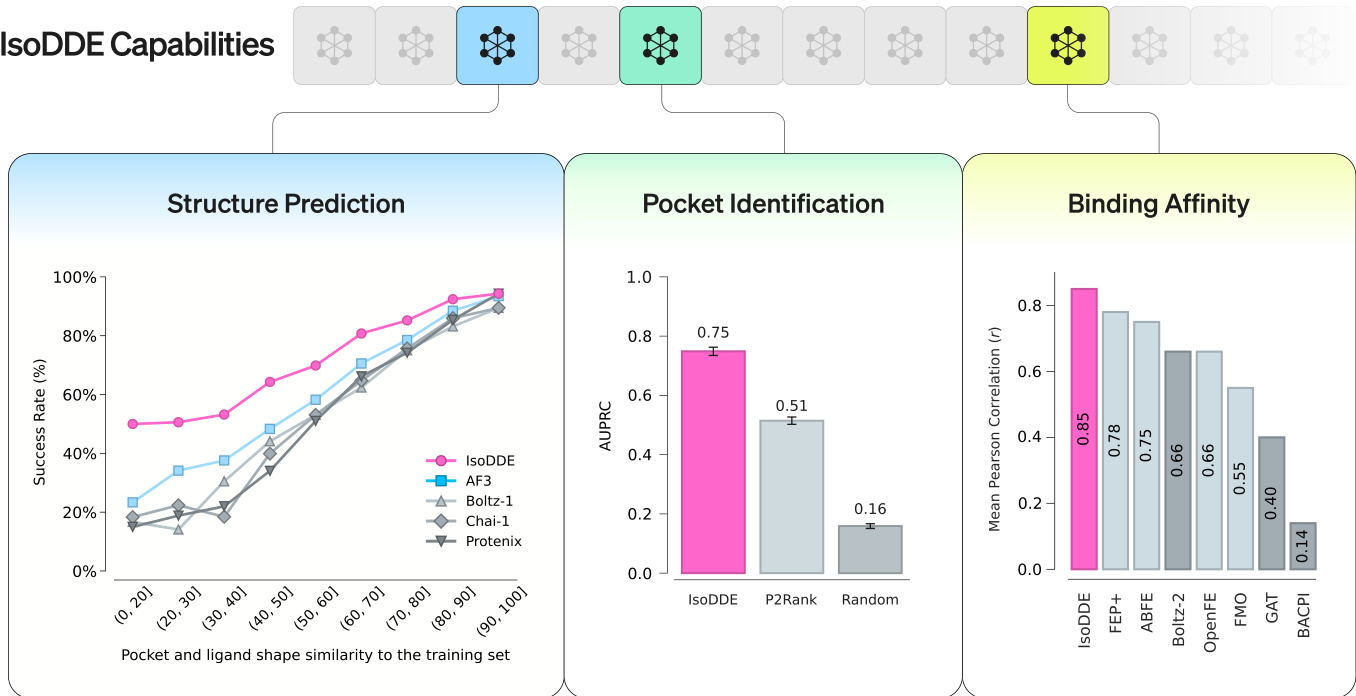
生体分子相互作用の予測は、合理的創薬(rational drug design)の根幹を成すものであるが、実験精度と同等の精度を維持しつつ、未知の化学空間(chemical space)に対して汎用性を確保することは、依然として極めて重要なボトルネックとなっている。AlphaFold 3をはじめとするディープラーニングによるアプローチは構造予測を飛躍的に進歩させたが、ベンチマークの結果によれば、未探索の分子領域への汎化、結合親和性(binding affinity)の推定、および未解明のタンパク質表面における分子結合部位(molecular binding sites)の検出においては、依然として限界があることが明らかになっている。本論文では、これらの課題を解決するために設計された統合的な計算システムである「Isomorphic Labs Drug Design Engine (IsoDDE)」を提案する。我々は、難易度の高いタンパク質-リガンド汎化ベンチマークにおいて、IsoDDEがAlphaFold 3の精度を2倍以上に向上させることを実証した。これにより、誘起適合(induced fit)のような複雑な分布外(out-of-distribution)事象のモデリングや、新規結合ポケット(binding pockets)の正確な特定に成功している。バイオロジクス(biologics)領域において、IsoDDEは既存のモデルを大幅に上回り、抗原抗体界面(antibody-antigen interface)の予測およびCDR-H3ループのモデリングにおいて、新たなSOTA(state of the art)を確立した。さらに、低分子結合剤(small molecule binders)に対しては、IsoDDEの親和性予測がゴールドスタンダードである物理ベースの手法を凌駕しており、従来の物理ベースのワークフローのような膨大な計算コストをかけることなく、実験レベルの精度への乖離を埋めることに成功した。本研究の結果は、IsoDDEがAI創薬のためのスケーラブルな基盤を提供し、前例のない精度で未知の生物学的システムを探索するために必要な予測忠実度(predictive fidelity)を備えていることを示している。
One-sentence Summary
The Isomorphic Labs Drug Design Engine (IsoDDE) is a unified computational system that outperforms AlphaFold 3 on protein-ligand generalization benchmarks by modeling complex out-of-distribution events like induced fits, achieving state-of-the-art accuracy in antibody-antigen interface and CDR-H3 loop modeling, and providing small molecule binding affinity predictions that exceed gold-standard physics-based methods.
Key Contributions
- The paper introduces the Isomorphic Labs Drug Design Engine (IsoDDE), a unified computational system that achieves a step change in unconditional accuracy for biomolecular interaction prediction. This architecture demonstrates the ability to more than double the accuracy of AlphaFold 3 on protein-ligand generalization benchmarks and successfully models complex out-of-distribution events like induced fits.
- This work presents a high-performance model for the biologics domain that establishes a new state of the art in antibody-antigen interface prediction and CDR-H3 loop modeling. The system also enables blind pocket identification, allowing for the discovery of novel binding sites on previously uncharacterized protein surfaces without requiring a specified ligand.
- The research provides a quantitative binding affinity estimation capability that outperforms gold-standard physics-based methods for small molecule binders. This approach bridges the gap toward experimental-grade precision while avoiding the high computational overhead associated with traditional free energy perturbation workflows.
Introduction
Accurate prediction of biomolecular interactions is essential for rational drug design and the discovery of new biological mechanisms. While deep learning models like AlphaFold 3 have advanced structure prediction, they often struggle to generalize to unexplored chemical spaces, fail to identify novel binding pockets, and lack the ability to provide precise quantitative binding affinity. Current methods for estimating affinity are either computationally expensive physics-based simulations or deep learning models that correlate poorly with experimental data. The authors introduce the Isomorphic Labs Drug Design Engine (IsoDDE), a unified computational system that achieves a step change in accuracy and generalization. IsoDDE more than doubles the accuracy of previous state-of-the-art models on protein-ligand benchmarks, provides superior antibody-antigen interface modeling, and delivers binding affinity predictions that exceed gold-standard physics-based methods.
Experiment
IsoDDE was evaluated across multiple benchmarks, including Runs N' Poses, FoldBench, and antibody-antigen datasets, to assess its structural modeling and generalization capabilities. The results demonstrate that the model significantly outperforms previous state-of-the-art methods like AlphaFold 3 and Boltz-2, particularly when predicting highly novel protein-ligand interfaces and complex antibody-antigen structures. Furthermore, IsoDDE shows exceptional performance in predicting binding affinities and identifying cryptic pockets, proving to be a robust tool for navigating diverse chemical and biological spaces in drug discovery.
The authors compare the performance of IsoDDE against AF3 across different subsets of the Runs N' Poses benchmark. Results show that IsoDDE achieves a higher success rate than AF3 in the full dataset, the filtered dataset, and the filtered plus clustered dataset. IsoDDE demonstrates a consistent performance advantage over AF3 across all evaluated data subsets The mean gain in success rate remains substantial whether using the full or filtered datasets IsoDDE maintains superior performance even when the data is filtered and clustered to reduce redundancy

The authors evaluate the performance of IsoDDE against Boltz-2 across different data subsets. Results show that IsoDDE maintains a higher success rate than Boltz-2 in the full, filtered, and clustered datasets. IsoDDE demonstrates a substantial mean gain in performance compared to Boltz-2 across all tested sets The model maintains consistent improvements even when data is filtered or clustered Performance advantages are observed in both the full dataset and more specialized subsets

The authors evaluate IsoDDE's structural modeling performance on the FoldBench dataset across three distinct interface types. Results show that IsoDDE achieves superior success rates compared to several external models in antibody-antigen, protein-ligand, and protein-protein benchmarks. IsoDDE demonstrates higher success rates in antibody-antigen interface prediction than all compared models The model shows improved performance in protein-ligand modeling relative to the other evaluated methods IsoDDE maintains a competitive advantage across protein-protein interaction benchmarks
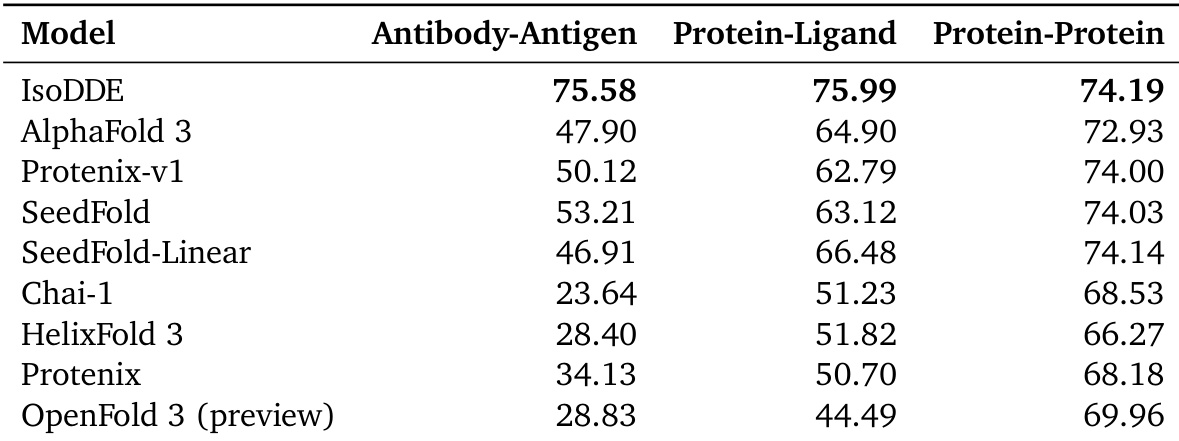
IsoDDE was evaluated against AF3, Boltz-2, and various external models using the Runs N' Poses and FoldBench benchmarks to assess its structural modeling capabilities. Across diverse datasets and interface types, including antibody-antigen, protein-ligand, and protein-protein interactions, IsoDDE consistently demonstrated superior success rates. The results indicate that the model maintains a robust performance advantage even when data is filtered or clustered to reduce redundancy.