Command Palette
Search for a command to run...
テキストからビデオへの検索におけるパフォーマンスの頭打ちの理解:包括的な経験的および言語学的分析
テキストからビデオへの検索におけるパフォーマンスの頭打ちの理解:包括的な経験的および言語学的分析
Maria-Eirini Pegia Dimitrios Stefanopoulos Björn Þór Jónsson Anastasia Moumtzidou Ilias Gialampoukidis Stefanos Vrochidis Ioannis Kompatsiaris
概要
テキストベースのビデオ検索は、自然言語のクエリを用いて関連する動画コンテンツを検出することを可能にする技術であり、オンライン動画の急激な拡大に伴い、その重要性が増しつつある。過去6年間の研究により、デュアルエンコーダー、注意力駆動型モデル、マルチモーダル融合アプローチなど、数多くの手法が提案されてきた。しかし、モデルの挙動、データセットの影響、およびクエリの難易度に関する根本的な課題は未だに解決されていない。本研究では、統一された前処理および評価フレームワークの下、3つの広く使用されているデータセットにおいて、14の最先端の検索手法を評価した。我们分析了标题(キャプション)の特性——包括长度、清晰度、语义类别、以及动作与场景的比例——并探讨它们与模型性能之间的关系。我们的结果显示,简短、清晰、简单的标题——例如描述单一动作或颜色属性的标题——能够实现更高的召回率;然而,对于所有现有模型而言,复杂事件、多步骤活动或细粒度的场景描述仍然具有挑战性。注意力驱动型架构在处理时间依赖性或分步骤查询方面表现更优,而双编码器模型和跨模态融合模型则主要在处理较简单或单一类别的标题时表现良好。跨数据集的泛化能力随着更大规模、更多样化的标题集而提升,但由生成模型创建的标题并未始终提高检索的准确性。总之,我们的研究结果强调了关键的数据集因素、基准测试挑战以及查询内容与模型架构之间的相互作用,为开发更高效的文本到视频检索系统提供了指导。
One-sentence Summary
Through a comprehensive empirical and linguistic analysis evaluating fourteen state-of-the-art retrieval models across three datasets under a unified framework, this study demonstrates that attention-driven architectures outperform dual-encoder and multimodal fusion approaches on complex, temporally dependent queries, while short and semantically simple captions consistently yield higher recall across all evaluated systems.
Key Contributions
- Introduces a unified preprocessing and evaluation framework that systematically benchmarks fourteen state-of-the-art text-to-video retrieval models across three widely used datasets.
- Analyzes the correlation between query characteristics, including caption length, clarity, semantic category, and action versus scene balance, and overall retrieval performance.
- Demonstrates distinct architectural trade-offs, showing that attention-driven models excel at temporally dependent queries while dual-encoder and multimodal fusion approaches achieve higher recall on simpler, single-category captions.
Introduction
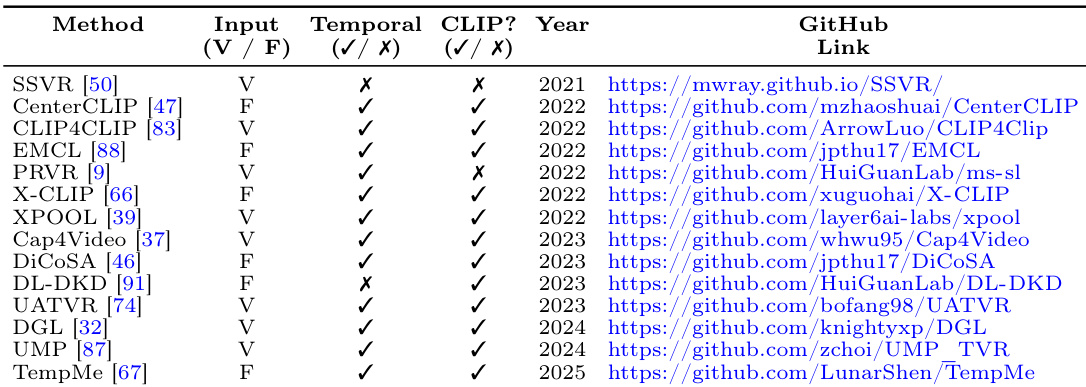
Text-to-video retrieval enables users to navigate massive video libraries using natural language, a capability that has become essential for semantic search, digital assistants, and personalized recommendation systems. Despite six years of architectural innovation, the field has stalled at a performance plateau while computational complexity continues to rise. Prior research suffers from inconsistent evaluation protocols, heavy reliance on aggregate metrics, and a fundamental lack of insight into how query difficulty, linguistic structure, and dataset composition actually drive retrieval outcomes. To address these gaps, the authors conduct a standardized evaluation of fourteen leading retrieval architectures across three major benchmarks, systematically isolating the impact of caption diversity, semantic categories, and temporal reasoning requirements. Their analysis reveals that model success hinges on query simplicity and dataset annotation quality, offering a clear framework for designing more rigorous benchmarks and next-generation retrieval systems.
Dataset

• Dataset Composition and Sources: The authors evaluate their method using three established video-text retrieval benchmarks sourced from public repositories: MSVD, MSRVTT, and LSMDC.
• Subset Details: MSVD (2012) and MSRVTT (2016) consist of short YouTube clips annotated with crowdsourced human captions. LSMDC (2015) contains movie clips from the 1990s to 2010s paired with professional audio descriptions. The LSMDC training split is filtered to 6,209 videos after removing corrupted files from the original 7,408. Each benchmark provides a fixed test set containing 1,000 queries for MSRVTT and LSMDC, and 670 queries for MSVD.
• Data Usage and Processing: The authors apply the default train and test splits provided by the original creators without modifying mixture ratios or training pipelines. To study caption diversity, they generate an extended LSMDC version by producing five additional captions per video using CLIP and Meta-Llama-3-8B-Instruct. The evaluation focuses on how models perform across different query distributions and dataset characteristics.
• Metadata Construction and Preprocessing: Textual queries are categorized into 10 semantic types using spaCy, NLTK, and sentence-transformers, with category expansions refined through Transformer similarity scores and WordNet synonyms. Queries that cannot be confidently assigned to a category are retained as unrecognized to prevent analysis noise. The authors do not implement custom cropping or frame extraction strategies, relying entirely on the original dataset preprocessing workflows and frame-splitting configurations.
Method
The authors leverage a comparative framework to analyze the relationship between textual query characteristics and video retrieval performance across multiple datasets and methods. The core of their methodology involves evaluating three distinct video retrieval architectures—LSMDC, MSVD, and MSRVTT—each representing a different model or dataset configuration. The evaluation is structured around a set of defined metrics and query difficulty classifications to assess performance under varying conditions.
Refer to the framework diagram 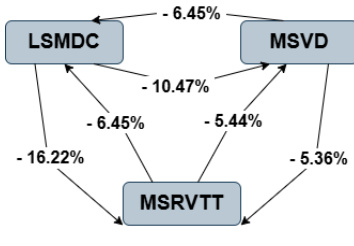 . The diagram illustrates the performance differences between the models, with percentage values indicating relative changes in retrieval performance. For instance, the MSVD model shows a 6.45% improvement over LSMDC, while MSRVTT exhibits a 16.22% improvement over LSMDC. These metrics are derived from the average ground-truth index of retrieved videos, which is used to define query difficulty. Queries are categorized into three levels based on their average rank: easy (rank < 200), medium (rank 401–600), and hard (rank > 800). This categorization enables a granular analysis of how each model handles queries of differing difficulty.
As shown in the figure below: 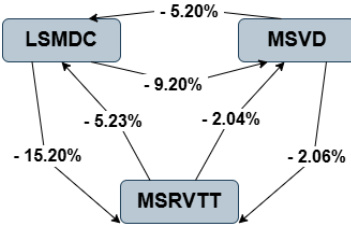 , the performance disparities among the models are further highlighted. The MSVD model again shows a 5.20% improvement over LSMDC, while MSRVTT demonstrates a 15.20% improvement. These differences are quantified through the relative performance gaps, which reflect the effectiveness of each model in retrieving relevant videos based on textual queries. The framework provides a systematic approach to understanding the impact of query composition and model architecture on retrieval outcomes.
Experiment
This study evaluates fourteen text-to-video retrieval models across three benchmark datasets under a unified training setup to assess architectural performance, training efficiency, and data sensitivity. The experiments validate how query semantics, caption diversity, and video preprocessing directly influence retrieval outcomes, revealing that success depends more on dataset characteristics than on model architecture. Clear, medium-length queries with concrete semantics consistently perform better, while abstract descriptions remain challenging, and models trained on multi-caption datasets demonstrate substantially improved cross-dataset generalization. Furthermore, sensitivity analyses confirm that aggressive compression or low frame rates reduce computational costs at the expense of retrieval accuracy, ultimately indicating that field progress has plateaued and highlighting the need for richer datasets and architectures capable of handling complex multimodal queries.
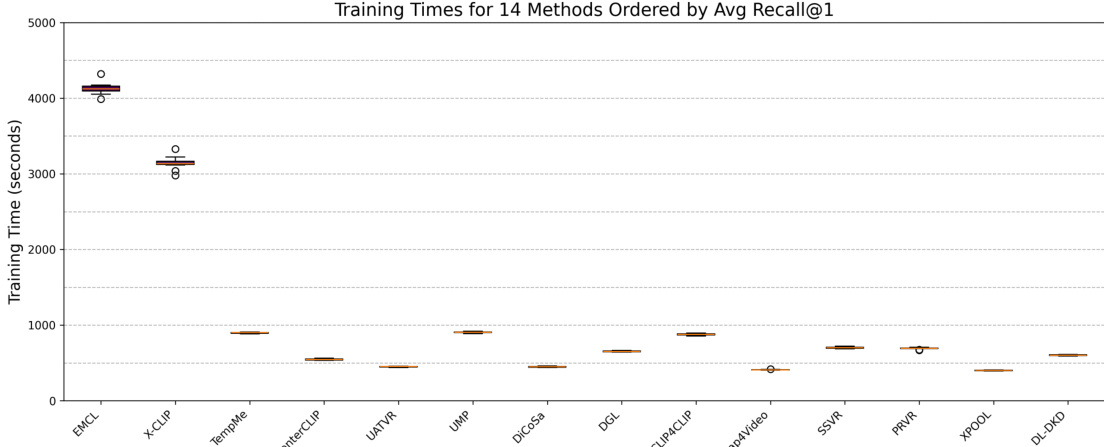
{"summary": "The authors evaluate 14 video-text retrieval methods using a consistent experimental setup across three benchmark datasets. The analysis reveals a trade-off between model performance and training efficiency, with some methods achieving high recall at the cost of significantly longer training times. The results also indicate that retrieval performance is influenced by factors such as query difficulty, caption quality, and dataset characteristics.", "highlights": ["Methods with higher average Recall@1 generally require longer training times, indicating a trade-off between performance and computational cost.", "Most methods exhibit similar training times, but a few top-performing models show substantially longer training durations.", "The evaluation highlights that model performance and efficiency are affected by dataset properties and query characteristics, not just model architecture."]
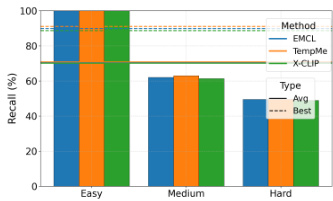
The authors analyze video-text retrieval performance across different query difficulty levels, showing that models achieve higher recall on easy queries compared to medium and hard ones. The results indicate that retrieval performance varies significantly with query difficulty, with the top-performing models demonstrating stronger performance on simpler queries. Models achieve higher recall on easy queries compared to medium and hard queries. Performance differences across difficulty levels are consistent across multiple retrieval methods. Top-performing models show stronger performance on easy queries, indicating a dependency on query simplicity.
{"summary": "The authors evaluate 14 video-text retrieval methods across three benchmark datasets, analyzing performance differences, task effects, and training efficiency under consistent settings. The study highlights that model performance is influenced by query characteristics such as length, clarity, and semantic type, as well as dataset properties like caption quantity and diversity, with datasets containing multiple captions enabling better generalization.", "highlights": ["Query characteristics such as length, clarity, and semantic type significantly affect retrieval performance, with medium-length and concrete queries performing better than complex or abstract ones.", "Datasets with multiple captions per video provide richer supervision and improve cross-dataset generalization compared to single-caption datasets.", "Top-performing models exhibit different strengths, with attention-based models handling complex queries better, while dual-encoder models perform well on simple or single-category queries."]
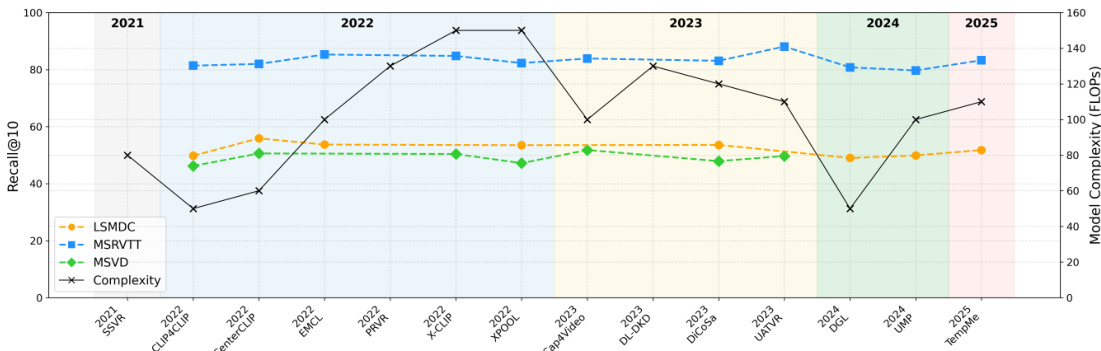
The authors analyze video-text retrieval models across multiple datasets and evaluate their performance based on recall metrics and model complexity. The results show that model performance varies significantly across datasets, with some methods achieving higher recall on certain datasets while others perform consistently. The analysis also highlights a trade-off between computational efficiency and retrieval accuracy, as more complex models tend to achieve better recall but require more training time. Performance varies across datasets, with some methods excelling on specific datasets while others maintain consistent results. There is a trade-off between model complexity and training efficiency, as more complex models achieve higher recall but require more computational resources. Model performance is influenced by dataset characteristics, including the number and quality of captions provided.
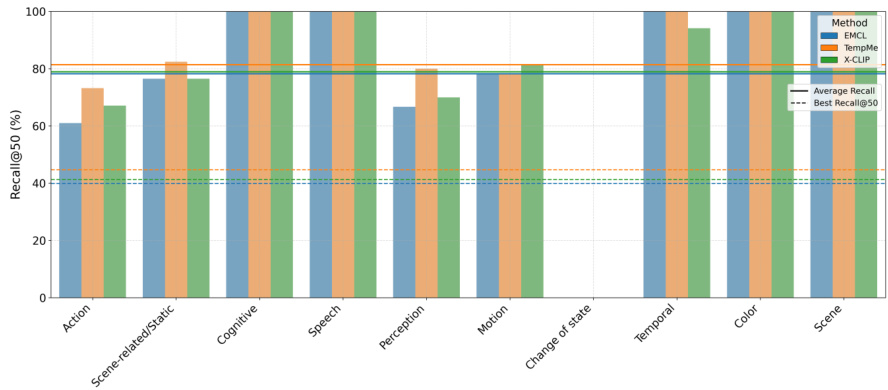
The authors analyze video-text retrieval models across different semantic categories, focusing on how query types influence performance. Results show that models achieve higher recall for concrete and simple queries such as Speech, Motion, and Color, while performance drops for more abstract or complex categories like Action and Scene-related/Static. The top-performing methods, EMCL, TempMe, and X-CLIP, exhibit varying strengths depending on the query type, with some showing consistent performance across categories and others being more sensitive to specific semantic types. Models achieve higher recall for concrete and simple query types such as Speech, Motion, and Color compared to abstract or complex categories. Performance varies significantly across semantic categories, with Action and Scene-related/Static queries being more challenging for retrieval. Top-performing methods show differing strengths across categories, indicating that model architecture influences sensitivity to query semantics.
The authors evaluate fourteen video-text retrieval methods across three benchmark datasets to assess overall performance, training efficiency, and sensitivity to input characteristics. The experiments validate that retrieval success depends heavily on query difficulty and semantic clarity, with models consistently outperforming on concrete queries compared to abstract ones, while datasets with multiple captions per video significantly improve generalization. Ultimately, the analysis reveals a clear trade-off between retrieval accuracy and computational cost, demonstrating that optimal model selection must balance architectural complexity with training efficiency and specific query demands.