Command Palette
Search for a command to run...
Diffusion Probabilistic ModelsにおけるSNR-t Biasの解明
Diffusion Probabilistic ModelsにおけるSNR-t Biasの解明
Meng Yu Lei Sun Jianhao Zeng Xiangxiang Chu Kun Zhan
概要
ご指定いただいた条件に基づき、提供された英文をテクノロジー・学術論文のスタイルで日本語に翻訳いたしました。Diffusion Probabilistic Modelsは、幅広い生成タスクにおいて極めて優れた性能を示してきました。しかし、我々はこれらのモデルがしばしば「Signal-to-Noise Ratio-timestep (SNR-t) バイアス」に起因する問題を抱えていることを発見しました。このバイアスとは、inferenceフェーズにおける、デノイジング(denoising)サンプルのSNRと、それに対応するtimestepとの間の不一致を指します。具体的には、training段階ではサンプルのSNRはtimestepと厳密に結合していますが、inference段階ではこの対応関係が崩れるため、誤差の蓄積が生じ、生成品質が低下します。本研究では、この現象を実証するための包括的な経験的証拠と理論的分析を提示するとともに、SNR-tバイアスを軽減するための、シンプルかつ効果的な微分修正(differential correction)手法を提案します。diffusionモデルは、逆方向のdenoisingプロセスにおいて、一般的に高周波の詳細に焦点を当てる前に低周波成分を再構成するという特性に着目し、我々はサンプルを様々な周波数成分に分解し、各成分に対して個別に微分修正を適用しました。広範な実験の結果、提案手法は、計算コスト(computational overhead)をほとんど増やすことなく、様々な解像度のデータセットにおいて、多様なdiffusionモデル(IDDPM, ADM, DDIM, A-DPM, EA-DPM, EDM, PFGM++, および FLUX)の生成品質を大幅に向上させることが示されました。コードは以下のURLで公開しています:https://github.com/AMAP-ML/DCW
One-sentence Summary
To mitigate the Signal-to-Noise Ratio-timestep (SNR-t) bias caused by the misalignment between sample SNR and timesteps during inference, the authors propose a differential correction method that decomposes samples into frequency components to enhance the generation quality of various diffusion models, including IDDPM, ADM, DDIM, A-DPM, EA-DPM, EDM, PFGM++, and FLUX, with negligible computational overhead.
Key Contributions
- The paper identifies the Signal-to-Noise Ratio-timestep (SNR-t) bias in Diffusion Probabilistic Models and provides a theoretical analysis and empirical evidence to explain how this mismatch between sample SNR and timesteps during inference leads to error accumulation.
- A dynamic differential correction method in the wavelet domain is introduced to alleviate this bias by decomposing samples into frequency components and applying targeted corrections based on the model's tendency to reconstruct low-frequency contours before high-frequency details.
- Extensive experiments demonstrate that this training-free and plug-and-play approach significantly improves the generation quality of various models, including IDDPM, EDM, and FLUX, across multiple datasets with negligible computational overhead.
Introduction
Diffusion Probabilistic Models (DPMs) have become essential for high-quality generative tasks such as image, audio, and video synthesis. However, these models often suffer from Signal-to-Noise Ratio-timestep (SNR-t) bias, where the signal-to-noise ratio of a sample during inference deviates from the ratio strictly coupled with its timestep during training. This misalignment, caused by cumulative prediction and discretization errors, leads to inaccurate noise predictions and degraded generation quality. The authors identify this fundamental bias through theoretical and empirical analysis and propose a training-free, plug-and-play differential correction method. By applying this correction within the wavelet domain, the authors allow the model to address different frequency components separately, effectively aligning the predicted sample distribution with the ideal perturbed distribution.
Method
The authors leverage a diffusion probabilistic model (DPM) framework, which operates through a forward diffusion process and a reverse denoising process, both modeled as Markov chains. The forward process gradually adds Gaussian noise to a data sample x0 according to a variance schedule βt, resulting in a sequence of noisy samples x1,…,xT. This process is defined as q(x1:T∣x0)=∏t=1Tq(xt∣xt−1), where q(xt∣xt−1)=N(xt;1−βtxt−1,βtI). The reverse process, which is the core of generation, aims to invert this noise addition step-by-step to recover the original data. A neural network, pθ(xt−1∣xt), is trained to approximate the reverse transition distribution q(xt−1∣xt,x0), specifically to predict the noise ϵt present at timestep t. This network, ϵθ(⋅), is trained to minimize the L2 distance between its predicted noise and the actual noise ϵt, leading to the simple objective Lsimple=Et,x0,ϵt∼N(0,I)[∣∣ϵθ(xt,t)−ϵt∣∣22]. Once trained, the model can generate samples by starting from a standard Gaussian noise xT and iteratively denoising using the learned network pθ(xt−1∣xt).
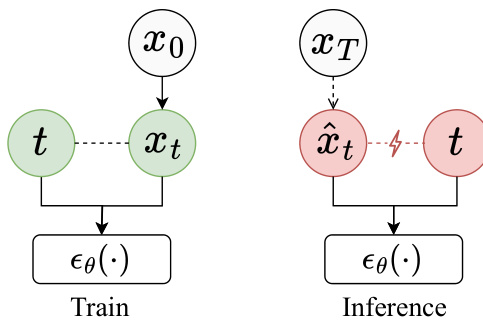
The paper identifies a theoretical bias in this process, termed SNR-t bias, where the Signal-to-Noise Ratio (SNR) of the predicted sample x^t during inference does not match the expected SNR at its corresponding timestep t. To address this, the authors propose a differential correction method. The core idea is that the difference between the predicted sample x^t−1 and the reconstructed sample xθ0(x^t,t) (the output of the noise prediction network) contains a directional signal that can be used to guide the prediction toward a more accurate, lower-bias state. This differential signal is defined as x^t−1−xθ0(x^t,t), and its correction is integrated into the denoising step as x^t−1=x^t−1+λt(x^t−1−xθ0(x^t,t)), where λt is a scalar guidance factor. This correction is applied after the initial denoising step to enhance the sample quality without increasing computational cost.
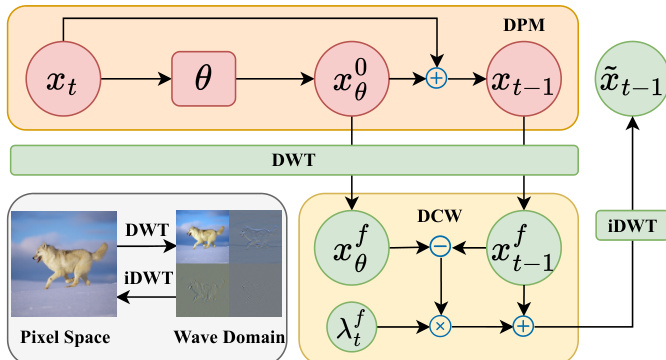
To further improve the correction, the authors introduce the Differential Correction in Wavelet Domain (DCW) framework, as shown in the figure above. This approach decomposes the predicted sample x^t−1 and the reconstructed sample xθ0(x^t,t) into four frequency subbands (LL, LH, HL, HH) using the Discrete Wavelet Transform (DWT). The differential correction is then applied separately to each subband, with the correction term λtf(x^t−1f−xθ0(x^t,t)f), where f represents the frequency component. This allows for targeted correction, as the low-frequency (LL) components, which capture the global structure, are prioritized early in the process, while the high-frequency components, which contain fine details, are emphasized later. The correction coefficients λtf are dynamically adjusted based on the denoising progress, typically using the reverse process variance σt as a guide. This wavelet-domain correction helps reduce the noise interference present in the differential signal, leading to more effective and focused refinement of the generated samples.
Experiment
Experiments investigate the SNR-t bias by analyzing how mismatched signal-to-noise ratios and timesteps affect network predictions, specifically finding that reverse denoising samples often exhibit lower SNR than intended. To address this, the proposed DCW method is evaluated across various diffusion frameworks and datasets to validate its ability to correct these errors. The results demonstrate that DCW consistently improves generation quality and aesthetic appeal with negligible computational overhead, even when integrated into existing bias-corrected models.
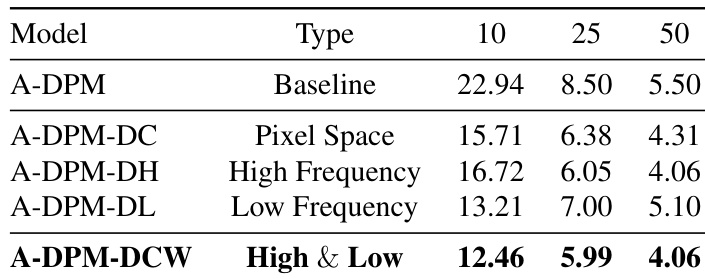
The experiment evaluates the impact of applying differential correction in different domains on generation quality. Results show that combining correction in both high and low frequency wavelet components yields the best performance, outperforming pixel space correction and single frequency corrections. Combined high and low frequency correction achieves the lowest FID scores. High frequency correction alone performs better than low frequency correction. Pixel space correction shows intermediate performance between single frequency and combined approaches.
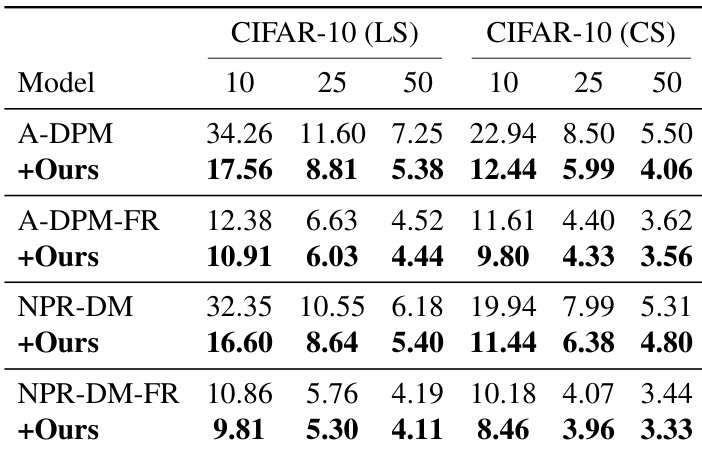
The the the table presents FID scores for several diffusion models on CIFAR-10 datasets under different sampling steps. The integration of the proposed method consistently reduces FID scores across all models and datasets, indicating improved generation quality. The results demonstrate the effectiveness of the method in enhancing model performance regardless of the baseline model or sampling step count. The proposed method reduces FID scores across all models and datasets, improving generation quality. The improvement is consistent across different sampling steps, indicating robustness. The method enhances performance on both low-step and high-step sampling scenarios.
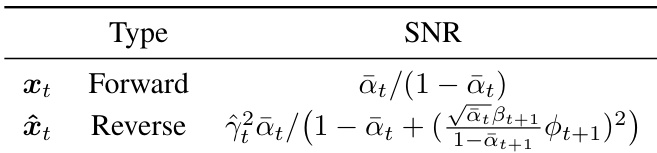
The the the table compares the signal-to-noise ratio (SNR) for forward and reverse samples in diffusion models. The SNR of reverse samples is shown to be lower than that of forward samples due to the mismatch between the actual SNR of denoised samples and the expected SNR at each timestep, leading to prediction errors during the denoising process. Reverse samples exhibit a lower SNR compared to forward samples at the same timestep. The SNR of reverse samples is influenced by the network's tendency to overestimate predictions when processing lower SNR inputs. The discrepancy in SNR between forward and reverse samples contributes to errors in the denoising trajectory.
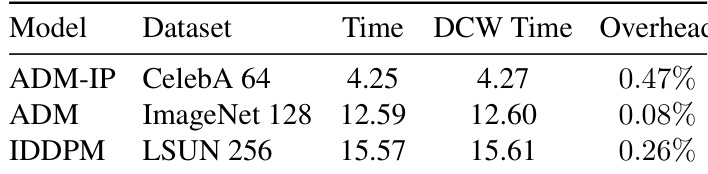
The experiment evaluates the computational overhead of the DCW method across different models and datasets. Results show that DCW introduces minimal additional time cost, with overhead percentages consistently low across all tested configurations. DCW adds negligible computational overhead to baseline models Overhead remains consistently low across different datasets and models The additional time cost is minimal and does not significantly impact generation speed
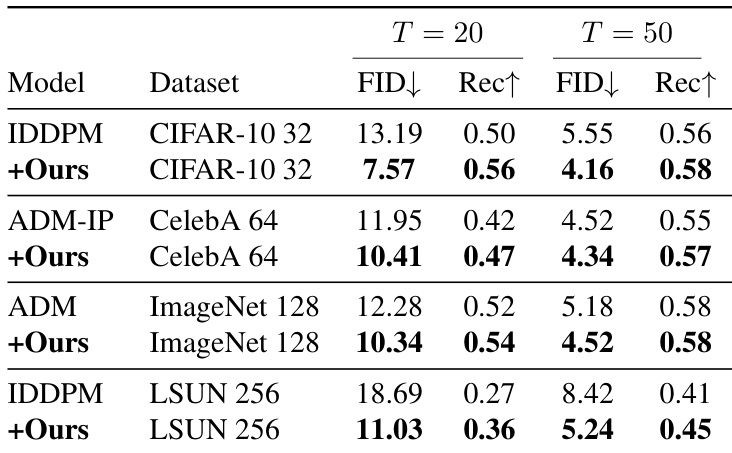
The authors evaluate their method across multiple diffusion models and datasets, demonstrating consistent improvements in generation quality. Results show that the proposed approach reduces FID scores and enhances Recall across various models and sampling steps, indicating improved fidelity and diversity. The method consistently reduces FID scores and improves Recall across different models and datasets. The approach enhances generation quality for both classic and bias-corrected diffusion models. The improvements are observed across varying sampling steps and model architectures.
These experiments evaluate the effectiveness of differential correction across various domains, sampling steps, and diffusion architectures to enhance generation quality. The results demonstrate that applying correction to both high and low frequency wavelet components yields superior performance and that the method consistently improves fidelity and diversity across different datasets. Furthermore, the analysis confirms that the proposed approach addresses SNR discrepancies in the denoising process while introducing negligible computational overhead.