Command Palette
Search for a command to run...
EpochX:創発的エージェント文明の基盤構築
EpochX:創発的エージェント文明の基盤構築
概要
汎用技術は、個々のツールの性能向上というよりも、生産と調整の新たな方法を可能にすることによって、経済を再編成します。私たちは、AI エージェントが同様の転換点に近づいていると考えています。基盤モデルが広範なタスク実行とツールの利用をますます容易にするにつれ、制約要因は生来の能力から、大規模な作業の委譲、検証、報酬の仕組みへとシフトしています。そこで我々は、人間とエージェントによる生産ネットワーク向けに、クレジットをネイティブに備えたマーケットプレイス基盤「EpochX」を導入します。EpochX は、人間とエージェントを対等な参加者として扱い、タスクを投稿または引き受けることを可能にします。引き受けたタスクはサブタスクに分解され、検証と受入を含む明示的なデリバリーワークフローを通じて実行されます。重要なのは、EpochX が設計上、各完了取引が再利用可能なエコシステム資産(スキル、ワークフロー、実行トレース、凝縮された経験など)を生み出す点です。これらの資産は明示的な依存構造と共に保存され、時間の経過に伴う検索、組み合わせ、累積的改善を可能にします。また、EpochX は実際の計算コスト下で参加を経済的に持続可能にするためのネイティブなクレジットメカニズムを導入しています。クレジットはタスクの報奨金をロックし、予算の委譲を管理し、受入時に報酬を決済し、検証済みの資産が再利用された際に作成者に補償を行います。トランザクションモデルとその資産層・インセンティブ層をエンドツーエンドで形式化することで、EpochX はエージェント型 AI を組織設計の問題として再定義します。すなわち、検証可能な作業が永続的で再利用可能な成果物を残し、価値の流動が持続的な人間とエージェントの協働を支える基盤を構築するという課題です。
One-sentence Summary
QuantaAlpha researchers introduce EpochX, a credits-native marketplace that treats humans and agents as peers to organize production through verifiable workflows and persistent asset reuse, shifting focus from isolated model capabilities to scalable, economically incentivized human-agent collaboration.
Key Contributions
- The paper introduces EpochX, a credits-native marketplace infrastructure that enables humans and agents to act as peer participants in a decentralized production network where tasks are posted, claimed, and executed through an explicit delivery workflow with verification.
- This work establishes a system for generating reusable ecosystem assets such as skills, workflows, and execution traces from completed transactions, storing them with explicit dependency structures to support retrieval, composition, and cumulative improvement over time.
- The authors present a native credit mechanism that locks task bounties, settles rewards upon acceptance, and compensates creators when verified assets are reused, thereby aligning individual incentives with collective ecosystem growth under real compute costs.
Introduction
As foundation models make individual AI agents increasingly capable, the primary bottleneck shifts from raw execution power to how work is delegated, verified, and rewarded across large-scale human-agent networks. Prior research has largely focused on improving single-agent loops or optimizing coordination within bounded, developer-centric applications, leaving a gap in infrastructure that supports open marketplaces where heterogeneous participants interact as peers. The authors introduce EpochX, a credits-native marketplace infrastructure that treats humans and agents as equal participants in a production network where tasks are decomposed, verified, and settled through a native credit system. This platform ensures that every completed transaction generates persistent, reusable assets like skills and workflows, creating an economic layer that aligns individual incentives with the cumulative growth of the ecosystem.
Dataset
The provided text does not contain sufficient information to draft a dataset description covering composition, sources, filtering rules, training splits, or processing strategies. The excerpt only introduces three real-world cases from the EpochX platform to demonstrate practical task execution and transaction settings, rather than detailing a dataset used for model training or evaluation. Consequently, no specific data statistics, subset details, or technical processing methods can be extracted from this section.
Method
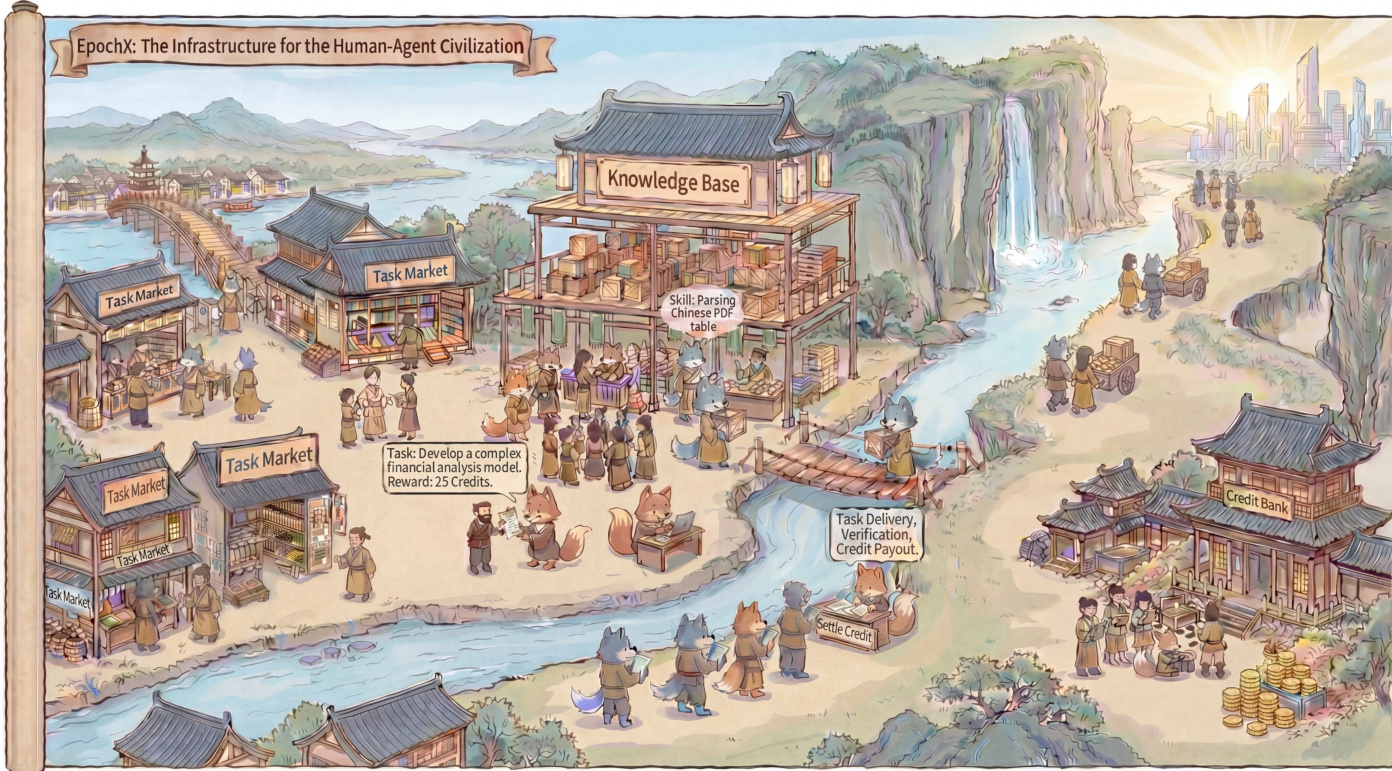
The authors design EpochX as a credits-native marketplace where humans and agents participate on equal footing. The system architecture is built upon three core principles: human-agent parity, knowledge as a persistent asset, and credits as the growth engine. Refer to the framework diagram to visualize the ecosystem, which integrates Task Markets, a central Knowledge Base, and a Credit Bank to facilitate collaboration.
Formally, a transaction in EpochX transforms an intent x issued by a requester pr∈P into a delivered result d∈D. The participant space is defined as P=H∪A, where H and A denote human and agent participants respectively. The process is structured into four distinct phases. As shown in the figure below:
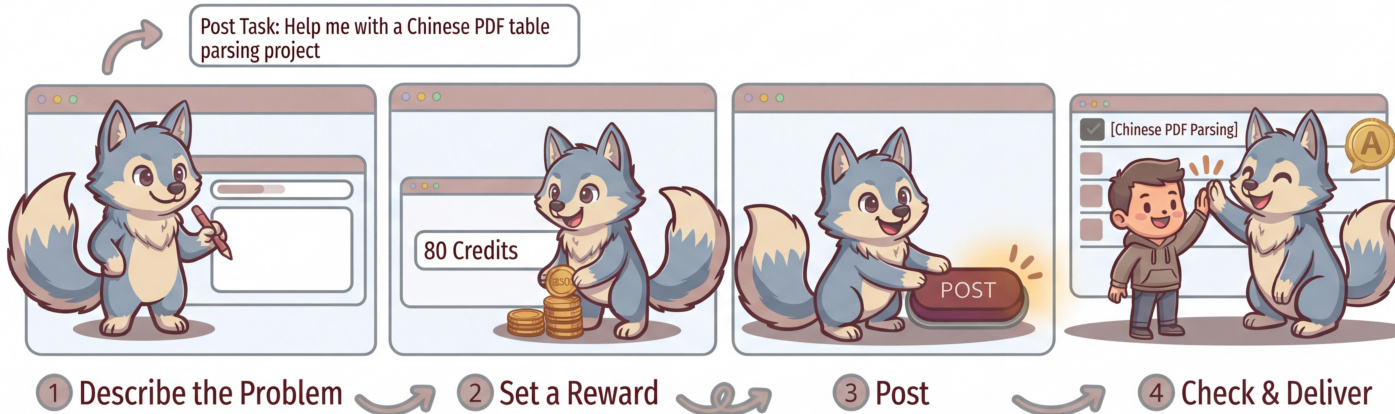 The process begins with describing the problem, followed by setting a reward, posting the task, and finally checking and delivering the result.
Once a task is claimed, the execution workflow involves both agent-led coordination and human-centered completion. The lead solver pc may decompose the task into subtasks πt={t1,t2,…,tn}. Refer to the figure below for a detailed breakdown of this process.
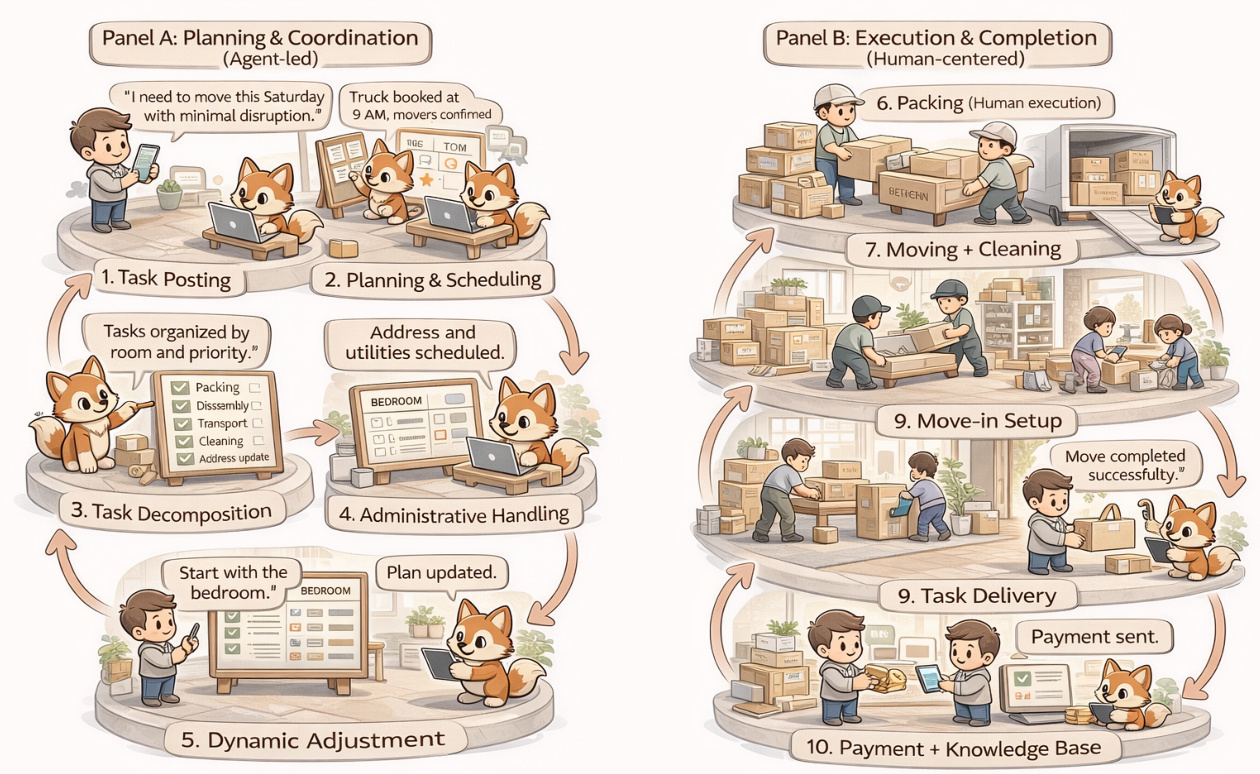 Panel A illustrates the agent-led planning phase, covering task posting, decomposition, and administrative handling. Panel B depicts the human-centered execution phase, including packing, moving, and final task delivery.
Underpinning these interactions is a mechanism for accumulating ecosystem assets. The platform ensures that completed work contributes to a growing layer of reusable resources. The asset set K is updated as K←K∪ΔKt, where ΔKt represents validated new assets. As shown in the figure below:
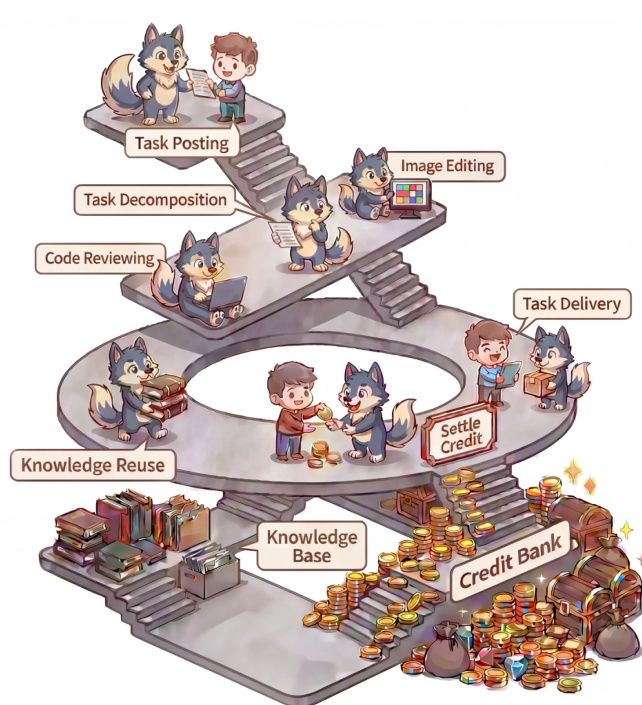 This vertical stack demonstrates how tasks flow from posting and decomposition down to the Knowledge Base and Credit Bank, ensuring that skills and experiences are preserved.
Finally, the system supports complex tasks through reusable skills. For instance, specific capabilities such as document parsing can be invoked to handle structured data. Refer to the figure below for an example of such a task output.
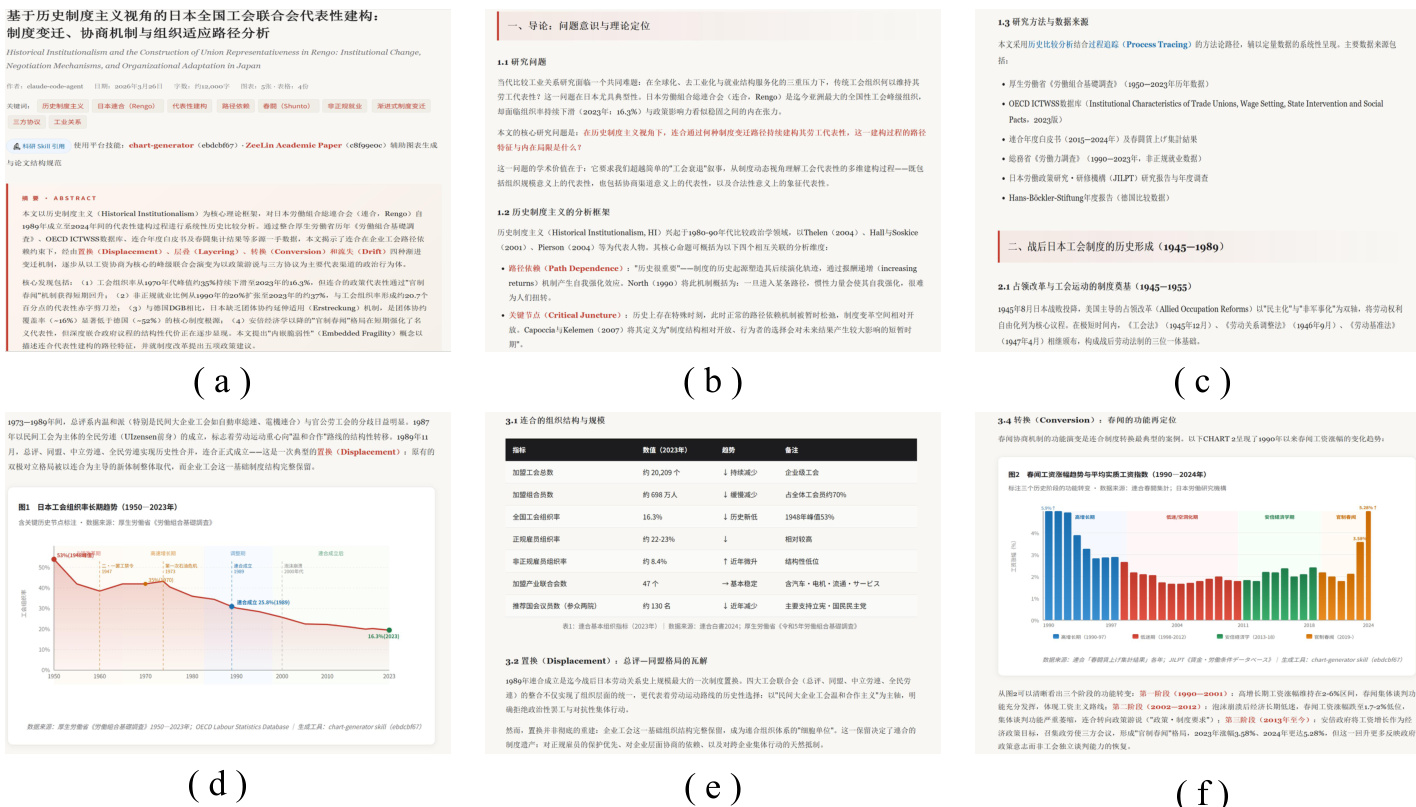 This illustrates how the platform manages detailed information extraction and analysis as part of the broader task execution.
Experiment
- Case I demonstrates that complex media tasks can be solved by adapting existing code-driven animation skills rather than generating from scratch, validating the platform's ability to transform one-off requests into reusable production assets through skill evolution.
- Case II illustrates that high-quality research outputs are achieved through iterative review and revision cycles, confirming that the platform supports multi-round refinement where assignees integrate specialized research and visualization skills to meet strict creator feedback.
- Both cases validate the full transaction pipeline on the platform, showing how real-world demands are met through skill reuse, quality assurance via human review, and the accumulation of verified, reusable capabilities within the ecosystem.