Command Palette
Search for a command to run...
TAPS:Speculative Sampling 用の Task Aware Proposal Distributions
TAPS:Speculative Sampling 用の Task Aware Proposal Distributions
Mohamad Zbib Mohamad Bazzi Ammar Mohanna Hasan Abed Al Kader Hammoud Bernard Ghanem
概要
推論的デコーディングは、軽量なドラフトモデルが将来のトークンを提案し、より大規模なターゲットモデルがそれを並列に検証することで、自己回帰生成を加速する。しかし実際には、ドラフトモデルは広範な汎用コーパスで訓練されることが多く、推論的デコーディングの品質がドラフトの訓練データ分布にどの程度依存するかは不明確であった。本研究では、MathInstruct、ShareGPT、およびこれらを混合したデータバリエーションで訓練された軽量な HASS および EAGLE-2 ドラフターを用いてこの問いを検証し、MT-Bench、GSM8K、MATH-500、SVAMP 上で評価を行った。受け入れ長(acceptance length)で測定したところ、タスク固有の訓練により明確な特化が観測された。すなわち、MathInstruct で訓練されたドラフトは推論ベンチマークで最も優れ、ShareGPT で訓練されたドラフトは MT-Bench で最も優れていた。混合データによる訓練はロバスト性を向上させるが、より大規模な混合データがすべてのデコーディング温度において支配的になるわけではない。さらに、推論時に特化型ドラフターを如何に組み合わせるかについても検討した。単純なチェックポイントの平均化は性能が低く、一方、信頼度(confidence)に基づくルーティングは単一ドメインのドラフトよりも優れ、マージドツリー検証(merged-tree verification)は両方のバックボーンにおいて全体として最も長い受け入れ長を実現した。最後に、エントロピーよりも信頼度の方がより有用なルーティングシグナルであることが示された。拒絶されるトークンは一般にエントロピーが高い傾向にあるが、信頼度に基づくアプローチの方がベンチマークレベルでのルーティング決定がはるかに明確であった。これらの結果は、推論的デコーディングの品質がドラフトアーキテクチャだけでなく、ドラフト訓練データと下流ワークロードとの適合性にも依存すること、また、特化型ドラフターは重み空間においてではなく、推論時に組み合わせた方が優れていることを示している。
One-sentence Summary
Researchers from KAUST and the American University of Beirut propose TAPS, demonstrating that task-specific training of HASS and EAGLE-2 drafters significantly boosts speculative decoding acceptance on matched workloads. Their work reveals that combining specialized models via confidence-based routing or merged-tree verification at inference time outperforms naive weight averaging, optimizing LLM throughput for diverse domains like math and conversation.
Key Contributions
- The paper introduces an empirical analysis showing that task-specific training of draft models yields clear specialization, where MathInstruct-trained drafters excel on reasoning benchmarks while ShareGPT-trained drafters perform best on MT-Bench.
- This work demonstrates that combining specialized drafters at inference time via confidence-based routing and merged-tree verification significantly outperforms naive weight-space averaging, achieving the highest acceptance length across both HASS and EAGLE-2 backbones.
- Results indicate that confidence serves as a more effective routing signal than entropy for making benchmark-level decisions, as rejected tokens exhibit higher entropy but confidence provides clearer distinctions for selecting the optimal drafter.
Introduction
Autoregressive generation in LLMs faces a significant inference bottleneck that speculative decoding addresses by using a lightweight drafter to propose tokens for parallel verification by a larger target model. While prior work focuses on improving draft architectures or verification procedures, most draft models are trained on broad generic corpora, leaving the impact of training data distribution on acceptance quality under-explored. The authors leverage task-specific training on datasets like MathInstruct and ShareGPT to demonstrate that specialized drafters significantly outperform generic ones on matched benchmarks. They further show that combining these specialists at inference time through confidence-based routing and merged-tree verification yields superior results compared to naive weight averaging or mixed-data training.
Method
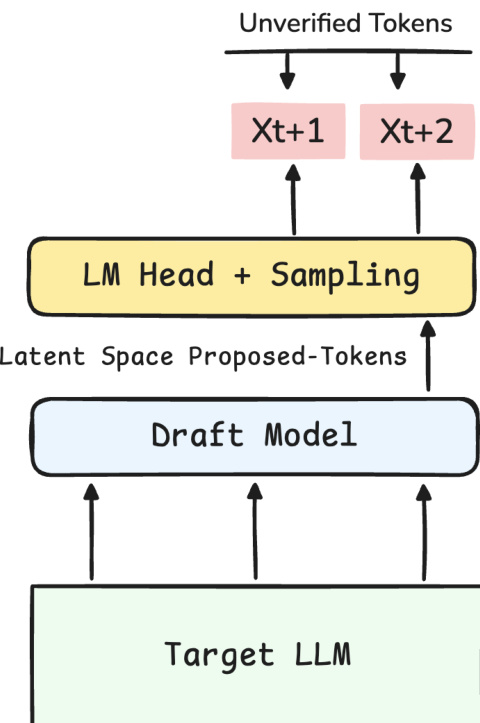
The authors leverage a speculative decoding framework where a lightweight draft model proposes future tokens for verification by a larger target LLM. As shown in the framework diagram, the process begins with the Target LLM providing context to the Draft Model. The draft model operates in latent space to propose tokens, which are then passed through an LM Head and sampling layer to generate unverified tokens like Xt+1 and Xt+2.
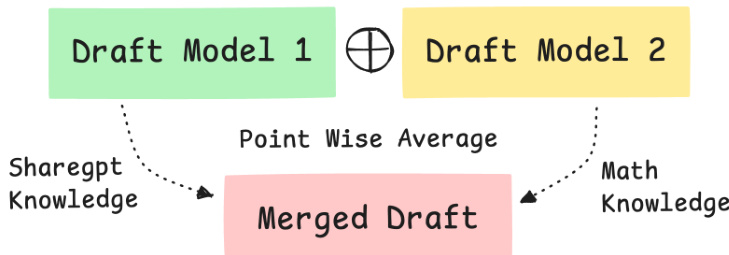
To enhance the quality of these drafts, the authors explore composition strategies for specialized models. One baseline approach is checkpoint averaging. As illustrated in the figure below, parameters from distinct draft models, such as one trained on ShareGPT data and another on Math data, are combined via point-wise averaging to create a single merged draft model.
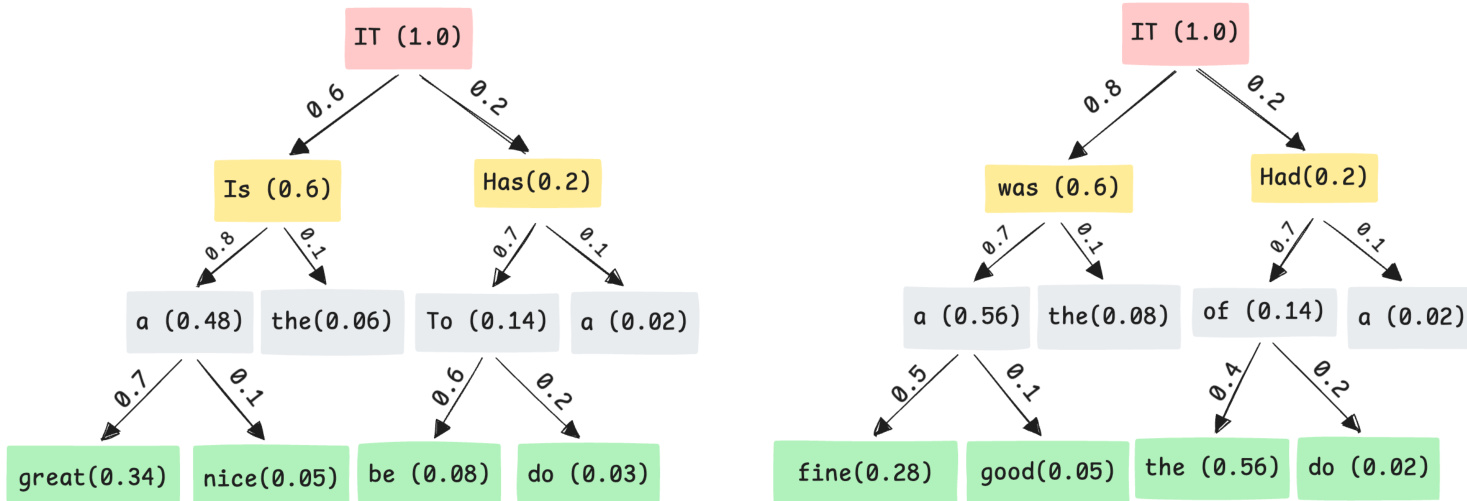
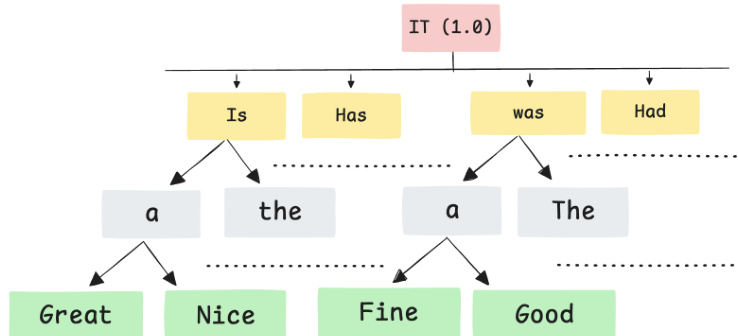
Alternatively, the authors investigate inference-time composition strategies that maintain separate specialized checkpoints. In this setting, specialized models generate distinct candidate continuations with associated confidence scores, as depicted in the tree diagrams showing separate branches for different experts.
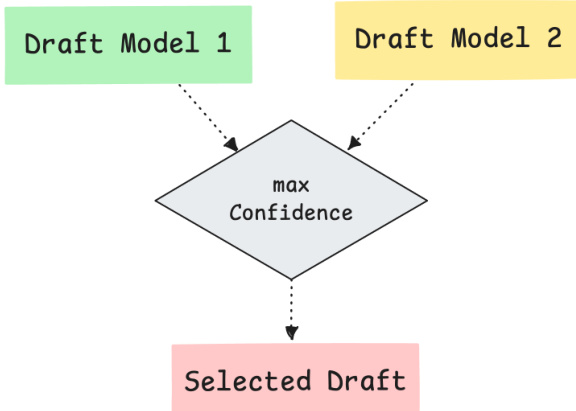
For inference-time selection, the authors propose confidence routing. This method generates separate draft trees from different checkpoints and selects the tree with the higher mean node confidence before verification, as shown in the routing diagram where the max confidence path is chosen.
A more comprehensive strategy is merged-tree verification. Instead of selecting a single tree, the method packs multiple draft trees under a shared root. This allows the verifier to evaluate candidates from all specialists in a single parallel pass. The flattened merged-tree input preserves ancestry through tree attention masks and depth-based position ids, enabling the verifier to process both specialized subtrees without cross-subtree attention.
Experiment
- Single-domain training validates that drafters achieve significantly higher acceptance lengths when their training distribution matches the target workload, with mathematical models excelling on reasoning tasks and conversational models on dialogue benchmarks.
- Mixed-data training demonstrates that combining domains improves cross-domain robustness, though the optimal mixture ratio depends on the decoding temperature and does not guarantee uniform generalization.
- Inference-time composition strategies, specifically confidence-based routing and merged-tree verification, substantially outperform weight-space averaging, proving that keeping specialized models separate and combining them at runtime is more effective than merging parameters.
- Analysis of confidence, entropy, and speculative depth reveals that confidence is the superior signal for routing between specialists, while deeper speculative steps increasingly favor task-matched experts over broad-coverage models.
- The overall conclusion establishes that proposal quality in speculative decoding is a function of both architecture and training distribution, necessitating task-aware drafting and dynamic composition rather than static, averaged checkpoints.