Command Palette
Search for a command to run...
動画推論の解明
動画推論の解明
概要
最近の動画生成技術の進展は、予期せぬ現象を明らかにしました。拡散モデルに基づく動画モデルが、非自明な推論能力を発揮するのです。先行研究では、この能力はフレーム間連鎖(Chain-of-Frames; CoF)メカニズムによるものとされ、推論が動画フレームを順次経て展開されると仮定されていました。しかし、本研究はこの仮説に異議を唱え、本質的に異なるメカニズムを解明します。我々の分析により、動画モデルにおける推論は、主に拡散のノイズ除去ステップに沿って出現することが示されました。定性的分析と標的プロービング実験を通じて、モデルは初期のノイズ除去ステップで複数の候補解を探求し、次第に最終的な解答へと収束するプロセスを有することが判明しました。我々はこのプロセスを「ステップ連鎖(Chain-of-Steps; CoS)」と命名します。この中核メカニズムに加え、モデルの性能に不可欠な以下の3つの創発的推論行動を特定しました。(1) 作業記憶:持続的な参照を可能にする機能。(2) 自己修正・強化:誤った中間解からの回復を可能にする機能。(3) 行動に先行する知覚:初期ステップで意味的基盤を確立し、後続ステップで構造化された操作を行う機能です。さらに、拡散ステップ内において、Diffusion Transformers 内部に自己進化型の機能特化が存在することを発見しました。具体的には、初期層が高密度な知覚構造を符号化し、中間層が推論を実行し、後期層が潜在表現を統合するという役割分担が見られます。これらの知見に着想を得て、我々は概念実証として、トレーニング不要の簡易な戦略を提示しました。異なる乱数シードを用いた同一モデルの潜在軌跡をアンサンブルすることで、推論能力が向上することを示しました。総じて、本研究は動画生成モデルにおいて推論がどのように出現するかを体系的に理解する枠組みを提供し、動画モデルに内在する推論ダイナミクスを新たな知性の基盤としてより効果的に活用するための将来研究の基礎を築くものです。
One-sentence Summary
Researchers from SenseTime Research and Nanyang Technological University propose that video reasoning emerges via a Chain-of-Steps mechanism during diffusion denoising rather than across frames. This discovery reveals emergent behaviors like self-correction and enables a training-free strategy to enhance reasoning by ensembling latent trajectories.
Key Contributions
- The paper introduces the Chain-of-Steps (CoS) mechanism, demonstrating that reasoning in diffusion-based video models unfolds along denoising steps rather than across frames, where models explore multiple candidate solutions early and progressively converge to a final answer.
- This work identifies three emergent reasoning behaviors critical to performance: working memory for persistent reference, self-correction capabilities to recover from intermediate errors, and a perception-before-action dynamic where early steps establish semantic grounding before later steps perform manipulation.
- A training-free inference strategy is presented that improves reasoning by ensembling latent trajectories from identical models with different random seeds, with experiments showing this approach retains diverse reasoning paths and increases the likelihood of converging to correct solutions.
Introduction
Diffusion-based video models have recently demonstrated unexpected reasoning capabilities in spatiotemporally consistent environments, offering a new substrate for machine intelligence beyond static images and text. Prior research incorrectly attributed this ability to a Chain-of-Frames mechanism where reasoning unfolds sequentially across video frames, leaving the true internal dynamics largely unexplored. The authors challenge this assumption by revealing that reasoning primarily emerges along the diffusion denoising steps, a process they term Chain-of-Steps. They identify critical emergent behaviors such as working memory, self-correction, and functional layer specialization within the model architecture. Leveraging these insights, the team introduces a simple training-free strategy that ensembles latent trajectories from multiple model runs to improve reasoning performance by preserving diverse candidate solutions during generation.
Method
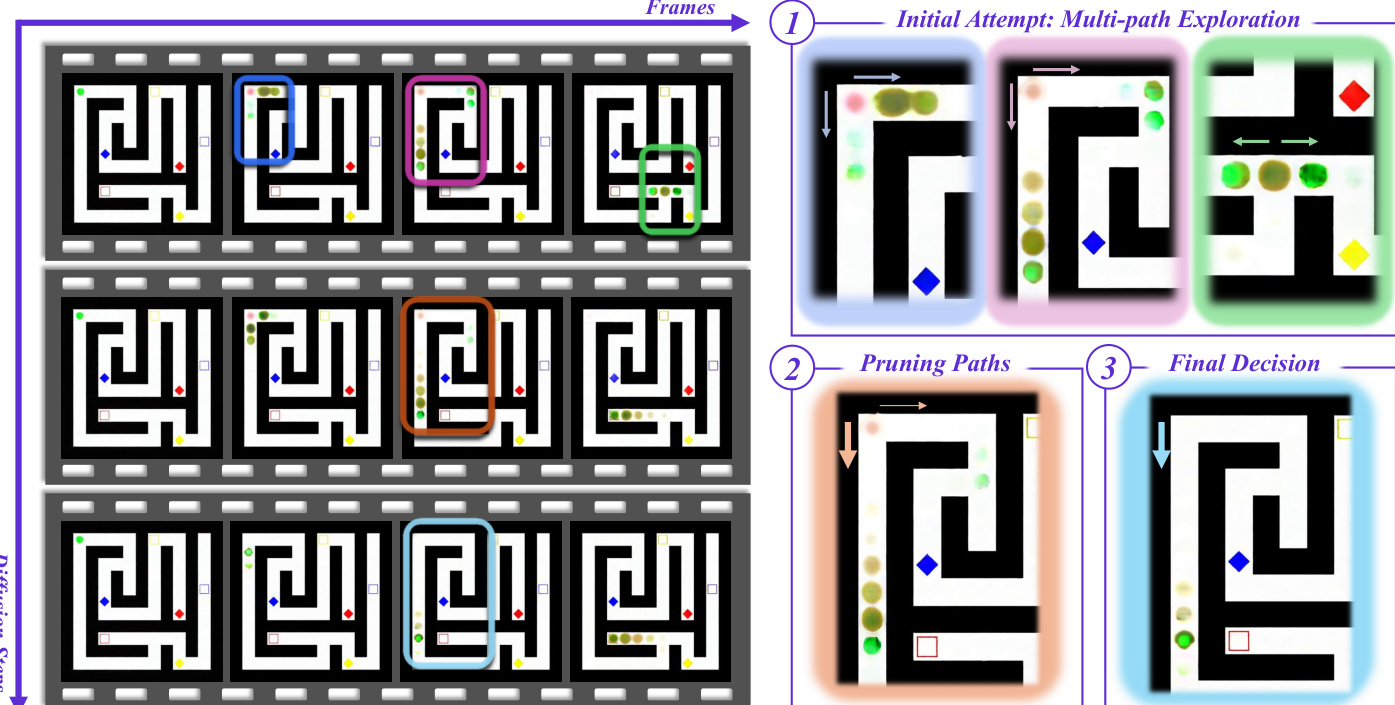
The proposed framework is built upon VBVR-Wan2.2, a video reasoning model finetuned from the Wan2.2-I2V-A14B architecture using flow matching. The core mechanism treats the diffusion denoising process as a primary axis for reasoning. The model learns a velocity field vθ(xs,s,c) conditioned on a prompt c, guiding the latent xs along a continuous transport path defined by xs=(1−s)x0+sx1, where x0 is the clean latent and x1 is noise. By estimating the clean latent at each step via x^0=xs−σs⋅vθ(xs,s,c), the system visualizes the evolution of semantic decisions. This analysis reveals that early diffusion steps function as a high-level heuristic search where the model populates the latent workspace with multiple hypotheses, while later steps prune suboptimal trajectories to converge on a solution.
Refer to the framework diagram for a visualization of this multi-path exploration and subsequent pruning in a maze-solving task.
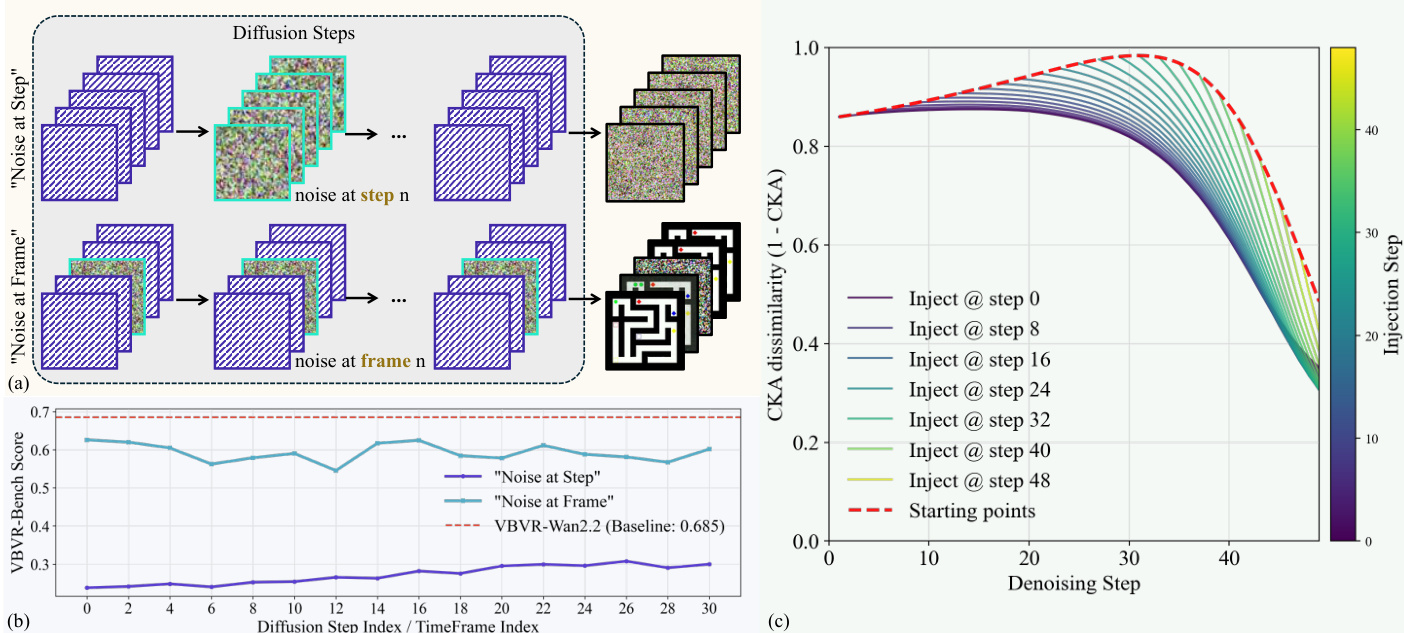
The study further analyzes the impact of noise injection strategies on the reasoning trajectory, comparing noise at specific diffusion steps versus frames.
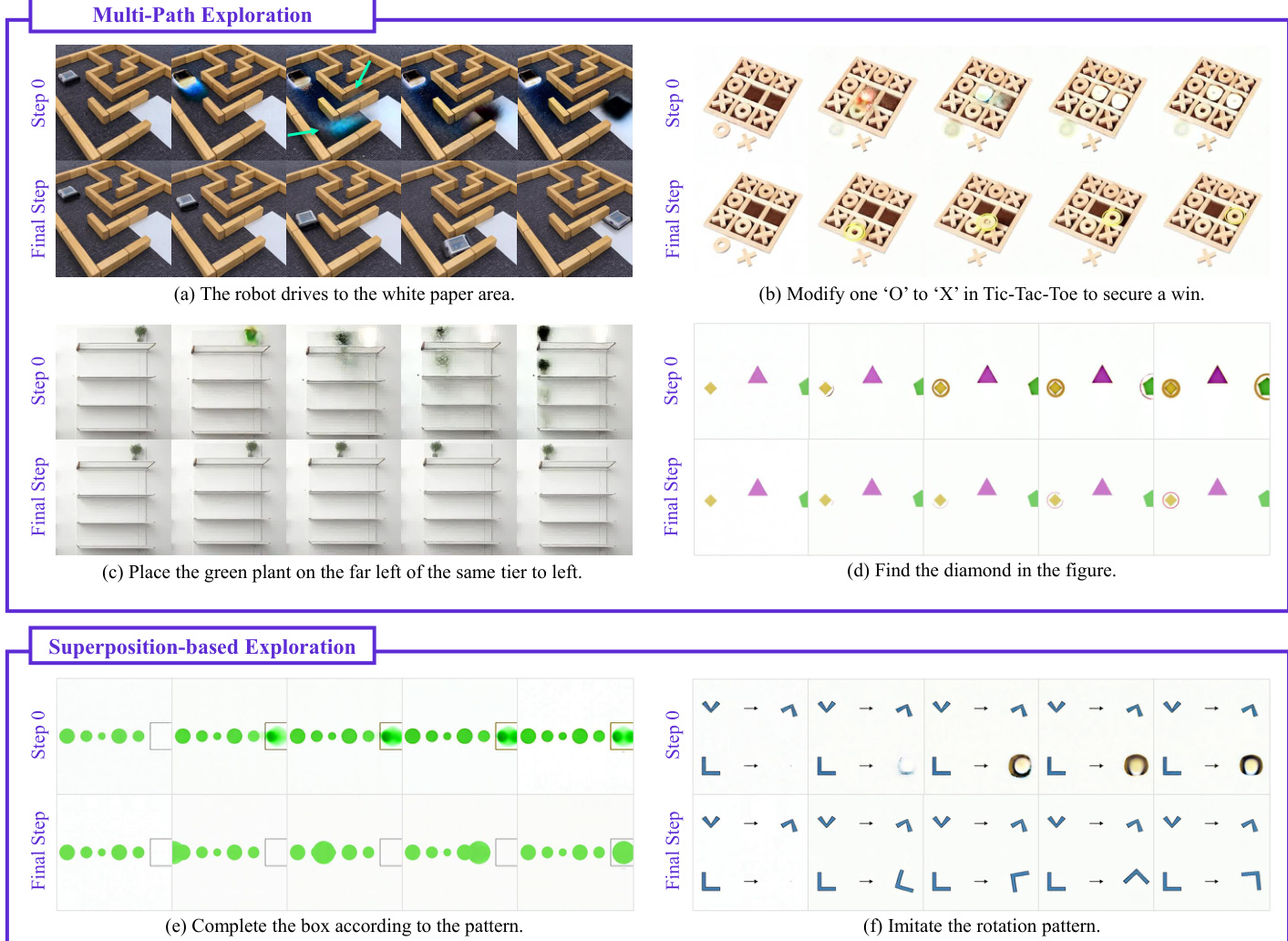
Two distinct modes of step-wise reasoning are identified: Multi-path Exploration, where parallel possibilities are spawned, and Superposition-based Exploration, where patterns are completed through overlapping states.
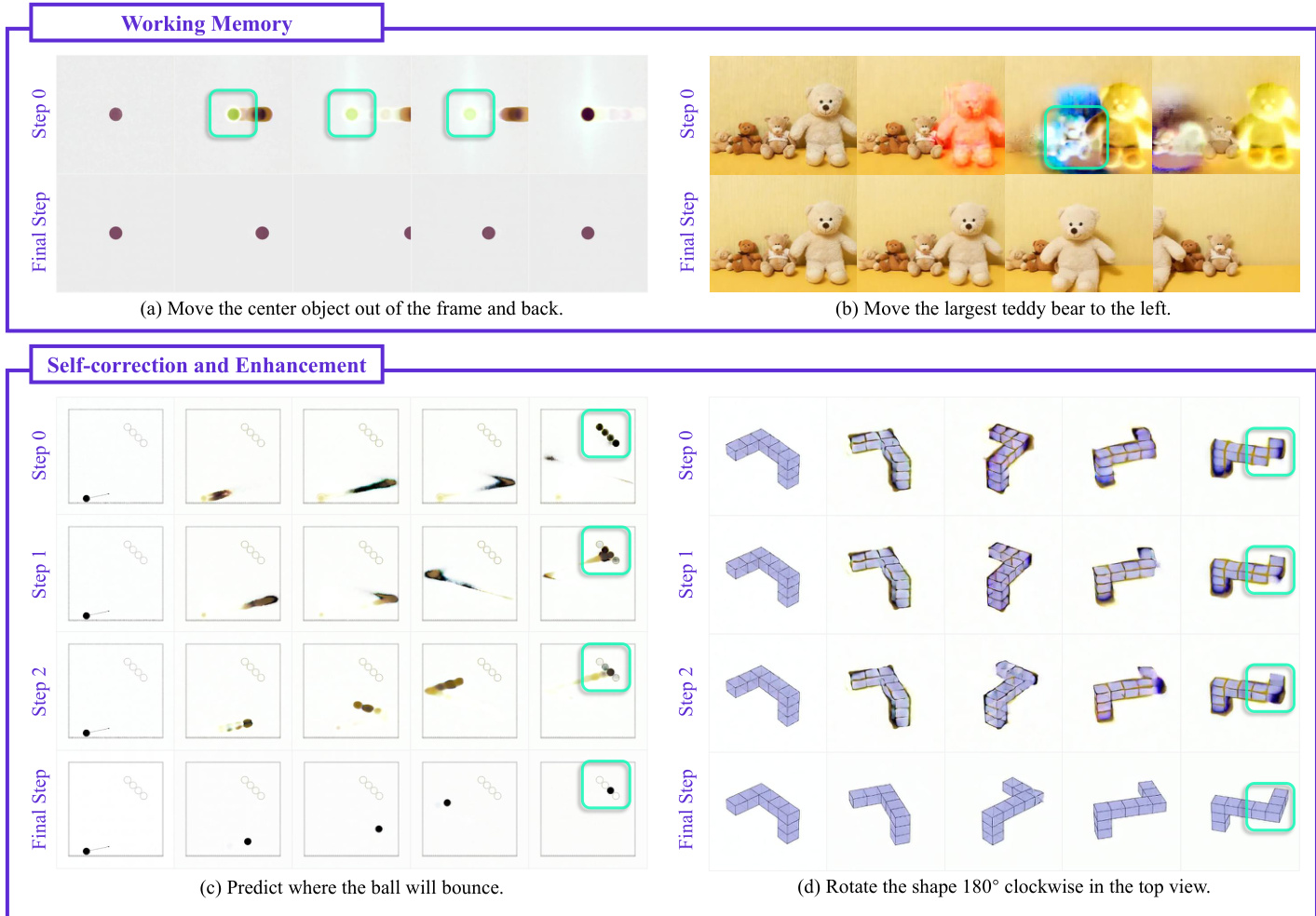
The architecture exhibits emergent reasoning behaviors critical for complex tasks, including working memory to retain essential information and self-correction to refine intermediate hypotheses.
To stabilize these reasoning trajectories, a training-free ensemble strategy is implemented. This method exploits the shared probabilistic bias in the reasoning manifold by executing multiple independent forward passes with different initial noise seeds. During the critical early diffusion steps, hidden representations from the mid-layers (specifically layers 20 to 29) are extracted and spatially-temporally averaged. This latent-space ensemble filters out seed-specific noise and steers the probability distribution toward a more stable state.
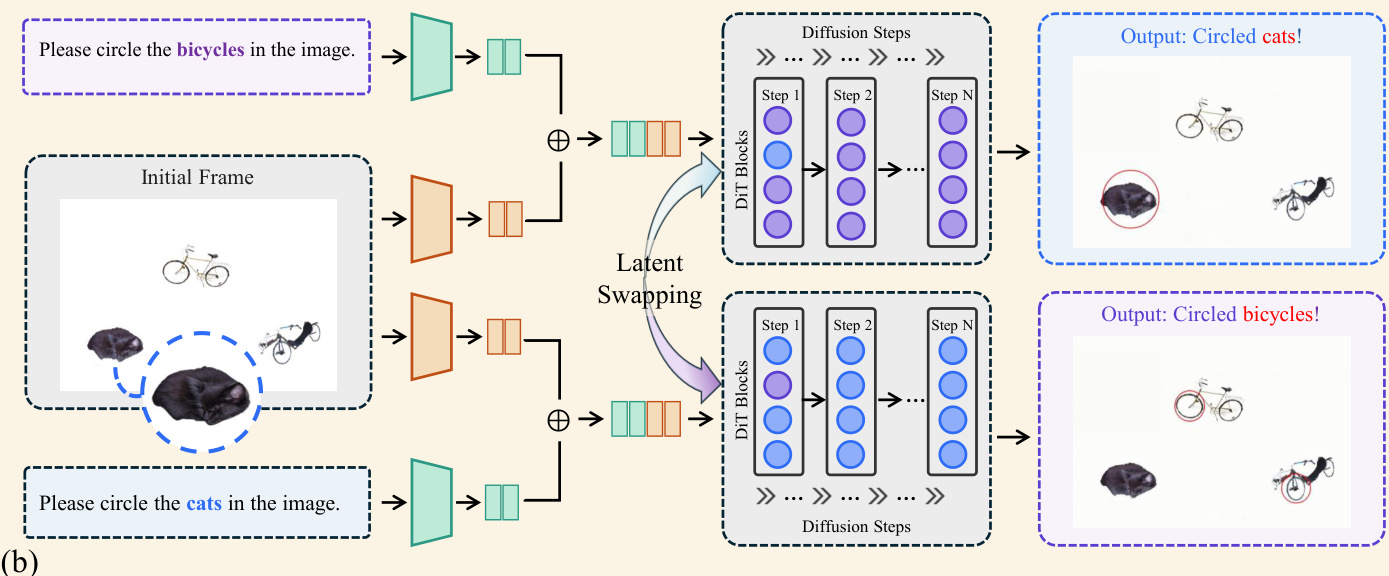
Experiment
- Chain-of-Steps analysis validates that video reasoning occurs across diffusion denoising steps rather than frame-by-frame, with models exploring multiple solution paths in parallel before converging to a final outcome.
- Noise perturbation experiments confirm that disrupting specific diffusion steps severely degrades performance, whereas corrupting individual frames is more easily recovered, proving that the reasoning trajectory is highly sensitive to step-wise information flow.
- Layer-wise mechanistic analysis reveals a hierarchical processing structure where early transformer layers focus on global background context, while middle and later layers concentrate on foreground objects and execute critical logical reasoning.
- Latent swapping experiments demonstrate that middle layers encode semantically decisive information, as altering representations at these specific depths directly reverses the final inference results.
- Investigations into frame counts and model distillation show that while reasoning is not strictly frame-dependent, maintaining a minimum number of frames is essential for spatiotemporal coherence, and aggressive step compression in distilled models can collapse the latent exploration phase required for effective reasoning.
- Qualitative observations identify emergent behaviors such as working memory for preserving object states, self-correction mechanisms that refine incorrect initial hypotheses, and a "perception before action" transition where static grounding precedes dynamic motion planning.