Command Palette
Search for a command to run...
リアルタイム AI サービスエコノミー:コンティニュアム全体にわたるアジェンティックコンピューティングのためのフレームワーク
リアルタイム AI サービスエコノミー:コンティニュアム全体にわたるアジェンティックコンピューティングのためのフレームワーク
Lauri Lovén Alaa Saleh Reza Farahani Ilir Murturi Miguel Bordallo López Praveen Kumar Donta Schahram Dustdar
概要
リアルタイム AI サービスは、デバイス・エッジ・クラウドを横断する連続体上で動作するケースが増加しており、自律的な AI エージェントが遅延に敏感なワークロードを生成し、多段階処理パイプラインをオーケストレーションするとともに、ポリシーおよびガバナンス制約の下で共有リソースを競合して利用している。本稿は、計算ステージをノードとし、実行順序をエッジで符号化する有向非巡回グラフ(DAG)としてモデル化されたサービス依存グラフの構造が、分散型かつ価格ベースのリソース割り当てが大規模で信頼性を持って機能するかどうかの主要な決定要因であることを示す。依存グラフが階層的(木構造または直列・並列構造)である場合、価格は安定した均衡に収束し、最適な割り当てを効率的に計算可能であり、適切なメカニズム設計(準線形効用と離散的スライスアイテムを前提)の下では、各意思決定エポックにおいてエージェントが自らの評価額を虚偽報告するインセンティブが生じない。一方、パイプラインステージ間を横断する結合が存在し、依存関係がより複雑になると、価格は振動し、割り当ての品質が劣化し、システムの管理が困難になる。このギャップを埋めるため、本稿では、複雑な部分グラフをリソーススライスにカプセル化し、市場の残部に対してより単純で構造化されたインターフェースを提供するクロスドメインインテグレータを組み込んだハイブリッド管理アーキテクチャを提案する。6 組の実験(各 10 シード、合計 1,620 回実行)による体系的なアブレーション研究により、(i) 依存グラフのトポロジーが価格の安定性とスケーラビリティの第一義的な決定要因であること、(ii) ハイブリッドアーキテクチャはスループットを犠牲にすることなく価格変動を最大 70〜75% 低減すること、(iii) ガバナンス制約はトポロジーと負荷の両方に依存する定量化可能な効率性とコンプライアンスのトレードオフを生み出すこと、(iv) 真実の入札の下では分散型市場が中央集権的な価値最適化ベースラインと同等の性能を達成し、分散型協調が中央集権的な割り当ての品質を再現し得ることが確認された。
One-sentence Summary
Authors from the University of Oulu and other European institutions propose a hybrid management architecture that encapsulates complex service dependencies into polymatroidal slices, enabling stable, incentive-compatible decentralized resource allocation for real-time AI agents across the device-edge-cloud continuum.
Key Contributions
- Real-time AI services across the device-edge-cloud continuum face instability when complex service-dependency graphs create cross-resource complementarities that prevent price convergence and efficient allocation.
- The proposed hybrid management architecture encapsulates complex sub-graphs into resource slices to enforce hierarchical topologies, ensuring the feasible allocation set forms a polymatroid that guarantees market-clearing prices and truthful bidding.
- Systematic ablation studies across 1,620 runs demonstrate that this approach reduces price volatility by up to 75% without sacrificing throughput while matching the value-optimal quality of centralized baselines under truthful bidding.
Introduction
Real-time AI services increasingly operate across device-edge-cloud environments where autonomous agents must coordinate latency-sensitive workloads under strict governance constraints. Prior approaches struggle because centralized orchestration is impractical across trust boundaries, while naive decentralized markets fail when complex service dependencies create resource complementarities that destabilize prices and make optimal allocation computationally intractable. The authors leverage service-dependency graph topology to identify stable regimes where tree or series-parallel structures guarantee market equilibrium and truthful bidding, then propose a hybrid architecture that encapsulates complex sub-graphs into simplified resource slices to restore stability without sacrificing throughput.
Method
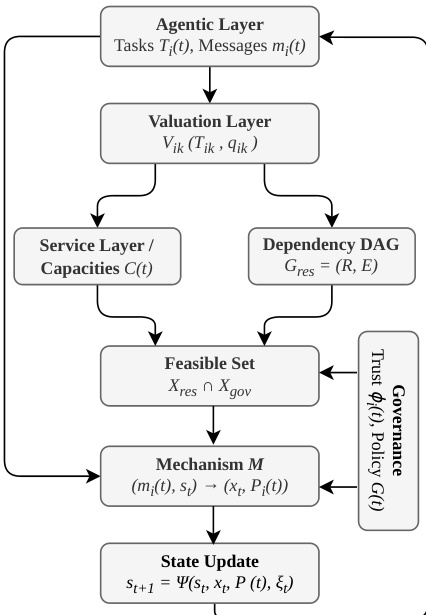
The authors propose a framework for distributed service computing where autonomous AI agents generate tasks, compose services, and interact economically across a continuum of devices, edge platforms, and cloud infrastructure. The system operates in discrete time periods t, with agents conditioning their valuations on a commonly accepted system state st. The overall model integrates agentic behavior, resource dependencies, governance constraints, and mechanism design to facilitate efficient allocation.
Refer to the framework diagram for a high-level overview of the system components and their interactions. The process begins at the Agentic Layer, where agents issue tasks Ti(t) and send messages mi(t). These inputs flow into the Valuation Layer, which computes latency-aware valuations defined as Vik(Tik,qik)=vik(qk)δik(Tik). Here, vik(q) represents the base value of completing a task at quality q, while δik captures latency decay. The valuation depends on the latency Tik and workload qk associated with the task.
Concurrently, the Service Layer defines available capacities C(t), while the Dependency DAG models structural dependencies among resources as Gres=(R,E). These factors converge at the Feasible Set, which is the intersection of resource constraints Xres and governance constraints Xgov. Governance inputs, including trust scores ϕ(t) and policies G(t), further restrict the feasible allocations. The Mechanism M then maps the messages and current state to an allocation xt and payments Pi(t). Finally, the State Update module evolves the system state according to st+1=Ψ(st,xt,P(t),ξt), incorporating exogenous events and realized allocations.
To ensure tractability in the presence of complex dependencies, the authors introduce a hybrid market architecture. As shown in the figure below, this architecture consists of three primary layers: Cross-Domain Integrators, Local Marketplaces, and AI Agents.
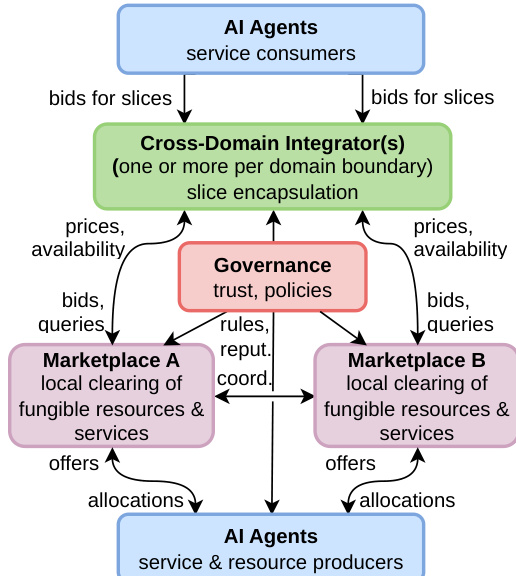
Cross-Domain Integrators form the agent-facing layer. Each integrator encapsulates a complex multi-resource service path into a governance-compliant slice. Internally, the integrator manages the dependency DAG of its sub-system and exposes a simplified, substitutable capacity interface. The capacity of this slice is set equal to the maximum flow of the internal sub-DAG. This encapsulation absorbs complementarities that would otherwise destabilize market-based coordination.
Beneath the integrators, Local Marketplaces operate at the device or edge scope to coordinate fungible services and resources, such as compute cycles and bandwidth. These markets clear via lightweight auctions or posted prices and enforce local governance policies. For simple, single-domain services, agents may interact directly with a local marketplace. Inter-Market Coordination ensures consistency through the exchange of coarse-grained signals, such as aggregate demand and congestion indicators, without requiring full system-wide optimization.
The mechanism design relies on the structural properties of the feasible allocation set. The authors demonstrate that when the service-dependency DAG is a tree or series-parallel network, the capacity constraints form a polymatroid. By using architectural encapsulation, the integrators ensure that the quotient graph seen by agents maintains this tree or series-parallel structure, even if the underlying infrastructure DAG is arbitrary. This preserves the polymatroidal structure of the agent-facing feasible region.
Furthermore, the latency-aware valuations satisfy the gross-substitutes (GS) condition under slice encapsulation. This is achieved because integrators expose discrete, indivisible slices with fixed internal routing and deterministic latency within each mechanism epoch. With a polymatroidal feasible set and GS valuations, the system admits a Walrasian equilibrium. Consequently, efficient allocation is computable in polynomial time via ascending auctions, and the outcome is implementable in a dominant-strategy incentive-compatible (DSIC) manner using mechanisms such as VCG or polymatroid clinching auctions.
Experiment
- Structural discipline experiments validate that polymatroidal topologies (tree and linear) ensure market stability with zero price volatility, whereas entangled dependency graphs cause severe degradation and market failure under high load.
- Hybrid architecture experiments confirm that encapsulating complex services into slices significantly reduces price volatility, with EMA smoothing acting as the primary stabilizer and efficiency factors improving latency and welfare in congested regimes.
- Governance experiments demonstrate that strict trust-gated capacity partitioning trades service coverage for quality by reducing latency, though it can induce price volatility in otherwise stable topologies due to smaller resource pools.
- Interaction studies reveal that the hybrid architecture effectively mitigates the volatility penalties introduced by strict governance, with synergy effects varying by topology from additive to super-additive.
- Market mechanism experiments show that under truthful bidding, price-based coordination yields welfare outcomes nearly identical to value-greedy allocation, indicating the mechanism's primary value lies in incentive alignment rather than informational superiority.