Command Palette
Search for a command to run...
AgentVista:超難易度の現実的視覚シナリオにおけるマルチモーダルエージェントの評価
AgentVista:超難易度の現実的視覚シナリオにおけるマルチモーダルエージェントの評価
概要
現実世界のマルチモーダルエージェントは、視覚的証拠に根ざした多段階のワークフローを解決する。例えば、配線の写真と回路図を関連付けて機器のトラブルシューティングを行い、オンラインドキュメントを用いて修正を検証する、あるいは交通網の地図を解釈し、経路制約の下で時刻表を確認しながら旅行を計画するなどのタスクが挙げられる。しかし、既存のマルチモーダルベンチマークは、単一ターンにおける視覚推論や特定のツール操作技能の評価に偏っており、実用的なエージェントが要求する現実性、視覚的微妙さ、長期にわたるツール利用の側面を十分に捉えていない。そこで本研究では、7 つのカテゴリーにまたがる 25 のサブドメインを網羅し、現実的で詳細に富んだ視覚シナリオと自然なハイブリッドなツール利用を対応付けた、汎用マルチモーダルエージェント向けのベンチマーク「AgentVista」を提案する。本ベンチマークのタスクは、ウェブ検索、画像検索、ページナビゲーション、画像処理および汎用プログラミング向けのコードベース操作など、マルチモーダルにわたる長期にわたるツール相互作用を要する。最先端モデルに対する包括的な評価により、長期にわたるマルチモーダルツール利用能力において顕著なギャップが存在することが明らかになった。評価対象の最上位モデルであるツール利用可能な Gemini-3-Pro でさえ、全体の正解率は 27.3% に留まり、困難な事例では 25 回を超えるツール呼び出しを要する場合もある。AgentVista は、現実的かつ極めて困難な問題解決に向けた、より能力が高く信頼性の高いマルチモーダルエージェントの開発を加速することが期待される。
One-sentence Summary
Researchers from HKUST and collaborating institutions introduce AgentVista, a comprehensive benchmark spanning 25 subdomains to evaluate generalist multimodal agents on long-horizon, hybrid tool-use tasks. This work exposes critical gaps in current models like GEMINI-3-PRO, aiming to drive progress in realistic, multi-step visual problem solving.
Key Contributions
- Existing benchmarks fail to capture the realism and long-horizon tool interactions required for practical multimodal agents that solve multi-step workflows grounded in visual evidence.
- The paper introduces AgentVista, a benchmark spanning 25 subdomains that pairs detail-rich visual scenarios with natural hybrid tool use including web search, image search, and code-based operations.
- Comprehensive evaluation reveals significant capability gaps in state-of-the-art models, with the best performer achieving only 27.3% accuracy on tasks that can require over 25 tool-calling turns.
Introduction
Real-world multimodal agents must solve complex, multi-step problems by grounding their reasoning in visual evidence and utilizing diverse tools like web search and code execution. Current benchmarks fall short because they focus on single-turn reasoning or isolated skills, failing to capture the realism, visual subtlety, and long-horizon tool interactions required for practical deployment. To address this, the authors introduce AgentVista, a comprehensive benchmark spanning 25 subdomains that pairs detail-rich visual scenarios with natural hybrid tool use to evaluate generalist agents on ultra-challenging tasks. Their work reveals significant performance gaps in state-of-the-art models, with even top systems achieving low accuracy on tasks requiring over 25 tool-calling turns.
Dataset
-
Dataset Composition and Sources The authors introduce AgentVISTA, a benchmark comprising 209 tasks grounded in real images and authentic user needs. Data originates from three primary channels: public vision-language model arenas (providing over 284,000 images), annotator-captured daily scenarios, and private community help-seeking forums. The dataset spans seven major categories including Technology, Commerce, Geography, Entertainment, Society, Academics, and Culture, which further divide into 25 specific sub-domains.
-
Key Details for Each Subset Each task is designed to be vision-centric, requiring the model to extract key evidence from complex visual inputs like product catalogs, maps, or technical diagrams rather than relying on text shortcuts. Tasks mandate natural interleaved tool use, forcing agents to combine at least two tool categories such as web search, image search, page navigation, and code execution. Every instance features a deterministic, verifiable answer in a fixed format, such as a specific number, entity name, or date, to ensure objective evaluation.
-
Model Usage and Training Strategy AgentVISTA functions exclusively as an evaluation benchmark rather than a training dataset. The authors utilize it to test generalist multimodal agents on long-horizon workflows that require multi-step reasoning and constraint tracking. Experiments reveal that even top-tier models like GEMINI-3-PRO achieve only 27.3% accuracy, highlighting significant gaps in visual grounding and reliable tool use. The benchmark measures performance by tracking the number of tool-calling turns and the ability to synthesize visual and external information correctly.
-
Processing and Construction Pipeline The dataset creation follows a rigorous four-stage pipeline starting with 300,000+ candidate images.
- Stage 1 (Agent-centric filtering): Models like CLAUDE-Opus-4 filter out images with limited visual information or weak agentic potential, followed by human screening to retain only rich visual evidence.
- Stage 2 (Expert finalization): Annotators rewrite queries into realistic user requests, ensuring tasks require fine-grained visual cues and interleaved tool use, while recording the ground truth and evidence steps.
- Stage 3 (Execution filtering): Tasks are validated by executing them in a tool environment to confirm reproducible outputs and remove instances solvable without tools.
- Stage 4 (Two-round verification): A separate verification team checks visual dependency and answer stability, removing any tasks with unclear evidence or unrealistic workflows. The final dataset excludes simple OCR tasks, direct Q&A, and subjective opinions, focusing strictly on complex, multi-hop reasoning scenarios.
Method
The authors design AgentVista to support a compact set of tools that cover common multimodal agent workflows. Models can call web_search to retrieve web pages, visit to open and navigate a page, and image_search to locate images when a query requires external visual references. The system also provides a code_interpreter, which supports both programming and image processing. This tool enables arithmetic and parsing, structured extraction, and operations such as cropping, resizing, measuring, and comparing visual regions when needed. All tools are exposed with detailed descriptions and structured inputs and outputs, so the model can decide when to call a tool and how to use the returned results.
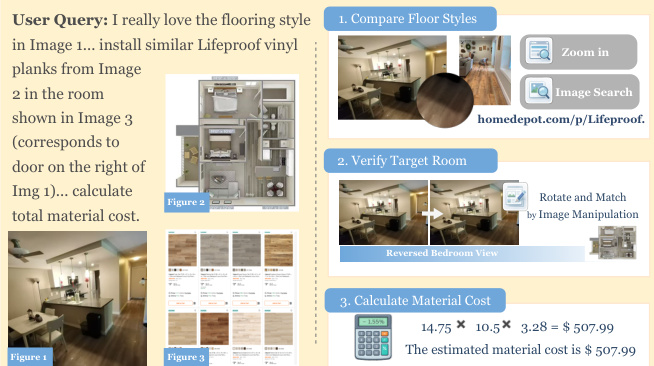
The agent follows a specific instruction protocol to solve tasks. It begins by analyzing the image and the user's question, followed by a step-by-step reasoning process. The agent then calls appropriate tools to gather information and iterates as needed until confident in its findings. Finally, the agent provides the answer inside specific tags. An example of this workflow is illustrated below, where the agent processes a query about flooring styles by comparing images, verifying the target room, and calculating material costs.
To ensure the quality and challenge level of the tasks, the authors employ a multi-stage filtering and validation pipeline. Refer to the framework diagram for the overall process, which transforms a raw data pool of over 300,000+ images and scenarios into a final dataset of 209 ultra-challenging tasks.
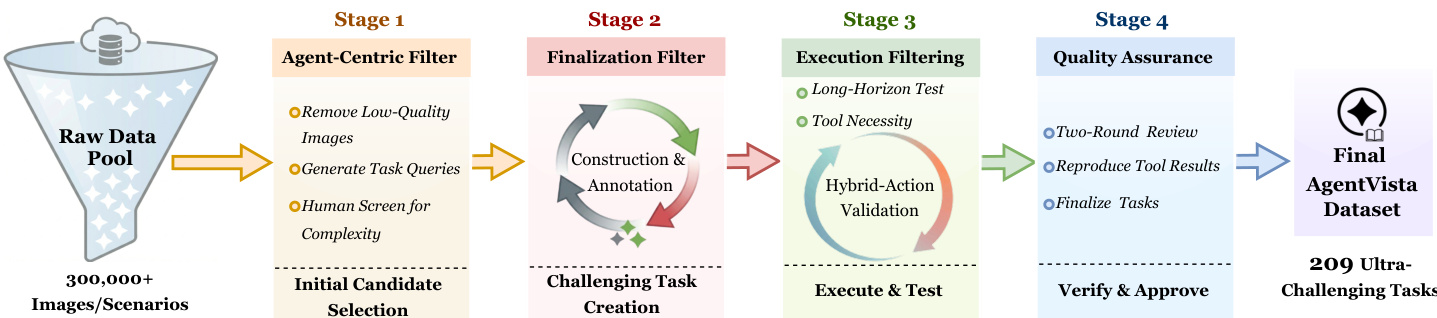
The process begins with Stage 1, the Agent-Centric Filter, which removes low-quality images, generates task queries, and involves human screening for complexity. Stage 2 focuses on Finalization Filter through construction and annotation to create challenging tasks. Stage 3 involves Execution Filtering, including long-horizon tests and tool necessity checks, alongside hybrid-action validation. Finally, Stage 4 ensures Quality Assurance through a two-round review, reproduction of tool results, and final task approval.
Experiment
- Evaluation of frontier multimodal models on the AgentVista benchmark reveals that current agents struggle with complex, long-horizon tasks requiring multi-step tool use grounded in real visual evidence, with even the best-performing model achieving only moderate accuracy.
- Performance varies significantly across model families and domains, indicating that no single model possesses uniform competence; GPT models excel in practical categories, Gemini leads in geography and overall accuracy, and Claude models show strength in tasks requiring careful constraint following.
- Experiments comparing input modes demonstrate that multi-image inputs often improve accuracy by providing complementary evidence and reducing ambiguity, suggesting that the primary bottleneck lies in long-horizon reasoning rather than the complexity of processing multiple images.
- Tool ablation studies confirm that hybrid workflows combining visual manipulation and external retrieval yield the best results, though the reliance on specific tools differs by model, with some prioritizing code-based image analysis and others favoring web search.
- Error analysis identifies visual misidentification as the dominant failure mode, followed by knowledge hallucination, highlighting critical weaknesses in fine-grained visual understanding and the ability to ground reasoning in provided evidence.
- Test-time scaling experiments show that generating multiple samples and selecting the best answer improves performance, yet a significant gap remains between selected outputs and the theoretical upper bound, indicating a need for better optimization methods to handle complex tool interactions.