Command Palette
Search for a command to run...
Geminiを用いた準自律的数学発見:Erdős問題に関する事例研究
Geminiを用いた準自律的数学発見:Erdős問題に関する事例研究
概要
本稿では、Geminiを用いた半自律的数学発見の事例研究を提示する。対象は、ブルームのエルドシュ問題データベースに「未解決(Open)」とラベル付けされた700件の未解決予想であり、AIによる自然言語処理を活用して検索空間を絞り込み、その後人間の専門家による評価を通じて予想の正しさと新規性を検証するハイブリッド手法を採用した。本研究では、データベース上で「未解決」とされていた13件の問題に取り組んだ。そのうち5件は、明らかに新しい自律的解決法により解決された。残り8件については、既存の文献に既に存在する解決法が同定された。これらの結果から、これらの問題が「未解決」とされていたのは、困難さというよりもむしろ文献的不明瞭さ(情報の見えにくさ)によるものであることが示唆された。また、大規模な数学予想に対するAIの適用に伴う課題、特に文献の同定の難しさやAIによる「無意識的剽窃(subconscious plagiarism)」のリスクについても指摘し、議論した。最後に、エルドシュ問題に対するAI支援型アプローチから得られた教訓について考察する。
One-sentence Summary
Researchers from Google and collaborators propose using Gemini to evaluate 700 open math conjectures, resolving 13 via novel AI solutions or rediscovered literature, revealing that “open” status often reflects obscurity, not difficulty, while cautioning against AI’s risk of subconscious plagiarism in large-scale mathematical discovery.
Key Contributions
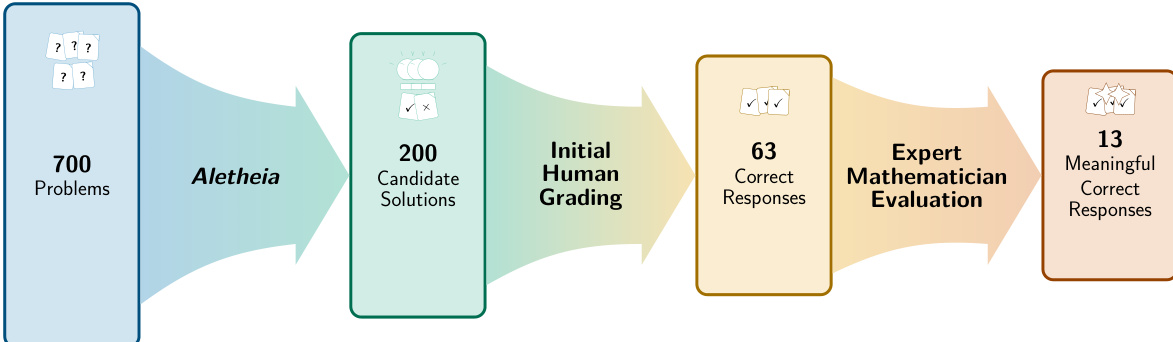
- We applied Gemini to evaluate 700 'Open' conjectures from Bloom’s Erdős Problems database using a hybrid AI-human workflow, narrowing the search via natural language verification before expert validation, and resolved 13 problems—5 with novel autonomous solutions and 8 by rediscovering prior literature.
- Our results indicate that the 'Open' status of these problems often stems from obscurity rather than intrinsic difficulty, as AI efficiently surfaced overlooked or trivially resolved conjectures, challenging assumptions about problem hardness in the database.
- We document key challenges in scaling AI for mathematical discovery, including the difficulty of comprehensive literature retrieval and the risk of AI inadvertently reproducing known results without attribution, which we term “subconscious plagiarism.”
Introduction
The authors leverage Gemini to evaluate 700 “Open” conjectures from Bloom’s Erdős Problems database, using AI-driven natural language verification to filter candidates before human expert review. This approach matters because it scales AI-assisted discovery in math, where expert evaluation is bottlenecked by time and scarcity. Prior work faced challenges in reliably verifying correctness at scale and identifying whether solutions already existed in the literature — often leading to redundant or misleading claims. The authors’ main contribution is resolving 13 problems: 5 with seemingly novel autonomous solutions and 8 by uncovering prior literature, revealing that many “open” problems were simply obscure, not hard. They also highlight systemic issues like AI’s risk of subconscious plagiarism and the difficulty of literature retrieval — problems formal verification cannot solve.
Method
The authors leverage a geometric incidence framework to establish a lower bound on the growth rate of αk, defined as the minimal number of distinct distances determined by any point in a set of n points in the plane. The core of the method involves constructing a family of circles derived from a carefully selected subset of k points and then applying a known incidence bound to derive a contradiction unless αk grows at least as fast as k1/4.
The construction begins by selecting a set Pn={x1,…,xn}⊂R2 ordered such that R(xi), the number of distinct distances from xi to other points in Pn, is non-decreasing. The first k points, S={x1,…,xk}, are used to define a family of circles C=⋃i=1k{Γ(xi,r):r∈Di}, where Di is the set of distinct distances from xi to the rest of Pn. Since each ∣Di∣<αkn1/2, the total number of circles satisfies ∣C∣<kαkn1/2.
The key insight is that every point p∈Pn∖S lies on at least k circles in C, one for each center in S. This yields a lower bound on the number of incidences between Pn and C: (n−k)k. Applying the Pach–Sharir incidence bound (Theorem 1) with k=3 and s=2 for circles, the upper bound on incidences becomes c(3,2)(n3/5∣C∣4/5+n+∣C∣). Substituting the bound on ∣C∣ and taking the limit as n→∞ yields k≤C(αk4/5k4/5+1), which implies αk=Ω(k1/4).
This method hinges on the interplay between geometric construction and combinatorial incidence bounds, transforming a problem about distance distributions into one about curve-point incidences, and then leveraging asymptotic analysis to extract the desired growth rate.
Experiment
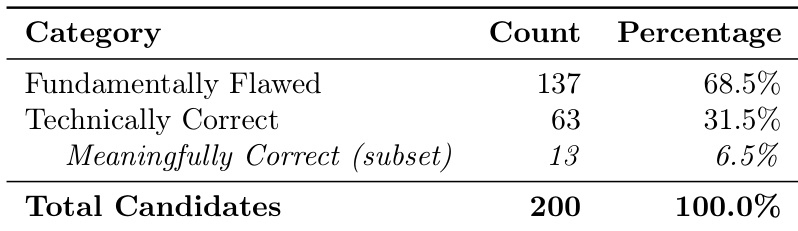
- Aletheia, a math research agent built on Gemini Deep Think, evaluated 700 open Erdős problems, yielding 63 technically correct solutions, but only 13 meaningfully addressed Erdős’s intended problem statements; 50 correct solutions were mathematically trivial due to misinterpretation, and 12 were ambiguous.
- Human evaluation revealed that 68.5% of 200 graded responses were fundamentally flawed, highlighting the high cost of verifying AI output, including debugging errors and checking for literature overlap or unintentional plagiarism.
- Among 13 meaningfully correct solutions, 5 were autonomously novel (Erdős-652, 654, 935, 1040, 1051), though none rose to the level of a standalone research paper; Erdős-1051 was later expanded into a collaborative paper.
- Aletheia also identified 8 problems already solved in the literature (e.g., Erdős-333, 591, 705), and rediscovered 3 solutions independently (e.g., Erdős-397, 659, 1089), raising concerns about subconscious plagiarism from training data.
- Final validation revealed that some “solved” problems had flawed or ambiguous formulations, such as Erdős-75, where the listed problem was a misstatement of Erdős’s original intent, underscoring the need for precise problem framing in AI-driven research.
- The effort emphasizes that while AI can assist in mathematical discovery, its outputs require rigorous human vetting, and claims of “accelerating science” must account for the hidden labor of verification and contextual accuracy.
The authors used a specialized AI agent to generate solutions for 700 open Erdős problems, then evaluated 200 candidate responses with human mathematicians. Results show that while 31.5% of responses were technically correct, only 6.5% meaningfully addressed the intended mathematical problem, highlighting the gap between syntactic correctness and semantic relevance in AI-generated mathematics. The evaluation underscores the need for rigorous human oversight and contextual understanding when assessing AI contributions to mathematical research.