Command Palette
Search for a command to run...
LongSpeech: 長尺音声における文字起こし、翻訳、理解のためのスケーラブルなベンチマーク
LongSpeech: 長尺音声における文字起こし、翻訳、理解のためのスケーラブルなベンチマーク
Fei Yang Xuanfan Ni Renyi Yang Jiahui Geng Qing Li Chenyang Lyu Yichao Du Longyue Wang Weihua Luo Kaifu Zhang
概要
音声言語モデルの近年の進展は、短くセグメント単位の音声タスクにおいて顕著な成功を収めてきた。しかし、会議の文字起こし、スピーチドキュメントの理解、対話分析といった現実世界でのアプリケーションには、長時間の音声を処理し、推論できる堅牢なモデルが必要とされる。本研究では、長時間音声に対する音声モデルの能力を評価し向上させることを目的とした大規模で拡張性の高いベンチマーク「LongSpeech」を発表する。LongSpeechは、各々が約10分の長さを持つ10万を超える音声セグメントで構成されており、自動音声認識(ASR)、音声翻訳、要約、言語検出、話者数数え上げ、コンテンツ分離、質問応答に対して豊富な注釈が付与されている。私たちは、多様なソースから長時間音声ベンチマークを構築するための再現性のあるパイプラインを導入し、将来的な拡張を可能にした。最先端モデルを用いた初期実験により、性能に有意なギャップが存在することが明らかになった。モデルはしばしば他のタスクを犠牲にして一つのタスクに特化しており、より高度な推論においては困難を示している。これらの所見は、本ベンチマークの難しさを浮き彫りにする。我々のベンチマークは、研究コミュニティに対して公開される予定である。
One-sentence Summary
The authors present LongSpeech, a scalable benchmark comprising over 100,000 speech segments approximately 10 minutes long annotated for transcription, translation, and understanding, alongside a reproducible construction pipeline, with initial experiments revealing significant performance gaps in state-of-the-art models regarding higher-level reasoning for real-world applications such as meeting transcription.
Key Contributions
- The work presents LongSpeech, a large-scale benchmark comprising over 100,000 speech segments approximately 10 minutes long with rich annotations for tasks like ASR and summarization. This dataset is designed to evaluate and advance the capabilities of speech models on long-duration audio across multiple domains.
- A reproducible pipeline for constructing long-form speech benchmarks from diverse sources is introduced to enable future extensions. This method facilitates the replication and expansion of the benchmark construction process for subsequent studies.
- Experiments conducted with state-of-the-art models reveal significant performance gaps, particularly in higher-level reasoning tasks such as summarization and temporal localization. These findings validate the challenging nature of the benchmark and highlight critical gaps in current models' ability to maintain context over extended audio streams.
Introduction
Advanced audio-language models face significant challenges when processing extended audio streams for real-world tasks. Existing systems often exhibit a trade-off between core functions like transcription and higher-level reasoning tasks such as summarization or temporal localization. To address these deficiencies, the authors introduce LongSpeech. This large-scale benchmark serves as a scalable evaluation platform designed to test and improve transcription, translation, and understanding capabilities in long-form speech.
Dataset
-
Dataset Composition and Sources
- The authors construct LongSpeech using over 100,000 speech segments, each approximately 10 minutes long.
- Sources include LibriSpeech, TED-LIUM v3, SPGISpeech, Vox-Populi, CommonVoice, AISHELL-2, IWSLT, and a custom movie dialogue corpus.
- These corpora cover diverse domains, speakers, and languages under research-permissive licenses.
-
Curation and Processing Details
- LibriSpeech and SPGISpeech data are grouped by speaker and chapter, concatenating sequentially to reach roughly 600 seconds.
- CommonVoice segments utilize embedding-based selection with FAISS clustering to group semantically similar content.
- VoxPopuli and AISHELL-2 prioritize supervised multi-speaker segments while filtering out short utterances.
- The movie corpus uses text-to-speech synthesis to ensure diverse speaker and gender distributions.
- Ground-truth transcriptions come from original datasets or high-quality generation models.
- Metadata for speaker counting and language detection is inferred from corpus-level annotations.
-
Model Training and Splits
- The benchmark evaluates eight tasks including ASR, translation, summarization, and question answering.
- Data is partitioned into train, dev, and test sets following a 7:1.5:1.5 ratio.
- Final splits aggregate examples from all tasks to ensure comprehensive representation.
- The total set contains 142,200 training examples, 30,100 development examples, and 30,100 test examples.
Experiment
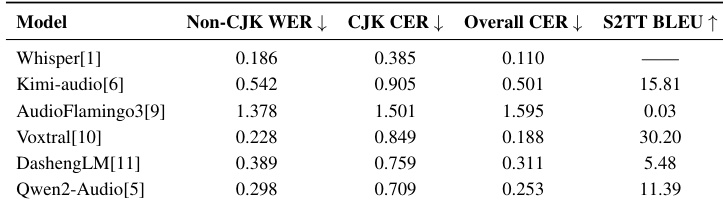
The study evaluates multiple foundation audio-language models using standard metrics across core speech tasks and higher-level understanding benchmarks. Results reveal significant performance gaps where models demonstrate specialization in areas like translation but struggle with long-form processing and deep semantic reasoning. Notably, systems frequently parse user intent correctly yet lack the precision to extract accurate information or track temporal issues, underscoring the necessity of the LongSpeech benchmark for identifying current limitations.
The the the table evaluates the performance of various audio-language models on speech recognition and translation tasks, revealing distinct specializations rather than uniform superiority across the board. While Whisper achieves the lowest error rates for recognition, it does not support translation, whereas Voxtral demonstrates the strongest translation capabilities. Other models like AudioFlamingo3 exhibit significantly higher error rates across both metrics compared to the specialized baselines. Voxtral delivers the strongest speech-to-text translation performance among the evaluated models. Whisper achieves the most accurate speech recognition but lacks translation functionality. AudioFlamingo3 shows the weakest performance with the highest error rates in both recognition and translation.
The authors evaluate audio-language models on tasks ranging from content separation to temporal localization, revealing significant limitations in current long-form speech processing. While models generally excel at parsing query intent, they struggle to generate accurate answers, particularly in reasoning-heavy tasks like temporal localization. Voxtral emerges as the strongest performer overall, although AudioFlamingo3 shows strength in language detection. Voxtral achieves the highest scores in emotion analysis, summarization, and temporal localization tasks. DashengLM demonstrates high parsability rates in speaker counting but fails to provide correct numeric answers. Language detection is the only task where AudioFlamingo3 outperforms the other models significantly.

These experiments evaluate audio language models on speech recognition, translation, and long form processing tasks, revealing distinct specializations rather than uniform superiority across the board. Voxtral emerges as the strongest overall performer, particularly in translation and reasoning tasks, whereas Whisper achieves the most accurate recognition but lacks translation functionality. While current models excel at parsing query intent, they exhibit significant limitations in generating accurate answers for complex reasoning, with AudioFlamingo3 showing the weakest performance despite its strength in language detection.