Command Palette
Search for a command to run...
GaMO:スパースビュー3D再構成のための幾何学的注意型マルチビュー拡散外挿
GaMO:スパースビュー3D再構成のための幾何学的注意型マルチビュー拡散外挿
Yi-Chuan Huang Hao-Jen Chien Chin-Yang Lin Ying-Huan Chen Yu-Lun Liu
概要
3D再構築分野における最近の進展は、高密度な多視点画像からの高品質なシーン撮影において顕著な進歩を遂げているが、入力視点が限られている場合には依然として困難に直面している。これを克服するため、正則化技術や意味論的事前知識、幾何制約などのさまざまなアプローチが提案されてきた。最新の拡散モデルベースの手法は、新たなカメラポーズから新しいビューを生成し、学習データを拡張することで、従来の正則化や事前知識に基づく手法を上回る大幅な性能向上を達成している。しかし、こうした最先端手法にも、以下の3つの重要な課題が存在することが明らかになった:既知視点の周辺領域における十分なカバー範囲の欠如、生成ビュー間の幾何学的整合性の不足、および計算コストの高さである。本研究では、スパースビュー再構築をマルチビューの外延(outpainting)として再定式化するフレームワーク「GaMO(Geometry-aware Multi-view Outpainter)」を提案する。GaMOは、新たな視点を生成するのではなく、既存のカメラポーズから視野を拡張することで、幾何学的整合性を自然に保持しつつ、より広範なシーンカバレッジを実現する。本手法は、訓練を必要とせず、ゼロショットの形でマルチビュー条件付けと幾何学的意識を持つノイズ除去戦略を採用している。ReplicaおよびScanNet++における広範な実験により、3、6、9視点という異なる入力条件下で最先端の再構築品質を達成し、PSNRおよびLPIPS指標において既存手法を上回った。さらに、最先端の拡散モデルベース手法と比較して25倍の高速化を実現し、処理時間は10分未満に抑えることに成功した。プロジェクトページ:https://yichuanh.github.io/GaMO/
One-sentence Summary
The authors from National Yang Ming Chiao Tung University propose GaMO, a geometry-aware multi-view diffusion outpainter that expands sparse input views to enhance 3D Gaussian Splatting reconstruction, achieving superior geometric consistency and visual quality by leveraging zero-shot multi-view conditioning and geometry-aware denoising, outperforming prior diffusion-based methods in PSNR and LPIPS while reducing processing time by 25×.
Key Contributions
-
Sparse-view 3D reconstruction faces challenges in handling unobserved regions, leading to holes, ghosting, and geometric inconsistencies, particularly when relying on novel view generation from diffusion models that introduce misalignment and artifacts across views.
-
GaMO introduces a geometry-aware multi-view outpainting framework that expands the field of view from existing camera poses, leveraging multi-view conditioning and zero-shot geometry-aware denoising to preserve consistency and avoid the pitfalls of novel view synthesis.
-
Evaluated on Replica and ScanNet++, GaMO achieves state-of-the-art results in PSNR and LPIPS across 3, 6, and 9 input views, while reducing reconstruction time to under 10 minutes—25× faster than prior diffusion-based methods—without requiring any training.
Introduction
Reconstructing 3D scenes from limited input views is critical for applications like virtual tours and telepresence, but prior methods struggle with incomplete geometry and visual artifacts due to sparse data. While recent diffusion-based approaches improve reconstruction by generating novel views, they suffer from geometric inconsistencies, poor coverage beyond known view peripheries, and high computational costs from complex trajectory planning. The authors introduce GaMO, a geometry-aware multi-view outpainting framework that expands the field of view around existing camera poses instead of generating new ones. This approach inherently preserves geometric consistency, avoids multi-view alignment issues, and enables zero-shot, efficient reconstruction without fine-tuning. GaMO achieves state-of-the-art results on Replica and ScanNet++ across 3, 6, and 9 input views, improving both PSNR and LPIPS metrics while delivering a 25× speedup and completing reconstructions in under 10 minutes.
Method
The authors leverage a three-stage pipeline for sparse-view 3D reconstruction, beginning with a coarse 3D initialization to establish geometric priors. This initial step uses DUSSt3R to generate a point cloud and trains a coarse 3D Gaussian Splatting (3DGS) model to capture the scene's structure. From this model, an opacity mask and a coarse color rendering are generated for each target outpainted view. The opacity mask is derived by rendering the scene with an enlarged field-of-view (FOV) and thresholding the resulting opacity map to identify regions requiring outpainting. The coarse rendering provides appearance priors. These two outputs serve as essential geometry and appearance cues for the subsequent diffusion-based outpainting stage.
The core of the method is the GaMO (Geometry-aware Multi-view Diffusion Outpainter), a multi-view diffusion model that generates outpainted views with enlarged FOV. The model operates in latent space using DDIM sampling for efficient denoising. It conditions the generation process on multiple signals to ensure geometric consistency. For camera representation, Plücker ray embeddings are used, providing dense 6D ray parameterizations for each pixel that encode both ray origin and direction. For geometric correspondence, input RGB images and Canonical Coordinate Maps (CCM) are warped to align with the expanded FOV, and the original inputs are downsampled and placed at the center of the warped features to create augmented signals. For appearance, the input RGB images are encoded into clean latent features using a variational autoencoder (VAE). All conditioning signals are processed through lightweight convolutional encoders and fused with the latent features to condition the pre-trained diffusion model in a zero-shot manner.
The central component of GaMO is the denoising process with mask latent blending, which integrates the coarse geometry priors into the diffusion loop. At selected denoising timesteps, the denoised latent is blended with the coarse latent, which is obtained by encoding the coarse rendering. To ensure both latents share the same noise level, noise is added to the coarse latent. The blending is performed using a latent-space mask derived from the opacity mask, with the mask evolution controlled by iterative mask scheduling. This process ensures that outpainted content respects existing scene structures while generating plausible peripheral regions.
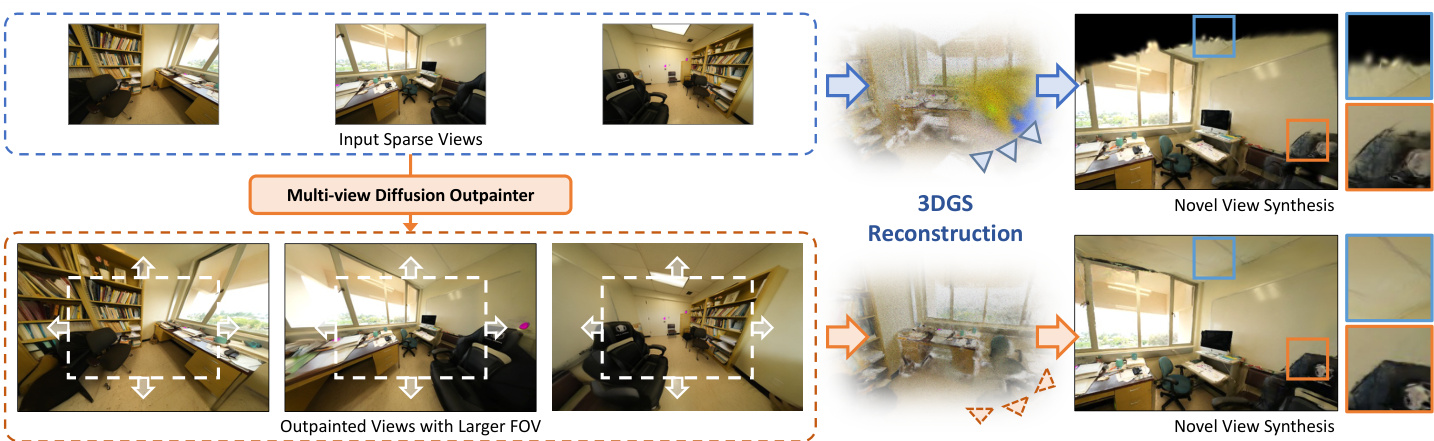
To maintain smooth transitions across blended regions, noise resampling is performed after each blending operation. After blending, the model predicts the clean latent from the blended latent and adds noise back to the current timestep. This resampling prevents boundary artifacts and ensures smooth integration between the coarse geometry and generated content. The iterative mask scheduling strategy dynamically adjusts the mask region throughout the denoising process. It employs progressively shrinking mask sizes at specific denoising steps to balance generative freedom with geometric consistency, allowing the model to first explore peripheral content and later refine geometry within coarse regions. This framework ensures that outpainted regions seamlessly blend with known content while maintaining geometric plausibility, requiring only inference without fine-tuning the backbone diffusion model.
Experiment
- 3DGS refinement with outpainted views: Joint optimization using input and outpainted views validates that perceptual loss (LPIPS) and masked latent blending improve reconstruction quality, reducing artifacts and enhancing geometric consistency in unobserved regions.
- Quantitative evaluation on Replica and ScanNet++: Achieved 25.84 dB PSNR and 25.9% lower LPIPS than GuidedVD-3DGS on Replica, and 23.41 dB PSNR with 11.3% lower LPIPS on ScanNet++, while being 25× faster.
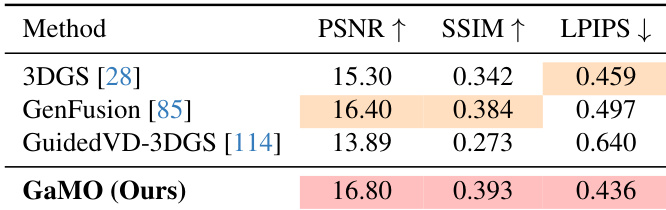
- Generalization to Mip-NeRF 360: Outperformed 3DGS, GenFusion, and GuidedVD-3DGS in PSNR, SSIM, and LPIPS across nine outdoor and indoor scenes, maintaining structural fidelity and high-frequency details.
- Ablation studies: Demonstrated that iterative mask scheduling, hard masking, and noise resampling improve outpainting quality and 3DGS refinement, with perceptual loss significantly reducing artifacts and filling holes.
- Multi-view consistency: Outperformed adapted diffusion baselines (SEVA, MGenMaster) in outpainting consistency and reconstruction quality, avoiding multi-view inconsistencies and noise.
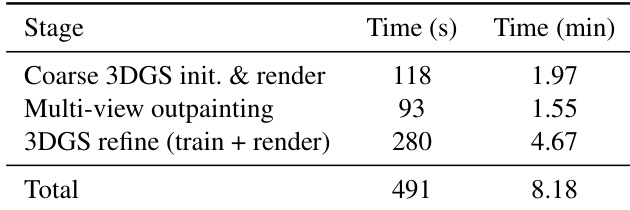
- Runtime: Completed 6-view reconstruction in under nine minutes on a single RTX 4090 GPU, with efficient pipeline stages.
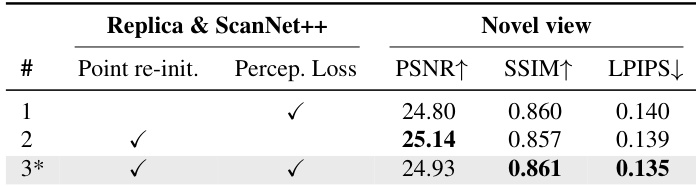
Results show that combining point cloud re-initialization and perceptual loss during 3DGS refinement leads to the best performance on both Replica and ScanNet++ datasets, achieving the highest PSNR and SSIM while maintaining the lowest LPIPS. The full method with both components outperforms the baseline and individual ablation variants across all metrics.
Results show that GaMO achieves the highest PSNR and SSIM values while also attaining the lowest LPIPS score among the compared methods, indicating superior reconstruction quality and perceptual consistency. The authors use a joint optimization framework that combines input views and outpainted views to refine the 3DGS model, with perceptual loss guiding the filling of unobserved regions.
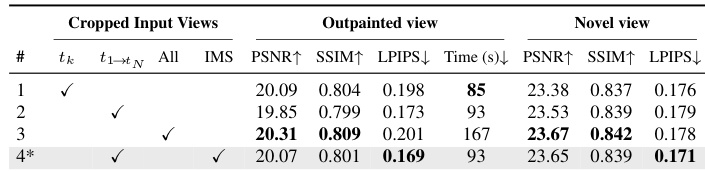
The authors use a multi-step mask blending strategy with iterative mask scheduling to improve the quality of outpainted views, achieving the best performance in terms of PSNR, SSIM, and LPIPS compared to single-step and every-step blending approaches. Results show that their method produces more coherent and geometrically consistent reconstructions, particularly in challenging regions with complex structures.
The authors use a three-stage pipeline for 3D reconstruction, with the total end-to-end runtime on a single NVIDIA RTX 4090 GPU being 491 seconds (8.18 minutes). The most time-consuming stage is the 3DGS refinement, which takes 280 seconds (4.67 minutes), followed by multi-view outpainting at 93 seconds (1.55 minutes) and coarse 3DGS initialization and rendering at 118 seconds (1.97 minutes).
Results show that the proposed method achieves higher PSNR, SSIM, and lower LPIPS compared to GuidedVD-3DGS across all view settings on ScanNet++ with 3, 6, and 9 input views, while also being significantly faster in terms of reconstruction time.
