Command Palette
Search for a command to run...
KlingAvatar 2.0 技術報告
KlingAvatar 2.0 技術報告
概要
近年、アバター動画生成モデルは著しい進展を遂げている。しかし、従来の手法は長時間かつ高解像度の動画生成において効率が限定的であり、動画の長さが増すにつれて時間的なずれ(temporal drifting)、品質の低下、およびプロンプトへの追随性の弱さといった課題に直面している。これらの課題に対処するため、空間的・時間的次元におけるアップスケーリングを実現する「スパティオ・テンポラル・カスケード(spatio-temporal cascade)」フレームワークを採用したKlingAvatar 2.0を提案する。本フレームワークは、まずグローバルな意味情報と動きを捉えた低解像度のブループリント・キーフレームを生成し、その後、最初と最後のフレームを基準とする戦略により、高解像度かつ時間的に整合性のあるサブクリップへと精緻化することで、長時間動画における滑らかな時間的遷移を維持する。さらに、長時間動画におけるマルチモーダルな指示融合と整合性を強化するため、3つのモダリティ固有の大型言語モデル(LLM)エキスパートから構成される「コリーズニング・ディレクター(Co-Reasoning Director)」を導入する。これらのエキスパートは、各モダリティの優先順位を推論し、ユーザーの潜在的な意図を推察することで、複数回の対話によって入力を詳細なストーリーラインに変換する。また、負のプロンプト(negative prompts)の精度をさらに高めるために「ネガティブ・ディレクター(Negative Director)」を追加し、指示の整合性を改善する。これらの構成要素を基盤とし、ID特有の複数キャラクター制御を実現する拡張も行っている。広範な実験の結果、本モデルは効率的かつマルチモーダルに整合した長時間・高解像度動画生成における課題を効果的に解決し、視覚的明瞭性の向上、正確な口唇同期を伴うリアルな口内構造(唇・歯)の再現、顔の特徴の強固な保持、そして一貫性のあるマルチモーダル指示の追従性を実現したことが示された。
One-sentence Summary
Kuaishou Technology's Kling Team proposes KlingAvatar 2.0, a spatio-temporal cascade framework generating long-duration high-resolution avatar videos by refining low-resolution blueprint keyframes via first-last frame conditioning to eliminate temporal drifting. Its Co-Reasoning Director employs multimodal LLM experts for precise cross-modal instruction alignment, enabling identity-preserving multi-character synthesis with accurate lip synchronization for applications in education, entertainment, and personalized services.
Key Contributions
- Current speech-driven avatar generation systems struggle with long-duration high-resolution videos, exhibiting temporal drifting, quality degradation, and weak prompt adherence as video length increases despite advances in general video diffusion models.
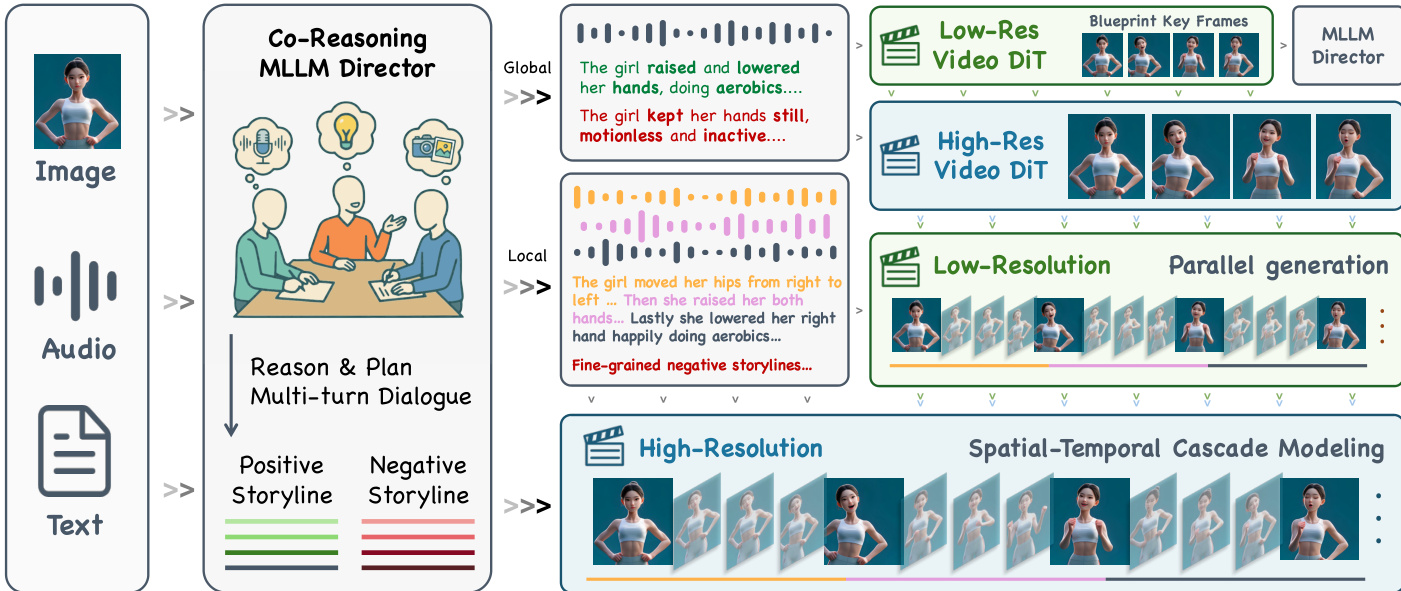
- KlingAvatar 2.0 introduces a spatio-temporal cascade framework that first generates low-resolution blueprint keyframes capturing global motion and semantics, then refines them into high-resolution sub-clips using a first-last frame strategy to ensure temporal coherence and detail preservation in extended videos.
- The Co-Reasoning Director employs three modality-specific LLM experts that collaboratively infer user intent through multi-turn dialogue, converting inputs into hierarchical storylines while refining negative prompts to enhance multimodal instruction alignment and long-form video fidelity.
Introduction
Video generation has advanced through diffusion models and DiT architectures using 3D VAEs for spatio-temporal compression, enabling high-fidelity synthesis but remaining limited to text or image prompts without audio conditioning. Prior avatar systems either rely on intermediate motion representations like landmarks or lack long-term coherence and expressive control for speech-driven digital humans. The authors address this gap by introducing KlingAvatar 2.0, which leverages multimodal large language model reasoning for hierarchical storyline planning and a spatio-temporal cascade pipeline to generate coherent, long-form audio-driven avatar videos with fine-grained expression and environmental interaction.
Method
The authors leverage a spatio-temporal cascade framework to generate long-duration, high-resolution avatar videos with precise lip synchronization and multimodal instruction alignment. The pipeline begins with a Co-Reasoning Director that processes input modalities—reference image, audio, and text—through a multi-turn dialogue among three modality-specific LLM experts. These experts jointly infer user intent, resolve semantic conflicts, and output structured global and local storylines, including positive and negative prompts that guide downstream generation. As shown in the framework diagram, the Director’s output feeds into a hierarchical diffusion cascade: first, a low-resolution Video DiT generates blueprint keyframes capturing global motion and layout; these are then upscaled by a high-resolution Video DiT to enrich spatial detail while preserving identity and composition. Subsequently, a low-resolution diffusion model expands the high-resolution keyframes into audio-synchronized sub-clips using a first-last frame conditioning strategy, augmented with blueprint context to refine motion and expression. An audio-aware interpolation module synthesizes intermediate frames to ensure temporal smoothness and lip-audio alignment. Finally, a high-resolution Video DiT performs super-resolution on the sub-clips, yielding temporally coherent, high-fidelity video segments.
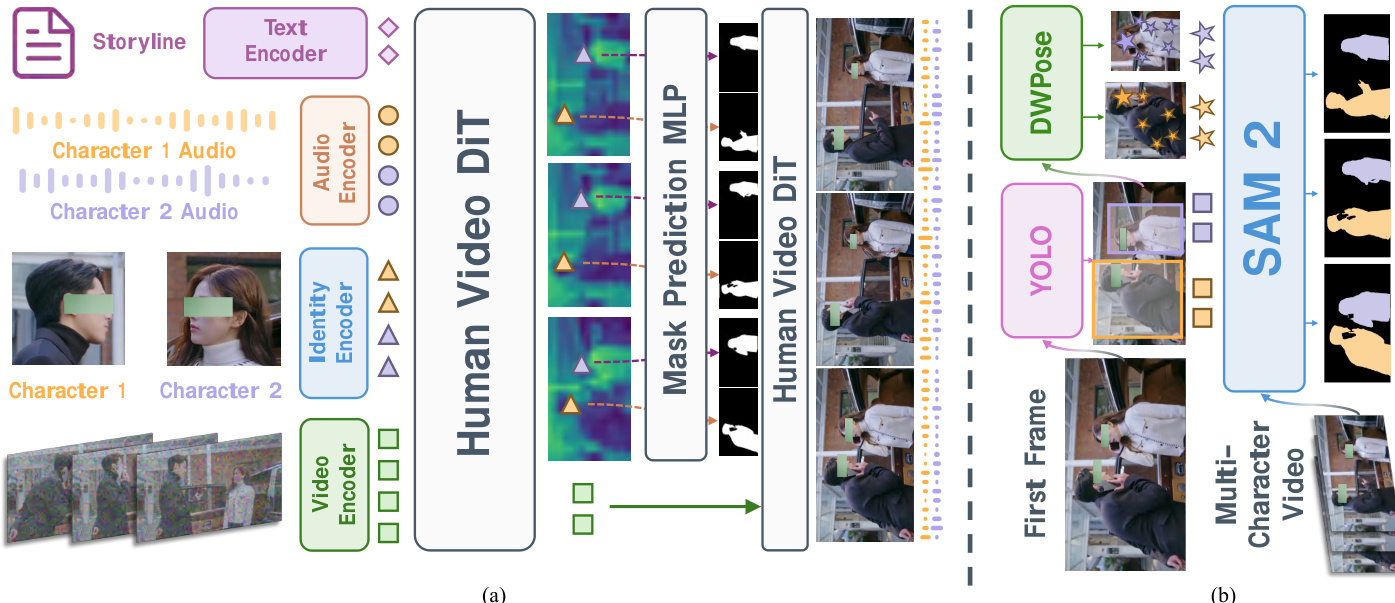
To support multi-character scenes with identity-specific audio control, the authors introduce a mask-prediction head attached to deep layers of the Human Video DiT. These deep features exhibit spatially coherent regions corresponding to individual characters, enabling precise audio injection. During inference, reference identity crops are encoded and cross-attended with video latent tokens to regress per-frame character masks, which gate the injection of character-specific audio streams into corresponding spatial regions. For training, the DiT backbone remains frozen while only the mask-prediction modules are optimized. To scale data curation, an automated annotation pipeline is deployed: YOLO detects characters in the first frame, DWPose estimates keypoints, and SAM2 segments and tracks each person across frames using bounding boxes and keypoints as prompts. The resulting masks are validated against per-frame detection and pose estimates to ensure annotation quality. As shown in the figure, this architecture enables fine-grained control over multiple characters while maintaining spatial and temporal consistency.
Experiment
- Accelerated video generation via trajectory-preserving distillation with custom time schedulers validated improved inference efficiency and generative performance, surpassing distribution matching approaches in stability and flexibility.
- Human preference evaluation on 300 diverse test cases (Chinese/English speech, singing) demonstrated superior (G+S)/(B+S) scores against HeyGen, Kling-Avatar, and OmniHuman-1.5, particularly excelling in motion expressiveness and text relevance.
- Generated videos achieved more natural hair dynamics, precise camera motion alignment (e.g., correctly folding hands per prompt), and emotionally coherent expressions, while per-shot negative prompts enhanced temporal stability versus baselines' generic artifact control.
Results show KlingAvatar 2.0 outperforms all three baselines across overall preference and most subcategories, with particularly strong gains in motion expressiveness and text relevance. The model achieves the highest scores against Kling-Avatar in motion expressiveness (2.47) and text relevance (3.73), indicating superior alignment with multimodal instructions and richer dynamic expression. Visual quality and motion quality also consistently favor KlingAvatar 2.0, though face-lip synchronization scores are closer to baselines.
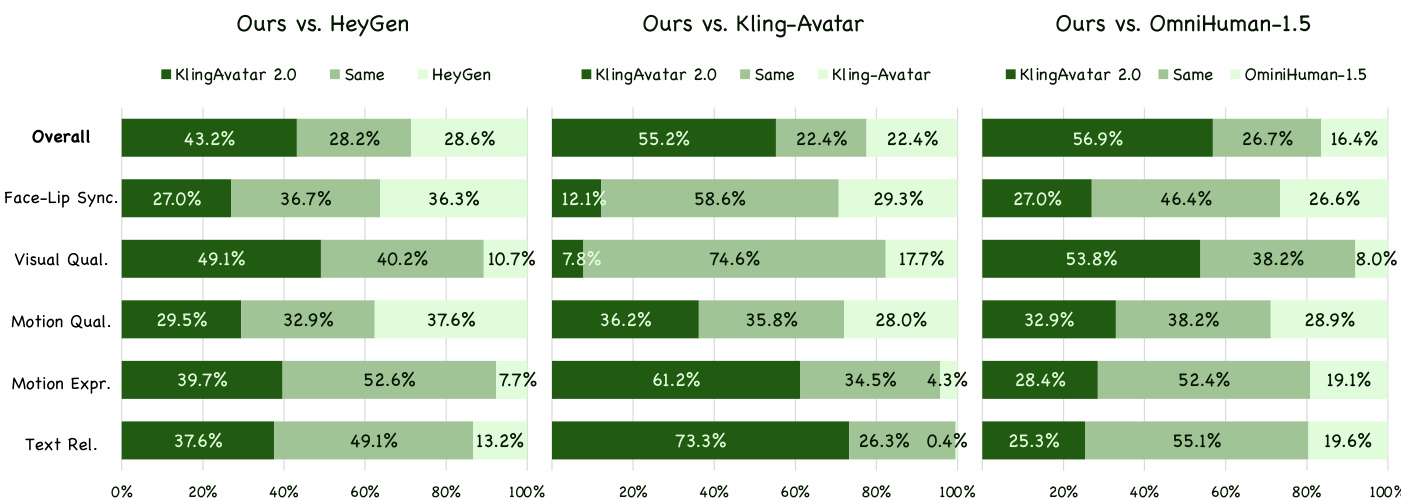
Results show KlingAvatar 2.0 outperforms all three baselines across overall preference and most subcategories, with particularly strong gains in motion expressiveness and text relevance. The model achieves the highest scores against Kling-Avatar in motion expressiveness (2.47) and text relevance (3.73), indicating superior alignment with multimodal instructions and richer dynamic expression. Visual quality and motion quality also consistently favor KlingAvatar 2.0, though face-lip synchronization scores are closer to baselines.
