Command Palette
Search for a command to run...
LFM2 技術報告
LFM2 技術報告
概要
本稿では、デバイス内での効率的なデプロイと強力なタスク処理能力を実現するためのLiquid Foundation Models(LFM2)のファミリを提案する。エッジ環境における遅延とメモリ制約下でハードウェアを考慮したアーキテクチャ探索を用いて、ゲート付き短距離畳み込みと少数のグループ化クエリアテンションブロックを組み合わせたコンパクトなハイブリッドバックボーンを構築した。この構造により、同サイズのモデルと比較して、CPU上でプレフィル(prefill)およびデコード処理を最大2倍高速化できる。LFM2ファミリは3.5億~83億パラメータの範囲をカバーしており、密度型モデル(3.5億、7億、12億、26億)とMixture-of-Experts(MoE)型モデル(合計83億、活性パラメータ15億)を含む。すべてのモデルは32Kのコンテキスト長をサポートしている。LFM2の学習パイプラインには、サポートの不一致を回避するための温度調整付き・分離型Top-K知識蒸留(knowledge distillation)目的関数、難易度順に並べたデータを用いたカリキュラム学習、および教師あり微調整(supervised fine-tuning)、長さ正規化された好み最適化、モデル統合の3段階後学習プロセスが含まれる。10~12兆トークンで事前学習されたLFM2モデルは、多様なベンチマークで優れた性能を示す。例えば、LFM2-2.6BはIFEvalで79.56%、GSM8Kでは82.41%のスコアを達成した。さらに、多モーダルおよび検索用のバリエーションも開発した:視覚言語タスク向けのLFM2-VL、音声処理向けのLFM2-Audio、検索タスク向けのLFM2-ColBERT。LFM2-VLは、トークン効率的な視覚処理により、精度と遅延のトレードオフを柔軟に調整可能である。LFM2-Audioは音声入力と出力のパスを分離することで、3倍のパラメータを持つモデルと競合するリアルタイム音声対音声相互作用を実現している。LFM2-ColBERTはクエリおよびドキュメント用の低遅延エンコーダを提供し、複数言語にわたる高精度な検索を可能にしている。本研究で開発したすべてのモデルは、オープンな重みと、ExecuTorch、このURL、およびvLLM用のデプロイパッケージとして公開されている。これにより、高速かつメモリ効率の良い推論を実現しつつ、強力なタスク処理能力を持つエッジアプリケーションの実用基盤としてLFM2が活用可能となる。
One-sentence Summary
The Liquid AI Team introduces LFM2, a family of edge-optimized foundation models featuring a hardware-in-the-loop co-designed hybrid backbone with gated short convolutions and sparse grouped-query attention, enabling up to 2× faster prefill and decode on CPUs while maintaining strong task performance across 350M–8.3B parameters; the models leverage a tempered, decoupled Top-K distillation objective and a three-stage post-training pipeline for enhanced small-model quality, with extensions to multimodal (LFM2-VL, LFM2-Audio) and retrieval (LFM2-ColBERT) tasks, all released with open weights and deployment support for ExecuTorch, llama.cpp, and vLLM, making them practical for on-device applications requiring low-latency, memory-efficient inference.
Key Contributions
-
LFM2 introduces an edge-first architecture co-designed for on-device deployment, featuring a minimal hybrid backbone of input-aware gated convolutions and grouped-query attention (GQA), optimized via hardware-in-the-loop search to balance quality, latency, and memory under strict device constraints across CPUs and heterogeneous NPUs.
-
The LFM2 training pipeline includes a 10–12T token pre-training phase with long-context mid-training and a novel tempered, decoupled Top-K distillation objective that improves small-model performance without support mismatch, followed by a three-stage post-training process that enhances robustness and downstream accuracy.
-
LFM2 achieves strong efficiency-accuracy trade-offs on-device, with dense models (350M–2.6B) showing up to ~2× speedup in prefill and decode latency over comparable baselines on CPUs, while the 8.3B MoE variant delivers 3–4B-class performance with only ~1.5B active parameters, and supports native multimodal (vision, audio) and retrieval capabilities.
Introduction
The authors leverage the growing demand for on-device generative AI in applications like voice assistants, local copilots, and agentic workflows, where strict latency, memory, and energy constraints on CPUs and NPUs make cloud-based inference impractical. Prior work has focused on large-scale models optimized for datacenter deployment, leaving a gap in efficient, high-quality small models tailored for edge environments. To address this, the authors introduce LFM2, a second-generation family of Liquid Foundation Models co-designed from architecture to training for edge-first performance. Their key contribution is a hardware-in-the-loop optimized hybrid backbone combining gated convolutions and grouped-query attention, enabling dense and MoE models (350M–8.3B active parameters) to achieve 2× faster prefill and decode speeds on CPUs while maintaining strong accuracy. The framework also includes efficient pre-training with a decoupled Top-K distillation objective, a three-stage post-training pipeline, and native multimodal variants for vision, audio, and retrieval—all with open weights and deployment support across major edge runtimes.
Dataset

-
The LFM2 dense models are pre-trained on a mixed dataset composed of approximately 75% English text, 20% multilingual text, and 5% code. The multilingual component prioritizes Japanese, Arabic, Korean, Spanish, French, and German, with additional support for Chinese, Italian, and Portuguese. The MoE model LFM2-8B-A1B uses a similar mixture but with a stronger emphasis on code—60% English, 25% multilingual, and 15% code—where 50% of code examples are trained using a fill-in-the-middle (FIM) objective.
-
The dense LFM2 models are pre-trained for 10 trillion tokens at a 4,096-token context length, followed by a mid-training phase on 1 trillion higher-quality tokens with a 32,768-token context window and accelerated learning-rate decay. The LFM2-8B-A1B model follows the same two-stage process but is pre-trained for 12 trillion tokens initially.
-
Supervised Fine-Tuning (SFT) data consists of 5.39 million samples for the 350M to 2.6B models and 9.24 million for the 8B-A1B model, drawing from 67 and 79 curated sources respectively. These include open-source datasets, licensed data, and synthetic data optimized for on-device deployment. The corpus is 80% English, with the remaining 20% evenly distributed across Arabic, Chinese, French, German, Japanese, Korean, and Spanish. Multilingual content is integrated across all task categories, not isolated, to enable natural cross-lingual transfer.
-
A comprehensive data quality pipeline ensures high-fidelity training data. It begins with human evaluation of candidate datasets, followed by automated filtering using an ensemble of judge LLMs to assess factual accuracy, relevance, and helpfulness. Malformed samples, refusal patterns, and overused phrases are removed via rule-based and automated methods. Exact, near-duplicate, and semantic deduplication are applied using CMinHash and sentence embeddings with high similarity thresholds. Decontamination via n-gram and semantic matching prevents leakage from evaluation benchmarks.
-
A data-driven curriculum learning strategy ranks training examples by difficulty using a model ensemble of 12 diverse LLMs. For each item, the empirical success rate across models determines its difficulty level. A secondary model predicts this ranking based on prompt features, enabling training to progress from simpler to more complex examples.
-
For vision-language models, image preprocessing uses two regimes: single-frame for images up to 512×512 pixels, where resizing aligns with the SigLIP2 encoder’s patch grid; and dynamic tiling for larger images, which are split into 512×512 tiles (2–10 tiles), optionally with a thumbnail frame. Tiles and the thumbnail are interleaved with positional tokens and wrapped with image start/end tokens. Image token count ranges from 128 to 2,800, depending on resolution.
-
VLM training uses a multi-stage mixture: connector pre-training with diverse image-text captioning data, mid-training with broad captioning, document VQA, OCR, and fine-grained reasoning data (some re-captioned and augmented), and SFT with multi-turn, multi-image, and task-diverse vision-language interactions. Multilingual vision-language data is translated into Arabic, Chinese, French, German, Italian, Japanese, Korean, Portuguese, and Spanish to strengthen cross-lingual visual understanding. No explicit grounding supervision (e.g., bounding boxes) is used.
-
Audio training data spans transcription, language classification, text-to-speech, and audio chat instruction tuning. It includes open-source datasets like CommonVoice and LibriSpeech, as well as in-house synthetic conversations generated via proprietary pipelines. Synthetic data emphasizes paralinguistic features (pauses, fillers, intonation) and diverse user voices via voice cloning. Data is filtered using rule-based and LLM-based methods for coherence and quality. The total audio volume is ~472,000 hours per epoch, equivalent to ~21.5 billion audio embeddings.
-
The model is evaluated on a range of benchmarks: MMLU (5-shot, chat template), MMLU-Pro (5-shot CoT, system prompt), GPQA Diamond (10 runs with permuted answers), IFBench (strict/loose accuracy), Multi-IF (3-turn average), GSM8K, GSMPlus, MATH 500, MATH Level 5, MMMLU (0-shot, multilingual), and MGSM (5-shot per language). All use greedy decoding with context-appropriate token limits and consistent parsing strategies.
Method
The LFM2 architecture is designed as a family of foundation models optimized for on-device deployment, emphasizing efficiency and strong task capabilities. The core design is a minimal hybrid backbone, which is the result of a hardware-in-the-loop architecture search process. This search prioritizes downstream quality while adhering to strict device-side constraints on latency and peak memory, particularly on CPUs and heterogeneous NPUs. The resulting architecture is a decoder-only stack that combines two primary block types: a majority of inexpensive gated short convolution blocks and a minority of grouped-query attention (GQA) blocks, augmented with SwiGLU feed-forward blocks. This hybrid design is selected because it achieves the best quality–latency–memory trade-off, outperforming more complex hybrid architectures that include linear attention or state-space models under the same on-device performance budgets. The framework diagram illustrates the overall structure, showing the LFM2-Base model as the foundation, from which specialized variants like LFM2-VL, LFM2-Audio, and LFM2-ColBERT are derived. The LFM2-Base model itself is composed of a sequence of identical layers, each containing a gated short convolution block, a GQA block, and a SwiGLU block, arranged in a specific interleaved pattern. The model's efficiency is further enhanced by the use of pre-norm RMSNorm and RoPE with QK-Norm, which are standard components in modern transformer architectures.
The gated short convolution block is a key component of the LFM2 backbone, providing fast local mixing with excellent cache behavior on CPUs. This block operates on an input hidden sequence h∈RL×d by first applying a linear map to generate three feature vectors, B, C, and h~. It then uses element-wise multiplication to apply input-dependent gating around a depthwise 1D convolution with kernel size k. The output of the convolution is then modulated by another element-wise multiplication with C before being projected to the final output dimension. This operator is closely related to the short-range components found in other efficient sequence blocks, and the search results indicate that its local mixing capability is sufficient for most tasks when combined with a small number of global attention layers. The GQA block, which handles long-range dependencies, reduces key-value (KV) memory traffic by sharing keys and values across head groups while maintaining multi-head queries. The SwiGLU block, a position-wise multi-layer perceptron, uses a size-dependent expansion ratio chosen by the search to provide non-linear transformation. The model's tokenizer is a byte-level BPE with a 65,536-token vocabulary, designed for efficient encoding of multiple languages and structured data.
The LFM2 family includes both dense and mixture-of-experts (MoE) variants. The dense models, ranging from 350M to 2.6B parameters, are built directly from the hybrid backbone. The MoE variant, LFM2-8B-A1B, has 8.3B total parameters but only 1.5B active parameters per token, making it suitable for on-device regimes where compute per token is the primary constraint. This model retains the fast LFM2 hybrid backbone but replaces the dense MLPs in most layers with sparse MoE MLPs. For stability, the first two layers remain dense, while all subsequent layers include an MoE block. Each MoE layer has 32 experts, and the model selects the Top-k=4 experts per token using a normalized sigmoid router with adaptive routing biases for load balancing. The experts themselves are SwiGLU MLPs. This sparse architecture allows the model to achieve the quality of a 3–4B-class model at the decode cost of a 1.5B-class model.
The training pipeline for LFM2 is a multi-stage process designed for small, on-device models. It begins with pre-training on a large-scale dataset of 10–12T tokens, using a standard next-token prediction objective combined with a tempered, decoupled Top-K knowledge distillation (KD) objective. This KD objective leverages an internal version of LFM1-7B as a teacher model. To address the support mismatch that arises when distilling from a large teacher model, the authors decompose the Kullback–Leibler (KL) divergence into two terms: a binary term that matches the total probability mass assigned to the teacher's Top-K set, and a conditional KL term that matches the relative probabilities within the Top-K set. This "decoupled, tempered Top-K" objective avoids the instability of naive Top-K distillation by applying temperature only to the conditional term, preventing the support mismatch that occurs when tempering the truncated distribution over the full vocabulary. The overall loss is a balanced combination of this KD term and the standard next-token cross-entropy loss.
Following pre-training, each LFM2 checkpoint undergoes a three-stage post-training pipeline to enhance its capabilities for end-user applications. The first stage is Supervised Fine-Tuning (SFT), which uses a large general-purpose mixture of data to teach the model conversational skills, instruction following, and multi-turn coherence. The second stage is Preference Alignment, which enables efficient direct alignment on offline data, including on-policy samples generated from the SFT checkpoint. This stage employs a family of length-normalized alignment objectives, such as a generalized loss function that combines relative and absolute loss components based on the implicit reward. The third stage is Model Merging, which involves the systematic evaluation and combination of candidate models to increase robustness and optimize performance. This pipeline is designed to improve downstream capabilities relevant to end users, such as Retrieval-Augmented Generation (RAG) and function calling. The overall training taxonomy is illustrated in the framework diagram, showing the progression from a base model through SFT, alignment, and merging to a final, optimized model.
Experiment
- LFM2 models demonstrate superior inference efficiency on smartphone (Samsung Galaxy S25) and laptop (AMD Ryzen AI 9 HX 370) CPUs, achieving 1.4–3.7× higher prefill and decode throughput than similarly sized open baselines such as Qwen3, Gemma, and Llama-3.2 across multiple scales, with LFM2-8B-A1B showing 2.8–3.7× higher decode throughput than dense 4B models.
- On-device performance is validated through consistent throughput gains across 350M to 8B parameter scales, with LFM2-1.2B achieving 2.3–2.8× higher prefill and 1.7–2.2× higher decode throughput than comparable models, while maintaining competitive quality.
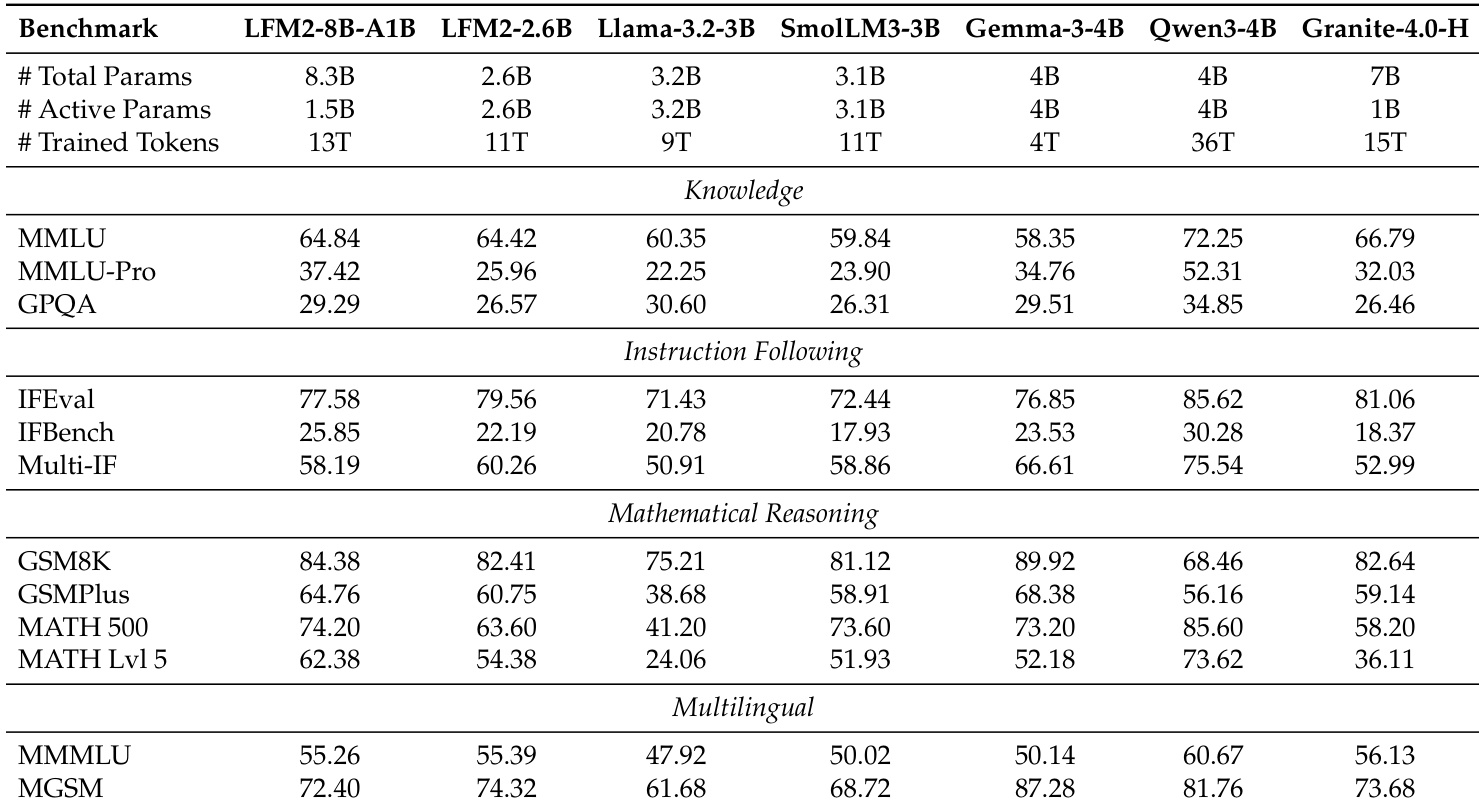
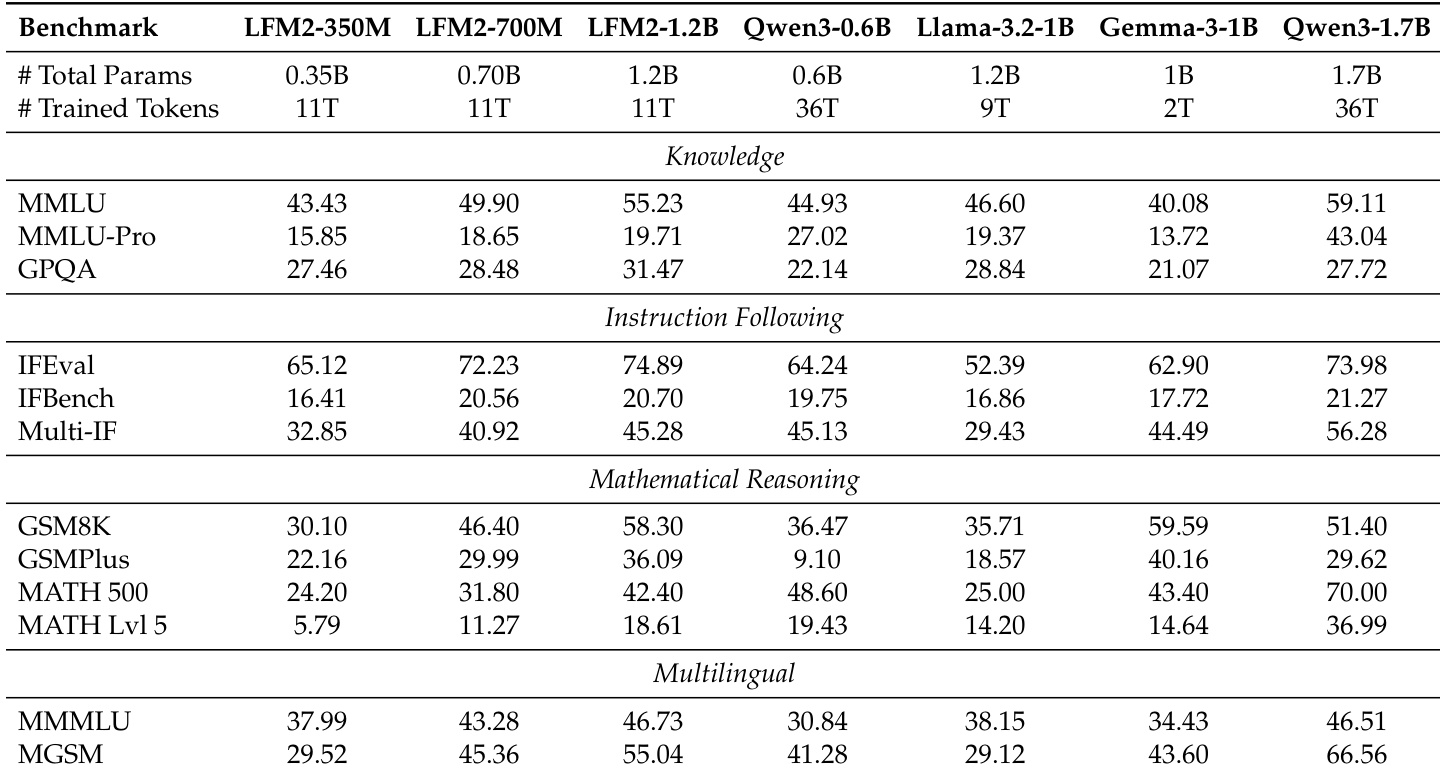
- LFM2 models achieve state-of-the-art performance on knowledge, instruction following, and mathematical reasoning benchmarks: LFM2-1.2B scores 74.89% on IFEval (surpassing 30% larger Qwen3-1.7B), LFM2-2.6B reaches 82.41% on GSM8K, and LFM2-8B-A1B improves by +10.6 points on MATH 500.
- LFM2-VL models outperform similarly sized open-source VLMs on multimodal benchmarks: LFM2-VL-3B scores 76.55 on SEEDBench and 71.37 on RealWorldQA, exceeds Qwen2.5-VL-3B on multilingual MMBench (+1.51) and MMB (+3.92), and maintains strong language-only performance (62.70 on MMLU).
- LFM2-Audio-1.5B achieves competitive performance in speech-to-speech chat (VoiceBench) and ASR, matching or approaching larger models like Qwen2.5-Omni-3B and Whisper, with strong real-time, low-latency suitability.
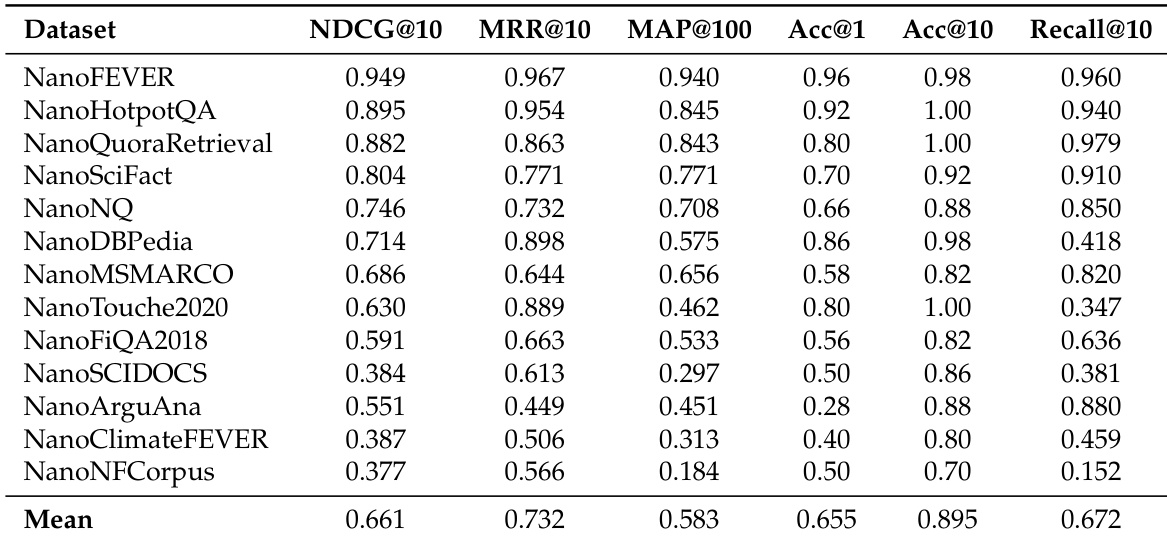
- LFM2-ColBERT-350M achieves 0.661 mean NDCG@10 on multilingual retrieval (NanoBEIR), outperforming GTE-ModernColBERT-v1 in cross-lingual transfer, with 26% smaller performance gap between English and low-resource languages (e.g., Arabic, Japanese, Korean).
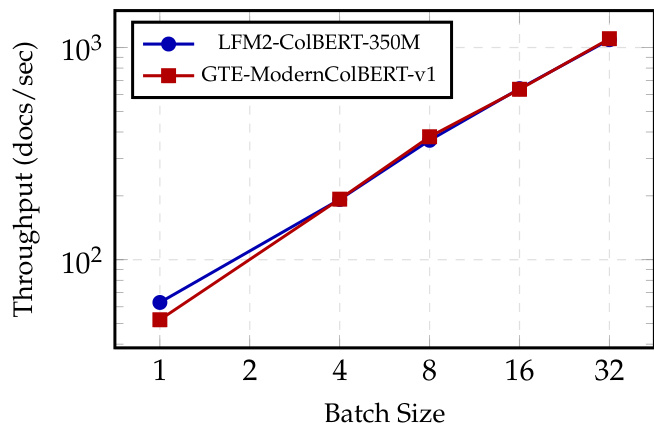
- LFM2-ColBERT-350M matches GTE-ModernColBERT-v1 in query and document encoding throughput on NVIDIA H100 GPUs despite being 2.37× larger, demonstrating high efficiency in retrieval workloads.
The authors use the table to compare LFM2 models with several open-source baselines across knowledge, instruction following, mathematical reasoning, and multilingual benchmarks. Results show that LFM2 models achieve competitive performance relative to their size, with LFM2-2.6B outperforming larger models like Llama-3.2-3B and SmolLM3-3B on instruction following and mathematical reasoning tasks, while LFM2-8B-A1B demonstrates strong gains in knowledge and reasoning capabilities compared to smaller variants.
The authors evaluate LFM2 models on a range of benchmarks, showing that LFM2-350M achieves competitive performance in knowledge tasks such as MMLU and GPQA, while LFM2-700M and LFM2-1.2B outperform similarly sized baselines in instruction following and mathematical reasoning. The results indicate that LFM2 models maintain strong performance across diverse evaluation dimensions, particularly excelling in instruction following and mathematical reasoning relative to their size.
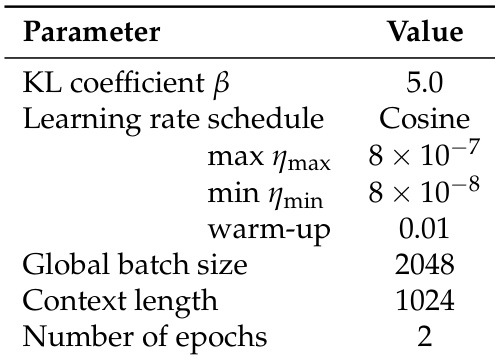
The authors use a cosine learning rate schedule with a maximum learning rate of 8×10⁻⁷, a minimum of 8×10⁻⁸, and a warm-up factor of 0.01, along with a global batch size of 2048, a context length of 1024, and 2 training epochs. These settings are applied during the training of the LFM2 models, which are optimized for efficient inference on edge devices.
The authors use a custom evaluation harness to measure the performance of LFM2-ColBERT-350M on monolingual and cross-lingual retrieval tasks, demonstrating strong multilingual capabilities and consistent performance across diverse languages. Results show that LFM2-ColBERT-350M achieves a mean NDCG@10 of 0.661 across all tasks and languages, with particularly strong performance in English and robust cross-lingual transfer for European languages.
The authors evaluate LFM2-ColBERT-350M on the NanoBEIR Multilingual benchmark, achieving a mean NDCG@10 of 0.661 across 13 diverse retrieval tasks and languages. The model demonstrates strong multilingual capabilities, maintaining consistent performance across both high-resource and low-resource languages, with significantly reduced performance gaps compared to the GTE-ModernColBERT-v1 baseline.