Command Palette
Search for a command to run...
PrismAudio:動画から音声への生成のための分解型チェーン・オブ・ソートと多次元報酬
PrismAudio:動画から音声への生成のための分解型チェーン・オブ・ソートと多次元報酬
Huadai Liu Kaicheng Luo Wen Wang Qian Chen Peiwen Sun Rongjie Huang Xiangang Li Jieping Ye Wei Xue
概要
ビデオから音声への生成(Video-to-Audio: V2A)には、意味的一貫性、音声・映像の時間的同期、美的品質、空間的精度という 4 つの重要な知覚次元のバランスが求められる。しかし、既存の手法は単一の損失関数で競合する目的を混同する客観的なエンタングルメントに悩まされ、人間の嗜好との整合性も欠いている。本研究では、専門的な思考連鎖(Chain-of-Thought: CoT)計画を統合した V2A 生成における強化学習(Reinforcement Learning)の導入を初めて実現したフレームワーク「PrismAudio」を提案する。本アプローチでは、単一の推論モジュールを、それぞれ目的に応じた報酬関数と対をなす 4 つの専門的 CoT モジュール(意味的、時間的、美的、空間的 CoT)に分解する。この CoT と報酬の対応関係により、多次元 RL 最適化が可能となり、モデルがすべての観点にわたってより優れた推論を同時に生成することを導くことで、客観的エンタングルメントの問題を解決しつつ解釈性を維持する。この最適化を計算上実用的にするため、既存の GRPO 実装と比較してトレーニングオーバーヘッドを劇的に削減するハイブリッド ODE-SDE サンプリングを採用した「Fast-GRPO」を提案する。さらに、既存のデータセットよりも分布的にバランスが良く、より現実的で多様かつ困難なシナリオを網羅する厳密なベンチマーク「AudioCanvas」を導入する。同ベンチマークは単一イベントクラス 300 件および複数イベントサンプル 501 件で構成される。実験結果により、PrismAudio はドメイン内データセットである VGGSound テストセットおよびドメイン外ベンチマークである AudioCanvas において、4 つの知覚次元すべてで最先端(state-of-the-art)のパフォーマンスを達成することを示した。
One-sentence Summary
Researchers from HKUST, Alibaba Group, and CUHK introduce PrismAudio, the first framework to integrate reinforcement learning into video-to-audio generation via specialized chain-of-thought planning that decomposes reasoning into semantic, temporal, aesthetic, and spatial modules paired with targeted rewards to resolve objective entanglement while preserving interpretability, alongside Fast-GRPO for reduced training overhead and the AudioCanvas benchmark with 300 single-event classes and 501 multi-event samples.
Key Contributions
- We introduce PrismAudio, the first framework to integrate Reinforcement Learning into video-to-audio generation with specialized Chain-of-Thought planning. This approach decomposes reasoning into four specialized CoT modules paired with targeted reward functions to address objective entanglement while preserving interpretability.
- To ensure computational practicality, we propose Fast-GRPO, an optimization method employing hybrid ODE-SDE sampling. This technique dramatically reduces training overhead compared to existing GRPO implementations.
- We also introduce AudioCanvas, a rigorous benchmark that is more distributionally balanced and covers more realistically diverse and challenging scenarios than existing datasets. It includes 300 single-event classes and 501 multi-event samples to support evaluation.
Introduction
Video-to-Audio generation requires balancing semantic consistency, temporal synchrony, aesthetic quality, and spatial accuracy to synthesize soundscapes from silent videos. Existing methods suffer from objective entanglement where competing goals are conflated in single loss functions, and they lack human preference alignment. Recent Chain-of-Thought approaches further fail due to monolithic planning that cannot address distinct perceptual dimensions independently. The authors introduce PrismAudio, which integrates Reinforcement Learning with specialized Chain-of-Thought modules for each perceptual axis. This decomposition enables multi-dimensional RL optimization to guide reasoning across all perspectives while preserving interpretability. To reduce training overhead, they propose Fast-GRPO using hybrid ODE-SDE sampling. Additionally, the team presents AudioCanvas, a rigorous benchmark for diverse scenarios, achieving state-of-the-art performance across all dimensions.
Dataset
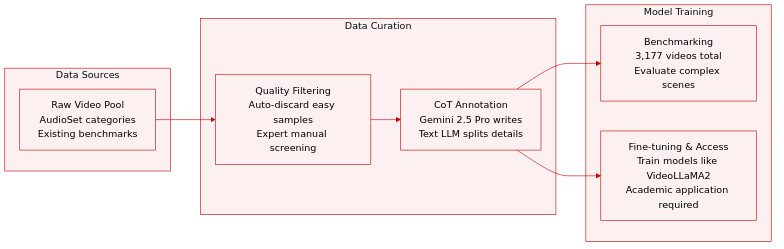
- The authors construct AudioCanvas using 300 distinct categories from the AudioSet ontology, focusing on sound effects and music while excluding human speech and singing.
- The final benchmark comprises 3,177 high-quality videos, including a curated subset of 501 multi-event videos designed to evaluate complex scene interactions.
- Filtering protocols automatically discard samples where existing V2A models achieve near-perfect scores, while professional experts manually screen for diversity and audio-visual correlation.
- Gemini 2.5 Pro generates structured Chain-of-Thought captions covering semantic, temporal, aesthetic, and spatial dimensions, which are subsequently decoupled into separate modules by a text LLM.
- The dataset supports both advanced benchmarking and fine-tuning for models like VideoLLaMA2, with access restricted to academic researchers via a formal application process.
- Privacy and ethical standards are maintained by providing reference links instead of raw video redistribution and using anonymized identifiers for all content.
Method
The proposed method, PrismAudio, operates through a three-stage pipeline comprising a CoT-aware audio foundation model, customized CoT modules for reasoning decomposition, and a GRPO post-training framework. The overall architecture integrates these components to enable high-quality video-to-audio generation with multi-dimensional reasoning capabilities.
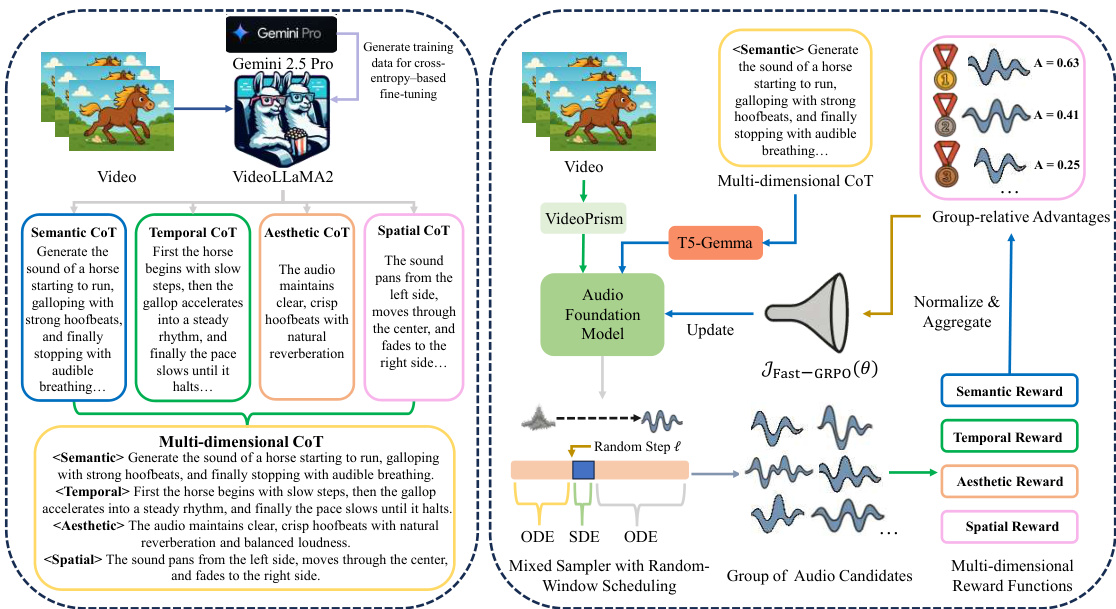
CoT-Aware Audio Foundation Model The core generation model is built upon a diffusion transformer backbone utilizing flow matching. To overcome the limitations of existing models in handling complex video scenarios and structured reasoning text, the authors implement two key architectural enhancements. First, they replace standard CLIP-based encoders with VideoPrism, a state-of-the-art video encoder designed to capture rich semantic representations of objects, actions, and environmental contexts. Second, to effectively condition the model on the structured reasoning patterns required for multi-dimensional CoT, the standard T5 encoder is upgraded to T5-Gemma. This encoder-decoder architecture adapts the reasoning capabilities of decoder-only LLMs, enabling robust comprehension of the analytical text generated by the CoT modules.
Decomposing Multi-dimensional CoT Reasoning To address the limitations of monolithic reasoning paths, the method decomposes video-to-audio reasoning into four specialized dimensions: Semantic, Temporal, Aesthetic, and Spatial. The Semantic CoT identifies audio events and characteristics, while the Temporal CoT determines the sequential ordering of these events. The Aesthetic CoT focuses on quality aspects like naturalness and fidelity, and the Spatial CoT analyzes sound positioning and distance. High-quality training data for these dimensions is constructed using Gemini 2.5 Pro. This data is then used to fine-tune VideoLLaMA2, enabling it to generate the four specialized CoTs. These distinct reasoning texts are concatenated to form a multi-dimensional CoT, which serves as enhanced structured text conditioning for the audio foundation model.
Fast-GRPO Post-Training Framework The final stage aligns the audio foundation model with multi-dimensional human preferences using a Fast-GRPO framework. This process involves four specialized reward functions corresponding to the CoT dimensions: Semantic Reward (measured by MS-CLAP), Temporal Reward (assessed via Synchformer), Aesthetic Reward (using Meta Audiobox Aesthetics), and Spatial Reward (employing StereoCRW). To optimize efficiently across these objectives, the authors introduce a mixed sampler with random-window scheduling. While the flow matching generation is inherently deterministic (an ODE), it is reformulated as a stochastic process (an SDE) to enable RL-based optimization. The Fast-GRPO algorithm strategically confines stochasticity to a small, randomly placed window of timesteps within the generation trajectory. For each training iteration, a starting position ℓ is sampled to define an optimization window W(ℓ) with width w≪T:
W(ℓ)={ℓ,ℓ+1,…,ℓ+w−1}.The generation process interleaves deterministic ODE steps and stochastic SDE steps based on this window. For a step size Δt, the update rule is:
xt+1={xt+vθ(xt,t,c)Δt,xt+μSDE(xt,t,c)Δt+σtΔtεt,if t∈/W(ℓ)(ODE step)if t∈W(ℓ)(SDE step)where εt∼N(0,I) and vθ is the model's predicted velocity. This hybrid approach allows for tractable policy ratio computation and reduces the Number of Function Evaluations (NFE) per sample, enabling near-linear complexity training. The policy model is optimized by maximizing the following objective, derived from the Fast-GRPO formulation restricted to the selected SDE steps:
JFast−GRPO(θ) = Ec,ℓ,{xi}∼πθoldN1i=1∑Nw1t∈W(ℓ)∑min(rti(θ)Ai,clip(rti(θ),1−ε,1+ε)Ai).where Ai is the group-normalized advantage computed from the weighted sum of the multi-dimensional rewards.
Experiment
The study evaluates performance on the VGGSound test set and the newly introduced AudioCanvas benchmark using comprehensive objective metrics and subjective Mean Opinion Scores to assess semantic, temporal, spatial, and aesthetic dimensions. Results demonstrate that PrismAudio achieves state-of-the-art performance by employing a multi-dimensional Chain-of-Thought reinforcement learning framework that effectively balances competing perceptual objectives, while ablation analyses confirm that structured decomposed reasoning is essential for maintaining robustness in complex scenarios. Qualitative comparisons further highlight the model's superior ability to preserve high-frequency details and accurate transient responses compared to existing methods.
The the the table compares various Chain-of-Thought reasoning strategies, ranging from a baseline without reasoning to the proposed multi-dimensional approach. Results demonstrate that structured, decomposed reasoning significantly improves performance across semantic, temporal, and aesthetic metrics compared to unstructured or single-block methods. The MultiCoT method achieves the best overall scores, validating the necessity of logical planning for high-quality generation. MultiCoT achieves the highest semantic alignment and temporal synchrony scores Structured reasoning strategies outperform random or unstructured approaches Decomposed reasoning yields better aesthetic quality than monolithic methods

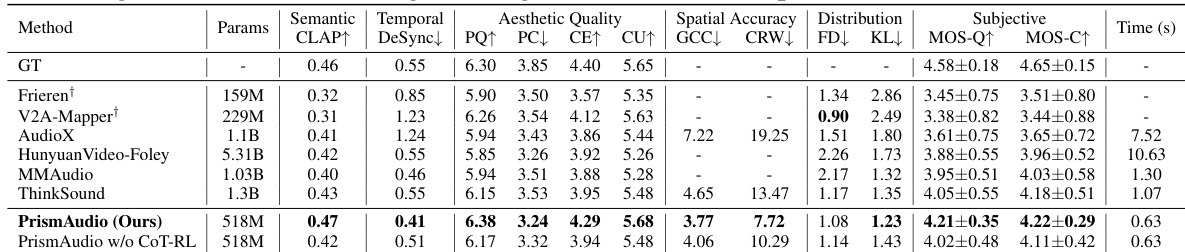
The authors evaluate the proposed method against competitive baselines on the VGGSound test set. Results show that PrismAudio achieves superior performance across semantic, temporal, and aesthetic dimensions compared to prior models. The ablation study further indicates that the CoT-RL framework provides substantial improvements over the foundation model. PrismAudio secures the highest subjective scores for audio quality and consistency. The proposed method outperforms baselines in spatial accuracy and temporal synchrony. CoT-RL optimization delivers significant performance gains over the base foundation model.
The experiment evaluates the impact of different Chain-of-Thought reasoning structures on audio generation quality. Results demonstrate that structured, decomposed reasoning significantly outperforms unstructured or monolithic approaches across semantic, temporal, and aesthetic dimensions. MultiCoT outperforms monolithic CoT in semantic understanding and aesthetic quality Baseline models without CoT reasoning perform poorly across all evaluation metrics Structured logical plans are essential for high-quality generation compared to random keyword ordering

The authors evaluate video encoders on a retrieval task using the AudioCanvas benchmark. VideoPrism achieves significantly higher recall scores compared to CLIP and X-CLIP across all scene complexities. The performance gap is particularly large in multi-event scenarios, highlighting VideoPrism's robustness. VideoPrism achieves the highest recall scores across all scene categories Performance advantage is most significant in complex multi-event scenes VideoPrism maintains robust retrieval accuracy while baselines degrade

The authors compare text encoders to validate their ability to handle structured reasoning. T5-Gemma consistently achieves better results than T5-Base and T5-Large across sequential understanding and causal logic metrics. These findings support the selection of instruction-tuned models for processing complex Chain-of-Thought descriptions. T5-Gemma achieves the highest scores in sequential understanding tasks. Causal reasoning capabilities are significantly stronger with T5-Gemma. Multi-step reasoning accuracy remains high for T5-Gemma compared to baselines.

The experiments validate the proposed framework by comparing it against baselines across audio generation, video retrieval, and text encoding tasks. Results indicate that structured, multi-dimensional Chain-of-Thought reasoning and CoT-RL optimization significantly enhance semantic alignment and temporal synchrony compared to unstructured approaches. Additionally, components like VideoPrism and T5-Gemma demonstrate superior robustness in complex scene retrieval and causal logic, confirming the necessity of instruction-tuned models for high-quality generation.