Command Palette
Search for a command to run...
FirstAidQA:低接続環境における救急対応向けの合成データセット
FirstAidQA:低接続環境における救急対応向けの合成データセット
Saiyma Sittul Muna Rezwan Islam Salvi Mushfiqur Rahman Mushfique Ajwad Abrar
概要
緊急事態においては、一秒一秒が重要である。時間的に厳しく、通信環境が不安定あるいは完全に切断された状況下で、大規模言語モデル(LLM)の活用は依然として限られている。現行のモデルは計算リソースを大量に要するため、救助隊員や一般市民が使用する低性能デバイスには不適切である。軽量でドメイン特化型の解決策を開発する上で大きな障壁となっているのは、救急対応に特化した高品質なデータセットが不足していることである。この課題に対応するため、本研究では「FirstAidQA」と名付けられた合成データセットを提案する。このデータセットには、救急処置および緊急対応の多様なシナリオを網羅する5,500件の高品質な質問・回答ペアを含んでいる。データセットは、『Vital First Aid Book(2019年版)』のテキストを基に、ChatGPT-4o-miniという大規模言語モデルを用いて、プロンプト駆動型の文脈内学習(in-context learning)により生成した。その後、テキストのクリーニング、文脈に基づくチャンク分割、フィルタリングといった前処理を実施し、さらに人間による検証を経て、質問・回答ペアの正確性、安全性、実用性を確保した。FirstAidQAは、大規模言語モデル(LLM)および小規模言語モデル(SLM)のインストラクションチューニングおよびファインチューニングを支援することを目的として設計されており、緊急現場における高速かつ信頼性が高く、オフライン動作可能なシステムの実現を可能にする。本データセットは公開しており、救急・緊急対応における安全が求められる、リソース制約のあるAIアプリケーションに関する研究を促進することを目的としている。データセットはHugging Faceにて公開されており、以下のリンクからアクセス可能である:https://huggingface.co/datasets/i-am-mushfiq/FirstAidQA。
One-sentence Summary
Muna et al. from Islamic University of Technology introduce FirstAidQA, a synthetic dataset of 5,500 high-quality first aid question-answer pairs generated via ChatGPT-4o-mini using prompt-based in-context learning and human validation, addressing the scarcity of domain-specific emergency response data to train lightweight LLMs and SLMs for offline-capable systems in time-sensitive, low-connectivity scenarios.
Key Contributions
- Identifies the critical absence of domain-specific datasets for first aid as a barrier to deploying lightweight AI in low-connectivity emergency scenarios and introduces FirstAidQA, a synthetic dataset of 5,500 question-answer pairs generated via ChatGPT-4o-mini using in-context learning from the Vital First Aid Book with rigorous preprocessing and human validation.
- Validates dataset safety and accuracy through expert evaluation of 200 randomly sampled pairs by three medical professionals, assessing criteria including safety completeness and relevance while documenting flagged examples for cautious handling as evidenced in the provided evaluation tables.
- Enables offline-capable emergency response systems by structuring FirstAidQA specifically for fine-tuning small language models, building on methodologies proven effective in prior resource-constrained medical applications like Cahlen's offline first-aid systems.
Introduction
The authors address a critical gap in emergency response tools for low-connectivity regions where immediate, accurate first-aid guidance can save lives but internet access is unreliable. Prior solutions like FAQ-based chatbots or commercial voice assistants often omit evidence-based steps or provide incomplete instructions, while existing medical QA datasets focus on clinical records or general health information—not actionable, step-by-step first aid for laypeople. Synthetic datasets like Self-Instruct or Offline Practical Skills QA demonstrate LLMs' potential for scalable data generation but lack first-aid specificity. The authors' main contribution is FirstAidQA, a purpose-built synthetic dataset generated to deliver reliable, guideline-compliant first-aid instructions offline, overcoming the absence of dedicated resources for this high-stakes domain.
Dataset
- The authors introduce FirstAidQA, a synthetic dataset comprising 5,500 question-answer pairs focused on first aid and emergency response scenarios. It is generated using ChatGPT-4o-mini via prompt-based in-context learning, with source material exclusively drawn from the certified Vital First Aid Book (2019).
- Key category details include:
- Total size: 5,500 QA pairs spanning 15 emergency categories (e.g., CPR, burns, fractures, head injuries, bleeding management).
- Source: Text chunks from the Vital First Aid Book, manually segmented to preserve context (e.g., casualty movement protocols or burn treatment steps).
- Filtering: Irrelevant theoretical content was excluded; only text applicable to real-world emergencies was retained for QA generation.
- Safety rules: Prompts explicitly constrained the LLM to generate answers strictly from provided context chunks, with diversified topic sampling to reduce bias.
- The dataset supports instruction-tuning and fine-tuning of lightweight LLMs/SLMs for offline deployment in low-connectivity environments. The authors use the full dataset (without specified train/validation splits) to train models requiring rapid, reliable emergency guidance, emphasizing practical procedural knowledge over clinical diagnostics.
- Processing includes contextual chunking of source text, structured JSON-formatted output generation (20 QA pairs per prompt batch), human validation for accuracy/safety, and iterative refinement to ensure diversity (e.g., adding pediatric/elderly scenarios). No cropping strategy is applied; instead, context-preserving chunks maintain situational relevance for edge-device deployment.
Experiment
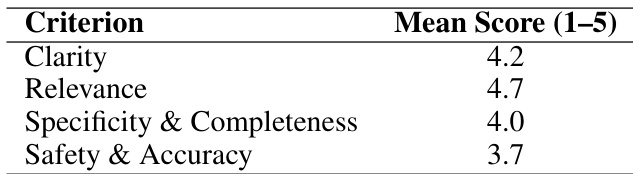
- Expert evaluation of 200 randomly sampled QA pairs by three medical professionals validated clarity, relevance, specificity and completeness, and safety and accuracy, with mean ratings documented in Table 2
- Tables 3 and 4 highlight specific QA pairs containing potentially unsafe instructions that require cautious handling during dataset utilization
The authors use expert evaluation to assess 200 QA pairs across four criteria, with scores averaged across three medical professionals. Results show the highest mean score for Relevance (4.7) and the lowest for Safety & Accuracy (3.7), indicating that while questions are well-targeted and clear, some answers may contain medically inaccurate or unsafe content.