Command Palette
Search for a command to run...
テスト時進化的探索を用いた画像および動画生成のスケーリング
テスト時進化的探索を用いた画像および動画生成のスケーリング
概要
モデルの事前学習における計算量(データおよびパラメータ)のスケーリングに伴う限界コストが著しく増加する中、推論時における追加計算を割り当てる「推論時スケーリング(Test-Time Scaling: TTS)」は、生成モデルの性能向上に向けた有望なアプローチとして浮上している。TTSは複数の言語タスクにおいて顕著な成果を上げているが、画像および動画生成モデル(拡散モデルやフローに基づくモデル)における推論時スケーリングの挙動に関する理解には依然として大きなギャップが存在する。近年、視覚タスクにおける推論時戦略の探索が開始されているものの、これらのアプローチには根本的な制約が存在する:タスク固有の領域に限定される、スケーラビリティが低い、あるいはサンプルの多様性を損なうような報酬過最適化に陥るといった問題である。本論文では、追加の学習やモデル拡張を必要とせずに、拡散モデルおよびフローに基づくモデルの両方において、画像および動画生成のスケーラビリティを効果的に向上させる、新規で汎用的かつ効率的なTTS手法「EvoSearch(Evo)」を提案する。EvoSearchは、拡散モデルおよびフローモデルに対する推論時スケーリングを、生物進化の原理を用いた進化的探索問題として再定式化する。このアプローチにより、ノイズ除去の軌道を効率的に探索・最適化することが可能となる。特に、確率的微分方程式に基づくノイズ除去プロセスに特化した選択および突然変異メカニズムを慎重に設計し、多様性を保持しつつ、高品質な「子孫」を反復的に生成する。画像および動画生成タスクにおける拡散モデルとフローモデルの両方に対して広範な評価を行った結果、本手法は既存手法を一貫して上回り、高いサンプル多様性を達成するとともに、未観測の評価指標に対しても強い汎化性能を示した。本研究のプロジェクトページは、https://tinnerhrhe.github.io/evosearch にて公開されている。
One-sentence Summary
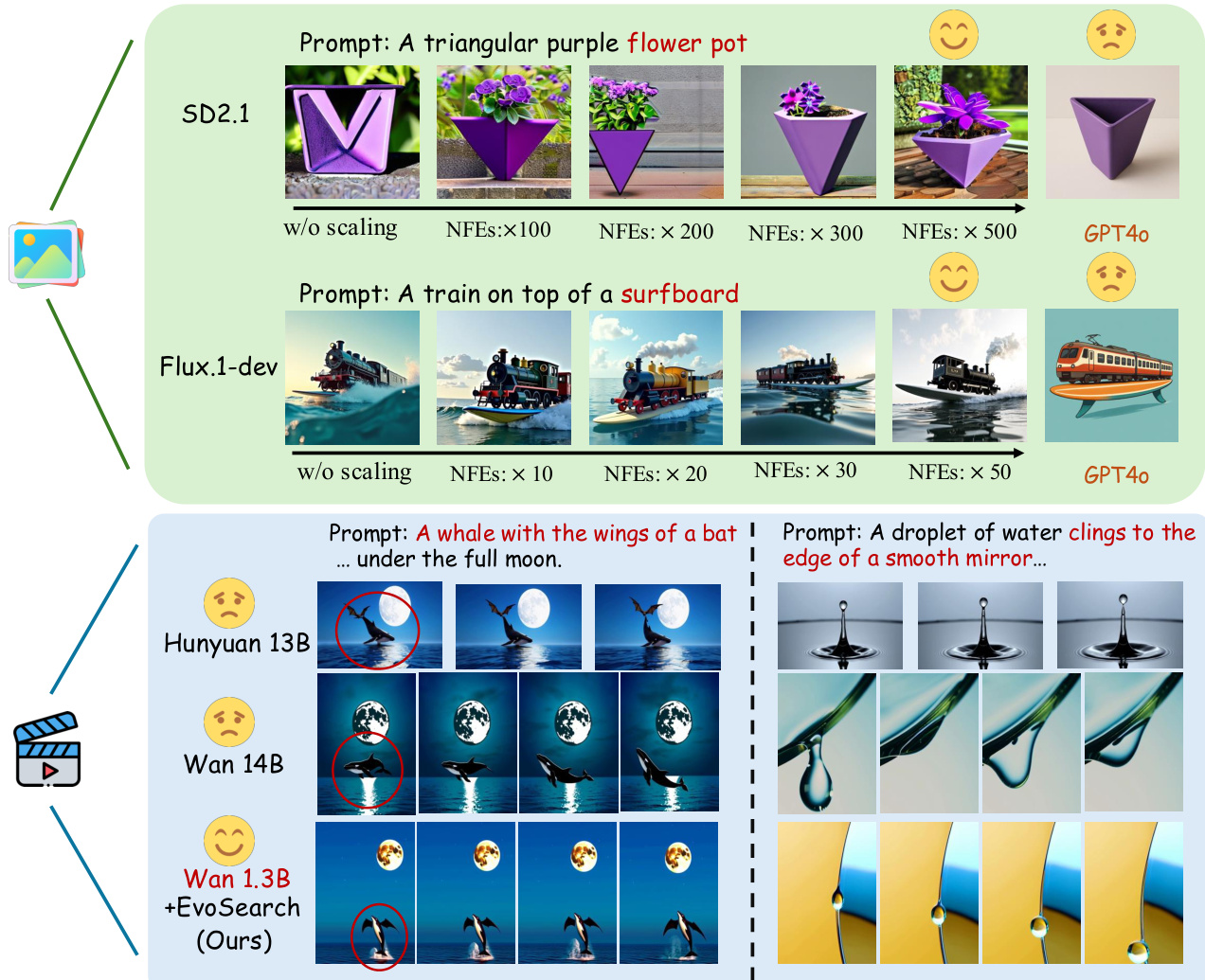
The authors from Hong Kong University of Science and Technology and Kuaishou Technology propose EvoSearch, a generalist test-time scaling framework that reformulates image and video generation as an evolutionary search problem, using selective mutation in denoising trajectories to enhance quality and diversity without retraining; it enables Stable Diffusion 2.1 to surpass GPT4o and a 1.3B model to outperform 14B and 13B counterparts with 10× fewer parameters.
Key Contributions
- Test-time scaling (TTS) for image and video generative models remains underexplored despite its success in language models, with existing methods limited by poor scalability, task-specific constraints, or reward over-optimization that reduces sample diversity.
- EvoSearch introduces a generalist TTS framework that reformulates denoising as an evolutionary search process, using denoising-aware selection and mutation mechanisms to iteratively improve sample quality while preserving diversity across diffusion and flow models.
- Extensive evaluations show EvoSearch significantly outperforms baselines, enabling Stable Diffusion 2.1 to surpass GPT4o and a 1.3B model to exceed 14B and Hunyuan 13B models with 10× fewer parameters, demonstrating strong generalization and efficiency.
Introduction
Test-time scaling (TTS) has emerged as a critical approach to enhance generative model performance without additional training, particularly as training-time scaling faces rising costs and data limitations. While TTS has shown success in language models, applying it to image and video generation—especially diffusion and flow models—remains challenging due to the high-dimensional, complex denoising trajectories these models traverse. Prior methods like best-of-N sampling and particle sampling suffer from inefficiency, limited exploration, and poor scalability, often failing to generate diverse, high-quality samples because they rely on fixed initial candidates and lack mechanisms to actively discover new, high-reward states.
The authors propose Evolutionary Search (EvoSearch), a generalist TTS framework that reframes test-time scaling as an evolutionary search problem. By leveraging selection and mutation mechanisms tailored to the denoising process, EvoSearch iteratively evolves a population of samples, enabling active exploration of the latent space while preserving diversity. It dynamically allocates computation along the denoising trajectory, reducing cost over time, and works across both diffusion and flow models without requiring model updates or gradient access. The method achieves state-of-the-art results, enabling smaller models to outperform larger ones and allowing Stable Diffusion 2.1 to surpass GPT4o in human preference evaluations, demonstrating strong scalability, generalizability, and efficiency.
Method
The authors leverage a unified framework for test-time scaling that reformulates the sampling process from a target distribution as an active evolutionary optimization problem, applicable to both diffusion and flow models. The core of this approach, termed Evolutionary Search (EvoSearch), reinterprets the denoising trajectory as an evolutionary path, where the initial noise and intermediate states are actively evolved to discover higher-quality generations. This framework operates by progressively moving forward along the denoising trajectory, starting from the initial Gaussian noise xT, and applying evolutionary operations at specific timesteps to refine and explore new states. The overall process is guided by a reward model that evaluates the quality of generated samples, enabling a dynamic search for high-reward regions in the state space.
The framework is structured around a cascade of evolutionary generations. It begins with an initial population of kstart randomly sampled Gaussian noises at timestep T. This population is then processed through a series of evolutionary operations—selection, mutation, and fitness evaluation—according to a predefined evolution schedule T. The evolution schedule specifies the timesteps at which these operations are performed, allowing the method to focus computational resources on key points in the denoising process rather than at every step, thereby improving efficiency. The population size schedule K further adapts the number of samples at each generation, enabling a flexible trade-off between computational cost and exploration.

At each evolution timestep ti, the fitness of each parent state xti is evaluated using a reward model r, which is computed based on the fully denoised output x0. This direct evaluation on the clean output provides high-fidelity reward signals, avoiding the inaccuracies associated with prediction-based estimators. The selection process employs tournament selection to identify high-quality parents, ensuring that the best candidates are propagated to the next generation. To maintain population diversity and prevent premature convergence, a specialized mutation strategy is employed. This strategy preserves a set of elite parents with the highest fitness scores and mutates the remaining parents to explore the neighborhoods around them. The mutation operation is tailored to the nature of the state: for initial noise xT, a Gaussian-preserving mutation is used, while for intermediate denoising states xt, a mutation inspired by the reverse-time SDE is applied to preserve the intrinsic structure of the latent state.
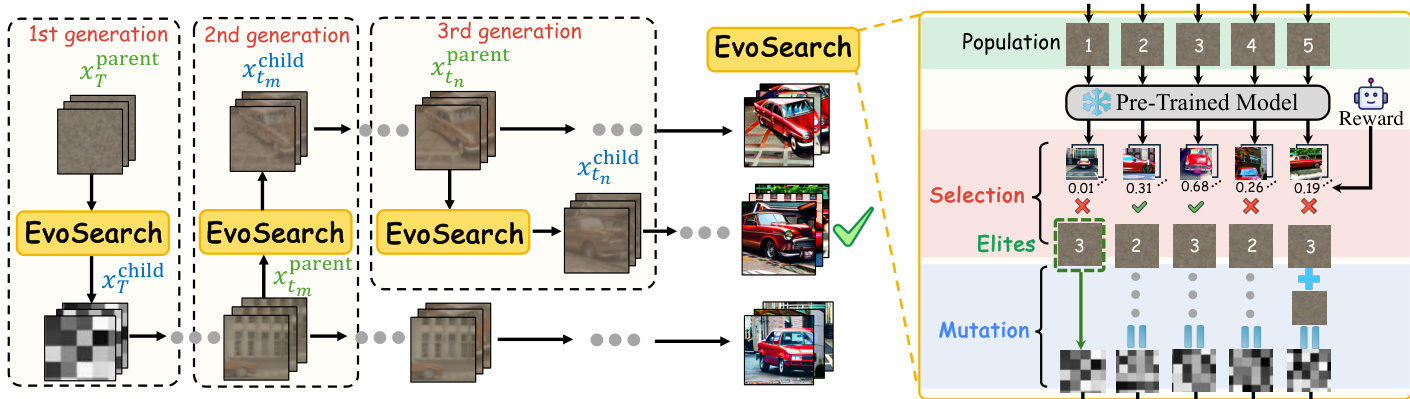
The framework is designed to be a generalist solution, encompassing existing methods like best-of-N and particle sampling as special cases. By setting the evolution schedule to only include the initial noise timestep, EvoSearch degenerates to best-of-N. Conversely, by eliminating both the initial noise search and mutation operations, it reduces to particle sampling. This unified design allows EvoSearch to achieve efficient and effective test-time scaling across a range of image and video generation tasks.
Experiment
- Evaluated EvoSearch on large-scale text-conditioned image and video generation tasks using DrawBench, VBench, and Videogen-Eval datasets, with models including Stable Diffusion 2.1 (865M) and Flux.1-dev (12B) for images, and HunyuanVideo and Wan models for videos.
- On DrawBench, EvoSearch achieved superior performance over baselines (Best-of-N and Particle Sampling) across both diffusion and flow models, with improvements of up to 32.8% and 14.1% on Wan 1.3B and 23.6% and 20.6% on HunyuanVideo 13B, respectively, using VideoReward as guidance.
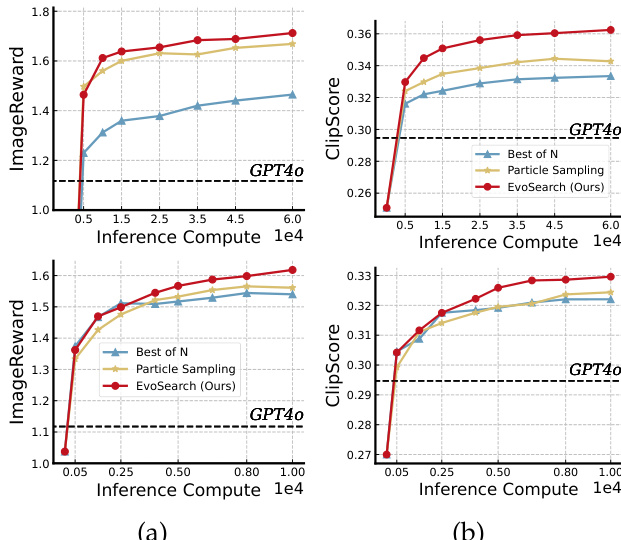
- EvoSearch demonstrated monotonic performance gains with increasing inference-time computation (NFEs), outperforming baselines that plateaued after ~1e4 NFEs, particularly on the 12B Flux.1-dev model.
- EvoSearch generalized effectively to unseen reward functions, maintaining stable performance on out-of-distribution metrics such as Aesthetic and Physics, with minimal degradation compared to baselines that suffered significant drops.
- Human evaluation showed EvoSearch achieved higher win rates than baselines across Visual Quality, Motion Quality, Text Alignment, and Overall Quality.
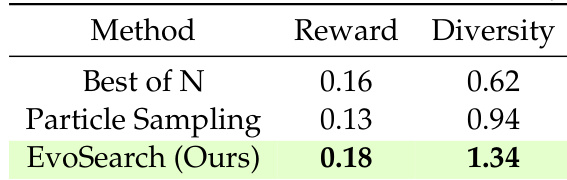
- EvoSearch achieved the highest diversity (measured by CLIP feature L2 distance) and reward simultaneously, outperforming baselines in both quality and diversity.
- EvoSearch enabled smaller models to surpass larger ones: SD2.1 with EvoSearch outperformed GPT4o under 30 seconds inference time, and Wan 1.3B with 5× scaled computation matched or exceeded Wan 14B’s performance on equivalent hardware.
The authors use EvoSearch to evaluate image generation performance on Stable Diffusion 2.1 and Flux.1-dev models, comparing it against baselines Best of N and Particle Sampling. Results show that EvoSearch consistently outperforms both baselines across increasing inference-time computation, achieving higher ImageReward and ClipScore values, and surpassing GPT4o in quality even with significantly lower computational cost.
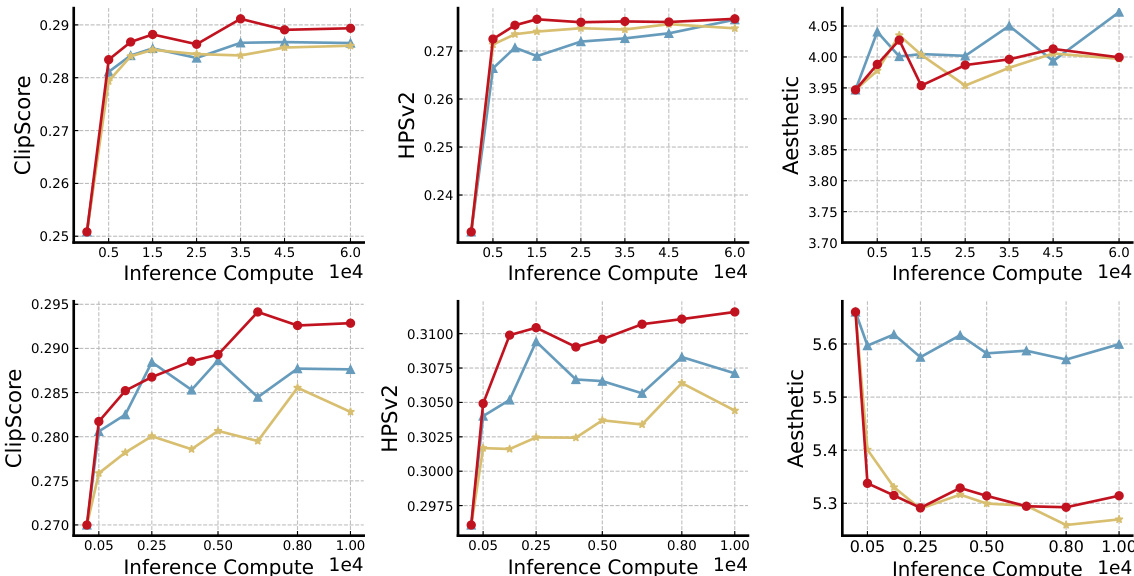
The authors use EvoSearch to evaluate image generation on Stable Diffusion 2.1 and Flux.1-dev, measuring performance across multiple metrics including ClipScore, HPSv2, and Aesthetic as inference-time computation increases. Results show that EvoSearch consistently improves generation quality with higher inference compute, outperforming baseline methods which plateau, and achieves superior performance across all metrics while maintaining higher diversity.
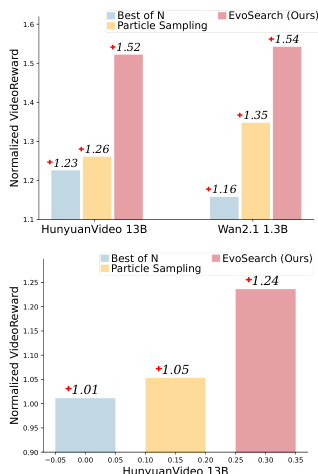
The authors use EvoSearch to evaluate video generation performance on HunyuanVideo 13B and Wan2.1 1.3B models, comparing it against Best of N and Particle Sampling. Results show EvoSearch achieves higher normalized VideoReward scores than both baselines across both models, with improvements of 1.54 and 1.35 for HunyuanVideo 13B and Wan2.1 1.3B respectively, while the baselines show lower or comparable performance.
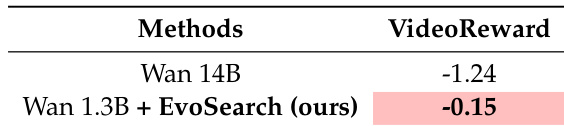
The authors evaluate EvoSearch on video generation tasks using the Wan 1.3B and Wan 14B models, with VideoReward as the guidance metric. Results show that Wan 1.3B enhanced with EvoSearch achieves a significantly higher VideoReward score compared to the larger Wan 14B model, demonstrating that EvoSearch enables smaller models to outperform larger ones under equivalent inference time.
The authors use EvoSearch to evaluate its performance against baseline methods in terms of reward and diversity. Results show that EvoSearch achieves the highest reward and diversity scores, outperforming Best of N and Particle Sampling.