Command Palette
Search for a command to run...
確率的勾配降下法の高速な不確実性定量化のための安価なブートストラップ
確率的勾配降下法の高速な不確実性定量化のための安価なブートストラップ
Henry Lam Zitong Wang
概要
確率的勾配降下法(SGD)または確率的近似は、モデルの学習および確率的最適化において広く用いられてきた。その収束性の解析に関する膨大な文献が存在する一方、SGD によって得られた解に対する統計的推論は比較的新しく研究され始めた分野である。しかし、不確実性の定量化への要請が高まるにつれ、その重要性は増している。本研究では、SGD によって得られた解に対する信頼区間を構築するための、計算コストが低く抑えられた二つのリサンプリングに基づく手法を調査する。一つは、データからの置換リサンプリングを通じて並列的に少数の SGD を複数回実行する手法であり、もう一つはオンライン形式でこれを実行する手法である。我々の手法は、確立されたブートストラップ法の拡張と位置付けることができ、リサンプリング要件の観点から計算負荷を大幅に低減しつつ、既存のバッチ法における複雑な混合条件を回避するものである。これらの成果は、最近提唱された「安価なブートストラップ(cheap bootstrap)」の考え方と、SGD に対する Berry-Esseen 型不等式の改良を通じて達成された。
One-sentence Summary
Henry Lam and Zitong Wang from Columbia University propose two computationally cheap resampling methods to construct confidence intervals for stochastic gradient descent solutions. By leveraging a cheap bootstrap idea and refining Berry-Esseen bounds, their approach significantly reduces resampling requirements while bypassing complex mixing conditions in existing batching techniques for uncertainty quantification.
Key Contributions
- The paper introduces two computationally cheap resampling-based methods to construct confidence intervals for stochastic gradient descent solutions, utilizing either parallel runs with few replications or an online operational framework.
- These approaches enhance established bootstrap schemes by substantially reducing resampling requirements and bypassing the intricate mixing conditions typically needed in existing batching methods.
- Theoretical validity is supported by applying a recent cheap bootstrap concept and refining a Berry-Esseen-type bound specifically for stochastic gradient descent to ensure accurate uncertainty quantification.
Introduction
Stochastic gradient descent (SGD) is a cornerstone of modern machine learning and stochastic optimization, yet quantifying the statistical uncertainty of its solutions remains a critical challenge for applications requiring reliable confidence intervals. Prior approaches struggle with significant limitations, including the need for unavailable Hessian information, sensitivity to hyperparameter tuning in batch mean methods, high computational overhead from maintaining large ensembles in online bootstraps, or the requirement to fundamentally alter the SGD trajectory. The authors leverage a recent "cheap bootstrap" concept and refine a Berry-Esseen-type bound to introduce two computationally efficient resampling methods that construct valid confidence intervals with minimal resampling requirements while bypassing complex mixing conditions.
Method
The authors leverage a bootstrap approach designed to surmount challenges in SGD inference without requiring mixing-related tuning or substantial modification to the original SGD. This methodology synthesizes the recent cheap bootstrap idea with a derivation of the asymptotic joint distribution among SGD and resampled SGD runs. The framework supports both offline and online implementations, termed Cheap Offline Bootstrap (COfB) and Cheap Online Bootstrap (CONB).
For the offline version, COfB reruns the SGD using resampling with replacement from the data B times. It constructs confidence intervals from these resampled iterates via an approach similar to the standard error bootstrap. The key assertion is that B can be very small, such as 3, making the approach computationally less demanding than the delta method or online bootstrap. The online version, CONB, runs multiple, namely B+1, SGDs in parallel on the fly as new data comes in. It borrows the idea of perturbing the gradient estimate in the SGD iteration but maintains a very small number of SGD runs.
A comparison among different methods highlights the computational and memory advantages of the proposed approach. Refer to the comparison table below for a summary of these distinctions.
The delta method, random scaling, and online bootstrap demand a relatively heavy computation or memory load. In contrast, the proposed methods introduce B but keep it very small, resulting in a light computational and memory load. Additionally, the second derivative is only required by the delta method, which can be a challenge in some application scenarios.
The theoretical guarantees rely on establishing the asymptotic joint distribution, particularly independence, among SGD and resampled SGD runs. The authors prove a joint central limit theorem for both the original and resampled SGD runs when resampling with replacement. This guides the aggregation of outputs to construct asymptotically exact-coverage intervals. The confidence intervals are based on t-statistic construction and follow the behavior of t-intervals. While the widths are larger than those of normality intervals, they shrink rapidly as B increases.
In high-dimensional sparse settings, the authors extend the methods via a two-stage approach. The first stage reduces the problem to a lower-dimensional subspace via Lasso model selection. The second stage applies COfB or CONB to the problem confined to the support of the estimated parameter. This procedure correctly identifies the support of the true model parameter and provides confidence intervals with exact coverage for non-zero entries.
Experimental results support the statements regarding coverage probabilities and widths of confidence intervals. The results indicate that the methods generally deliver the most accurate coverage probabilities. Refer to the linear and logistic regression results below.
Although the methods produce wider confidence intervals, the interval width decreases sharply when B increases even slightly. In addition, the experiments suggest that the method outperforms others in terms of robustness. The analysis also applies to high-dimensional sparse linear regression to enlarge the scope of applicability. Refer to the sparse linear regression results below.
Experiment
- Experiments on linear and logistic regression with fixed dimensionality validate that the proposed COfB and COnB methods achieve accurate 95% coverage probabilities across various dimensions and covariance structures, whereas baseline methods like the delta method and HiGrad suffer from significant under-coverage as dimensionality increases.
- Comparative analysis demonstrates that while the proposed methods produce slightly wider confidence intervals than some baselines, they offer superior computational efficiency compared to the online bootstrap and avoid the high computational cost of matrix operations required by the delta and random scaling methods.
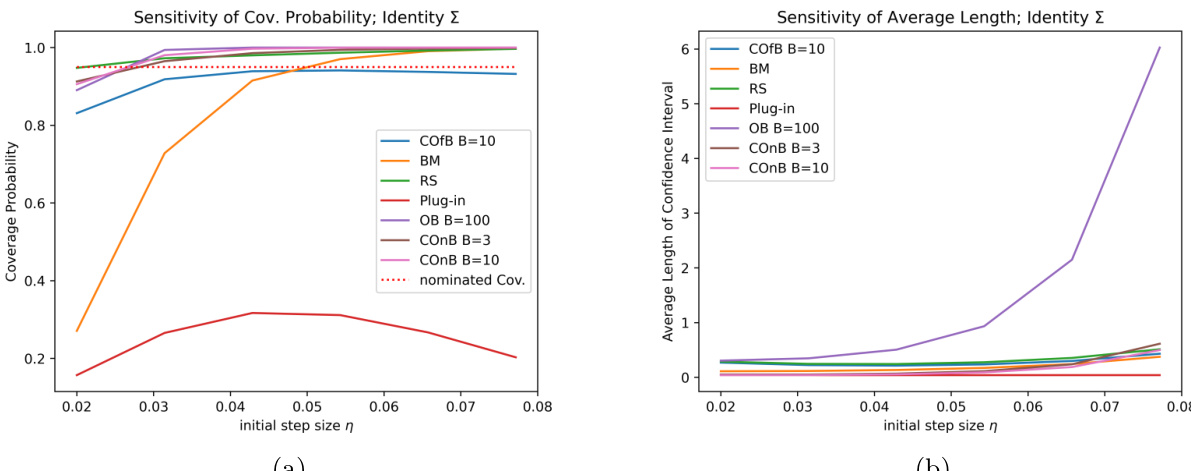
- Sensitivity analysis confirms that the proposed methods maintain stable coverage probabilities regardless of the initial step size, unlike the batch mean method which requires careful tuning, and the delta method which fails to provide valid intervals under varying step sizes.
- Experiments in sparse linear regression settings verify that the approach correctly identifies non-zero coefficients with near-nominal coverage while producing singleton intervals for zero coefficients, effectively handling model selection uncertainty.
- Robustness tests reveal that while the methods perform well under well-conditioned curvature and various learning rate schedules, performance degrades in extreme ill-conditioned scenarios, leading to wider intervals and reduced coverage accuracy.