Command Palette
Search for a command to run...
PageRank sensible aux thématiques
PageRank sensible aux thématiques
Taher H. Haveliwala
Résumé
Dans l'algorithme PageRank original, destiné à améliorer le classement des résultats de requêtes de recherche, un unique vecteur PageRank est calculé, en exploitant la structure des liens du Web, pour capturer l'« importance » relative des pages Web, indépendamment de toute requête de recherche particulière. Afin d'obtenir des résultats de recherche plus précis, nous proposons de calculer un ensemble de vecteurs PageRank, biaisés à l'aide d'un ensemble de thématiques représentatives, afin de capturer plus fidèlement la notion d'importance par rapport à une thématique particulière. En utilisant ces vecteurs PageRank biaisés (pré-calculés) pour générer, au moment de la requête, des scores d'importance spécifiques à la requête pour les pages, nous montrons que nous pouvons produire des classements plus précis qu'avec un unique vecteur PageRank générique. Pour les requêtes de recherche ordinaires par mots-clés, nous calculons les scores PageRank sensibles aux thématiques des pages satisfaisant la requête en utilisant la thématique des mots-clés de la requête. Pour les recherches effectuées en contexte (par exemple, lorsque la requête est formulée en surlignant des mots dans une page Web), nous calculons les scores PageRank sensibles aux thématiques en utilisant la thématique du contexte dans lequel la requête a été formulée.
One-sentence Summary
Stanford University researchers propose Topic-Sensitive PageRank, which computes a set of topic-biased PageRank vectors instead of a single generic one, enabling query-specific importance scores that yield more accurate search rankings by leveraging query keywords or surrounding context to select the appropriate biased vector.
Key Contributions
-
Topic-sensitive PageRank vectors are introduced by biasing PageRank with representative topics, modeling page importance with respect to specific subjects rather than a single query-independent global vector.
-
Sixteen topic-sensitive PageRank vectors are generated offline from Open Directory Project categories, then combined at query time as a weighted linear combination based on similarity between query keywords, available user context, and each topic.
-
The approach handles ordinary keyword search and context-based search by using query keywords or surrounding context for topic scores, producing more accurate rankings than a single generic PageRank vector while keeping query-time costs close to ordinary PageRank through offline precomputation.
Introduction
Link-based ranking uses Web hyperlinks to estimate page importance and improve search relevance, but a page’s authority often depends on topic and context. Prior approaches face a cost-quality tradeoff: HITS adapts to queries but needs expensive query-time computation on limited link neighborhoods, while global PageRank is efficient but ignores query-specific authority; more adaptive PageRank variants can be expensive to compute and store. The authors address this by precomputing a small set of topic-biased PageRank vectors from representative Open Directory categories, then at query time matching the query, user history, or browsing context to those topics and combining the vectors for a context-sensitive importance score with low query-time overhead.
Method
The authors leverage PageRank as the core link analysis framework and then extend it with topic-conditioned personalization so that a page’s importance score depends on the topical intent of the query. In standard PageRank, the importance of a page is propagated through the link graph. If page u links to page v, then u transfers part of its importance to v. If Nu is the outdegree of page u and Rank(u) denotes the PageRank value of page u, then one iteration of the algorithm updates the score of page v as
Ranki+1(v)=u∈Bv∑NuRanki(u),where Bv is the set of pages that point to v. This iterative process can be expressed as an eigenvector computation over the stochastic transition matrix M of the Web graph:
Rank=M×Rank.In practice, a damping vector p is introduced to guarantee convergence and to reduce the effect of rank sinks. The damped formulation is
Rank=(1−α)M×Rank+αp,where α controls the strength of the personalization vector p. If p is uniform, this recovers ordinary PageRank. The main design choice of the proposed method is to replace the uniform p with nonuniform, topic-specific personalization vectors.
The overall pipeline separates computation into an offline preprocessing stage and an online query-time stage. During offline preprocessing, the authors define a set of basis topics, here taken from the top-level categories of an open directory taxonomy. Each basis topic corresponds to a collection of manually organized URLs. For topic cj, let Tj be the set of URLs listed under that topic. The authors construct a topic-specific personalization vector vj by assigning probability mass uniformly to the pages in Tj and zero to all other pages:
vji={∣Tj∣10if i∈Tj,if i∈/Tj.Using this vector in the damped PageRank equation yields a topic-biased PageRank vector, denoted
PR(α,vj).The offline module therefore computes one biased PageRank vector for each basis topic. These vectors are not obtained by postprocessing a single global PageRank vector. Instead, the topic information is injected directly into the iterative rank propagation process, so pages that are strongly connected to the documents associated with a topic receive amplified importance under that topic-specific ranking.
In parallel, the authors compute topic language model statistics for the basis topics. For each topic cj, they build a term vector Dj, where Djt records the total number of occurrences of term t in the documents associated with that topic. This statistic is later used to estimate the topical affinity of a query or query context.
At query time, the system combines the precomputed topic-sensitive PageRank vectors into a single query-sensitive importance score. The input is a query q, optionally augmented with contextual information q′. For example, if a user issues a query after highlighting a term in a Web page, the context q′ can include the terms in that page. If no additional context is available, then q′=q.
The online module first estimates the probability that the query context belongs to each basis topic. Using a unigram language model with maximum likelihood estimates, the topic posterior is computed as
P(cj∣q′)∝P(cj)i∏P(qi′∣cj).The term probability P(qi′∣cj) is derived from the corresponding topic term vector Dj. The prior P(cj) may be uniform for general-purpose retrieval, but the authors note that it can also be personalized by using a user-specific prior Pk(cj) that reflects the interests of user k.
After estimating these topic weights, the system retrieves candidate documents that match the original query terms using a text index. For each retrieved document d, the system looks up its score in each precomputed topic-sensitive PageRank vector. Let rankjd be the PageRank score of document d under topic cj. The final query-sensitive importance score for document d is the weighted sum
sqd=j∑P(cj∣q′)⋅rankjd.The result list is then ranked according to sqd. This composite score favors pages that are both textually relevant to the query and structurally important with respect to the topics inferred from the query context.
The linear combination of topic-specific PageRank vectors has a useful equivalent interpretation. If weights wj are chosen such that ∑jwj=1, then
j∑[wjPR(α,vj)]=PR(α,j∑[wjvj]).Thus, a query-time mixture of already-computed topic-sensitive PageRank vectors is equivalent to computing a single PageRank vector whose personalization vector is the corresponding mixture of topic-specific personalization vectors. This gives the method an efficient architecture: the expensive PageRank computations are performed offline for a fixed set of basis topics, while the online stage only needs to estimate topic weights and combine stored scores.
The resulting computation can also be viewed through the random surfer model. With probability 1−α, the surfer follows an outgoing link uniformly. With probability α, the surfer jumps to a page selected according to a mixture personalization vector. If topic weights are set as wj=P(cj∣q′), then the surfer jumps into topic cj with probability αP(cj∣q′), and within that topic chooses a page from Tj uniformly. The long-term visit probability of a page under this modified random walk is exactly the composite score produced by the query-sensitive ranking formula.
The framework also supports multiple sources of context. Context may come from the page containing a highlighted query term, from a user’s recent query history, from a directory category being browsed, or from longer-term user signals such as bookmarks or browsing patterns. Rather than constructing a raw personalization vector directly from these signals, the system translates each context into weights over the basis topics. This mediated representation provides several design advantages: the system can handle different kinds of context uniformly, topic weights remain interpretable, and privacy-sensitive context can be summarized locally into topic weights before being sent to a server.
A possible refinement of the offline component is to avoid relying only on manually selected pages when defining topic personalization. Instead, a classifier can be trained on the basis-topic data to assign topic weights to pages across the Web. If wij denotes the weight of page i for topic cj, the topic-specific personalization vector can be defined as
vji=∑kwkjwij.This makes the topic-sensitive PageRank computation less dependent on the exact set of URLs assigned to each topic and potentially more robust to idiosyncratic judgments in the original topic data.
Experiment
Experiments using a large Web crawl and test queries evaluate topic-sensitive PageRank through ranking similarity measures and a user study. The results show that different topically biased ranking vectors produce substantially different rankings, while the bias factor has limited effect when chosen reasonably. Query-sensitive scoring based on the most relevant topics achieves better user preference and precision than ordinary PageRank, and using page context can further disambiguate query terms and select the appropriate topic vector.
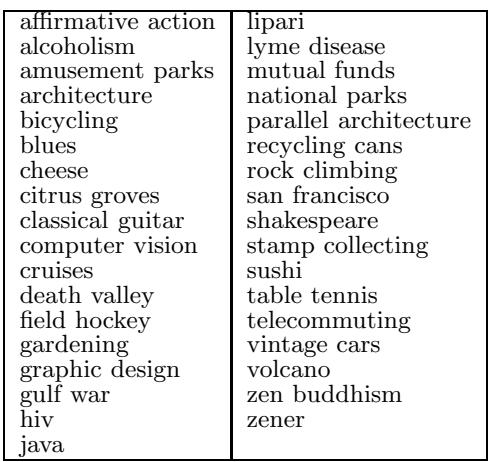
The table lists the sample queries used to evaluate topic-sensitive PageRank, covering a diverse range of topics such as arts, health, sports, travel, and technology. The surrounding results indicate that topic-sensitive ranking produced more relevant search results than ordinary PageRank for these queries. The query set spans many different subject areas, supporting tests of topic-sensitive ranking across varied search needs. Topic-sensitive PageRank showed improved retrieval effectiveness and stronger user preference compared with unbiased PageRank.
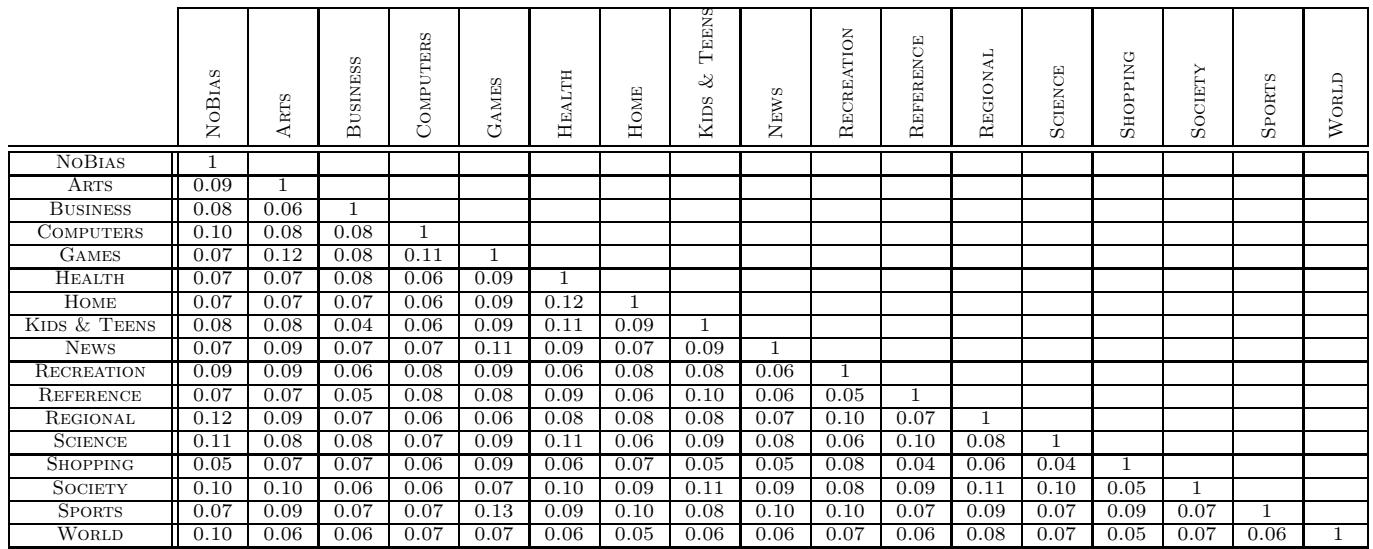
The comparison shows that rankings induced by topically biased PageRank vectors differ substantially from one another. Pairwise similarities between rankings built with different topic biases are low and close to zero. This indicates that the chosen topic vector strongly affects which URLs are ranked highly and how the resulting list is ordered. Different topically biased rankings show little overlap with one another. Unbiased PageRank rankings also show low agreement with topic biased rankings. The topic bias leads to substantially different relative orderings rather than only minor ranking changes.
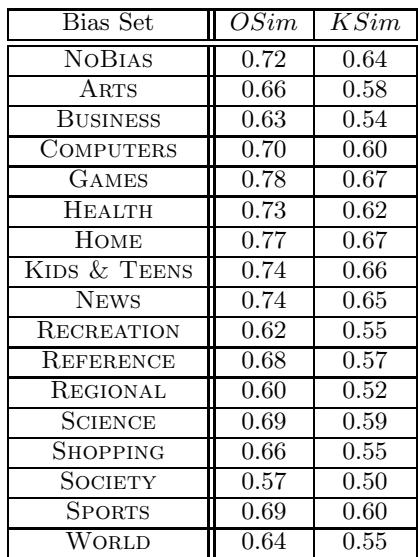
The table compares ranking similarity when the PageRank bias factor is changed between a small and a moderate value. Across bias sets, the top result overlap and rank agreement remain high, showing that the rankings are relatively insensitive to this parameter choice. Differences caused by the bias factor are therefore much smaller than differences caused by using different topically biased vectors. Rankings induced by the two bias factor settings show high overlap across bias sets. KSim values indicate generally good agreement on the relative ordering of the top results. Games, Home, and Health show the strongest stability when the bias factor changes. Arts and Business show somewhat lower agreement than other bias sets.
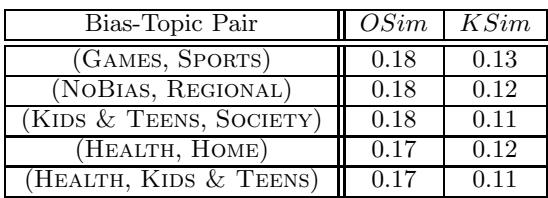
Several topic pairs produced notably similar ranking behavior, suggesting that related domains can induce comparable result orderings. Pairs such as Games and Sports, and Health with Home or Kids and Teens, appeared among the most similar, while the unbiased ranking also aligned closely with a regional topic. Two similarity measures showed broadly consistent findings, though their scores did not always match in magnitude. Games and Sports formed one of the most similar topic pairs under both measures Health-based rankings showed similarity to both Home and Kids and Teens rankings The unbiased ranking aligned closely with a regional topic ranking The two similarity metrics identified a similar set of closely related topic pairs
For the query bicycling, the example rankings show that the selected topic-sensitive PageRank vector strongly changes the top results. The Sports-biased vector is described as producing a high-quality ranking, while the Shopping-biased vector emphasizes bicycle-related accessory sites. This suggests that topical bias can steer search results toward different interpretations of the same query. Topically biased PageRank vectors produce different top results for the query bicycling. The Sports-biased ranking is noted as high quality for this query. The Shopping-biased ranking promotes bicycle-related accessory sites.

The experiments evaluate topic-sensitive PageRank using a diverse query set spanning topics such as arts, health, sports, travel, and technology. They show that the chosen topic bias strongly reshapes rankings, producing results that are substantially more relevant and preferred than those from unbiased PageRank. Additional comparisons indicate that related topics yield more similar rankings, while changing the PageRank bias factor has only a minor effect.