Command Palette
Search for a command to run...
Définir et détecter les vulnérabilités dans les directives d'évaluation humaine : une étude préliminaire vers une évaluation fiable du NLG
Définir et détecter les vulnérabilités dans les directives d'évaluation humaine : une étude préliminaire vers une évaluation fiable du NLG
Jie Ruan Wenqing Wang Xiaojun Wan
Résumé
L'évaluation humaine constitue l'étalon-or pour évaluer la qualité des systèmes de génération de langage naturel (NLG). Pourtant, les directives d'évaluation, en tant qu'élément central garantissant une évaluation humaine fiable et reproductible, ont reçu une attention limitée. Notre investigation a révélé que seuls 29,84 % des articles récents impliquant une évaluation humaine dans les grandes conférences publient leurs directives, et que des vulnérabilités ont été identifiées dans 77,09 % de ces directives. Des directives d'évaluation peu fiables peuvent produire des résultats d'évaluation inexacts, susceptibles d'entraver les progrès du domaine du NLG. Pour répondre à ces défis, nous faisons un premier pas vers des directives d'évaluation fiables en proposant le premier jeu de données de directives d'évaluation humaine, en collectant des annotations de directives extraites d'articles existants ainsi que générées par de grands modèles de langage (LLM). Nous introduisons ensuite une taxonomie de huit vulnérabilités et formulons un principe pour la rédaction de directives d'évaluation. De plus, une méthode de détection des vulnérabilités des directives a été explorée à l'aide de LLM, et nous proposons un ensemble de recommandations pour améliorer la fiabilité de l'évaluation humaine. Le jeu de données annoté de directives d'évaluation humaine et le code de la méthode de détection des vulnérabilités sont disponibles en ligne.
One-sentence Summary
Peking University researchers introduce the first human evaluation guideline dataset, including a taxonomy of eight vulnerabilities and an LLM-based detection method, revealing that 77.09% of existing NLG evaluation guidelines are vulnerable in order to enhance the reliability of human evaluation for NLG systems.
Key Contributions
- The paper releases the first annotated human evaluation guideline dataset, built from guideline excerpts extracted from published papers and examples generated by large language models, and makes the dataset and vulnerability-detection code publicly available.
- A taxonomy of eight guideline vulnerabilities and a principle for composing reliable evaluation guidelines are introduced to define concrete flaws and guide robust guideline construction.
- An LLM-based detection method is explored using few-shot prompting and chain-of-thought reasoning, with recommendations for using the detector to assess guideline reliability before conducting human evaluations.
Introduction
Natural Language Generation often relies on human evaluation because automated metrics can correlate poorly with human judgments, making clear evaluation guidelines essential for reliable and reproducible assessment. Prior work treats human evaluation as a gold standard but rarely examines or releases the guidelines used by annotators, and existing vulnerability detection work does not address flaws in these evaluation instructions. The authors analyze papers from major NLP conferences and find that few evaluation guidelines are released, while many released guidelines contain vulnerabilities such as ambiguity, bias, unclear ratings, and inflexible instructions. Their main contribution is a taxonomy of eight guideline vulnerability types, the first annotated dataset of human evaluation guidelines, and an LLM based method using chain of thought prompting to detect guideline weaknesses and support more reliable evaluation practices.
Dataset
-
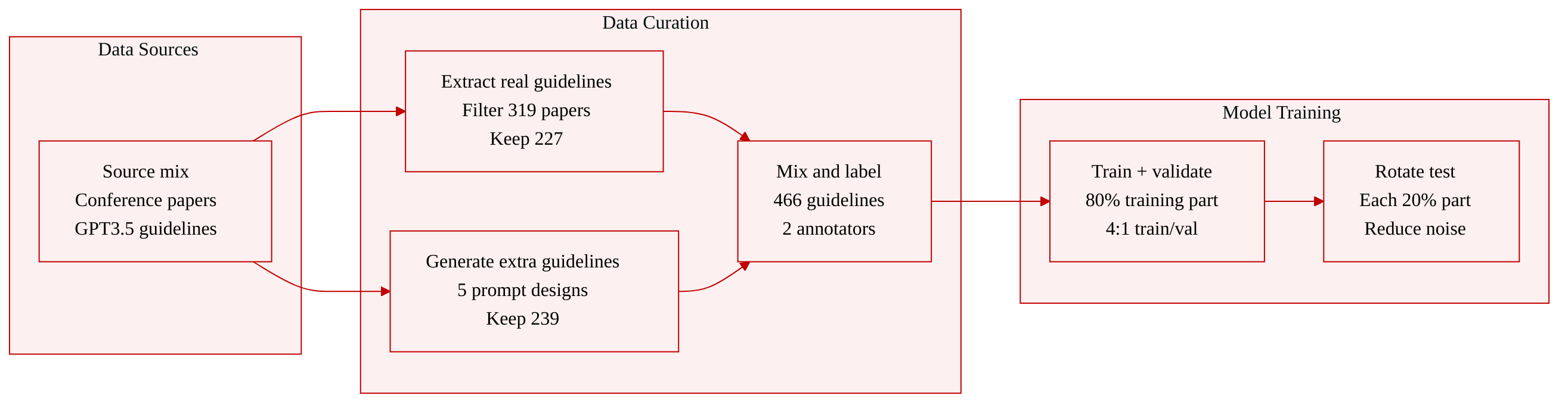
The authors construct the dataset because no existing resource directly evaluates human evaluation guidelines. The dataset combines authentic guidelines extracted from published papers and synthetic guidelines generated by GPT3.5 Turbo.
-
Authentic subset: papers are crawled from ACL, EMNLP, and NAACL from 2020 to 2022, yielding 3,233 raw papers. Keyword filtering uses terms such as human evaluation, manual assessment, guideline, instruction, questionnaire, interface, and screenshot to isolate 677 evaluation related papers and narrow the candidate paper set to 319. After manual filtering for NLG tasks, the authors extract 227 guidelines: 111 from ACL, 62 from EMNLP, and 54 from NAACL. Guidelines originally shown as figures or charts are converted into textual form.
-
Synthetic subset: the authors use five prompt designs for GPT3.5 Turbo, including raw prompts, raw prompts with evaluation aspects, structured prompts, structured prompts with evaluation aspects, and structured prompts with evaluation aspects and constraints. Each prompt covers 12 NLG tasks, 2 evaluation settings, and alternating keywords instruction and guideline, producing 48 guidelines per prompt. The final synthetic set contains 239 generated guidelines.
-
Final composition: the dataset contains 466 human evaluation guidelines in total, with 227 authentic guidelines and 239 synthetic guidelines. The average length is 247.64 words for authentic guidelines and 237.05 words for synthetic guidelines.
-
Schema and metadata: each sample is a guideline text associated with source information, such as authentic or synthetic origin, and annotation labels. Synthetic guidelines can also be traced to prompt type, NLG task, evaluation setting, and keyword choice. The dataset is annotated against eight vulnerability types: ethical issues, unconscious bias, ambiguous definition, unclear rating, edge cases, prior knowledge, inflexible instructions, and others. A None label is assigned when no vulnerability is present.
-
Annotation process: four qualified English proficient annotators label the guidelines. Authentic and synthetic guidelines are randomly mixed in the annotation interface to reduce source bias. Each guideline is annotated by two annotators, and a third annotator resolves disagreements. The dataset underwent batch assignment, daily review, and reannotation when daily accuracy was below 80 percent. Cohen kappa agreement between annotators is 0.722 for authentic guidelines and 0.737 for synthetic guidelines.
-
Processing details: no cropping strategy is reported. Main processing steps include keyword filtering, manual filtering of relevant NLG papers, guideline extraction, conversion of visual guideline elements into text, synthetic expansion through prompt templates, and annotation quality control.
-
Dataset usage: the authors divide the full dataset into five parts, with four parts used for training, 80 percent, and one part used for testing, 20 percent. The training portion is further split into train and validation sets in a 4 to 1 ratio. Each of the five parts is then used as a test set in turn while the remaining parts are used for training, so the full dataset contributes to evaluation and performance variance is reduced.
Method
The synthetic guideline generation module treats guideline construction as a prompt controlled generation workflow. Rather than relying on manually written rules, the authors leverage GPT-3.5-Turbo and design five prompt templates that progressively increase the degree of instruction, structure, evaluation conditioning, and constraint specification. The templates include a raw prompt, a raw prompt with evaluation aspects, a structured prompt, a structured prompt with evaluation aspects, and a structured prompt with both evaluation aspects and constraints. This design allows the generated guidelines to cover different levels of explicitness and formality, which can improve diversity in the resulting synthetic dataset.
The generation process combines prompt template control with combinatorial task expansion. For each prompt template, the authors instantiate different natural language generation tasks and evaluation settings, while alternating between the keywords “instruction” and “guideline.” The combination of 12 NLG tasks, 2 evaluation settings, and 2 keyword variants produces a fixed number of guidelines for each prompt template:
Nper prompt=12×2×2=48Across the five prompt templates, this workflow yields a broad synthetic guideline collection in which each guideline is shaped by a specific combination of task domain, evaluation perspective, prompt structure, and keyword phrasing. The use of evaluation aspects introduces assessment-oriented context, while the structured and constrained templates push the language model toward more organized and rule-like outputs. This modular prompt-based generation design makes it possible to systematically expand the raw guideline dataset while controlling both diversity and formatting consistency.
Experiment
The experiments treat guideline vulnerability detection as a multi-label classification task, comparing open and closed source LLMs, Transformer baselines, and zero shot and few shot prompting strategies across rotated training and testing splits. Case studies show that closed source models can provide useful reasoning, whereas open source models often produce invalid outputs, and the quantitative analysis confirms that few shot examples and Chain-of-Thought prompting generally improve detection. Overall, Text Davinci 003 with the CoT VDesc strategy is validated as the most effective setup, while results also show that synthetic guidelines are easier to audit than authentic ones and that model performance still varies across vulnerability types.
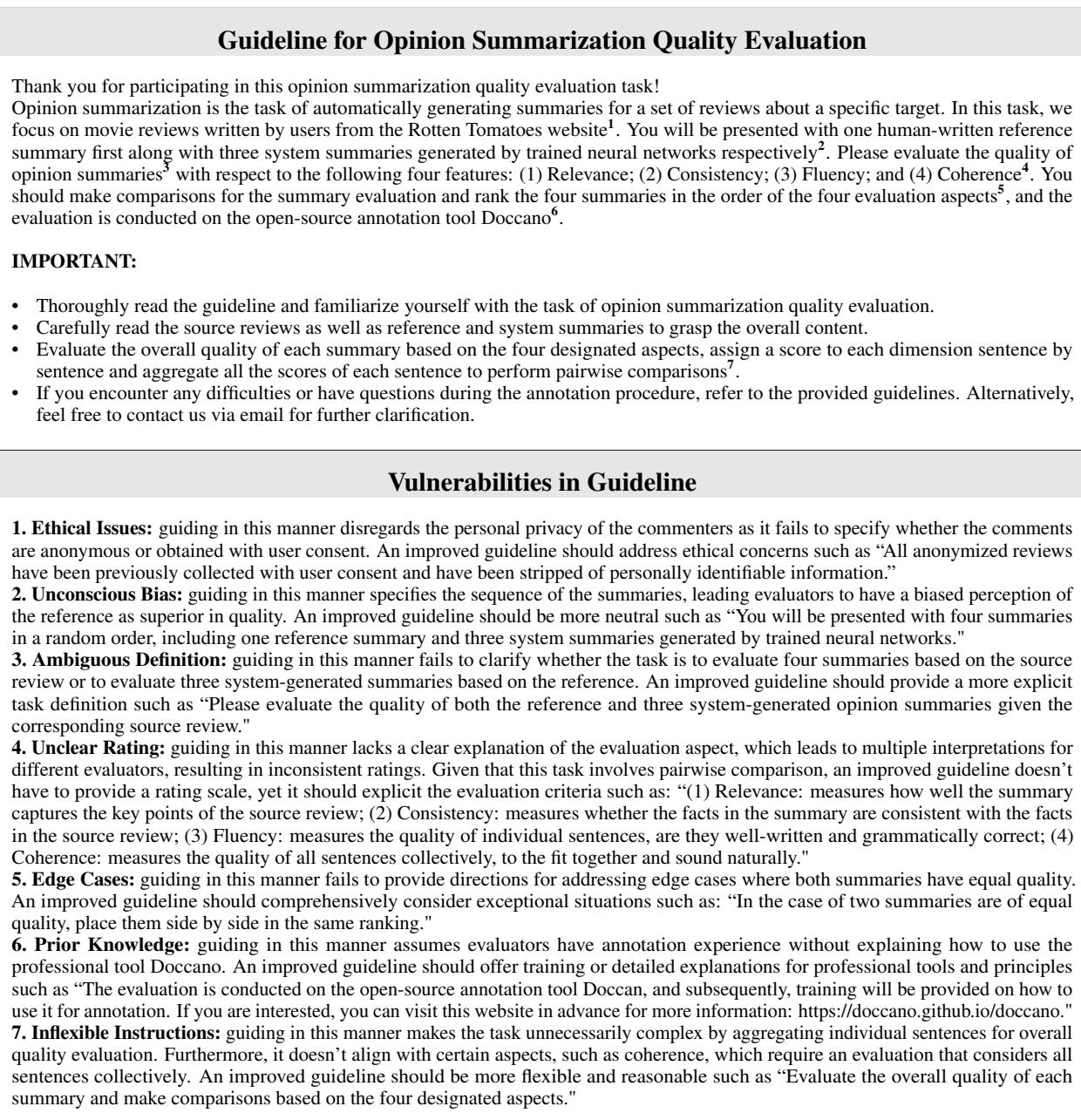
This illustration presents a taxonomy of guideline vulnerabilities in human evaluation instructions. It pairs a sample opinion summarization evaluation guideline with vulnerability diagnoses and suggested revisions for issues such as ethical oversight, ordering bias, unclear definitions, vague criteria, missing tie handling, insufficient tool instructions, and overly rigid procedures. The examples show that clearer, more neutral, and more explicit guidelines can reduce annotation ambiguity and bias. Sample vulnerabilities include privacy concerns, biased presentation order, ambiguous task scope, unclear rating definitions, missing edge-case guidance, assumed annotation tool knowledge, and inflexible aggregation of sentence scores. Each vulnerability is paired with a recommended revision that specifies consent and anonymization, random ordering, explicit task scope, concrete evaluation criteria, tie handling, tool training, and more flexible overall-quality comparison.
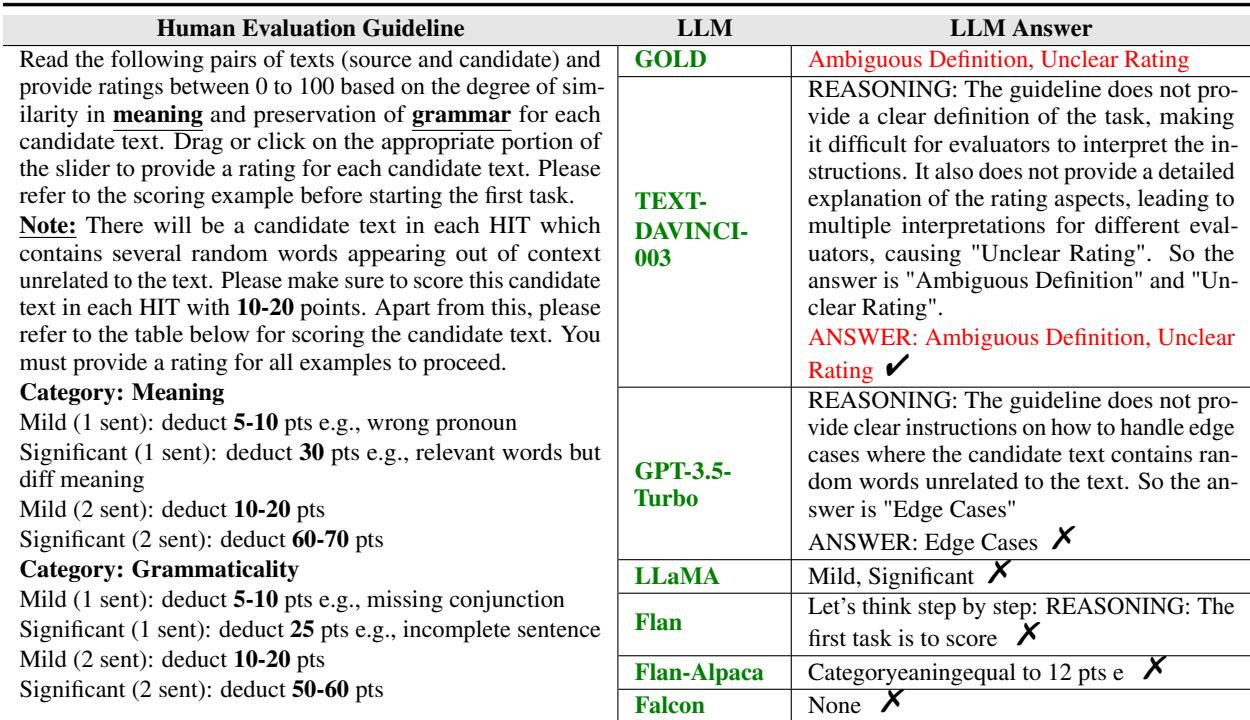
In the few-shot CoT example, TEXT-DAVINCI-003 correctly identifies Ambiguous Definition and Unclear Rating for the human evaluation guideline. Its reasoning also narrows the scope of the vulnerabilities, making them easier to correct. GPT-3.5-Turbo instead returns Edge Cases despite the guideline already describing how to handle unrelated random words, and the open-source models fail to produce valid vulnerability answers. TEXT-DAVINCI-003 produces the correct vulnerability types with usable reasoning GPT-3.5-Turbo misclassifies the guideline as having Edge Cases, while open-source models output unstructured or empty responses
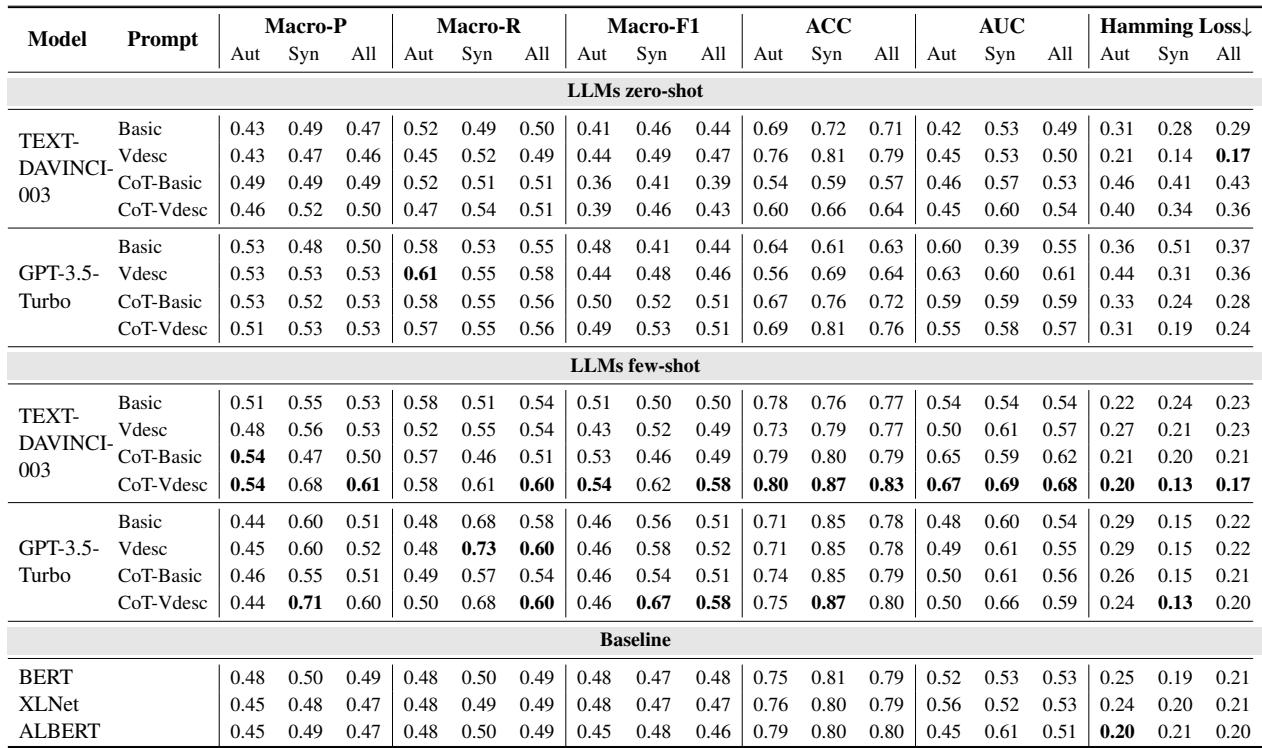
LLMs generally outperform pretrained baselines for guideline vulnerability detection, especially when using few-shot prompting and chain-of-thought strategies. TEXT-DAVINCI-003 with the CoT-Vdesc strategy is the strongest overall setup, while GPT-3.5-Turbo performs comparably and some pretrained models remain competitive in zero-shot settings without chain-of-thought. Models tend to detect synthetic guidelines more effectively than authentic guidelines, and recall is usually higher than precision, indicating a bias toward labeling guidelines as non-vulnerable. TEXT-DAVINCI-003 with CoT-Vdesc few-shot prompting gives the best overall detection performance. LLM-based models consistently beat pretrained baselines across most prompt strategies. Synthetic guidelines are detected more easily than authentic guidelines. Recall usually exceeds precision, showing a tendency to miss vulnerabilities by predicting no vulnerability.
The experiments evaluate a taxonomy of vulnerabilities in human evaluation guidelines, using guideline examples, qualitative revisions, and prompt-based detection tests. They show that more explicit, neutral, and structured instructions can reduce ambiguity and bias, while well prompted large language models, especially with few-shot chain of thought, are generally more effective than pretrained baselines at identifying vulnerability types. However, detection remains imperfect, with authentic guidelines more challenging than synthetic ones and tendencies toward imbalanced or conservative vulnerability judgments.