Command Palette
Search for a command to run...
Débattre avec des LLM plus persuasifs conduit à des réponses plus véridiques
Débattre avec des LLM plus persuasifs conduit à des réponses plus véridiques
Akbir Khan John Hughes Dan Valentine Laura Ruis Kshitij Sachan Ansh Radhakrishnan Edward Grefenstette Samuel R. Bowman Tim Rocktaschel Ethan Perez
Résumé
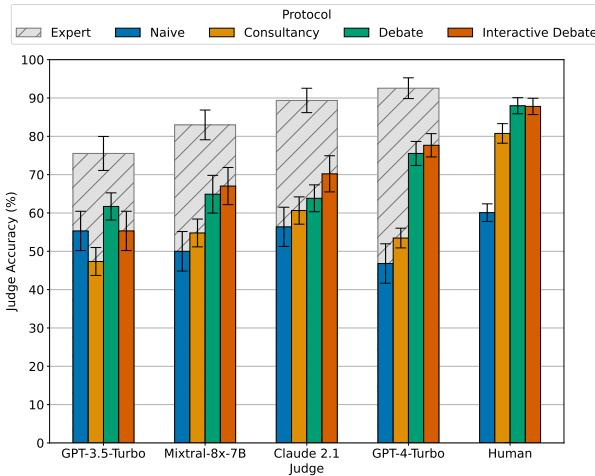
Les méthodes courantes d'alignement des grands modèles de langage (LLM) sur un comportement souhaité reposent fortement sur des données annotées par des humains. Toutefois, à mesure que les modèles deviennent de plus en plus sophistiqués, ils dépasseront l'expertise humaine, et le rôle de l'évaluation humaine évoluera vers un paradigme où des non-experts supervisent des experts. En anticipation de cette évolution, nous nous posons la question suivante : des modèles plus faibles peuvent-ils évaluer la justesse des réponses de modèles plus forts ? Nous étudions cette question dans un cadre analogique, où des modèles plus forts (experts) disposent des informations nécessaires pour répondre aux questions et des modèles plus faibles (non-experts) sont dépourvus de ces informations, mais sont par ailleurs tout aussi capables. La méthode que nous évaluons est le débat, dans lequel deux experts LLM argumentent chacun en faveur d'une réponse différente, et un non-expert sélectionne la réponse. Sur la tâche de compréhension QuALITY, nous constatons que le débat aide de manière cohérente à la fois les modèles non-experts et les humains à répondre aux questions, atteignant respectivement 76 % et 88 % de précision (les lignes de base naïves obtiennent 48 % et 60 %). De plus, l'optimisation des débatteurs experts pour la persuasivité de manière non supervisée améliore la capacité des non-experts à identifier la vérité dans les débats. Nos résultats fournissent des preuves empiriques encourageantes quant à la viabilité de l'alignement des modèles par le débat en l'absence de vérité de référence.
One-sentence Summary
The authors introduce LLM debate, in which two expert models argue for different answers and a non-expert selects the correct one, and show that unsupervised optimization of expert persuasiveness improves non-expert truth identification on QuALITY, achieving 76% and 88% accuracy for non-expert models and humans respectively.
Key Contributions
-
The paper introduces an information-asymmetric debate protocol for scalable oversight, where stronger LLM experts with source information debate alternative answers while weaker non-experts judge. On QuALITY, debate raises non-expert LLM judge accuracy to 76% and human judge accuracy to 88%, compared with 48% and 60% for naive baselines.
-
Optimising LLM debaters for persuasiveness in an unsupervised manner improves a judge’s ability to identify the correct answer. Inference-time methods such as best-of-N and critique-and-refinement make persuasive debaters more effective at arguing for the correct answer, and the benefit generalises to unseen judges.
-
The results show that debate outperforms single-model consultancy and yields better calibrated human oversight. Human judges reach 88% accuracy with debate versus 78% with consultancy, LLM judges reach 76% versus 54%, and debate improves accuracy across rejection thresholds while producing better calibration.
Introduction
Aligning increasingly capable language models is difficult because many methods depend on labeled data or expert ground truth, and as model performance surpasses human expertise, those labels may become unavailable. Prior scalable-oversight ideas, including debate, suggest that judging or critiquing an answer may be easier than generating it, but evaluating critiques remains challenging, and earlier debate work often used human debaters or restricted argument generation. The authors contribute an information-asymmetric debate setup for reading comprehension, where expert debaters access source text and use quoted evidence while weaker human or model judges lack the text and decide using debate arguments. They introduce persuasiveness, optimize debaters for judge approval with inference-time methods, and show that debate lets weak judges supervise stronger debaters better than single-expert consultancy, while improving calibration and generalizing to unseen model judges.
Method
The authors operationalize the oversight problem as an information-asymmetric question answering setting. An expert model, referred to as a debater or consultant, has access to the underlying long fiction text and can argue for one of two candidate answers. A non-expert judge cannot read the text and must rely only on the information exposed through the protocol. For each question, the system compares one correct answer against the best distractor, producing a balanced binary choice. The judge’s task is to identify the correct answer using only the protocol transcript and any verified evidence presented by the expert.
Refer to the framework diagram.
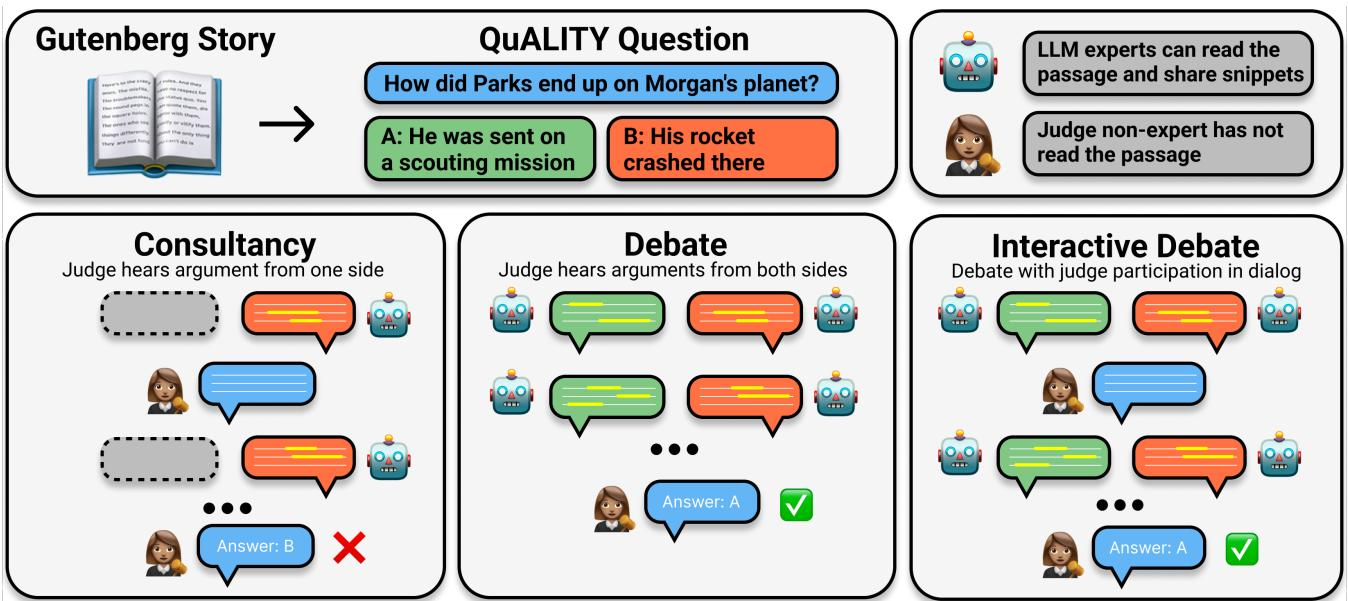
The pipeline consists of three main oversight protocols: debate, interactive debate, and consultancy. In the debate protocol, two expert models are assigned opposing answers and argue simultaneously for a fixed number of rounds. A transcript accumulates all arguments, and at the end of the debate a judge reads the transcript and selects one answer. The protocol is adversarial because each debater tries to persuade the judge to choose the assigned answer while undermining the opponent’s claims. At the start of each round, debaters receive prompts containing the rules of the game, their assigned answer, and the current transcript.
Interactive debate extends debate by allowing the judge to participate after each round. The judge can highlight unresolved subproblems, request clarification, or direct questions to either debater. These judge-generated statements are appended to the transcript and become visible to all participants in later rounds. This design gives the judge a more active role in eliciting relevant information rather than only evaluating passive arguments.
The consultancy baseline uses a single expert model instead of two. The consultant is assigned a specific answer and tries to persuade the judge that this answer is correct, while the judge asks probing questions to reveal information about the text. Consultancy is run for both the correct and incorrect candidate answers, preserving the same 50/50 prior used in debate.
The expert models are equipped with a quotation verification tool. During an argument, a model can insert text snippets inside quote tags. If the quoted snippet exactly matches a portion of the underlying passage, the tool marks it as verified; otherwise, it is marked unverified. The judge is instructed to trust only verified quotes. This module is intended to anchor arguments in factual text fragments and reduce ungrounded persuasion.
The experimental framework controls the amount of information presented to the judge. Protocols run for three rounds, and transcripts are limited to a fixed total length. Consultant arguments and debater arguments have separate word limits to account for the different number of speakers and to reduce verbosity bias. Expert models use an egocentric transcript view, where their own arguments appear first, and they may also use a hidden scratchpad that is not visible to the judge or other players.
To create a wide range of debater and consultant capabilities, the authors add inference-time optimization modules rather than relying only on base model performance. In best-of-N sampling, a model generates multiple candidate arguments, and a preference model selects the argument judged most persuasive. The preference model is optimized for judge feedback and uses language model log probabilities to score outputs. In critique-and-refinement, another model produces multiple critiques of an initial argument, a preference model grades the critiques, and the selected critique is used to refine the final answer. These modules allow the authors to generate debaters with different persuasive strengths for studying how oversight protocols scale with expert capability.
The evaluation system uses both LLM judges and human judges. LLM judging can introduce positional and verbosity biases, so the framework mitigates these issues by running each debate twice with the debater order swapped and by enforcing strict transcript length limits. Human judges interact with a web interface that shows only the question, transcript, and answer choices. They undergo a training phase and are filtered based on agreement with other annotators and the quality of their explanations, without using ground-truth labels as a selection criterion.
To compare many debater models efficiently, the authors use a cross-play tournament. Naively comparing every pair of models would require a quadratic number of matches. Instead, they use a Swiss-style tournament that pairs debaters in a way that produces informative rankings with roughly O(nlogn) matches for n debaters.
The method also introduces unsupervised metrics for measuring debater performance. A debate match is defined by two debaters, two candidate answers, and one judge. The win rate is the frequency with which a judge selects a particular debater’s answer:
ω1(D1,D2,J)=N1i=1∑N1{J(qi,ai1,ai2)=ai1}.Because some answer assignments may be easier to defend than others, the framework flips answer assignments across debaters and averages the resulting win rates. If the assignment-flipped win rate satisfies
ωˉ1(D1,D2,J)>21,then D1 is considered more persuasive than D2.
To obtain a general persuasiveness ranking, the authors fit an Elo-style latent skill parameter to aggregate win rates. Each debater receives a rating, and the expected win rate between two debaters D1 and D2 is
ωˉ1(D1,D2,J)=1+10(E2−E1)/4001.This Elo rating can be computed without ground-truth labels, making it suitable for unsupervised oversight evaluation.
The framework also measures truthfulness by conditioning on whether a debater was assigned the correct answer. It computes separate correct and incorrect ratings. The correct rating EC reflects persuasiveness when arguing for the true answer, while the incorrect rating EI reflects persuasiveness when arguing for a false answer. The conditioned win rate is
ωC(D1,D2,J)=1+10(E2I−E1C)/4001.A large gap between EC and EI indicates that a debater is more effective when supporting correct answers.
Finally, judge accuracy is evaluated over matches between copies of the same model. For debate,
α(D,J)=α(D,D,J).For consultancy, because the judge does not know the consultant’s intended answer, accuracy is averaged over both possible consultant assignments:
α(D1,J)=21(α(D1,−,J)+α(−,D1,J)).Together, the protocol design, quotation verification module, inference-time optimization modules, tournament scheduling, bias mitigation steps, and unsupervised rating metrics form a coherent evaluation pipeline for studying whether non-expert judges can use debate-style oversight to elicit correct answers from stronger expert models.
Experiment
The experiments evaluate an information-asymmetric reading-comprehension setting in which non-expert LLM or human judges must choose answers without access to the source text, while expert models support their arguments using a quote verification tool, testing debate versus consultancy as oversight methods. LLM-judge experiments show that debate outperforms consultancy, benefits from stronger debaters and judges, and becomes more truth-seeking as persuasiveness improves, whereas stronger consultants can disproportionately mislead judges. Human-judge experiments confirm that debate also improves accuracy and confidence calibration over consultancy, while interactive judging offers no clear gain and weak debater arguments remain the main limitation, supporting debate as a robust method for scalable oversight when evidence is verifiable.
The human judge protocols compare static and interactive variants of debate and consultancy, with a human judge serving as the final decision maker in each case. Human evaluation shows debate achieves higher judge accuracy than consultancy in both static and interactive settings, while consultancy is vulnerable to misleading experts. Adding interactive human contact does not improve debate accuracy, suggesting extra interaction does not overcome information asymmetry. Debate produces higher accuracy than consultancy for human judges in both static and interactive protocols Static debate matches interactive debate accuracy, indicating additional human interaction does not help Human judges achieve higher accuracy than LLM judges across protocols Consultancy can lead to low accuracy when experts provide incorrect information
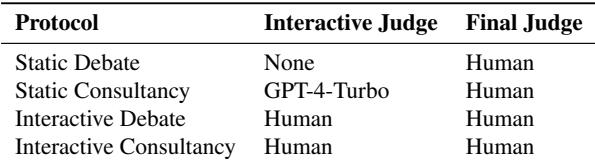
The experiments use human judge protocols to compare static and interactive versions of debate and consultancy, with the human judge making the final decision. They show that debate yields higher judge accuracy than consultancy in both settings, while consultancy can perform poorly when experts are misleading. Interactive debate does not outperform static debate, suggesting additional human interaction alone does not resolve information asymmetry, and human judges are generally more accurate than LLM judges.