Command Palette
Search for a command to run...
MiniLongBench : le banc d'essai à faible coût pour la compréhension de contextes longs dans les grands modèles de langage
MiniLongBench : le banc d'essai à faible coût pour la compréhension de contextes longs dans les grands modèles de langage
Zhongzhan Huang Guoming Ling Shanshan Zhong Hefeng Wu Liang Lin
Résumé
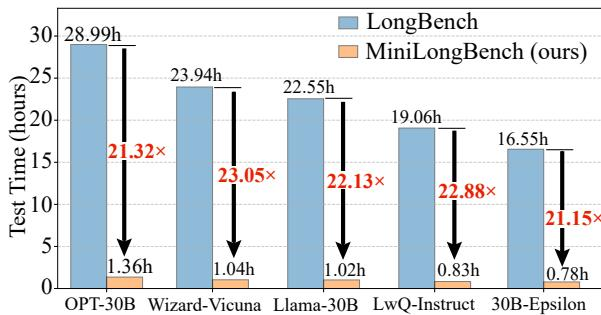
La compréhension de contextes longs (LCU) constitue un axe d'exploration crucial pour les grands modèles de langage (LLM) actuels. Toutefois, en raison de la nature intrinsèquement volumineuse des données textuelles longues, les bancs d'essai existants pour la LCU entraînent souvent des coûts d'évaluation prohibitifs, notamment en termes de temps de test et de dépenses d'inférence. À travers une expérimentation approfondie, nous découvrons que les bancs d'essai LCU existants présentent une redondance significative, ce qui traduit une inefficacité de l'évaluation. Dans cet article, nous proposons une méthode de compression de données concise, adaptée aux données textuelles longues dotées de caractéristiques d'information dispersée. En procédant à l'élagage du banc d'essai LCU bien connu LongBench, nous créons MiniLongBench. Ce banc d'essai ne comprend que 237 échantillons de test répartis sur six grandes catégories de tâches et 21 tâches distinctes. Grâce à une analyse empirique portant sur plus de 60 LLM, MiniLongBench parvient à réduire le coût moyen d'évaluation à seulement 4,5 % de celui de l'original tout en maintenant un coefficient moyen de corrélation des rangs de 0,97 avec les résultats de LongBench. Notre banc d'essai MiniLongBench, en tant que référence à faible coût, présente un fort potentiel pour stimuler considérablement les recherches futures sur les capacités de LCU des LLM. Veuillez consulter notre dépôt GitHub pour le code, les données et le tutoriel.
One-sentence Summary
Sun Yat-sen University and Peng Cheng Laboratory propose MiniLongBench, a compressed long context understanding benchmark created by pruning LongBench with a data compression method tailored for sparse long-text data, reducing evaluation cost to 4.5% of the original while maintaining an average rank correlation coefficient of 0.97 with LongBench results.
Key Contributions
- The paper introduces MiniLongBench, a compact long-context understanding benchmark distilled from LongBench, containing 237 test samples across six major task categories and 21 distinct tasks.
- The paper proposes a concise data compression method for long-text data with sparse information and validates significant redundancy in LongBench through random sampling experiments to enable low-cost testing.
- Empirical evaluation of more than 60 LLMs shows that MiniLongBench maintains an average rank correlation coefficient of about 0.97 with LongBench while reducing evaluation cost to 4.5% of the original.
Introduction
Long-context understanding is important for LLMs because applications such as book and paper summarization, document question answering, and repository-level code generation require models to process thousands or tens of thousands of tokens. Existing long-context benchmarks such as LongBench improve evaluation quality, but they are expensive to run because each example contains many tokens and the benchmark includes many test samples, leading to high GPU time and memory costs. The authors identify significant redundancy in these benchmark samples and propose a compact alternative, MiniLongBench, which prunes long-text evaluation data while preserving model ranking. Evaluated on more than 60 LLMs, MiniLongBench reduces evaluation cost to about 4.5% of LongBench while maintaining an average ranking correlation near 0.97.
Dataset
-
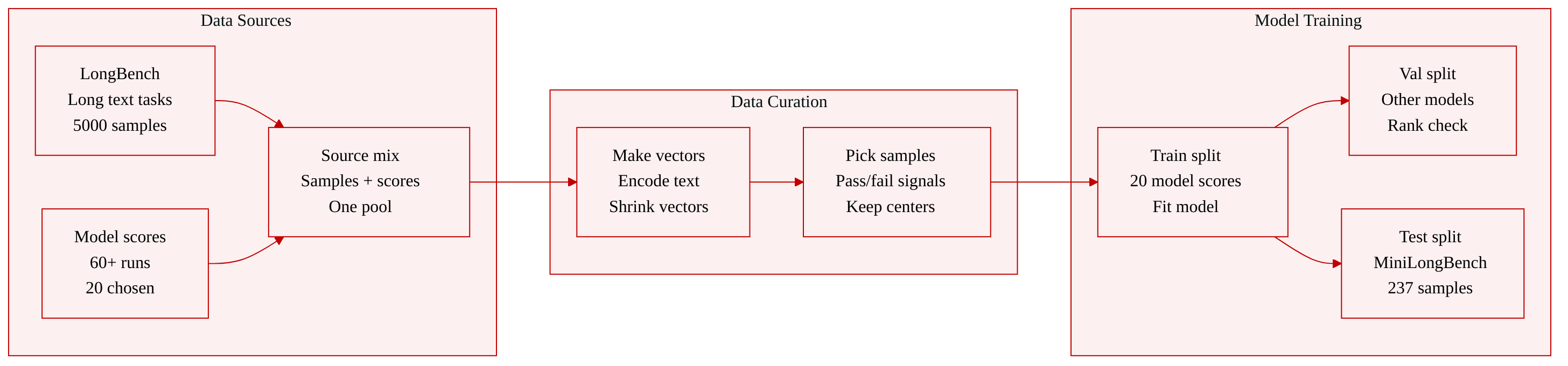
The authors construct MiniLongBench as a compact long-context understanding benchmark from LongBench, a widely used LCU benchmark containing nearly 5000 test samples across six major task categories: single-document question answering, multi-document question answering, summarization, few-shot learning, code completion, and synthetic tasks.
-
MiniLongBench retains the same task diversity as LongBench, covering six major categories and 21 distinct tasks. After compression, it contains 237 test samples, representing an approximate 95% reduction in benchmark size while preserving long-context evaluation coverage.
-
The compressed subset is generated with a compression ratio of p = 0.95. The resulting benchmark has an average input length of 6193 words for English data and 10344 characters for Chinese data, showing that the retained samples still preserve a similar long-context scale despite aggressive pruning.
-
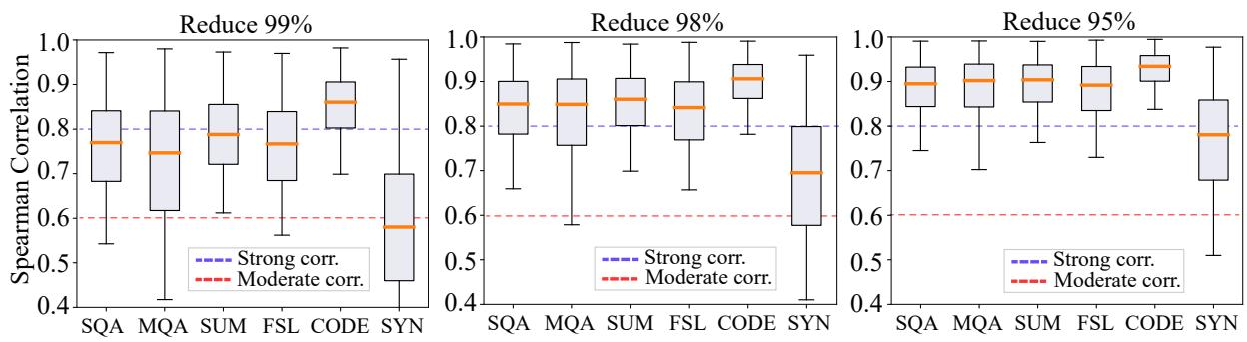
The dataset source is the original LongBench evaluation corpus. The authors first observe through random subsampling experiments that LongBench has high redundancy, because subsets with substantial sample removal can still correlate strongly with the full benchmark ranking results. This motivates a more stable compression procedure.
-
The authors use performance records from language models on LongBench to guide sample selection. More than 60 LLMs are considered overall, and 20 selected LLMs are used to construct MiniLongBench. The remaining LLMs are used for validation. The authors manually choose LLMs with generally strong and broad performance because sample representations depend heavily on model performance records.
-
During dataset construction, the original long-text samples are first embedded using a text encoder and reduced with principal component analysis to obtain denser low-dimensional representations. The paper sets the representation dimension to d = 10.
-
Continuous evaluation metrics from LongBench are converted into binary correctness signals using a threshold search. This allows each sample’s learned representation to reflect whether models succeed or fail on it, which is then used to identify representative samples.
-
The authors cluster the learned sample representations with K-Means and retain cluster centers as the final MiniLongBench test samples. No text cropping or content rewriting is described; the compression is primarily sample-level pruning, where selected cluster centers replace the larger original sample pool.
-
The constructed MiniLongBench is used as a low-cost evaluation set for estimating long-context model capabilities. The authors evaluate it against the full LongBench rankings to show that the compressed benchmark can preserve evaluation effectiveness while substantially reducing input token count and computational cost.
Method
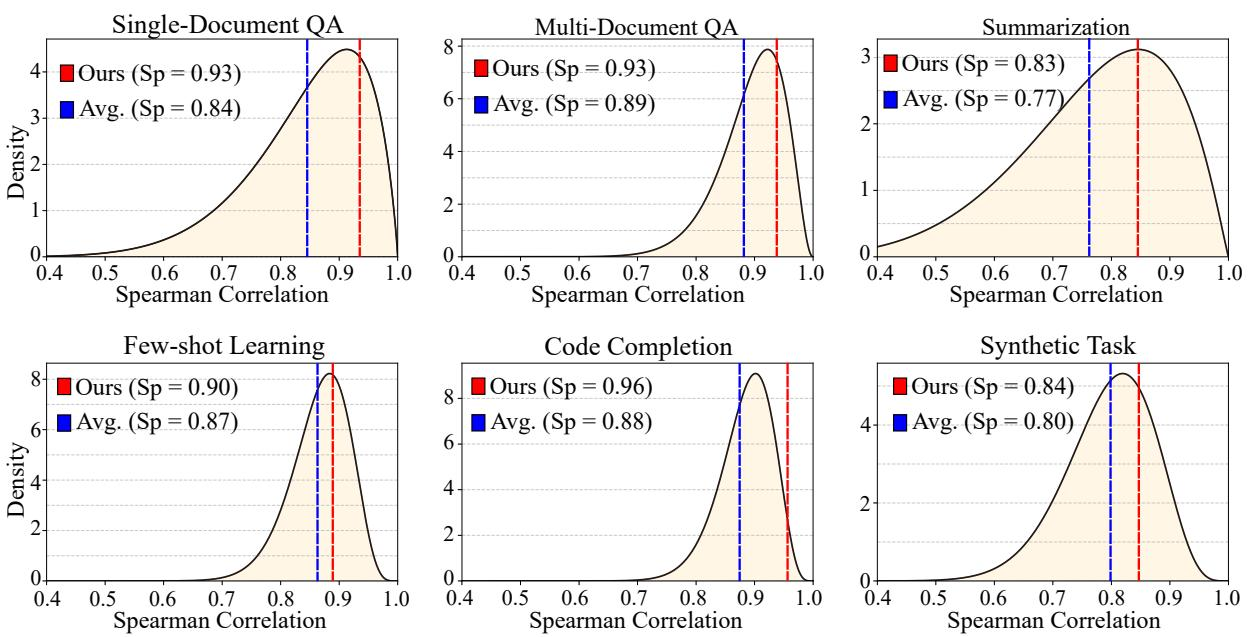
The authors leverage the performance records of a set of LLMs on a long context understanding benchmark to build a smaller and more stable evaluation subset. The starting observation is that many test samples are redundant, and large random reductions can still preserve ranking correlation, but the resulting estimates have high variance. This motivates a deterministic compression process rather than purely random sampling. Refer to the figure below:
The overall method is organized as a three-stage pipeline. It first densifies sparse long-text inputs, then learns sample representations from LLM performance, and finally clusters and prunes samples to obtain a compact benchmark. Refer to the framework diagram:
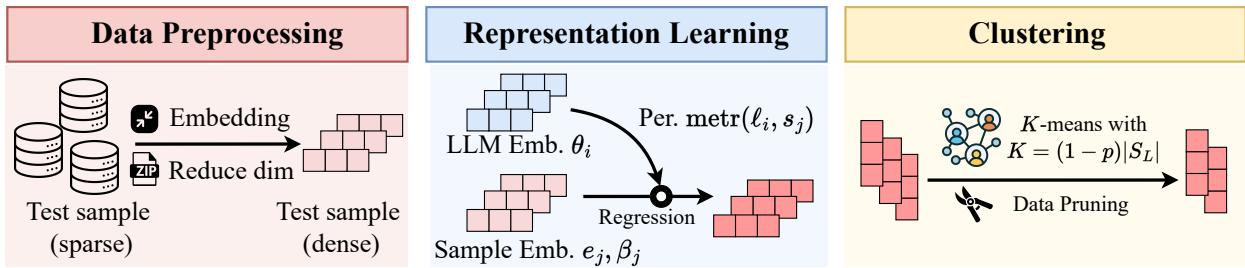
In the data preprocessing stage, long-text samples are highly sparse in effective information. To avoid unstable representation learning, the method first embeds each test sample using a long-context text encoder, such as OpenAIEmbedding, and then applies principal component analysis to obtain a lower-dimensional dense initialization. Given the test set SL={sj}j=1∣SL∣, the initial sample representation is
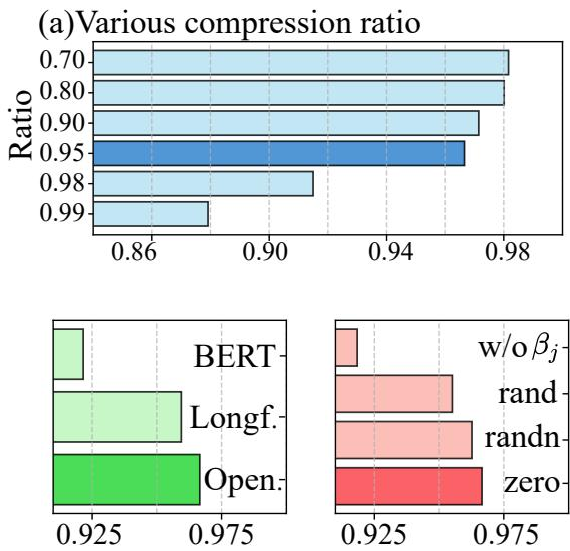
{ej}j=1∣SL∣=PCAd[{κtext(sj)}j=1∣SL∣],where d is set to 10 in the paper. The figure below summarizes related design choices, including the advantage of a long-context text embedding and the use of a learnable sample bias with zero initialization.
After the text-side representation is initialized, the method performs representation learning through a logistic regression formulation inspired by item response theory. For each LLM ℓi and each test sample sj, the probability that the LLM answers the sample correctly is modeled as
P(metr(ℓi,sj)=1∣θi,ej,βj)=[1+exp(−ej⊤θi+βj)]−1.Here, θi is the learnable embedding of LLM ℓi, initialized from a standard normal distribution. The parameters ej and βj are learnable representations of the test sample sj, where ej starts from the dense embedding produced by PCA and βj is initialized to zero.
When the original evaluation metric is continuous, such as an F1 score or edit distance, the method first normalizes the metric and then converts it into a binary label. It selects a threshold c by solving an approximate optimization problem:
cmini=1∑mj=1∑∣SL∣metr(ℓi,sj)−i=1∑mj=1∑∣SL∣1[metr(ℓi,sj)≥c].Once c is found, the continuous metric is replaced by
metr(ℓi,sj)′=1[metr(ℓi,sj)≥c],which allows all metrics to be handled within the same binary logistic regression framework.
The parameters θi, ej, and βj are updated simultaneously through logistic regression training. The LLM embeddings serve as learnable anchors, while the sample parameters are pushed toward a performance space shaped by how each LLM performs on each sample. This creates a representation that reflects both the content of the long-text sample and the behavioral signal contributed by the participating LLMs.
The choice of participating LLMs matters because the learned sample representations depend directly on the performance matrix. Poorly chosen LLMs can fail to project samples into a meaningful performance space. The figure below summarizes this sensitivity and supports the selection of several generally capable LLMs for constructing the compact benchmark.
After convergence, each test sample is represented by the concatenation of its learned embedding and bias, namely (ej,βj). The method then performs clustering using K-Means with Euclidean distance. The number of clusters is determined by the desired compression ratio p. Specifically, the method keeps
K=(1−p)∣SL∣cluster centers, which become the representative samples of the compressed benchmark Smini. A default compression ratio of 0.95 is used, meaning that only a small fraction of the original samples is retained.
For evaluating a new LLM ℓ0 with the compact benchmark, the method first measures its performance on all samples in Smini. The same normalization and discretization procedure is applied to these scores. Then a d-dimensional feature vector θˉ for ℓ0 is initialized from a standard normal distribution and fine-tuned using the learned sample parameters (ej,βj) from the mini benchmark. Once θˉ is adapted to the sample representation space, the performance on the full original benchmark is estimated as
∣SL∣1j=1∑∣SL∣[1+exp(−ej⊤θˉ+βj)]−1.This evaluation step requires only small stored representations and very little computation, because the main work is confined to fine-tuning a low-dimensional LLM vector rather than reevaluating the new model on the full long benchmark.
Experiment
The experiments first evaluate whether long-context understanding benchmarks contain redundancy, using random subsets of LongBench to show that compact samples can often preserve the original model ranking. A compression procedure is then constructed from text embeddings, dimensionality reduction, representation learning over evaluated LLMs, and clustering to select representative test cases. Validation with many LLMs indicates that the compact benchmark largely replicates LongBench rankings while substantially reducing computational cost. Ablations further show that sufficient dimensionality reduction, longer-context embeddings, moderate compression, a learnable sample bias, and an adequate number of training models are important for stable and reliable evaluation.
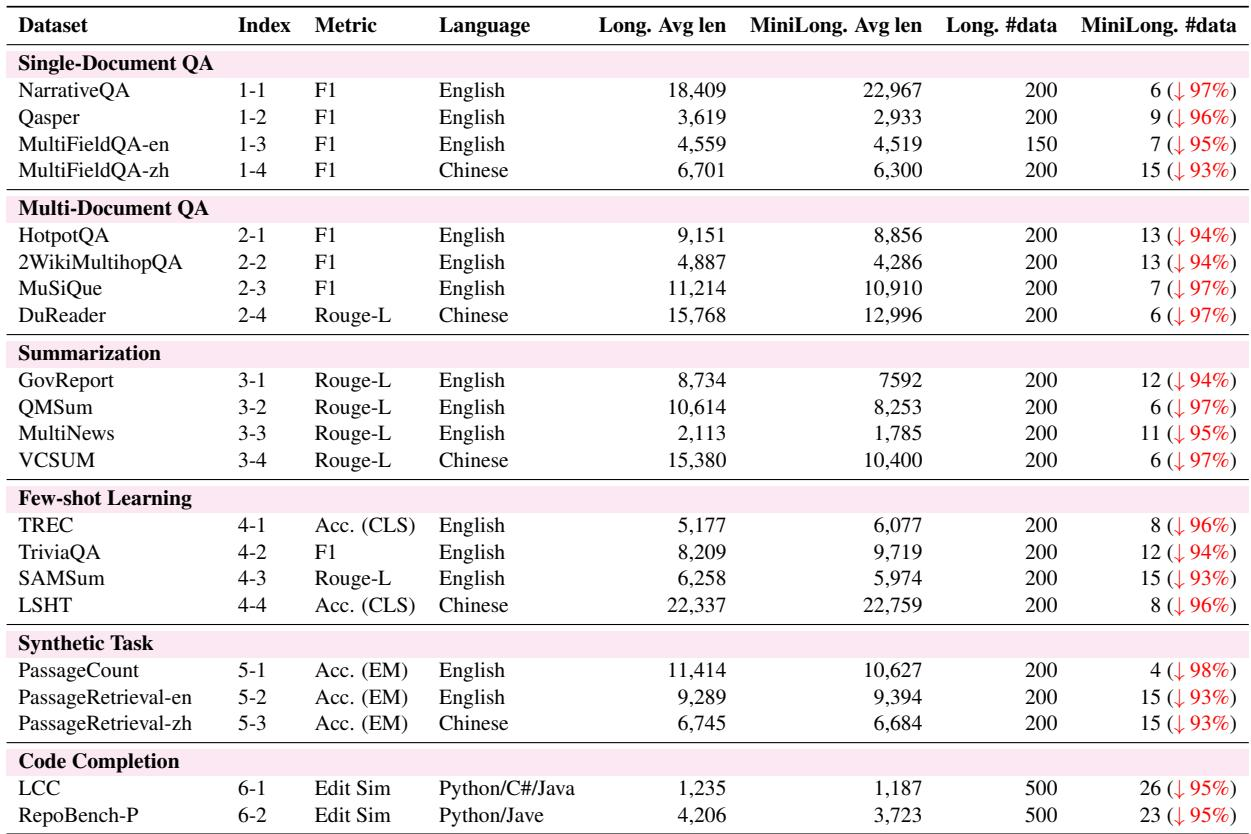
MiniLongBench is a compact version of LongBench created by pruning test samples while preserving six task categories and 21 tasks. The compressed benchmark has much fewer data points and lower average input length overall, while still keeping long-text inputs in a similar magnitude. This design reduces token counts and computational cost for long-context model evaluation and retains diversity across English and Chinese tasks. MiniLongBench greatly reduces dataset size, with shown task sample counts falling by roughly 95 percent compared with LongBench. Average input lengths are generally smaller but remain within a similar scale, indicating that the compact benchmark still covers long-text scenarios.
The evaluation results show that MiniLongBench reflects relative model strengths across compact long-context tasks, with higher-performing 128k models outperforming smaller or shorter-context models. Model capability gaps are largest on reasoning-heavy tasks such as summarization and synthesis, while code tasks remain relatively easier across models. The results support the claim that MiniLongBench can capture broad evaluation trends at lower computational cost. DeepSeek-V3-128k and GPT-4o-mini-128k consistently lead the task rankings, while smaller or older 8k models lag noticeably. Code-oriented evaluation yields the strongest scores for most models, whereas summarization and synthesis tasks are the most challenging.
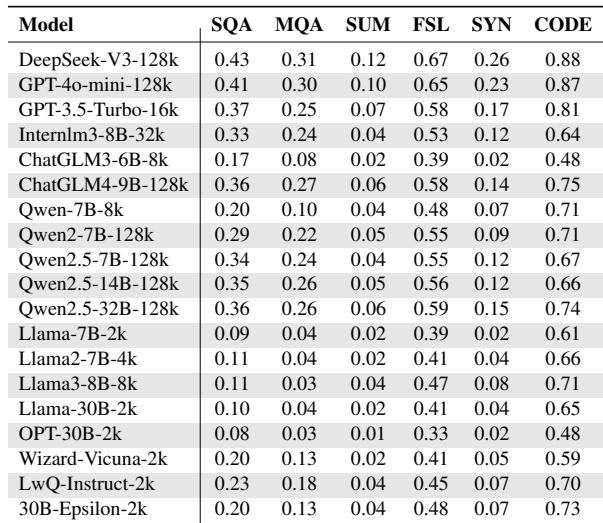
MiniLongBench is introduced as a compact evaluation benchmark that preserves the diversity and long-input nature of LongBench while greatly reducing sample size and computational cost. Experiments validate that the benchmark retains the relative performance trends of long-context models, showing stronger results for high-capability 128k models and more pronounced gaps on reasoning-heavy tasks such as summarization and synthesis.