Command Palette
Search for a command to run...
L'importance du passe-haut : perspectives théoriques et conception basée sur les sheafets pour les réseaux de neurones sur hypergraphes
L'importance du passe-haut : perspectives théoriques et conception basée sur les sheafets pour les réseaux de neurones sur hypergraphes
Ming Li Yujie Fang Dongrui Shen Han Feng Xiaosheng Zhuang Kelin Xia Pietro Lio
Résumé
Les réseaux de neurones sur hypergraphes (HNN) ont montré un grand potentiel pour modéliser les relations d'ordre supérieur entre plusieurs entités. Cependant, la plupart des HNN existants mettent principalement l'accent sur le filtrage passe-bas, négligeant le rôle des informations haute fréquence. Dans ce travail, nous présentons une investigation théorique du comportement spectral des HNN et prouvons que la combinaison des composantes passe-bas et passe-haut conduit à des modèles plus expressifs et plus efficaces. Notamment, notre analyse souligne que les signaux passe-haut jouent un rôle crucial dans la capture des structures discriminatives locales au sein des hypergraphes. Guidés par ces considérations, nous proposons un nouveau HNN basé sur les sheafets, qui intègre la théorie des faisceaux cellulaires et les transformées en framelets pour préserver les dépendances d'ordre supérieur tout en permettant une décomposition spectrale multi-échelle. Ce cadre met explicitement l'accent sur les composantes passe-haut, en accord avec nos résultats théoriques. Des expériences approfondies sur des ensembles de données de référence démontrent la supériorité de notre approche par rapport aux méthodes existantes, validant l'importance des informations haute fréquence dans l'apprentissage sur hypergraphes.
One-sentence Summary
Researchers from Zhejiang Normal University, City University of Hong Kong, Nanyang Technological University, and Cambridge University prove that integrating low-pass and \text{\text{high-pass}} components enhances hypergraph neural network expressiveness, highlight high-pass signals as crucial for capturing local discriminative structures, and propose sheafet-based HNNs combining cellular sheaf theory and framelet transforms for multi-scale spectral decomposition, outperforming existing methods on benchmark datasets.
Key Contributions
- Establishes a theoretical foundation characterizing the complementary roles of low-pass and high-pass components in hypergraph learning, formally proving that models leveraging both components exhibit improved representational capacity.
- Introduces HyperSheafets, a sheafet-based hypergraph neural network framework that integrates cellular sheaf theory and framelet transforms for multi-frequency spectral decomposition, explicitly emphasizing high-pass signals to capture fine-grained structural variations.
- Validates the approach through extensive empirical evaluations on multiple hypergraph benchmark datasets, demonstrating consistent effectiveness and superiority over existing hypergraph learning models.
Introduction
Hypergraphs extend graph models to capture higher-order interactions among multiple entities, which is critical for complex relational structures. While hypergraph neural networks (HNNs) have borrowed spectral and message-passing techniques from graphs, the spectral design of HNNs remains largely underexplored, particularly regarding frequency components. Most existing HNNs implicitly favor low-frequency propagation or neglect high-frequency signals, and prior work that combines sheaf theory with framelets applies only to graphs, not hypergraphs. To address this gap, the authors provide a rigorous theoretical analysis demonstrating that incorporating both low- and high-pass components yields more expressive and robust HNNs, with high-pass information being especially vital for capturing fine-grained structural variations and node-level distinctions. Based on these insights, they propose HyperSheafets, a novel framework that unifies cellular sheaf theory and framelet transforms to explicitly model multiple frequency bands on hypergraphs, emphasizing high-pass signals. The authors validate their claims empirically across multiple hypergraph benchmarks. Hypergraphs capture higher-order interactions among multiple entities, moving beyond the pairwise limits of traditional graphs and enabling richer relational representations. Although hypergraph neural networks (HNNs) have adapted message-passing and spectral techniques from graphs, their spectral design remains underexplored, particularly regarding frequency components: most existing HNNs either implicitly favor low-frequency propagation or overlook high-frequency signals. Prior efforts that combine cellular sheaf theory with framelets are limited to graphs and do not address hypergraphs, leaving the role of high-pass components in hypergraph learning unexamined. The authors address this gap by providing a theoretical analysis showing that combining low- and high-pass components substantially improves the expressivity and robustness of HNNs, with high-pass information being essential for capturing fine-grained structural variations and node-level distinctions. They then propose HyperSheafets, a framework that integrates cellular sheaf theory with framelet transforms to explicitly model multiple frequency bands, with a deliberate emphasis on high-pass signals, and validate its effectiveness across several hypergraph benchmarks.
Dataset
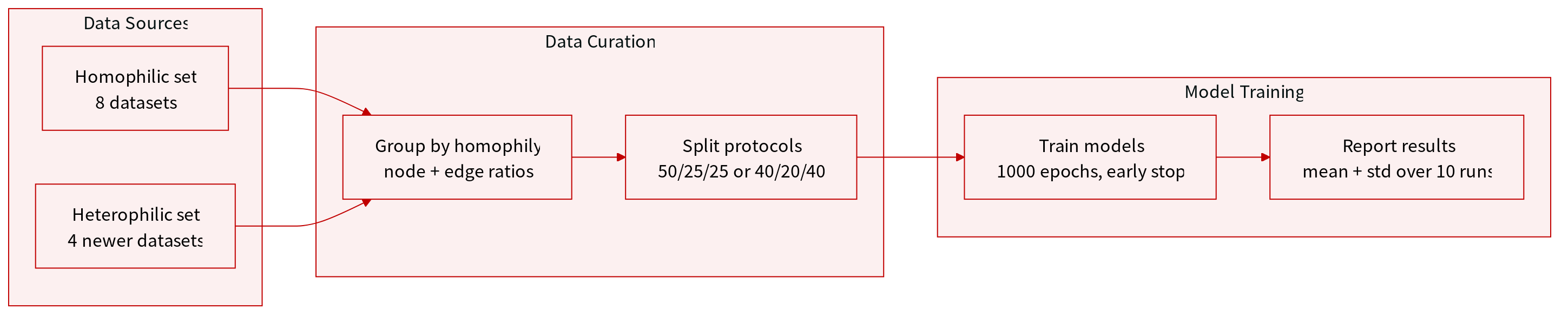
The authors evaluate HyperSheafets on 12 benchmark hypergraph datasets, split into two groups based on their homophily characteristics.
Dataset composition and sources
- Eight homophilic datasets: Cora, Citeseer, Pubmed, Cora-CA, DBLP-CA, House, Senate, and Congress.
- Four heterophilic hypergraph datasets, recently introduced: Actor, Twitch, Amazon, and Pokec.
Key details per subset
- The first eight datasets use a 50%/25%/25% train/validation/test split.
- The heterophilic datasets follow a 40%/20%/40% split protocol for fair comparison.
- Datasets are grouped into homophilic and heterophilic categories according to node-level and hyperedge-level homophily ratios.
- Dataset statistics, including both node homophily (H_node) and edge homophily (H_edge), are summarized in the appendix.
How the data is used
- All models are trained for up to 1,000 epochs with early stopping (patience = 200).
- Results are reported as mean accuracy and standard deviation over 10 random splits.
- The authors compare HyperSheafets against 9 baseline models, including HGNN, Hyper-GCN, UniGCNII, HyperND, AllDeepSets, AllSetTransformer, ED-HNN, SheafHyper-GNN, and HyperUFG.
The results highlight the model's strong capacity to handle complex higher-order relationships and its robustness across both homophilic and heterophilic hypergraph structures.
Method
The authors propose HyperSheafets, a framework for sheaf-based hypergraph neural networks that integrates cellular sheaf theory with framelet transforms to capture both low-frequency smoothness and high-frequency oscillations. This architecture is designed to enhance the generalization capability of node classification tasks by explicitly modeling multi-scale structural information.
The foundation of the method lies in the construction of cellular sheaves on hypergraphs. A cellular sheaf F is defined by vertex stalks associated with nodes, hyperedge stalks associated with hyperedges, and restriction maps that linearly project node features onto hyperedges. This structure facilitates the definition of a linear sheaf hypergraph Laplacian LF, which serves as the spectral operator for the hypergraph. The Laplacian is constructed using the restriction maps, ensuring that information flow respects the higher-order connectivity patterns of the hypergraph.
Refer to the framework diagram below for an overview of the HyperSheafets pipeline.
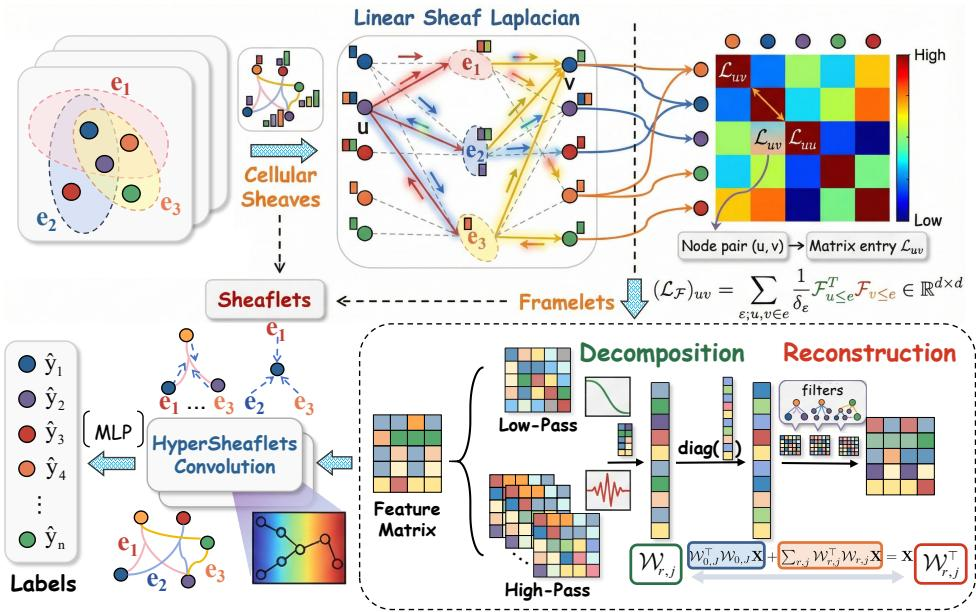
Building upon the spectral properties of LF, the authors construct undecimated sheafets to decompose signals into distinct frequency components. This involves defining scaling functions for low-pass filtering and wavelet functions for high-pass filtering, derived from the eigenpairs of the sheaf Laplacian. The decomposition operators separate the input feature matrix into coarse approximations (low-frequency) and detail coefficients (high-frequency) across multiple scales. To ensure computational efficiency and avoid the prohibitive cost of full eigendecomposition, the filter banks are approximated using Chebyshev polynomials of a fixed degree. This approximation allows the decomposition and reconstruction operators to be expressed as polynomial functions of the Laplacian matrix, enabling scalable implementation.
The core neural network layer utilizes these sheafet operators to perform spectral convolution. The input features are first projected into a higher-dimensional space and reshaped to align with the vertex stalk representation. The forward propagation rule aggregates information by combining the reconstructed low-pass and high-pass components. Specifically, the updated node representations are computed as a weighted sum of the low-pass filtered features and the high-pass filtered details, where the weights are determined by learnable spectral filter coefficients and transformation matrices. This dual-pathway design allows the model to simultaneously preserve global structural coherence through low-pass filtering and capture local variations and sharp transitions through high-pass filtering, thereby addressing the oversmoothing problem common in deep graph neural networks.
Experiment
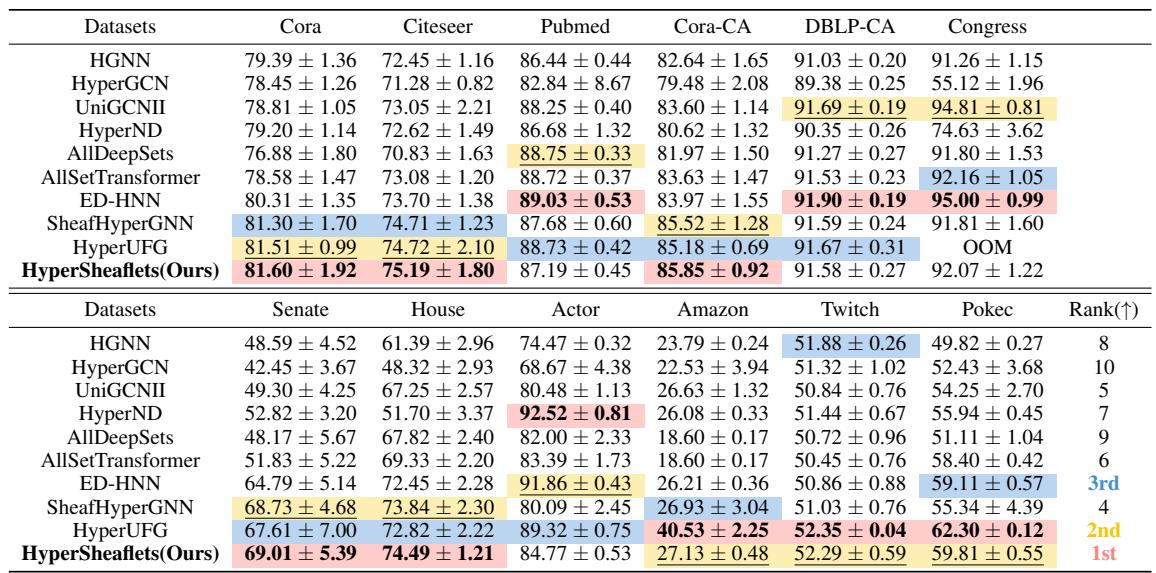
HyperSheafets is evaluated on 12 homophilic and heterophilic hypergraph benchmarks against 9 existing models, achieving state-of-the-art results on the majority, with notable gains on complex datasets like Senate, House, Twitch, and Pokec. The model maintains stable accuracy from 1 to 32 layers, showing resistance to oversmoothing. Parameter sensitivity analysis on Citeseer and House indicates that a small number of scales suffices for good performance. Ablation studies reveal that removing the high-pass component causes severe degradation, while removing low-pass has minor impact, confirming the importance of high-frequency signals.
HyperSheafets achieves state-of-the-art or competitive accuracy across both homophilic and heterophilic datasets, with notable gains on challenging heterophilic benchmarks. The model maintains stable performance across deeper architectures, indicating strong resistance to oversmoothing compared to existing hypergraph neural networks. Consistently outperforms or matches baselines on the majority of the 12 datasets, with clear advantages on heterophilic datasets like Senate, House, Twitch, and Pokec. Shows stable accuracy across layer depths from 1 to 32 on representative homophilic and heterophilic datasets, suggesting reduced oversmoothing.
An ablation study removing each frequency component from the model shows that omitting the high-pass component leads to severe and consistent performance drops across all datasets, while removing the low-pass component results in only marginal declines. This indicates that high-pass signals are essential for capturing local variations and preserving node-level discriminability, whereas low-pass information contributes less critically to overall performance. Removing the high-pass component causes large accuracy reductions on every dataset, with drops often exceeding 30 percentage points. Removing the low-pass component yields only slight performance decreases, typically under 2 percentage points on most datasets. The high-pass component is especially critical for non-homophilic or structurally complex settings, where its removal leads to the most severe degradation.
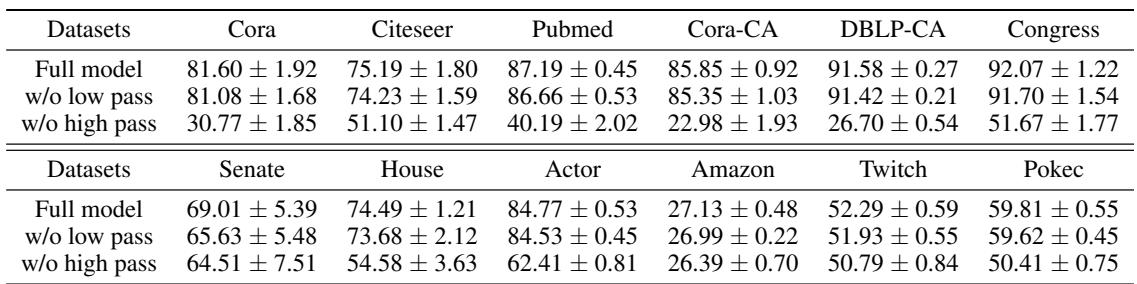
The evaluation of HyperSheafets spans 12 datasets, covering both homophilic and heterophilic settings, and demonstrates state-of-the-art or competitive accuracy, with the strongest gains on challenging heterophilic benchmarks. The model also shows stable performance across deeper architectures (up to 32 layers), indicating effective resistance to oversmoothing compared to baselines. An ablation study that removes frequency components reveals that the high-pass signal is crucial, as its omission causes severe accuracy drops across all datasets, while removing the low-pass component leads to only minor declines. This highlights the high-pass component's essential role in preserving node-level discriminability, particularly in non-homophilic or structurally complex graphs.