Command Palette
Search for a command to run...
Des agents paresseux répondent contre leurs propres croyances : l'apprentissage par renforcement avec croyances vérifiables leur apprend à agir selon ce qu'ils croient
Des agents paresseux répondent contre leurs propres croyances : l'apprentissage par renforcement avec croyances vérifiables leur apprend à agir selon ce qu'ils croient
Richmond Sin Jing Xuan Peilin Feng Wenbin Wang Soujanya Poria
Résumé
Les agents d'IA travaillant sur des tâches longues s'arrêtent souvent trop tôt et s'engagent sur une réponse avant de disposer de preuves suffisantes, un comportement souvent appelé paresse. Dans nos évaluations, ils s'engagent fréquemment alors même que leur croyance déclarée mentionne encore plusieurs réponses possibles. À chaque tour, l'agent décide s'il effectue une étape supplémentaire ou s'il s'engage sur une réponse. Une récompense de résultat en fin d'épisode ne note que la réponse finale. Elle ne montre pas quels tours ont été utiles et ne peut pas apprendre à l'agent quand s'engager, car une supposition chanceuse reçoit la même récompense qu'une réponse étayée par des preuves. Pendant l'entraînement, cependant, le simulateur connaît les règles reliant la réponse cachée aux preuves ; il peut donc calculer la distribution a posteriori exacte sur la réponse à chaque étape et déterminer si les preuves sont déjà suffisantes. Nous proposons l'apprentissage par renforcement avec croyances vérifiables (RLVB), qui considère cette distribution a posteriori comme la croyance étayée par les preuves. RLVB récompense l'agent pour effectuer des étapes supplémentaires tant que cette croyance admet encore plusieurs réponses et pour s'engager une fois que les preuves sont suffisantes. La récompense ne dépend que des preuves recueillies par l'agent et ne nécessite ni juge, ni critique, ni modèle de récompense. Elle ne lit jamais la ligne de croyance que l'agent écrit avant chaque action, bien que la mise à jour entraîne cette ligne conjointement avec l'action. Nous introduisons également Pro-Worlds, un banc d'essai de puzzles visuels où l'agent observe un vaste monde à travers une petite fenêtre et doit décider quand il dispose de suffisamment de preuves visuelles pour s'engager. Nous évaluons trois modèles vision-langage sur trois bancs d'essai, dont deux ne sont jamais vus pendant l'entraînement. RLVB améliore le modèle de base dans les neuf configurations, de 17,1 % en moyenne et de 10,4 % avec l'espérance-maximisation (EM) comme apprenant. Avec la récompense de résultat, GRPO et PPO se situent en dessous du modèle de base en moyenne. RLVB surpasse également PPO avec une récompense de processus issue d'un juge LLM de 9,3 % en moyenne tout en utilisant 1,6 fois moins d'heures GPU. Pour identifier l'origine de ce gain, nous regroupons les réponses selon les preuves dont dispose l'agent au moment où il répond. L'agent entraîné répond avec des preuves suffisantes dans 51 %, 12 % et 74 % des épisodes sur les trois bancs d'essai, contre 8 %, 0,4 % et 36 % pour le modèle de base. Pour chaque méthode, 66 à 92 % des réponses données avec des preuves suffisantes sont correctes. Le gain de précision de l'agent entraîné provient donc du fait qu'il répond plus souvent à des niveaux de preuve élevés, tandis qu'à niveau de preuve égal, ses réponses ne sont pas plus exactes que celles du modèle de base. La ligne de croyance montre comment l'agent entraîné atteint ce niveau de preuve : il agit selon sa propre croyance. Il ne s'engage que dans 0,1 à 2,2 % des tours où les preuves sont insuffisantes et où sa ligne mentionne encore plusieurs réponses, contre 3 à 68 % pour le modèle de base avec la même ligne. Sur l'ensemble des tours, sa ligne n'est pas systématiquement plus exacte que celle du modèle de base, et chacune de ses étapes ajoute à peu près autant de preuves qu'une étape du modèle de base. Étant donné que l'agent entraîné agit selon sa croyance, nous nous attendons à ce qu'une meilleure lecture des preuves se traduise par de meilleures réponses.
One-sentence Summary
Researchers from DeCLaRe Lab, Nanyang Technological University propose Reinforcement Learning with Verifiable Beliefs (RLVB), which uses simulator-derived posterior beliefs to reward evidence gathering and timely commitment without a judge, critic, or reward model, and introduce Pro-Worlds, a benchmark of visual puzzles where an agent views a large world through a small window; RLVB improves three vision-language models on three benchmarks by 17.1% on average and by 10.4% with expectation maximization (EM) as the learner, outperforms PPO with an LLM-judge process reward by 9.3% on average while using 1.6 times fewer GPU-hours, and leaves GRPO and PPO under outcome reward below the base model on average.
Key Contributions
- Reinforcement Learning with Verifiable Beliefs (RLVB) uses the simulator's exact posterior over hidden answers as a verifiable belief and assigns turn-level rewards for continuing while evidence still supports multiple answers and for committing once evidence is sufficient, requiring no judge, critic, or reward model.
- Pro-Worlds is introduced as a benchmark of visual puzzles in which an agent views a large world through a small window and must decide when it has enough visual evidence to commit.
- Across three vision-language models and three benchmarks, two of which are unseen during training, RLVB improves the base model in all nine settings, by 17.1% on average and by 10.4% with expectation maximization as the learner; it also outperforms PPO with an LLM-judge process reward by 9.3% on average while using 1.6 times fewer GPU-hours, with gains attributed to answering more often with sufficient evidence and acting on the stated belief.
Introduction
Long-horizon agents in games, embodied settings, and interactive environments must gather sufficient evidence before answering, but current models often stop too early and guess even when their own stated belief still leaves several answers open. This matters because users usually cannot check how an agent reached its answer, so reliability requires answers to be both correct and backed by sufficient evidence. Outcome-based reinforcement learning struggles here because a final answer reward cannot credit individual steps, and it can reinforce lucky guesses while penalizing careful but unsuccessful search. Process reward models and LLM judges can provide step-level credit, but they are expensive and may still reward lucky guesses. The authors introduce Reinforcement Learning with Verifiable Beliefs, or RLVB, which uses the simulator's privileged information to compute the exact posterior belief after every step and converts that belief into a process reward, requiring no judge, critic, or reward model.
Dataset
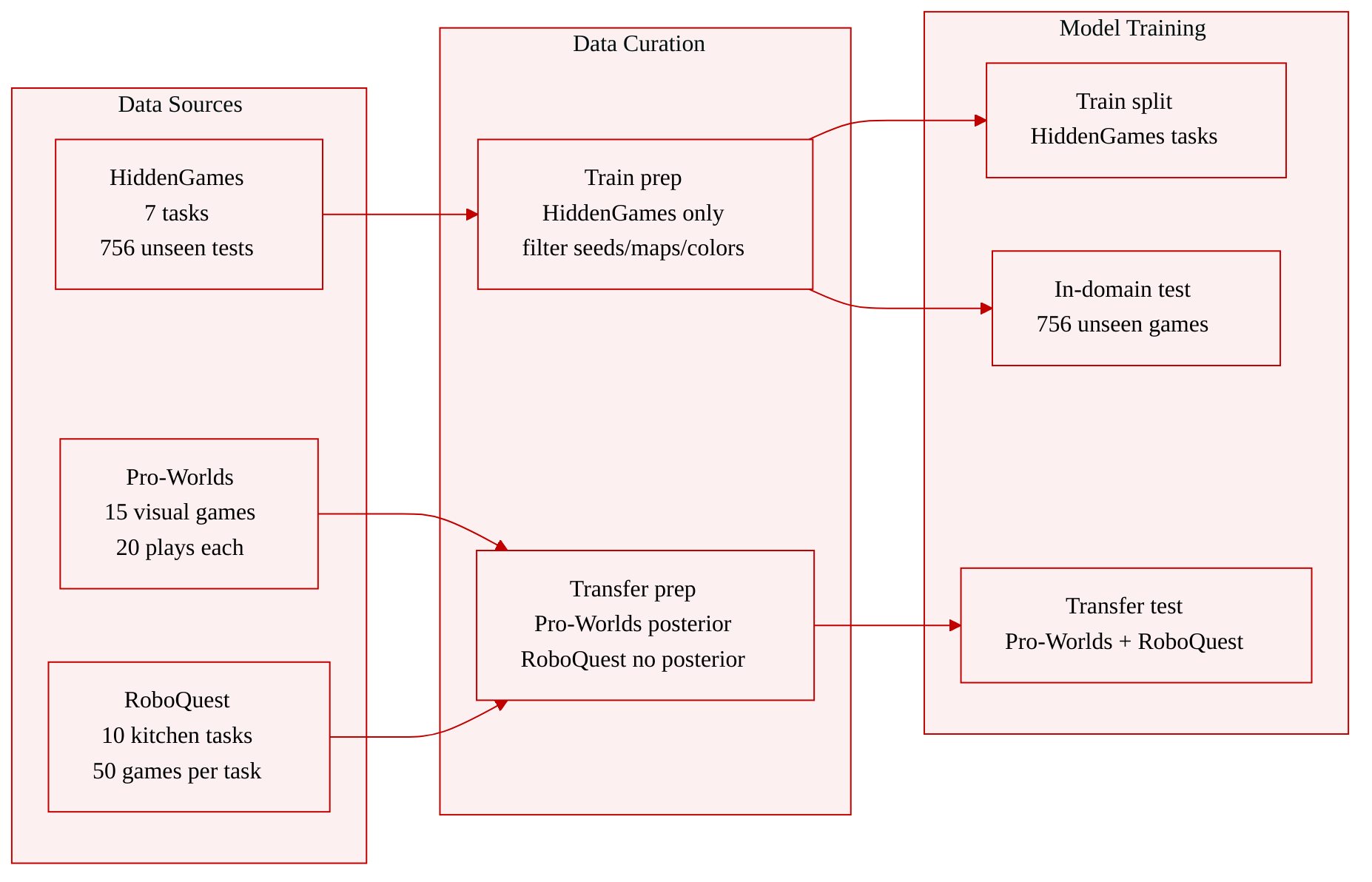
The authors use three benchmark suites, all with hidden answers that require the agent to collect evidence and decide when to answer.
- HiddenGames: combines seven tasks from existing agent benchmarks: MineSweeper, MiniGrid KeyCorridor, FrozenLake, Sokoban, and three Tabletop tasks rendered in ManiSkill3. The authors train on these tasks and test on 756 games with seeds, maps, and colors never seen in training.
- Pro-Worlds: a new out-of-domain visual benchmark with 15 games, 20 plays each: Face, Jigsaw, Kaleido, Bird, Fish, Recipe, Turtle, Balloon, Rocket, Bell, Bee, Candle, Sailboat, Barn, and Lantern. In each game, the agent sees a larger world through a small movable window, can make at most 35 moves, and then selects one of eight candidates, except Jigsaw which has ten candidates. Exact posterior distributions are computed from the game engine; a teacher using this posterior solves every game in 14.7 moves on average.
- RoboQuest: ten mobile manipulation tasks in simulated kitchens. It includes search, inspection, and interactive testing, such as finding an odd parcel by weighing. The authors test on 50 games per task.
Usage: HiddenGames provides the training and in-domain test data. Pro-Worlds and RoboQuest are used as transfer benchmarks to test visual evidence gathering and tasks without an exact posterior. Mixture ratios and additional filtering rules are not reported.
Method
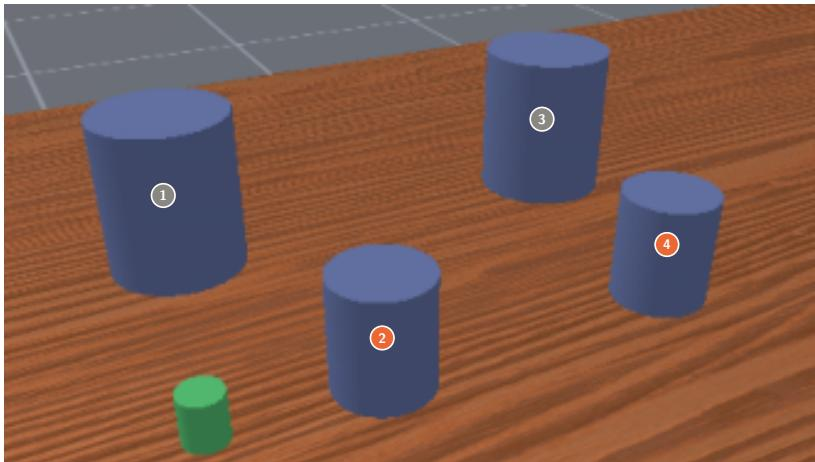
The authors propose RLVB, a reinforcement learning framework that trains vision-language agents to act based on verifiable beliefs in partially observable environments. The environment, such as the cups task shown below, involves a hidden target and evidence-gathering actions.
In this setup, the simulator computes an exact posterior over the hidden target based on the evidence gathered so far. The agent is a vision-language model that generates a turn consisting of reasoning, a belief line stating the set of possible answers, and an action. The objective is formulated as a partially observable Markov decision process where the agent must decide when to commit to an answer.
To guide the agent, the authors design a posterior teacher that operates on the exact posterior. This teacher values each action by computing the expected value of the posterior after the action, defining an optimal teacher policy. The teacher's stopping rule adapts to the agent's accuracy, encouraging more evidence gathering when the agent is unreliable.
The core of the method is the posterior process reward, which evaluates each turn at a given history. The reward function consists of an action term and a belief term. The action term scores the agent's action against the teacher policy based on the exact posterior, heavily penalizing premature answers while lightly discounting extra steps. This teaches the agent to commit only when the evidence is sufficient. The belief term directly checks the agent's stated belief line against the exact posterior, combining a log score, a penalty for overly wide beliefs, and a decision score. The full reward is expressed as R(h,x)=logπ∗(u∣b)+Sdec+η(S+W).
Refer to the framework diagram for a comparison of RLVB with other reinforcement learning approaches.
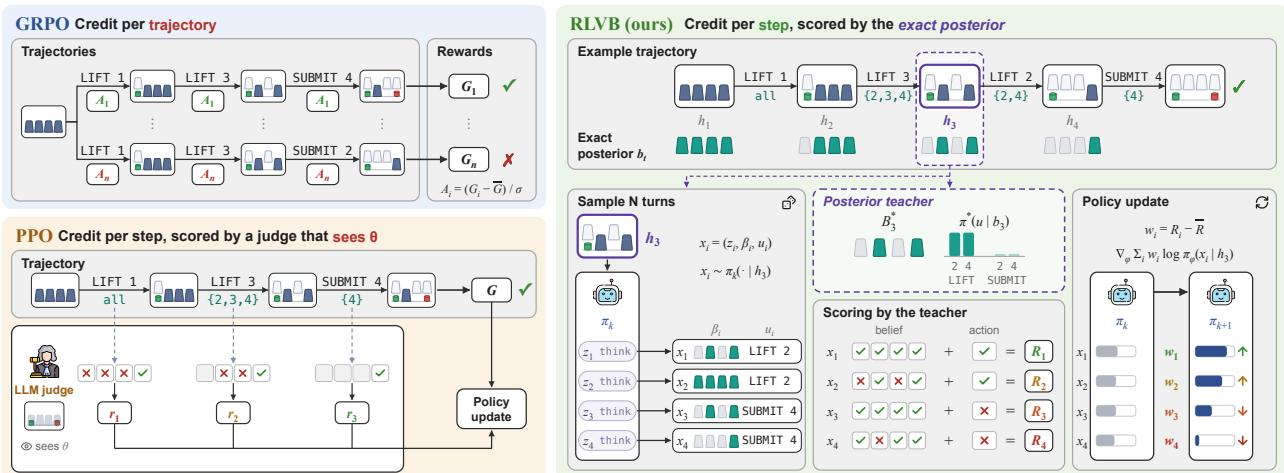
The policy update is performed step-by-step rather than over entire trajectories. Training occurs in phases where a fixed policy generates episodes, and at each history, multiple turns are sampled and scored. The update uses a group-relative weighting scheme similar to GRPO, but the group consists of the sampled turns at a single history. The weights are proportional to the reward minus the mean reward of the group. This ensures that each decision is credited only against alternatives under the exact same evidence, avoiding the credit assignment issues of trajectory-based methods. The model is updated via gradient steps on the weighted log likelihood, moving toward an improved policy while keeping the KL divergence within a threshold.
Experiment
The experiments evaluate agents on HiddenGames, Pro-Worlds, and RoboQuest, where answers are hidden and models must gather evidence before committing. They train open vision-language models with baselines using outcome rewards, belief-augmented PPO, and the proposed RLVB, which rewards turns against an exact posterior. RLVB achieves the highest accuracy and transfers to unseen benchmarks mainly by acting on its own belief line, committing less often when that line still names multiple answers and therefore gathering more evidence, even though its belief reading is not consistently better. Ablations show the posterior-based action term, rather than belief-line rewards, drives the gain, while limitations include relying on known rules and still performing below the posterior teacher.
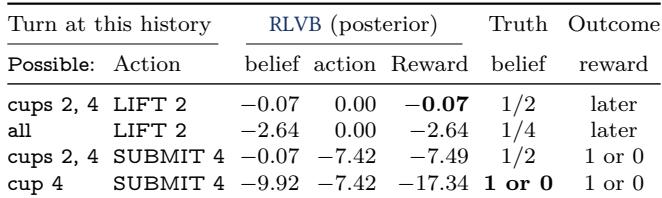
After the agent has lifted two cups, the target is equally likely under one of the two remaining cups. RLVB scores the next decision by combining a belief term and an action term, and it treats further evidence gathering as lower cost while heavily penalizing premature guesses, especially when the guessed cup is not confirmed. The pattern shows RLVB prefers further observation over premature commitment in this state. Lifting an unresolved cup can receive a zero action component and a relatively small belief penalty compared with submitting a guess. Submitting a guess under uncertainty is penalized more heavily than lifting, and the penalty grows further when the candidate cup is not confirmed. Exact posterior truth assigns equal probability to the two remaining cups, while final outcomes for submitted guesses are binary depending on whether the guessed cup hides the target.
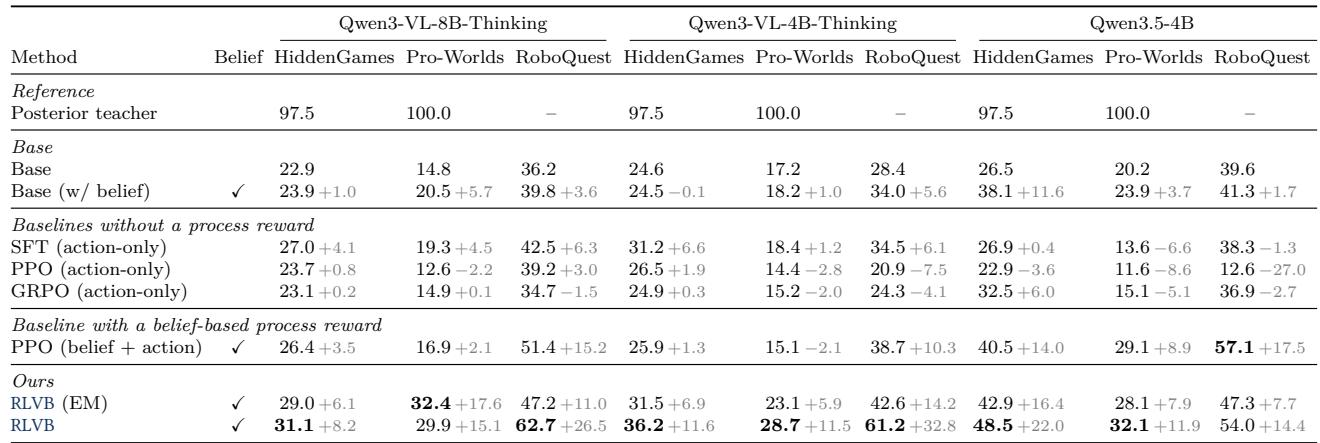
Three vision-language models were evaluated on three benchmarks spanning training tasks and unseen environments. Stating a belief before actions improves accuracy without training, but the main and most transferable gains come from the posterior process reward used by RLVB. RLVB and RLVB (EM) outperform outcome-reward, imitation, and judged process-reward baselines in nearly all settings and reduce premature answers by acting on the belief line. Stating a belief improves accuracy in eight of nine settings without training, but it does not prevent early answers; RLVB’s posterior reward yields the strongest gains and reduces premature answers. Outcome rewards provide little or negative average improvement, while posterior process rewards transfer to unseen benchmarks and make RLVB or RLVB (EM) the best method in eight of nine settings.
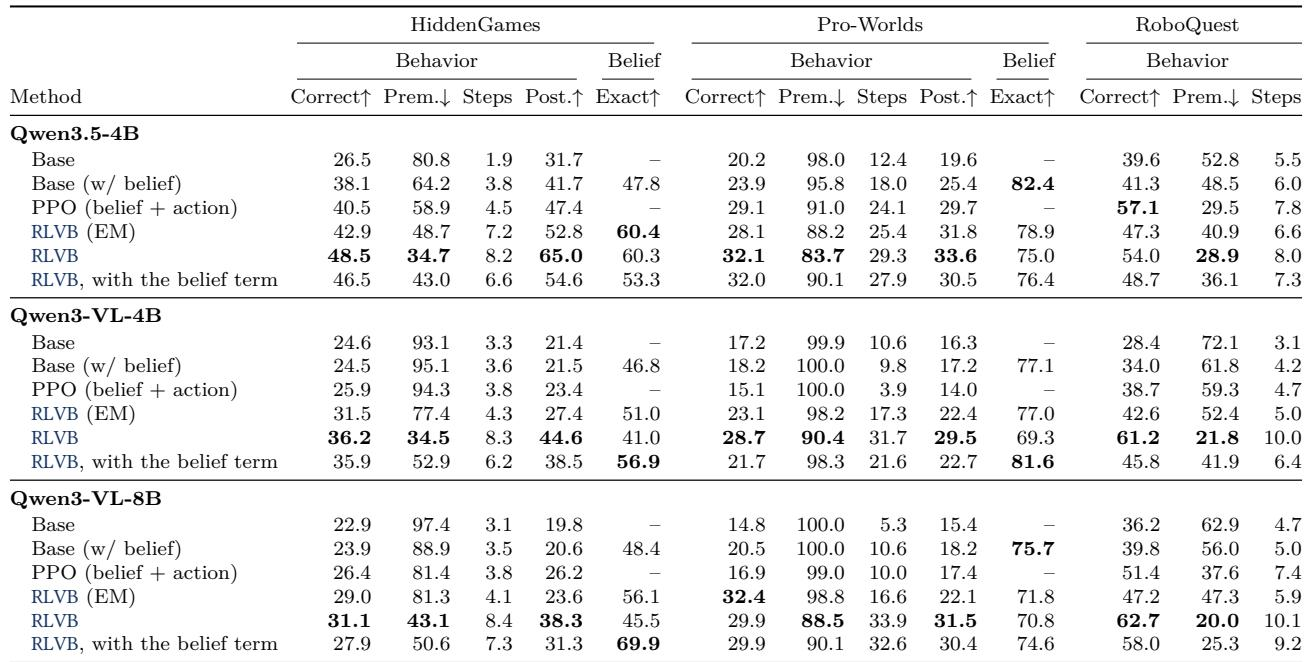
RLVB shows the most metacognitively consistent behavior among the evaluated agents, producing the fewest premature answers and taking the most evidence-gathering steps across all nine settings. On HiddenGames its premature answer rate is much lower than for PPO with belief and action or the base model with belief, even though its belief line is not the most often exactly aligned with the exact posterior. The improvement appears to come from acting on the stated belief, since the agent rarely commits while its belief line still names several answers. Across all nine settings, RLVB records the fewest premature answers and the highest number of evidence-gathering steps per episode. On HiddenGames, RLVB answers prematurely less often than PPO with belief and action or the base model with a belief line. RLVB rarely commits while its belief line still names multiple possible answers, linking its gain to acting on belief. Stating a belief alone does not prevent early answers, as base models with a belief line still commit on 3 to 68% of insufficient-evidence turns where their belief names several answers.
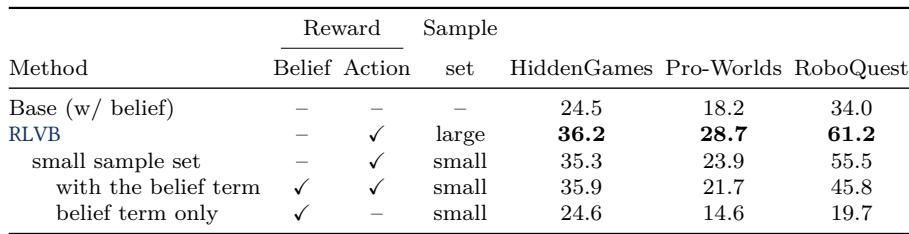
An ablation on Qwen3-VL-4B-Thinking shows that RLVB's gains are driven mainly by the action reward rather than the belief reward. Reducing the sample set from large to small leaves HiddenGames nearly unchanged but lowers accuracy on Pro-Worlds and RoboQuest, indicating the larger sample helps on benchmarks not seen in training. Adding the belief term to the action reward does not improve performance, and a belief-only reward performs at or below the base model. The action reward is the main source of RLVB gains; belief-only training matches or underperforms the base model across all three benchmarks. Using a large sample set mainly helps Pro-Worlds and RoboQuest, where the small sample set reduces accuracy. Adding the belief term to the action reward with a small sample set leaves HiddenGames nearly unchanged but lowers accuracy on Pro-Worlds and RoboQuest. Removing the action term causes performance to fall below the base model on Pro-Worlds and RoboQuest and to match the base model on HiddenGames.
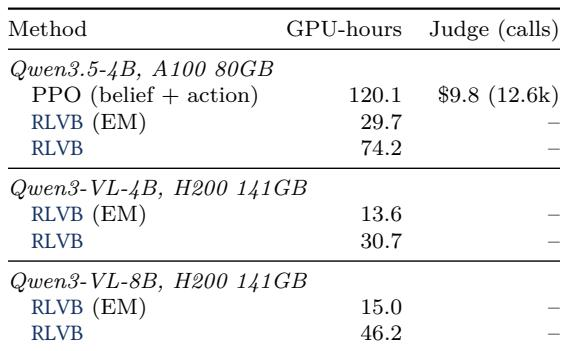
Training cost differs sharply by method. On the same model and GPU, PPO with belief and action is the most expensive setting and the only one with reported LLM judge calls, while RLVB runs are cheaper and RLVB EM runs are cheaper still. RLVB runs also stopped early after 20 to 35 updates because of a step KL limit, which contributes to their lower cost. Within Qwen3.5-4B runs, RLVB uses less GPU time than PPO, and the EM variant uses roughly a quarter of PPO's GPU time. The table reports no judge calls for RLVB variants, whereas PPO includes 12.6k judge calls costing $9.8. RLVB runs end before the planned 50 updates due to a step KL limit, reducing their compute cost.
The experiments evaluate RLVB in a sequential cup-search setting and across three vision-language benchmarks spanning training and unseen environments. RLVB's posterior process reward favors further evidence gathering over premature guessing, yielding the fewest premature answers and the most evidence-gathering steps, while belief statements alone improve accuracy but do not prevent early commitment. Ablations show the action reward, not the belief term, drives RLVB gains, larger sample sets help unseen benchmarks, and training cost is lower than PPO, especially for the EM variant.