Command Palette
Search for a command to run...
Rapport technique de Clover-35B-A3B-Preview
Rapport technique de Clover-35B-A3B-Preview
Résumé
Nous présentons Clover-35B-A3B-Preview (Clover), un modèle de langage à diffusion par mélange d'experts totalisant 35 milliards de paramètres, dont 3 milliards activés, et prenant en charge la génération en mode réflexion. Clover adapte les réseaux à delta fermé (Gated Delta Networks) à la diffusion par blocs en combinant une mémoire récurrente du contexte précédemment généré avec une attention softmax bidirectionnelle au sein du bloc courant. La lecture de la mémoire historique entre en compétition avec les jetons du bloc courant dans un softmax partagé, avec un calibrage apprenable de la taille des blocs et une branche de convolution distincte sur le contexte droit, initialisée à zéro. Clover arrive en tête sur les sept métriques d'agent évaluées, notamment 73,6 sur SWE-bench Verified et 51,7 sur Terminal-Bench 2.1. Sur des charges de travail d'agent internes, il atteint une vitesse de génération rapportée de 680 jetons/s avec un seul GPU NVIDIA GB300 en précision BF16 et une taille de lot unitaire. Nous organisons l'évaluation autour de la qualité du modèle, des coûts de rédaction et de vérification, ainsi que du déploiement sous contrainte mémoire. Nous décrivons également une variante de modèle de décision qui génère des réponses à des questions apparentées en une seule passe de débruitage. Sur un ensemble interne de 500 groupes, la prédiction conjointe fait passer la précision par question de 90,37 % à 93,88 % et la précision de groupe entièrement correcte de 65,4 % à 77,0 %.
One-sentence Summary
DifuSpace researchers introduce Clover-35B-A3B-Preview, a mixture-of-experts diffusion language model with 35 billion total parameters and 3 billion activated parameters that supports thinking-mode generation and adapts Gated Delta Networks to block diffusion by combining recurrent memory of previously generated context with bidirectional softmax attention inside the current block, along with learnable block-size calibration and a zero-initialized right-context convolution branch; it leads the seven evaluated agent metrics, including 73.6 on SWE-bench Verified and 51.7 on Terminal-Bench 2.1, and reaches a reported 680 tokens/s on one NVIDIA GB300 GPU at BF16 precision and batch size one.
Key Contributions
- Clover-35B-A3B-Preview is introduced as a 35B-total, 3B-activated mixture-of-experts diffusion language model supporting thinking-mode generation; it adapts Gated Delta Networks to block diffusion by combining recurrent historical memory with bidirectional softmax attention inside the current block, learnable block-size calibration, and a zero-initialized right-context convolution branch.
- Clover leads seven evaluated agent metrics, including 73.6 on SWE-bench Verified and 51.7 on Terminal-Bench 2.1, and reaches a reported generation speed of 680 tokens/s on internal agent workloads with one NVIDIA GB300 GPU at BF16 precision and batch size one.
- A decision-model variant generates answers to related questions in a single denoising pass, increasing question accuracy from 90.37% to 93.88% and all-correct group accuracy from 65.4% to 77.0% on an internal set of 500 groups; model weights, supervised fine-tuning code, and the inference engine are released with emphasis on local consumer-device deployment.
Introduction
Diffusion language models reconstruct text through iterative denoising, exposing parallel token prediction and a flexible generation order that can improve inference efficiency. In agentic applications, however, strong isolated reasoning or code-generation results do not guarantee reliable repository-level problem solving, and recent open diffusion models such as LLaDA2.2 flash and DiffusionGemma still trail evaluated Qwen baselines on Terminal-Bench 2.1 and SWE-bench Verified. The authors therefore present Clover-35B-A3B-Preview, a 35B-total, 3B-active mixture-of-experts diffusion language model designed for capable tool use and efficient repeated interaction with an environment. Its architecture combines a bidirectional adaptation of Gated Delta Networks with recurrent memory for completed context, block-local softmax attention for active tokens, learnable block-size calibration, and a separate right-context convolution branch. The work emphasizes agentic coding and tool use, analyzes the cost of turning parallel predictions into accepted output tokens, and includes on-device deployment and a decision-model variant that jointly generates related answers.
Method
Clover-35B-A3B-Preview adapts the text backbone of Qwen3.6-35B-A3B into a block diffusion language model with approximately 35B total parameters and 3B activated parameters per token. Its hybrid backbone combines recurrent sequence mixing, full attention, and sparse expert computation. The model comprises 40 decoder layers with a hidden width of D=2,048. A group of three Block-diffusion Gated DeltaNet (BD-GDN) layers followed by one full-attention layer is repeated ten times. Each mixer is followed by a block-aware Mixture of Experts (dMoE) module, utilizing pre-normalization and residual connections:
Uℓ=Hℓ+Mixerℓ(RMSNorm(Hℓ)) Hℓ+1=Uℓ+dMoEℓ(RMSNorm(Uℓ))where ℓ indexes decoder layers, Hℓ∈RL×D is the input hidden-state sequence, and Uℓ is the intermediate state. The architecture supports 131,072 tokens and features untied input and output embeddings with a vocabulary of 248,320 entries.
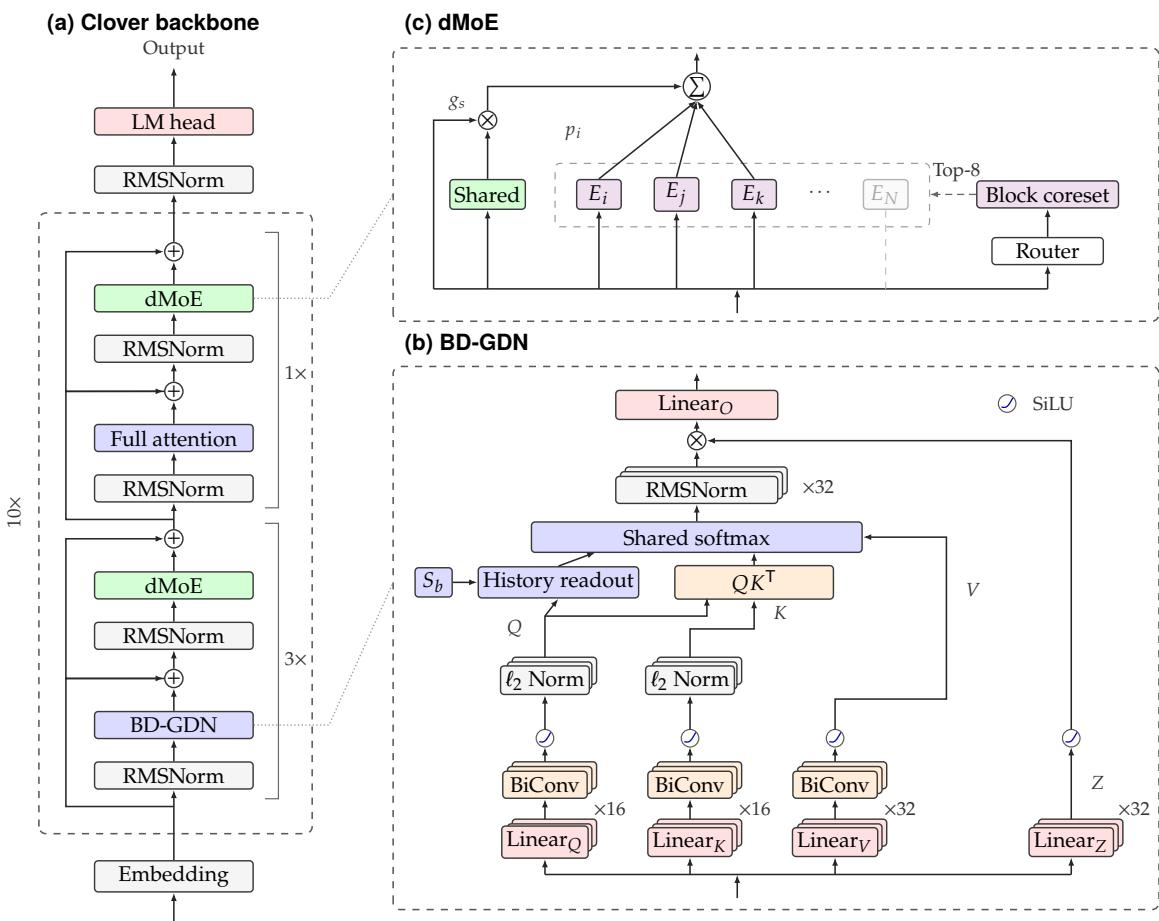
BD-GDN separates writing completed context from reading it during denoising. The clean path retains a gated delta-rule recurrence, while the noisy path reads the resulting prefix state and combines it with bidirectional attention over the current block. This prefix state remains fixed throughout the denoising passes of the active block. For a clean token, learned retention and write gates control the memory update. The recurrent memory stores completed context, and the residual corrects the value retrieved with the current key. During denoising, for a query position in the active block, the historical readout is computed from the clean prefix state. BD-GDN treats this readout as one information unit alongside the block token values. A shared softmax normalizes the local logits and the history logit together, allowing a query to use both the compressed prefix and individual current-block tokens. To compensate for the varying number of local competitors as block size changes, the history logit includes a learnable block-size calibration term.
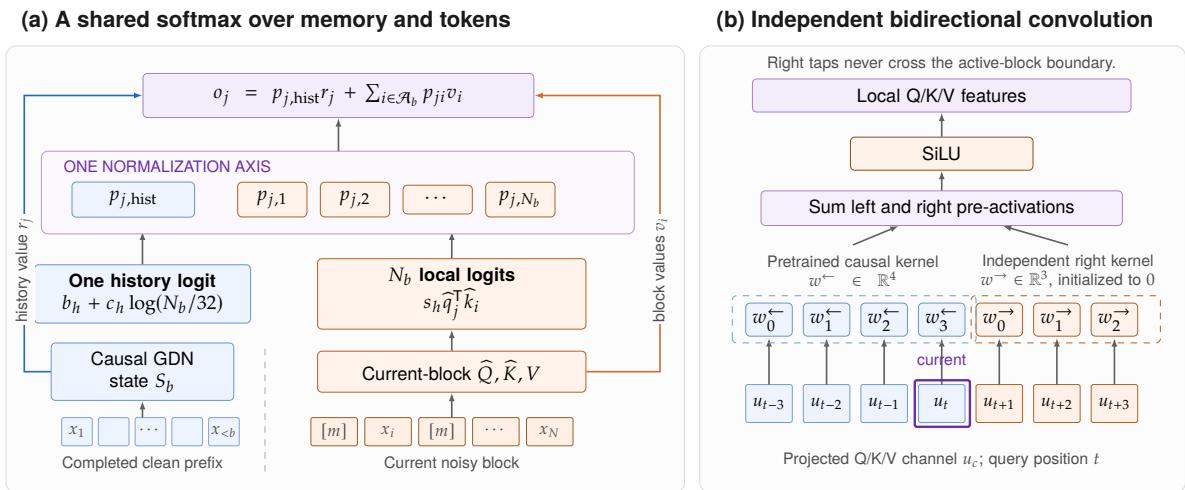
Additionally, BD-GDN employs an independent bidirectional short convolution. The query, key, and value projections pass through a causal depthwise kernel combined with an independent right-context kernel. The right taps are initialized to zero and read only valid successors within the current block, ensuring no right tap crosses a block or packed-example boundary.
To coordinate expert selection across parallel block predictions, the dMoE module first selects a shared expert pool for the block, then routes individual tokens within that pool. Each module contains 256 routed experts and one shared expert. For a given block, the router identifies each valid token top-eight experts and sums their probabilities by expert across the block. Sorting these aggregate scores, the system retains the smallest expert prefix covering a fraction of their total mass, forming the block expert coreset. Router logits outside the coreset are masked, and token-level top-eight selection is rerun. The shared expert is always evaluated and lies outside the coreset selection, encouraging expert reuse across parallel predictions while retaining token-specific weights.
The authors extend Megatron-Core to train the hybrid backbone with block diffusion, carrying the clean and noisy distinction through sequence packing, attention masks, recurrent state, expert routing, and distributed execution. For each example, a corrupted copy and a clean copy are constructed and stored sequentially. Clean queries are token-causal, while noisy queries can read clean tokens strictly before their block and noisy tokens within that block.
The training objective combines a denoising loss and an auxiliary causal supervision loss. The denoising objective uses no-shift alignment, where logits at a position predict the clean token. The auxiliary clean-stream objective uses shifted next-token prediction. The joint objective is:
L=λBDLBD+λARLARwhere LBD is the weighted masked cross-entropy and LAR is the standard autoregressive loss. Both objectives share one backbone pass and one output projection. For long-context sparse attention, structured metadata derived from example boundaries and block identities guides FlexAttention to execute permitted attention tiles. Parallelism handles heterogeneous layers via context parallelism, utilizing Ulysses sequence-to-head transpose or recurrent-state propagation for BD-GDN, and expert parallelism for routed experts.
Decoding proceeds block by block using a predict-and-commit strategy. Given the committed prefix, a block of mask tokens is appended, and all masked positions are predicted in parallel. Predictions exceeding a predefined confidence threshold are committed, while remaining positions are remasked for refinement. Once all tokens are decoded, the clean memory is updated.
To improve efficiency, self-speculative decoding uses the causal GDN to verify the draft block generated by a single diffusion step. Entropy-based verification adapts the acceptance threshold based on the uncertainty of the causal verification distribution. A draft token is accepted if its probability exceeds a threshold scaled by the exponential of the negative entropy. Draft tokens are verified sequentially until the first rejection. History-aware presence and repetition penalties are applied to mitigate repetition, alongside length-dependent positive logit biases for stop tokens to encourage response termination.
Experiment
The evaluation covers Clover-35B-A3B-Preview on 18 public benchmarks and coding-agent tasks, self-speculative decoding speed on an NVIDIA H200 GPU across math, agent replay, and chat workloads, and INT4 quantized deployment on a 16GB consumer GPU. The main findings are that Clover shows strong agentic and tool-use performance with competitive general capabilities, and its self-speculative decoding achieves higher committed-token yields and broader workload coverage even though draft cost can reduce math throughput; workload-aware expert placement improves on-device speed. Additional decision-model experiments show joint block-diffusion prediction improves complete-set accuracy and reduces group latency compared with independent or parallel calls.
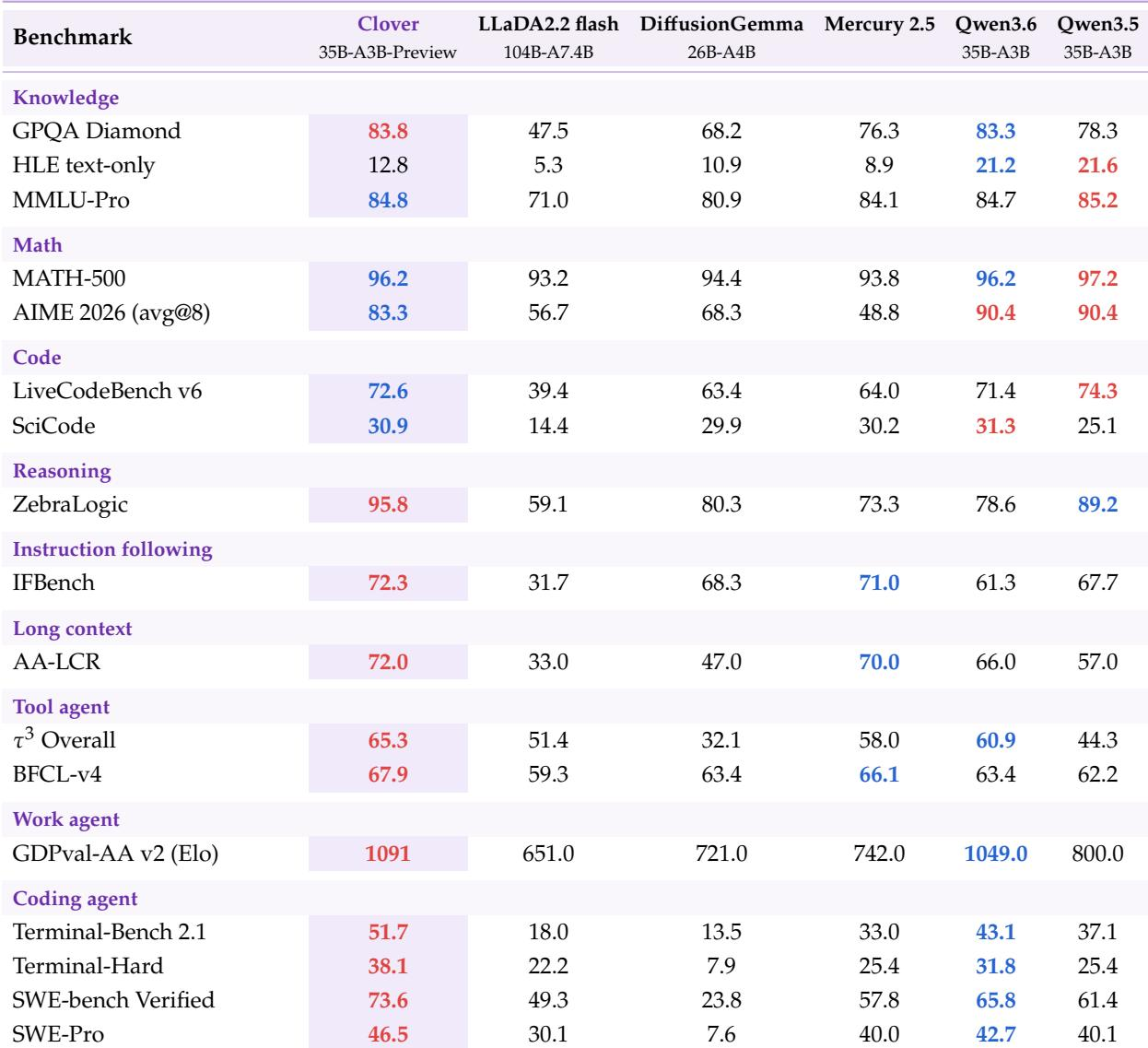
Clover demonstrates its most consistent advantage in agentic evaluations, with a lead across all seven evaluated agent benchmarks including SWE-bench Verified and Terminal-Bench. Its general knowledge and reasoning profile is competitive, leading on GPQA Diamond and performing near the top on MMLU-Pro, while trailing the autoregressive Qwen baselines on HLE text-only and on harder math tasks. Overall, the results position Clover as a capable general-purpose model with particular agentic strength and remaining opportunities in harder knowledge, competition mathematics, and standalone coding. Clover leads on GPQA Diamond and is competitive on MMLU-Pro among the evaluated models, while falling behind the Qwen baselines on HLE text-only. Its clearest and most consistent edge is in agentic tasks, where it leads across all seven evaluated agent benchmarks such as SWE-bench Verified and Terminal-Bench. In math evaluations, Clover performs competitively on MATH-500 but trails both autoregressive Qwen models on AIME 2026.
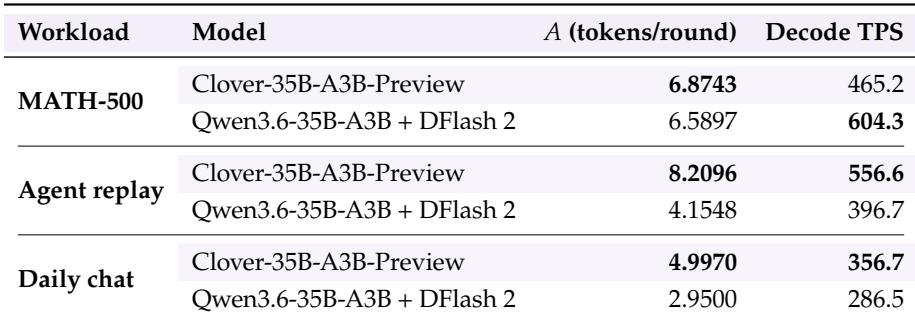
On an H200 GPU, Clover-35B-A3B-Preview commits more tokens per verification round than Qwen3.6-35B-A3B with DFlash 2 across MATH-500, agent replay, and daily chat. It also achieves higher decode throughput on agent replay and daily chat, while DFlash 2 is faster on MATH-500. The largest relative advantage for Clover appears in the long-context agent replay workload. Clover achieves higher committed tokens per verification round than DFlash 2 on all three workloads, with the largest relative lead in agent replay. For decode throughput, Clover leads in agent replay and daily chat, whereas DFlash 2 leads in MATH-500 despite slightly lower committed tokens per round.
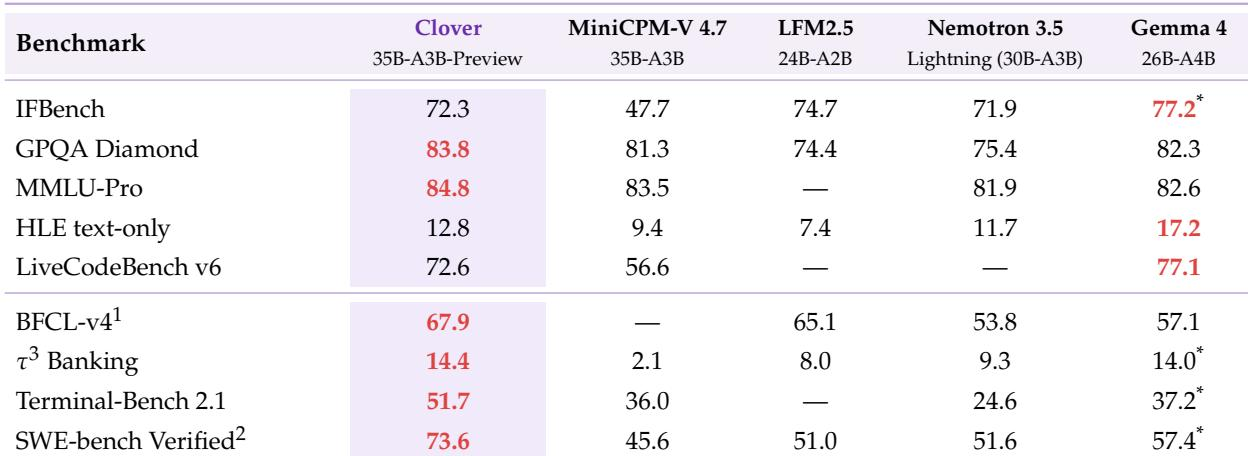
Clover leads the reported efficient on-device models on GPQA Diamond, MMLU-Pro, BFCL-v4, and τ^3 Banking, while trailing the best reported scores on HLE text-only and LiveCodeBench. In the matched in-house comparison with MiniCPM-V 4.7, Clover is higher on every shared benchmark, with the largest advantages on IFBench and τ^3 Banking. The pattern points to stronger function calling and agentic or tool-use capabilities, with remaining gaps in difficult knowledge and standalone code generation. Clover posts the best reported results among the compared models on BFCL-v4 and τ^3 Banking, and also leads on GPQA Diamond and MMLU-Pro. Against MiniCPM-V 4.7 under identical evaluation settings, Clover scores higher on all shared benchmarks, with especially large gaps on IFBench and τ^3 Banking.
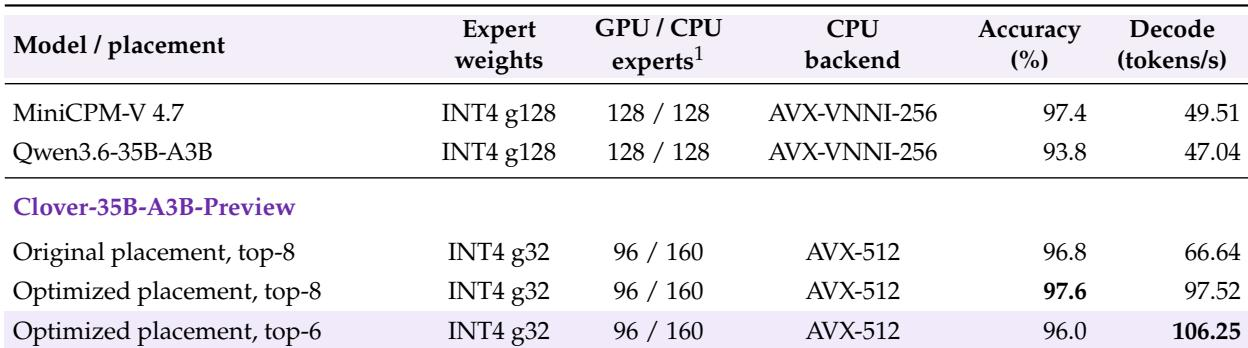
On the MATH-500 benchmark, workload-aware expert placement substantially improves Clover decode throughput while preserving or improving reviewed accuracy relative to its original placement. With eight active verification experts, optimized placement roughly doubles decode throughput and achieves the highest reviewed accuracy among evaluated configurations. Reducing verification to six active experts further improves throughput with a small accuracy decrease, while the baseline INT4 models remain notably slower. Optimized expert placement keeps the GPU and CPU expert counts unchanged but markedly raises Clover decode throughput compared with original placement. Using six active verification experts instead of eight provides a faster operating point at a modest accuracy cost. The optimized Clover configurations deliver higher decode throughput than the evaluated INT4 baseline models.
Joint prediction with the same decision model improves both individual and complete-set accuracy compared with independent prediction on the two evaluated tasks. The gains are larger for complete-set accuracy, with the strongest improvement on Sudoku boards. This indicates joint prediction is especially useful when the full set of decisions must be correct. Joint prediction improves both individual question or cell accuracy and complete-set accuracy on Multiple500 and Sudoku. Complete-set accuracy gains are larger than individual accuracy gains, with the biggest improvement on Sudoku boards where all missing cells must be correct.

The experiments evaluate Clover across agentic benchmarks, general knowledge and math tasks, H200 throughput, on-device comparisons, expert placement, and joint prediction. Clover demonstrates its clearest edge in agentic and tool-use settings, leading all seven agent benchmarks and showing strong function calling, while remaining competitive on GPQA Diamond and MMLU-Pro but trailing on harder knowledge, competition mathematics, and standalone coding. Workload-aware expert placement roughly doubles decode throughput on MATH-500 with preserved or improved accuracy, and joint prediction improves complete-set accuracy most when the full set of decisions must be correct.