Command Palette
Search for a command to run...
Des agents autonomes aux symbiotes cognitifs : vers une intelligence humaine augmentée par l’IA
Des agents autonomes aux symbiotes cognitifs : vers une intelligence humaine augmentée par l’IA
Hao Fei
Résumé
Au cours de la dernière décennie, les progrès de l’intelligence artificielle ont été mesurés à l’aune de ce qu’une machine peut accomplir par elle-même. Les grands modèles de fondation écrivent désormais du code, rédigent des documents, effectuent des recherches et exécutent des tâches en plusieurs étapes, tandis que les agents personnels autonomes fonctionnent en arrière-plan et agissent pour le compte d’une personne. Pourtant, les personnes oublient encore ce qu’elles savaient autrefois, ne remarquent pas ce qu’elles ne regardent pas, peinent à trouver les mots justes et affrontent des choix difficiles sans pouvoir s’appuyer sur leur propre histoire. La machine qui pourrait aider reste généralement extérieure à la situation : elle ne sait pas qui est la personne, où elle se trouve, ce qu’elle pense, ni comment interagir et communiquer avec elle dans l’instant. À mesure que l’IA entre dans le monde physique, l’attention s’est fixée sur un seul type d’individu intelligent, le robot incarné ; nous soutenons que l’ère de l’IA physique recèle un second type d’individu d’égale importance, la personne augmentée par l’IA, et, avec lui, une seconde moitié de l’objectif ultime de l’IA. À côté de l’intelligence artificielle générale, qui s’interroge sur le degré d’intelligence qu’une machine peut atteindre, se tient l’intelligence humaine augmentée par l’IA (AHI), qui s’interroge sur la quantité d’intelligence qu’une machine peut rendre possible chez une personne donnée. Sa réalisation exige un nouveau type de système, que nous appelons symbiote cognitif : un compagnon tout au long de la vie, intégré, en temps réel, privé, à faible friction et proactif, qui perçoit ce que la personne perçoit par l’intermédiaire de dispositifs externes, conserve son contexte et ses connaissances au fil des années, modélise sa situation et son esprit, participe à sa réflexion au moment opportun, accomplit les tâches quotidiennes avec son contexte à disposition et continue d’apprendre à connaître la personne à mesure que tous deux évoluent. Nous donnons à ce paradigme un noyau conceptuel, l’écart cognitif entre ce qu’une personne pourrait apporter à une situation et ce qu’elle peut maintenir en mémoire de travail, et nous organisons son espace de conception comme une boucle de symbiose incluant la perception, la conservation, la compréhension, la vie aux côtés de la personne, l’action pour elle et la réflexion avec elle, ainsi que la croissance, le tout enveloppé par un environnement d’exécution personnel et par la confiance. Parce qu’un symbiote modifie ce qu’une personne peut faire devant les autres, il soulève aussi des risques d’un genre nouveau, allant de l’assistance dissimulée lors d’examens et de conversations à la pression exercée sur chacun pour l’adopter, et nous considérons leur gouvernance comme faisant partie du paradigme.
One-sentence Summary
Researchers from the University of Oxford propose the cognitive symbiont, a lifelong, embedded, real-time, private, low-friction, proactive AI companion that, unlike autonomous agents, senses context, models the person’s situation and mind, and acts and thinks with them, framing AI-augmented human intelligence through the cognitive gap between a person’s potential and working memory and a symbiosis loop with trust and governance.
Key Contributions
- The paper introduces AI-augmented human intelligence as a distinct paradigm within Physical AI and defines the cognitive symbiont as a lifelong, embedded, real-time, private, low-friction, proactive system that senses with a person, maintains long-term context, models the person’s situation and mind, and participates in thinking and everyday tasks.
- It contributes a conceptual core, the cognitive gap between what a person could bring to a situation and what they can hold in working memory, and organizes the design space as a symbiosis loop covering sensing, keeping, understanding, living alongside, acting for, thinking with, and growing, enclosed by a personal runtime and trust.
- The paper develops a governance and evaluation account that places risks such as covert assistance, fairness, and adoption pressure inside the paradigm, maps governance layers across design, norms, law, markets, and research, and reframes evaluation around augmentation, synergy, and retention rather than task completion by the AI alone.
Introduction
The authors argue that AI progress has largely solved screen-based productivity through autonomous models and agents, but it has not addressed the everyday cognitive gaps that occur when a person cannot retrieve their own knowledge, understand a social situation, or receive timely support. They contend that the bottleneck for personal AI has moved from raw model capability to the coupling between a model and a particular person. Prior research from Licklider, Engelbart, lifelogging, wearables, egocentric AI, and personal agents has developed relevant components, but none has made lifelong augmentation of a specific individual its central target. Enabled by foundation models, agents, long-term memory, world models, and wearable hardware, the authors propose the cognitive symbiont as a second kind of intelligent individual beside the embodied robot. Their main contribution is the paradigm itself: naming AI-augmented human intelligence as the other half of the AI endgame, defining the symbiont through the cognitive gap and six necessary properties, and organizing the design space as a symbiosis loop that shifts evaluation from what the AI completes to what the augmented person can now do.
Dataset

The authors describe a personal context and lifelong knowledge pipeline rather than a fixed dataset. Data comes from first-person audio and video streams captured on device and at the edge.
-
Sources and scale
- Raw first-person audio and video are collected continuously.
- A single day can produce gigabytes; a lifetime can reach petabytes, so full retention is not feasible.
-
Dataset composition
- Raw streams: kept only briefly, with high-frequency, volatile, and low-value content filtered out early.
- Event-level summaries and indices: kept long term and record when and where something of a given kind happened.
- Knowledge entries: stable, repeated patterns promoted into long-term knowledge, with pointers back to the original sources.
-
Processing stages
- Front filtering: on device and at the edge, drops high-frequency, volatile, and low-value material before forwarding the rest.
- Back storage: absorbs frequent writes and updates and grows large over time.
- Offline consolidation: merges daily fragments into events, files events into projects, promotes repeated patterns into stable knowledge, and demotes expired material.
- No explicit cropping strategy is described; filtering acts as a temporal and importance-based selection mechanism. Metadata is built through event-level summaries and indices that point back to source streams.
-
How the record is used in the model
- The long-term record is not the raw audio/video itself but a low-fidelity index of event summaries and knowledge entries.
- This allows the past to be revisited through pointers to sources.
- Modeling a life record at this scale is listed as an open problem, so the text frames the record more as the target representation than as a directly usable training split.
Method
The authors propose a cognitive symbiont architecture organized around a continuous loop centered on the user.
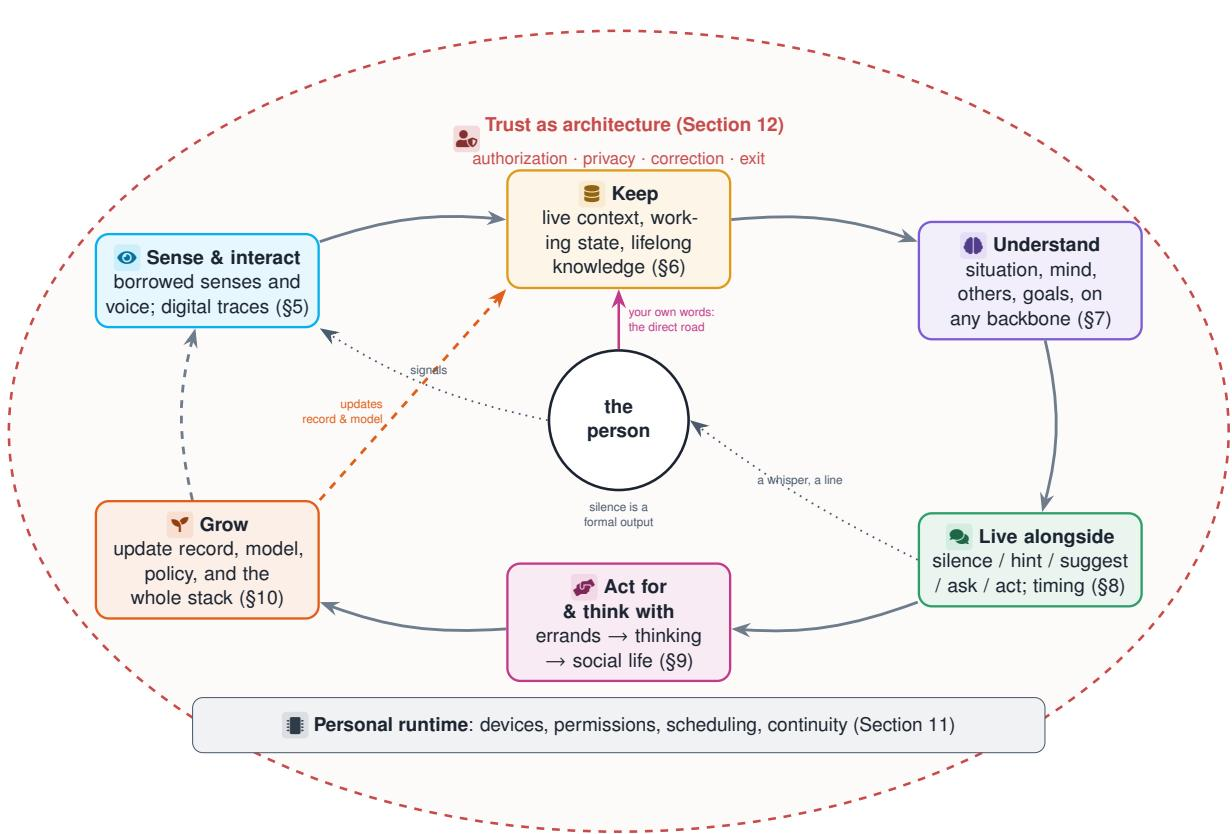
This framework, referred to as the symbiosis loop, consists of six stages: sensing and interacting, keeping context and knowledge, understanding the person, living alongside the user, acting and thinking with them, and growing over time. The entire process is supported by a personal runtime managing devices and permissions, and enclosed by a trust architecture governing privacy and authorization.
To perceive the world, the system relies on a device constellation rather than a single hardware unit.
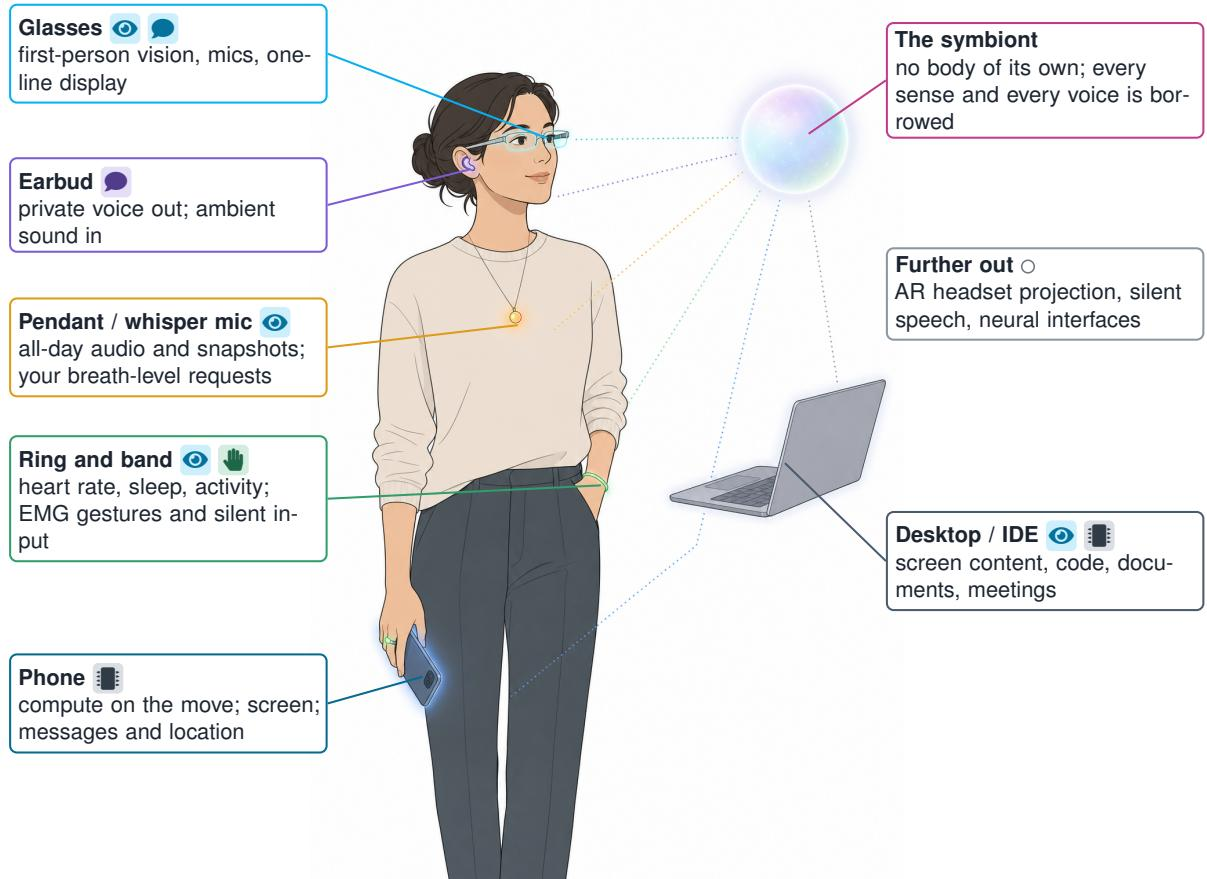
As shown in the figure below, the symbiont borrows senses and voice through a network of devices including glasses for first-person vision, earbuds for private audio, pendants for ambient recording, and wearables for physiological data. These inputs are managed as a unified set of senses by the runtime.
The system organizes personal information across three distinct timescales to balance immediate relevance with long-term retention.
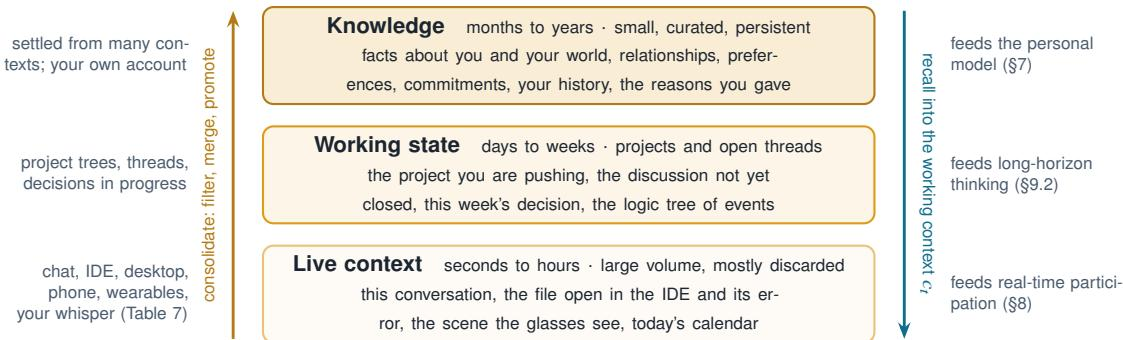
The diagram illustrates how live context, which is short-lived and high-volume, flows upward through consolidation into working state for projects and open threads, and finally into knowledge as curated, persistent facts. Conversely, recall moves relevant knowledge down into the working context ct to support real-time participation.
To make this record useful across different situations, the same underlying data is projected into multiple views.
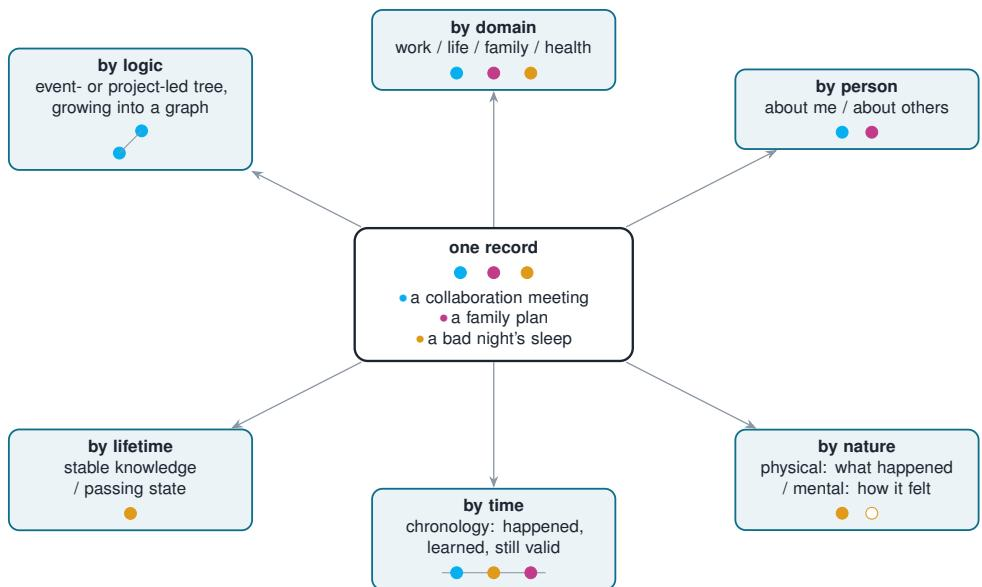
The figure demonstrates how a single record of events can be organized by logic, domain, person, lifetime, time, or nature, allowing the system to switch perspectives depending on the user's current needs.
The core of the personal model is built by synthesizing evidence from two independent sources.
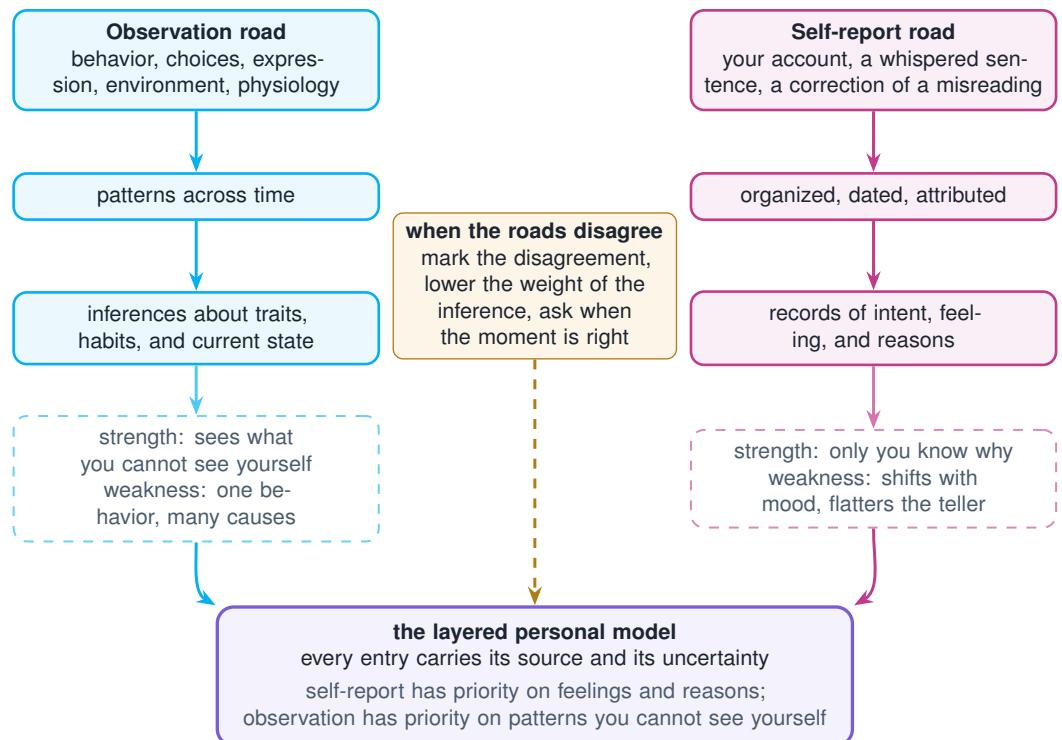
As depicted in the figure, the observation road infers patterns from behavior and physiology, while the self-report road captures the user's explicit accounts of intent and feeling. Both streams feed a layered personal model where every entry is tagged with its source and uncertainty. When the two roads disagree, the system marks the discrepancy and lowers the weight of the inference rather than overruling the user.
Experiment
This section outlines an evaluation framework for human-AI symbionts, measuring augmentation as the gain in a person's capability rather than the AI's intelligence, with separate quantities for synergy, retention, and personalization differential. It specifies ten evaluation dimensions, proposes N-of-1 and longitudinal methods as primary, with controls including no assistance, a generic assistant, and a personalized task agent, and organizes twenty-three open problems into a staged capability roadmap. The agenda also states falsification conditions, such as no measurable gain from personal context, long-term skill erosion, unacceptable surveillance or compute costs, or mostly positional adoption gains, which would narrow the paper's claims.
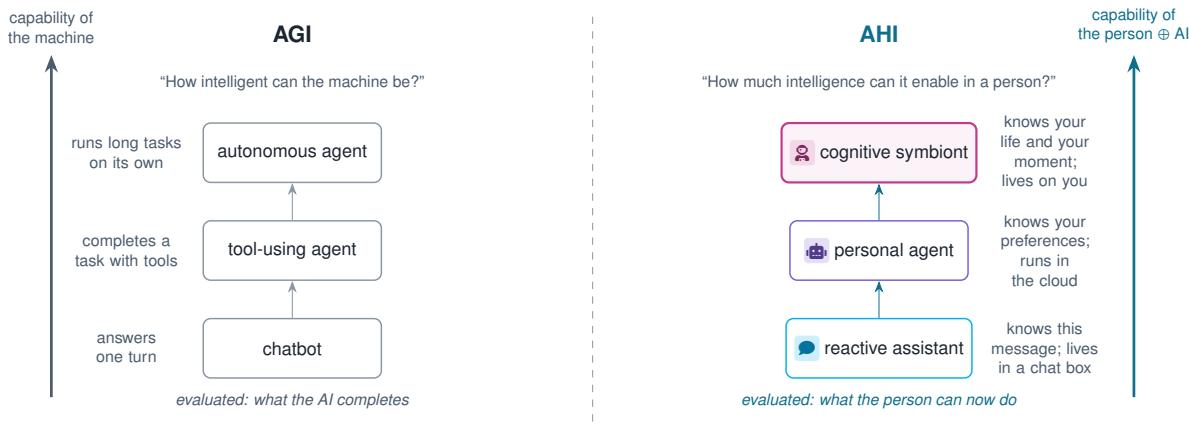
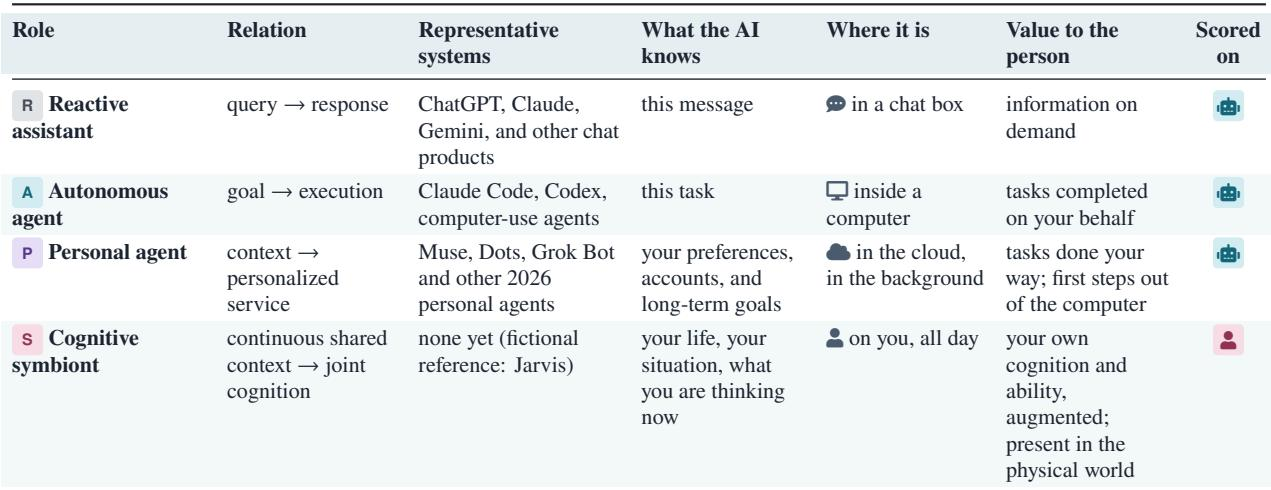
The framework distinguishes four roles in human-AI relations: reactive assistant, autonomous agent, personal agent, and cognitive symbiont. Reading down the roles, the AI knows more about the person, moves closer from a chat box to the body, and shifts from providing information toward augmenting the person's own cognition and ability. The cognitive symbiont includes the first three roles but changes the evaluation target from what the AI produced to how much stronger the person became. Reactive assistants work with a single message and provide information on demand, while autonomous agents take a task goal and complete it inside a computer. Personal agents learn long-term preferences, accounts, and goals and operate in the background from the cloud, doing tasks the person's way. A cognitive symbiont must first be a competent autonomous agent and personal agent, but its value is judged by the person's increased capability rather than the AI's output alone.
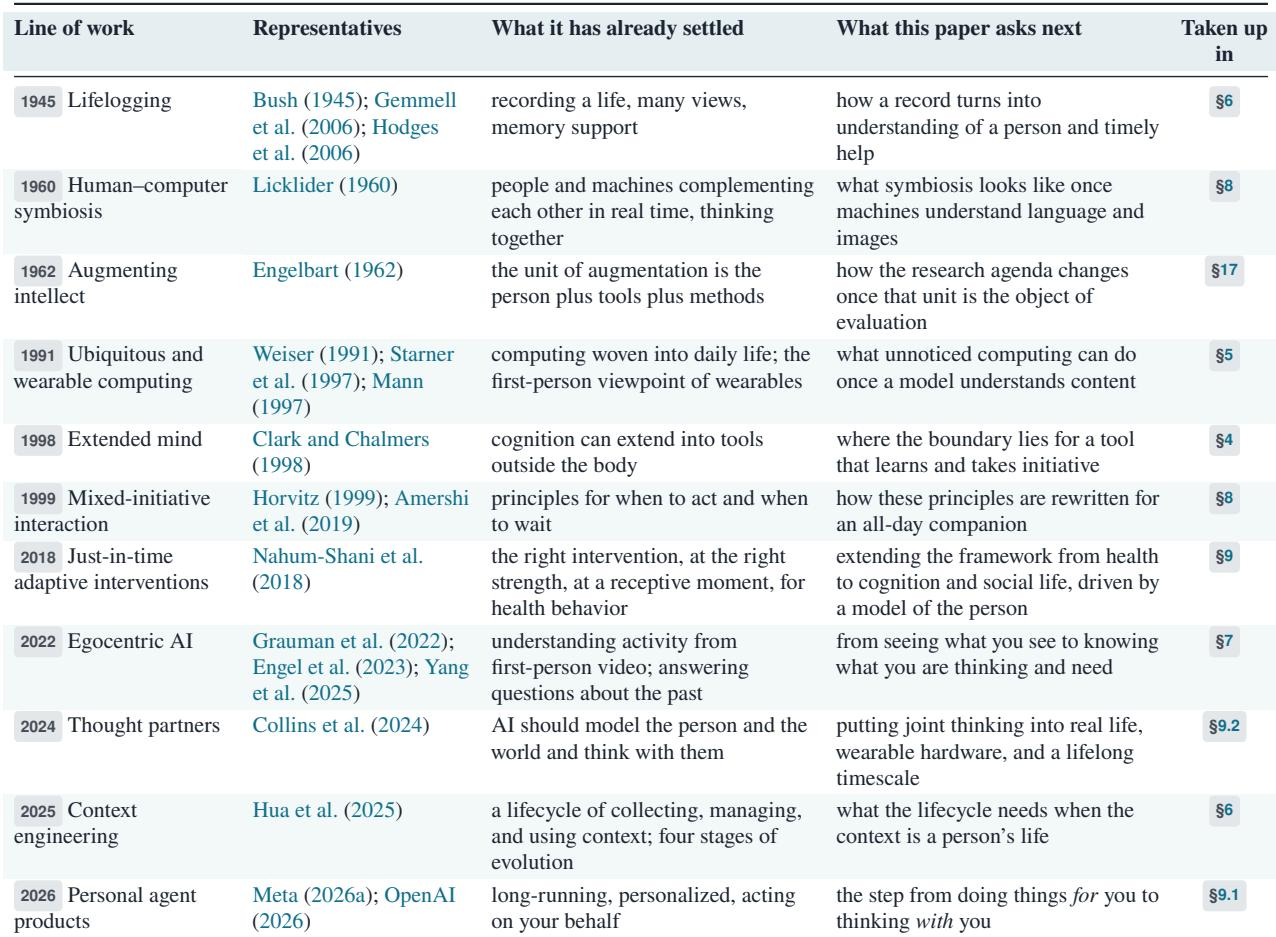
The lineage spans from early lifelogging and human-computer symbiosis through wearable computing, extended mind, and just-in-time adaptive interventions. Each line settled a foundation such as recording a life, complementing human abilities in real time, or timing help at receptive moments, and each left a question about turning records and machine understanding into personalized, timely assistance. The overall movement is from recording and augmenting human abilities toward all-day companions that model the person and intervene across cognition and social life. Lifelogging, human-computer symbiosis, and augmenting intellect settled that a life can be recorded for memory support, that people and machines can complement each other in real time, and that the unit of augmentation is the person plus tools and methods. Wearable and ubiquitous computing, extended mind, mixed-initiative interaction, and just-in-time adaptive interventions settled daily-life first-person computing, external cognition, and principles for when to act and for timing receptive-moment help; the open questions shift toward unnoticed content-aware assistance, tools that learn and take initiative, and extension from health to cognition and social life.
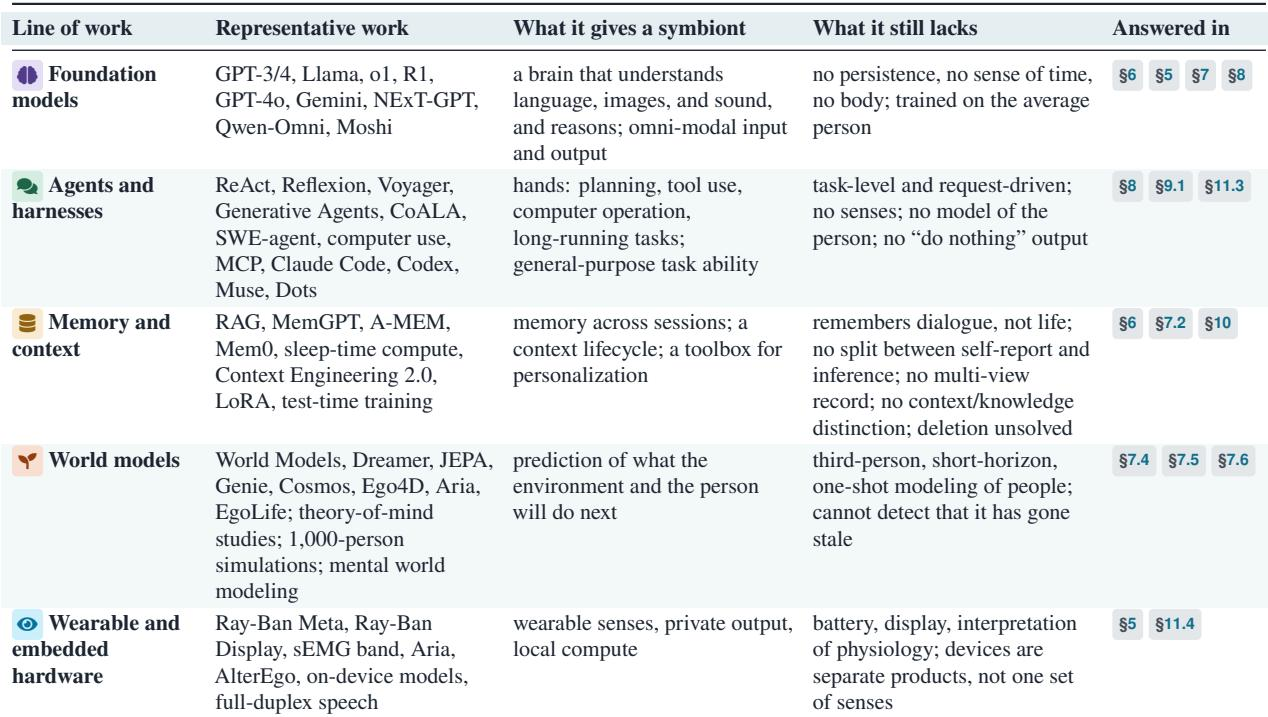
The comparison identifies five technology lines that each contribute a core capability to a cognitive symbiont: foundation models provide reasoning and multimodal understanding, agents provide action and tool use, memory systems provide cross-session context, world models provide prediction, and wearable hardware provides sensing and output. Each line still lacks the larger goal of augmenting one particular person over time, with gaps such as missing persistence, person models, lived memory, long-horizon personal prediction, and integrated devices. These gaps define the research space for the proposed framework. Foundation models offer multimodal understanding and reasoning but have no persistence, sense of time, or body, and are trained on an average person rather than one specific person. Agent harnesses add planning and tool use but remain task-level and request-driven, with no senses and no model of the person. Memory and context systems support cross-session memory and personalization but remember dialogue rather than lived experience and lack a distinction between context and knowledge. World models predict environment and person behavior but are third-person, short-horizon, one-shot models that cannot detect when they have become stale. Wearable and embedded hardware provides sensing, private output, and local compute but is limited by battery, display, physiology interpretation, and fragmented devices.
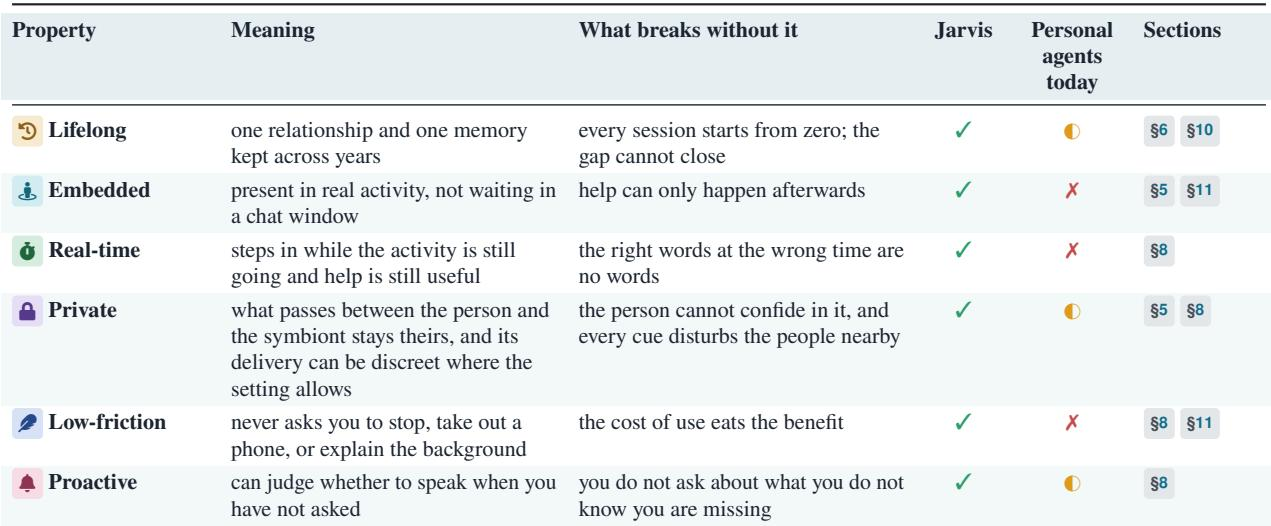
A cognitive symbiont requires six properties to be usable throughout daily life: lifelong, embedded, real-time, private, low-friction, and proactive. Jarvis is treated as satisfying all of them, while personal agents today show only partial lifelong, private, and proactive support and lack embedded, real-time, and low-friction behavior. These properties create tensions, especially proactive against low-friction and lifelong against private. Jarvis clears all six necessary properties, but personal agents today only partly satisfy lifelong, private, and proactive properties and do not satisfy embedded, real-time, or low-friction ones. Without embedded, real-time, or low-friction support, help is delayed until after the activity, arrives too late to be useful, or costs more than its benefit. The properties are not independent: being proactive can conflict with being low-friction, and being lifelong can conflict with being private.
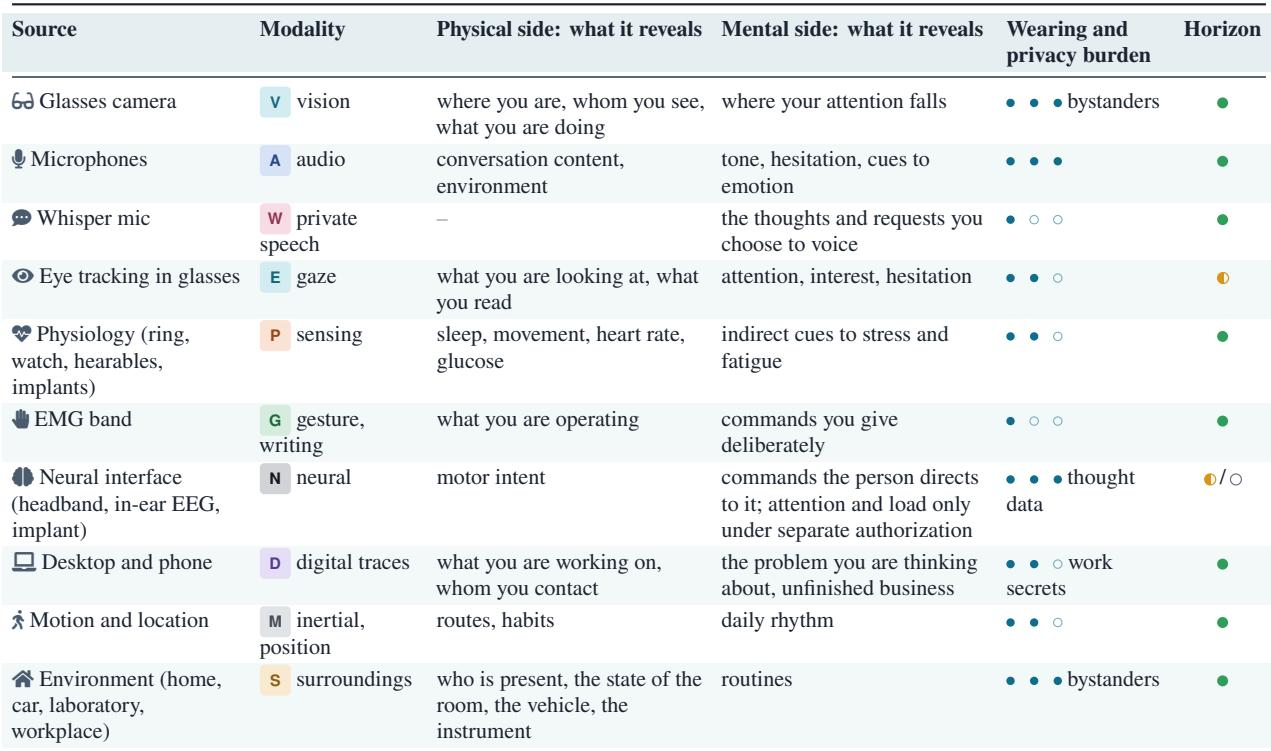
The table compares signal sources for a symbiotic sensing system, showing what each reveals about a person's physical context and mental state alongside wearing and privacy burden and readiness horizon. Several wearable sources provide immediate situational and emotional cues but often at high privacy cost, while private speech, gesture, and neural channels enable more deliberate input with different availability. Glasses cameras and microphones reveal physical activity, location, and conversation as well as attention and emotional cues, but carry high privacy burden, with camera burden falling partly on bystanders. Whisper microphones and EMG bands enable deliberate, private input such as voiced requests or gesture commands with low burden. Physiology sensors and eye tracking capture bodily state and attentional signals such as stress, fatigue, interest, and hesitation with moderate burden. Neural interfaces target motor intent and commands directed to the system, but involve thought data and remain on a distant or contingent research horizon.
The evaluation contrasts four human-AI relation roles and traces historical foundations from lifelogging and wearable computing to just-in-time interventions, showing a shift from reactive information tools toward all-day companions that augment a person's cognition. Across technology lines, foundation models, agents, memory, world models, and wearables each contribute capabilities but still lack persistence, personal models, lived memory, long-horizon prediction, or integrated devices. Comparisons of Jarvis-like properties and sensing sources further indicate that current personal agents miss embedded, real-time, and low-friction support, while wearable sensing involves trade-offs between insight and privacy burden. Overall, the framework identifies the research space for building a lifelong, private, proactive cognitive symbiont judged by how much stronger the person becomes.