Command Palette
Search for a command to run...
La mise à l’échelle vers l’AGI dépend-elle de ce que le Système 1 laisse exécuter au Système 2 ?
La mise à l’échelle vers l’AGI dépend-elle de ce que le Système 1 laisse exécuter au Système 2 ?
Résumé
Les progrès vers l’intelligence artificielle générale (AGI) ont largement reposé sur la mise à l’échelle d’un exécutif gourmand en ressources, le Système 2, par des modèles plus grands, davantage de données et de calcul, des raisonnements plus longs et un plus grand nombre d’agents. Nous nous demandons si la prochaine étape pourrait plutôt venir d’une co-conception de cet exécutif avec le Système 1, un prédicteur léger et sémantiquement conscient qui évalue les interactions candidates avant leur exécution, afin que le Système 2 n’agisse que sur celles qui en valent le coût. Notre réponse est un oui nuancé. Nous étudions l’interaction conditionnelle, une boucle prédire–filtrer–exécuter–mettre à jour : le Système 1 estime l’utilité de chaque interaction candidate, le Système 2 exécute celles qui sont admises par un seuil adaptatif, et les résultats mettent à jour le Système 1. Cette boucle couvre l’entraînement, le raisonnement au moment du test, la prise de décision adaptative et l’utilisation agentique d’outils, l’utilité et le coût étant définis par l’application. Sous un filtrage idéal et à coûts d’exécution égaux, le calcul d’exécution diminue d’un facteur approchant 1/ρu, où ρu est la densité des interactions pertinentes pour l’utilité (pondérée par le coût lorsque les coûts diffèrent) ; les erreurs de prédiction, l’exploration et le décalage de distribution réduisent cette économie. Nous bornons le regret de sélection par l’erreur du prédicteur et la marge d’utilité. Ces résultats motivent notre hypothèse centrale : ρu est une coordonnée mesurable de l’efficacité de mise à l’échelle et fait du calcul informatif une meilleure description de la mise à l’échelle que le calcul total.
One-sentence Summary
Researchers at Tsinghua University and THU-IDM propose conditional interaction, a predict-gate-execute-update loop in which a lightweight System-1 predictor gates System-2 execution across training, reasoning, decision-making, and agentic tool use, and under ideal screening execution compute falls toward 1/ρu, making ρu a measurable scaling-efficiency coordinate and informative compute a better metric than total compute.
Key Contributions
- The paper introduces a conditional interaction framework in which a lightweight System-1 predictor estimates candidate utility, an adaptive gate admits only utility-relevant interactions, and a costly System-2 executes the admitted actions; the predict-gate-execute-update loop is applied across training, test-time reasoning, decision-making, and agentic tool use.
- The paper provides theoretical support under stated assumptions, including screening and memory results, regret bounds, test-time and agentic cost bounds, and co-scaling results, plus application-specific evidence that predictive prompt and task sampling reduce execution compute, with ideal screening savings approaching a factor of 1/ρ_u.
- The paper identifies ρ_u, the density of utility-relevant interactions, as a measurable scaling-efficiency coordinate and proposes informative compute as a better scaling descriptor than total compute; the decay profile of ρ_u and the compute-optimal System-1/System-2 split are framed as concrete next steps.
Introduction
Recent progress toward artificial general intelligence has focused on scaling model capacity, data, compute, and resource-intensive System-2 reasoning, but as frontier models and multi-agent systems grow, the cost of each interaction becomes a limiting factor. The authors argue that simply increasing interaction count is inefficient because marginal returns diminish, high-quality data are finite, and many interactions, such as RLVR rollouts with uniform rewards or simulated rollouts over already mastered tasks, consume resources while yielding little learning signal. Prior work often filters after execution or randomizes across task spaces, paying the full cost of uninformative interactions. The authors introduce conditional interaction as a co-design principle: a lightweight System-1 predicts the utility of candidate interactions before execution, a costly System-2 runs only those above a resource-aware threshold, and System-2 outcomes refine System-1. They propose the density of utility-relevant interactions, rho_u, as a central efficiency metric for converting compute and data into capability across digital training, physical adaptation, and test-time inference.
Method
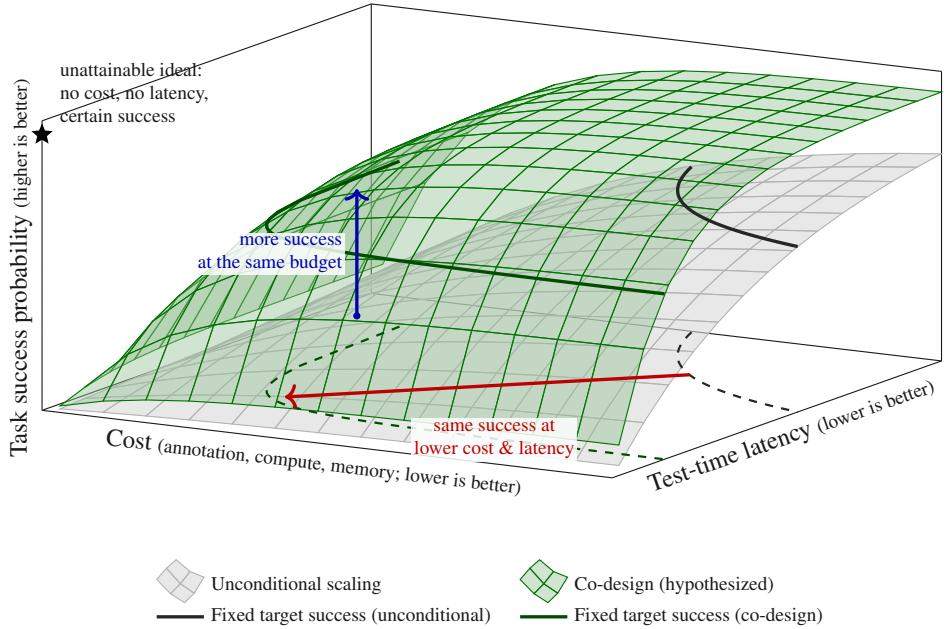
The authors propose conditional interaction as a co-design strategy where a lightweight, semantic-aware module (System-1) predicts the utility of candidate interactions, and a resource-intensive model or agent (System-2) executes only those that exceed a threshold. This co-designed pair aims to dominate the Pareto frontier over cost, latency, and task success, achieving higher success at the same budget or the same success at lower cost and latency.
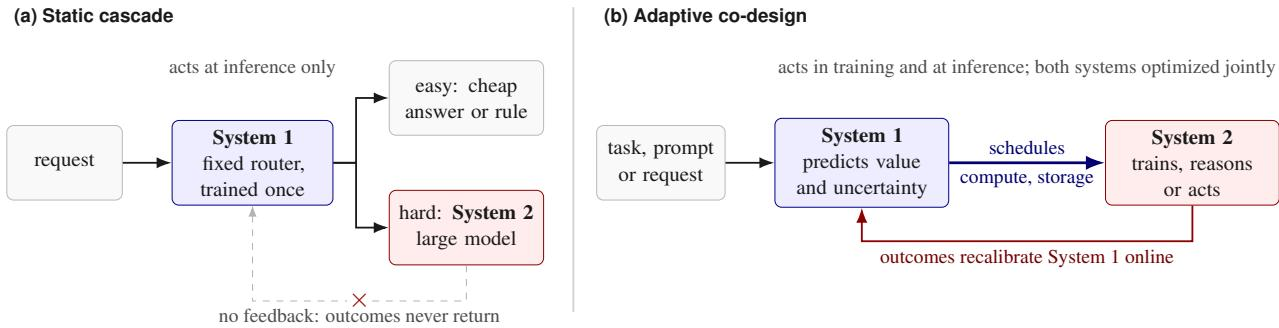
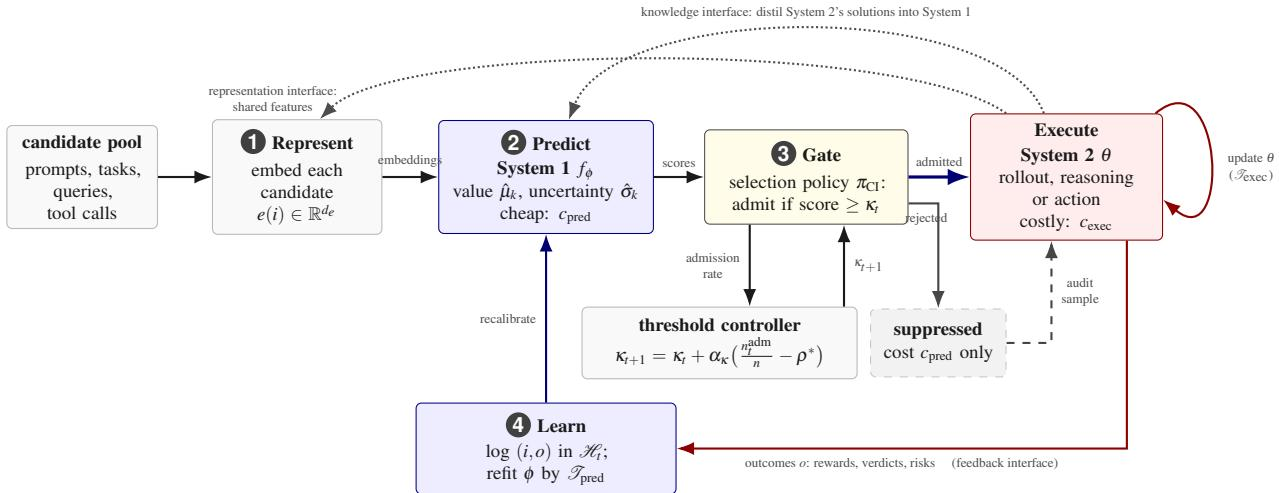
The pairing of these systems can be built as a static cascade or through adaptive co-design. In a static cascade, a fast model routes requests once at inference without receiving feedback from the large model outcomes. In contrast, adaptive co-design allows System-1 to schedule the compute and storage of System-2 during both training and inference. The outcomes from System-2 continuously recalibrate System-1 online, ensuring the predictor tracks an evolving executive.
The core interface is the predict-then-gate architecture. System-1 scores every candidate interaction at a low cost cpred. A threshold κt admits only those candidates predicted to be informative to System-2, which executes them at a much higher cost cexec≫cpred. Suppressed candidates incur only the prediction cost, while a small audit sample of suppressed candidates is executed to detect predictor misses. The realized utilities from executed outcomes are logged and used to refit System-1.
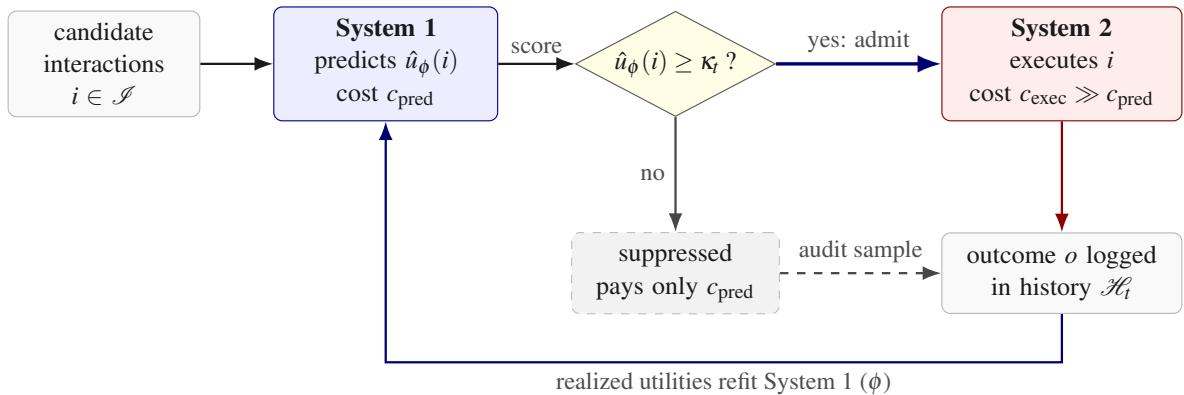
The decomposition is realized through four domain-agnostic components. First, candidates such as prompts, tasks, queries, and tool calls are embedded into a latent space. Second, System-1 predicts the value and uncertainty of each candidate cheaply. Third, a selection policy gates the candidates, admitting only those whose score clears the threshold κt, which is adjusted by a controller to maintain a target admission rate. Fourth, executed interactions are verified, logged, and used to refit System-1, while System-2 learns from the same outcomes. This architecture is supported by three interfaces: a knowledge interface for distilling solutions from System-2 into System-1, a representation interface for shared features, and a feedback interface for supervision signals.
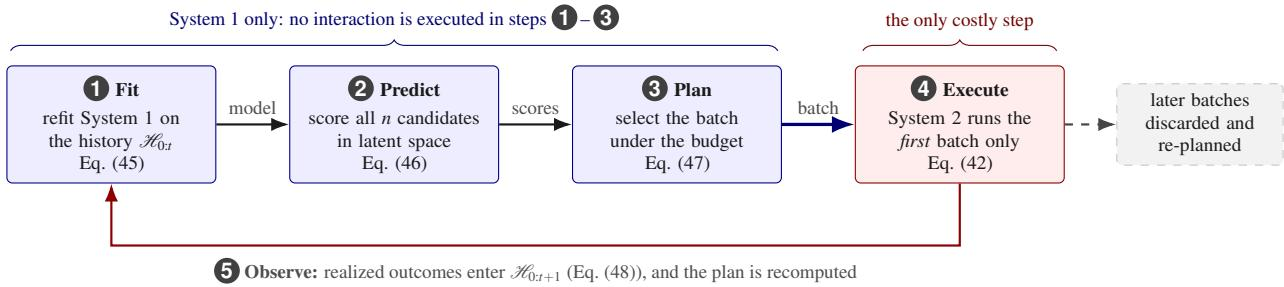
The authors frame this closed loop as receding-horizon control of a learning plant. The process begins by refitting System-1 on the history of past interactions. System-1 then scores all candidates in the latent space. Next, a budgeted selection plan is solved to choose the optimal batch. Only the first batch is executed by System-2, as it is the only costly step. Finally, the realized outcomes enter the history, and the plan is recomputed. The first three steps execute nothing in the environment but require compute, and the cost of the loop is dominated by execution only when these predictive steps are sufficiently cheap.
Experiment
This section compares predictive sampling with reactive execute-then-filter evaluation. It finds that predictive screening of cheap embeddings can sharply reduce execution cost when useful candidates are sparse and screening is cheap, with realized gains limited by screening errors. It also shows predictive scoring removes rollout-memory constraints on pool size, enabling larger candidate pools at fixed memory. Regret analysis confirms that selection is lossless when prediction error is smaller than the utility gap, while regret scales with prediction error and blind-spot candidates once errors exceed that gap.
A single conditional interaction pattern recurs across digital training, physical training, test-time reasoning, and agentic use: each interaction includes execution, and a gate admits actions whose predicted value clears a setting-specific threshold. The selection logic is shared, but the utility, learning dynamics, and conserved resource differ across settings, ranging from gradients and actuation during training to inference compute at test time and a composite agentic cost. Execution is part of each interaction in all four settings rather than a separate stage. The gate threshold is setting-specific but analogous across columns, from informative-sample rate and risk threshold to halting threshold and call/commit threshold. The conserved resource shifts from training compute or physics fidelity and actuation to inference compute, and then to a composite of latency, spend, tokens, and risk in agentic use.
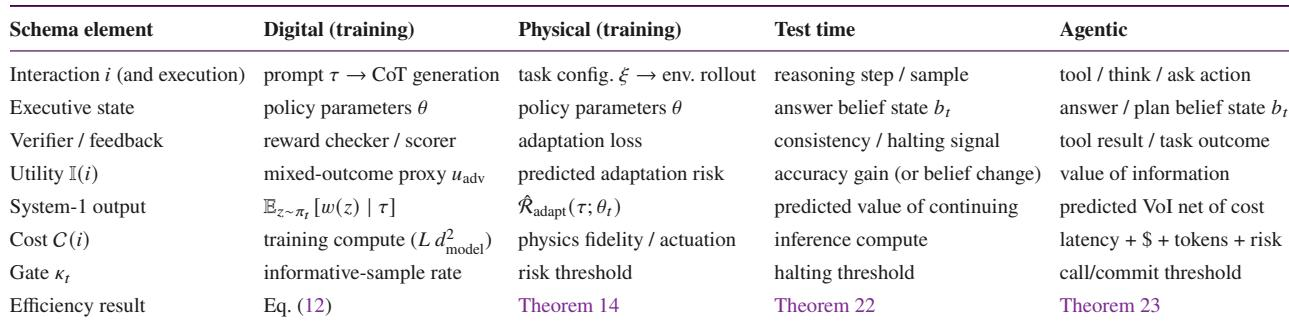
The experiments compare digital training, physical training, test-time reasoning, and agentic use, showing that all four share a conditional interaction pattern in which execution is part of each interaction and a value-based gate admits actions above a setting-specific threshold. The gate thresholds are analogous across settings, ranging from informative-sample and risk thresholds to halting and call/commit thresholds. The conserved resource also shifts by setting, from gradients and physical actuation during training to inference compute at test time and to a composite of latency, spend, tokens, and risk in agentic use.