Command Palette
Search for a command to run...
Alignement sensorimoteur : un proxy platonicien pour la réussite des politiques incarnées
Alignement sensorimoteur : un proxy platonicien pour la réussite des politiques incarnées
Yunfei Xie Howard H. Qian Shiyi Lan Kaiyu Hang Chen Wei
Résumé
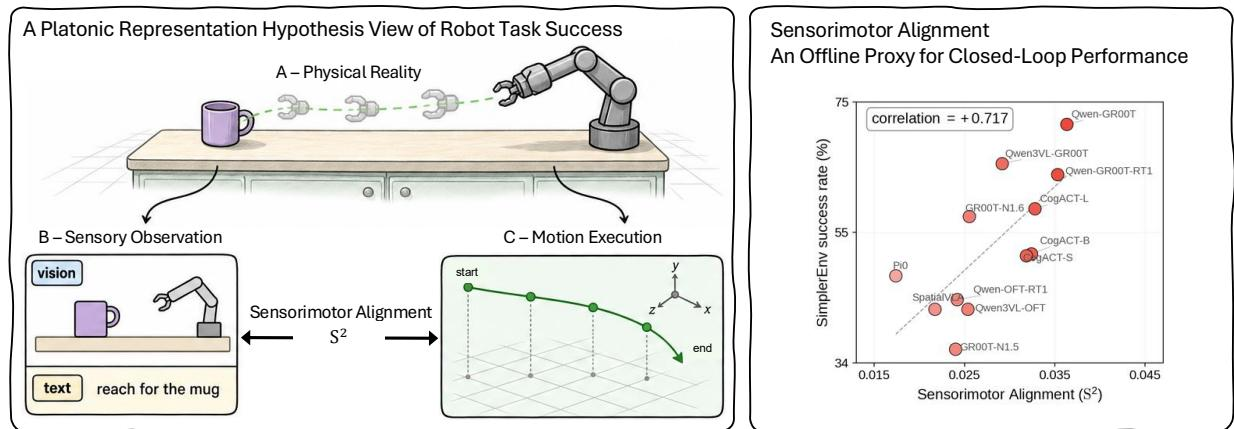
Les modèles de fondation pour la robotique sont généralement évalués au moyen de déploiements en boucle fermée coûteux, ce qui motive le recours à des indicateurs hors ligne peu coûteux de la capacité des modèles. L’hypothèse de la représentation platonicienne (Platonic Representation Hypothesis, PRH) [21] suggère qu’à mesure que les représentations s’améliorent, des modalités telles que la vision et le langage convergent vers un modèle statistique commun de la réalité. Nous nous demandons si les trajectoires de mouvement constituent une autre de ces modalités : à mesure que les modèles incarnés deviennent plus performants, leurs représentations sensorielles devraient-elles converger vers la structure du mouvement physique ? Pour tester cette hypothèse, nous proposons l’alignement sensorimoteur (Sensorimotor Alignment, S2), une métrique hors ligne sans entraînement qui mesure dans quelle mesure la représentation sensorielle d’un modèle s’aligne sur la géométrie du mouvement physique. Nous constatons que S2 est corrélé positivement au succès des tâches robotiques en aval pour différentes familles de modèles, ce qui en fait un indicateur hors ligne peu coûteux pour hiérarchiser les modèles avant une évaluation en boucle fermée. S2 peut également identifier des backbones prometteurs de modèles vision-langage (VLM) avant un ajustement fin coûteux en modèles vision-langage-action (VLA). Au-delà de cette corrélation, S2 fournit des explications au niveau des représentations pour des phénomènes observés dans les VLA et les modèles d’action du monde (world action models, WAM). Avec S2, nous étendons la PRH à la robotique et rendons l’alignement sensorimoteur mesurable, offrant ainsi une vue peu coûteuse et au niveau des représentations des modèles de fondation pour la robotique que les seuls taux de succès en boucle fermée ne peuvent à eux seuls révéler.
One-sentence Summary
Researchers at Rice University and NVIDIA propose Sensorimotor Alignment (S2), a training-free offline metric that measures how well a model’s sensory representation aligns with the geometry of physical motion, correlates positively with downstream robot task success, and enables screening of vision-language model (VLM) backbones before costly fine-tuning into vision-language-action models (VLAs), thereby extending the Platonic Representation Hypothesis (PRH) to robotics.
Key Contributions
- Introduces Sensorimotor Alignment (S^2), a training-free offline metric of alignment between sensory representations and end-effector trajectories, extending the Platonic Representation Hypothesis to robotics.
- Across VLAs, raw VLMs, WAMs in simulation, and real-robot policies, S^2 correlates positively with downstream task success, serving as a low-cost offline proxy for prioritizing models and identifying promising VLM backbones before costly fine-tuning or closed-loop evaluation.
- S^2 correlates more strongly with task success than VQA scores and video-quality metrics, and provides representation-level explanations for VLA and WAM phenomena including modality dominance, the performance drop from freezing the vision encoder, the small task-success cost of skipping iterative denoising, and the importance of mid-depth blocks for semantic reasoning.
Introduction
Robot foundation models increasingly build on large pretrained vision-language models, video models, and world action models, but selecting among them still relies on slow, noisy, and benchmark-dependent closed-loop rollouts. Existing offline proxies such as visual question answering or video-quality metrics measure passive perception or generation quality rather than whether a sensory representation is organized for action, and prior representation studies in robotics have mostly examined vision encoders without accounting for executed trajectories. The authors address this gap by extending the Platonic Representation Hypothesis to embodied models and proposing Sensorimotor Alignment (S^2), a training-free offline metric that measures whether episodes nearby in sensory feature space are also nearby in motor trajectory space. Across simulated and real-robot settings, S^2 correlates more strongly with downstream task success than VQA or video-quality metrics and also serves as a representation-level diagnostic for VLA and WAM behavior.
Method
The authors propose a metric called Sensorimotor Alignment (S2) to evaluate embodied models, motivated by the Platonic Representation Hypothesis. They hypothesize that more capable models exhibit closer alignment between their sensory representations (image and text features) and motor representations (end-effector trajectories). To make this alignment measurable, they construct both representations and compare their neighborhoods using a reference dataset of paired sensory inputs and physical motions.
For each sampled episode i, the authors form a sensory input xi by pairing a randomly sampled image frame with the task instruction. They encode this input using the vision and text encoders of a robot foundation model to obtain a sensory embedding:
zi=f(xi)∈Rd,where f applies the respective encoders and average-pools the output token features into a single d-dimensional vector.
Simultaneously, they extract the end-effector positions, orientations, and gripper states over the next h steps from the sampled frame to form the motor representation:
τi=(xi,yi,zi,ϕi,θi,ψi,gi)∈Rh×7,where the variables represent position coordinates, roll, pitch, and yaw angles, and the gripper coordinate. Positions are encoded as vectors in R3 and orientation angles as rotations in SO(3) to ensure distances reflect the geometry of translations and rotations.
To measure the alignment, the authors employ a mutual nearest-neighbor metric that compares the k-nearest-neighbor sets in both sensory and motor spaces. They utilize cosine distance in the sensory space and Dynamic Time Warping (DTW) in the motor space to accommodate trajectories at varying speeds. The distances between episodes i and j are defined as:
dsensory(i,j)=1−cos(zi,zj),dmotor(i,j)=DTW(τi,τj).Using these distance metrics, they form the sensory k-nearest-neighbor set Nsensory(i) and the motor k-nearest-neighbor set Nmotor(i) for each episode. The alignment score is calculated by taking the intersection of these two sets, dividing its size by k, and averaging over all N episodes:
mNN=Nk1i=1∑N∣Nsensory(i)∩Nmotor(i)∣.The authors visualize this neighborhood comparison process to illustrate how shared neighbors reflect alignment. As shown in the figure below:
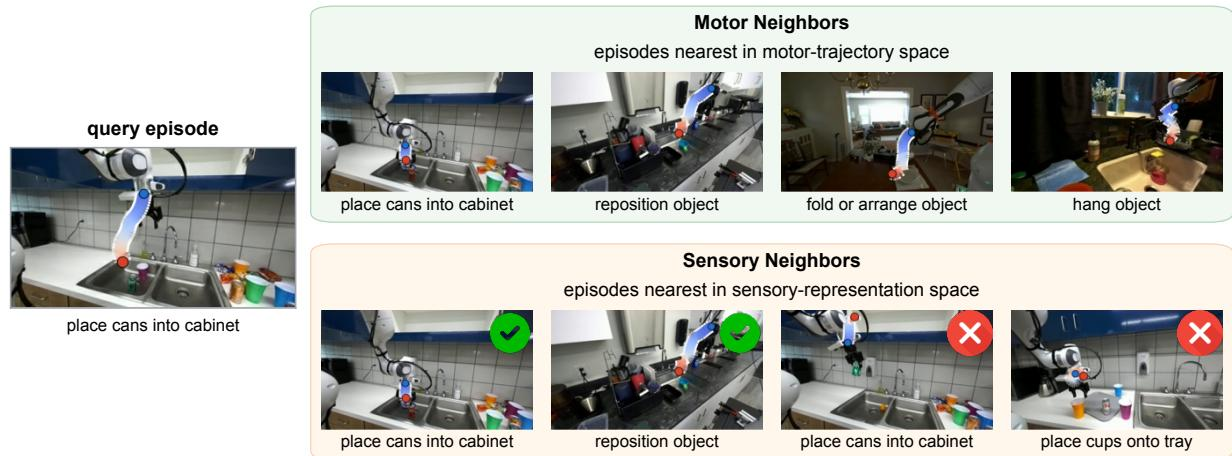
A greater overlap indicates that episodes with similar sensory representations also follow similar motor trajectories. In practice, the reported S2 metric utilizes a centered, normalized variant of this nearest-neighbor approach with k=10 neighbors.
Experiment
The experiments evaluate sensorimotor alignment, a metric comparing sensory and motor episode neighborhoods, as an offline predictor of downstream robot manipulation success. Across vision-language-action models, vision-language model backbones, world action models, and real-robot policies, higher alignment consistently corresponds to higher task success, and it tracks success more reliably than VQA or video-quality metrics while remaining stable across datasets, horizons, and evaluation choices. A mismatched-embodiment control weakens the correlation, supporting the metric as embodiment-sensitive. Representation-level analyses further show that fine-tuned policies rely mainly on visual rather than language features for motion, that freezing vision encoders limits alignment gains, and that early denoising features and mid-depth video backbone blocks already carry the strongest sensorimotor alignment.