Command Palette
Search for a command to run...
BlenderWorld : évaluation comparative des agents visuels pour la création 3D à partir de références du monde réel
BlenderWorld : évaluation comparative des agents visuels pour la création 3D à partir de références du monde réel
Résumé
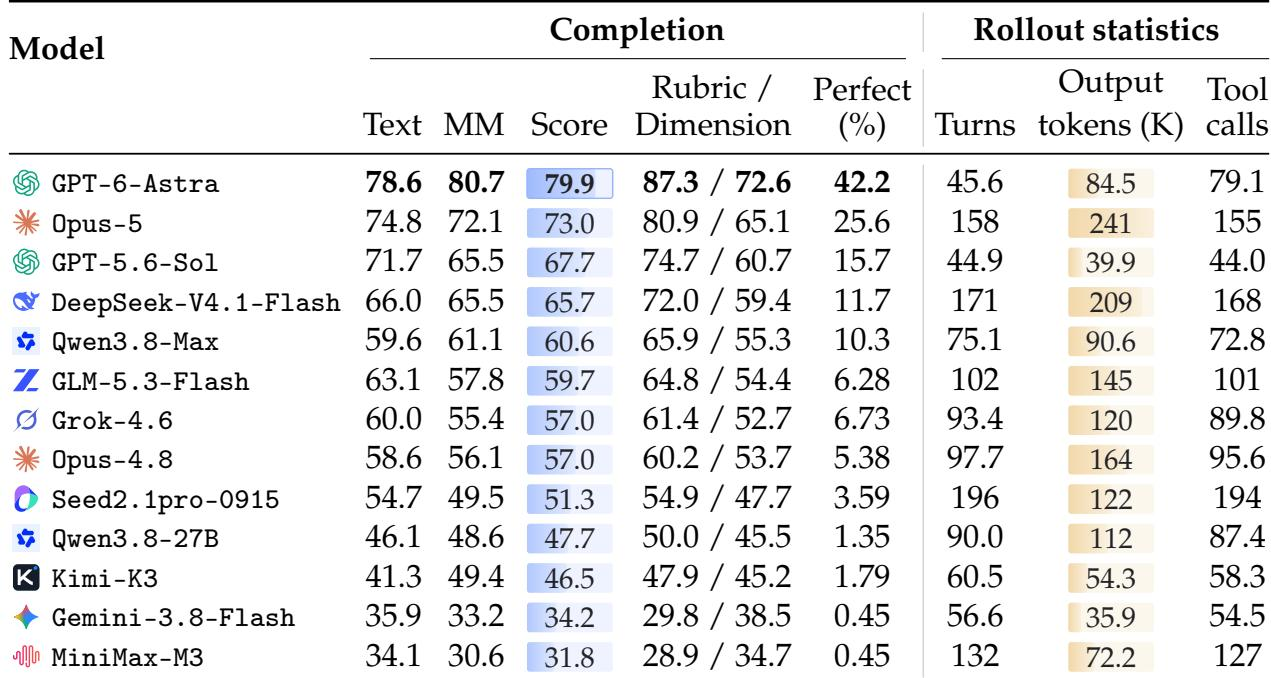
Les progrès récents des grands modèles de langage multimodaux (MLLM) leur permettent désormais d'agir comme des agents autonomes, créant et modifiant des modèles 3D par le biais de code ou de manipulation directe de logiciels. Dans les flux de travail pratiques, ces modèles doivent déduire les formes des objets, les matériaux, les agencements spatiaux et l'éclairage à partir de références diverses, tout en suivant strictement les instructions pour reconstruire, modifier ou concevoir du contenu 3D. Cependant, les référentiels d'évaluation existants couvrent de manière limitée ces requêtes ouvertes dans des scénarios du monde réel. Pour combler cette lacune, nous présentons BLENDERWORLD, le premier banc d'essai complet consacré à l'évaluation de modèles de pointe sur des tâches réalistes de création 3D. BLENDERWORLD comprend 223 tâches couvrant l'architecture, les produits, les environnements naturels et la visualisation scientifique, pilotées par des entrées textuelles, des images, des vidéos et des spécifications structurées. Afin d'évaluer rigoureusement ces livrables complexes, nous établissons un protocole d'évaluation unifié : nous rendons les projets Blender soumis depuis plusieurs points de vue et les évaluons à l'aide de 2 651 rubriques binaires spécifiques aux tâches, complétées par des scores holistiques de qualité visuelle. L'évaluation de treize modèles de pointe révèle que GPT-6-Astra obtient le score fusionné global le plus élevé, soit 79,9, suivi d'Opus-5 (73,0) et de GPT-5.6-Sol (67,7). En définitive, nos résultats mettent en évidence un goulot d'étranglement critique : si les modèles actuels parviennent à analyser des instructions générales, ils éprouvent encore de profondes difficultés en matière de cohérence spatiale 3D fine et de reproduction structurelle précise dans Blender, laissant une marge de progression substantielle pour les futures agentiques natives 3D.
One-sentence Summary
Researchers from Zhejiang University, Alibaba Group, and collaborating institutions introduce BLENDERWORLD, the first comprehensive benchmark for evaluating frontier models on realistic 3D creation from real-world references, which spans 223 tasks across architecture, products, natural environments, and scientific visualization and is assessed through multi-view rendering of submitted Blender projects, 2,651 task-specific binary rubrics, and holistic visual quality scores; benchmarking thirteen frontier models shows GPT-6-Astra leading with an overall fused score of 79.9, followed by Opus-5 at 73.0 and GPT-5.6-Sol at 67.7, and reveals that fine-grained 3D spatial coherence and accurate structural reproduction remain critical bottlenecks.
Key Contributions
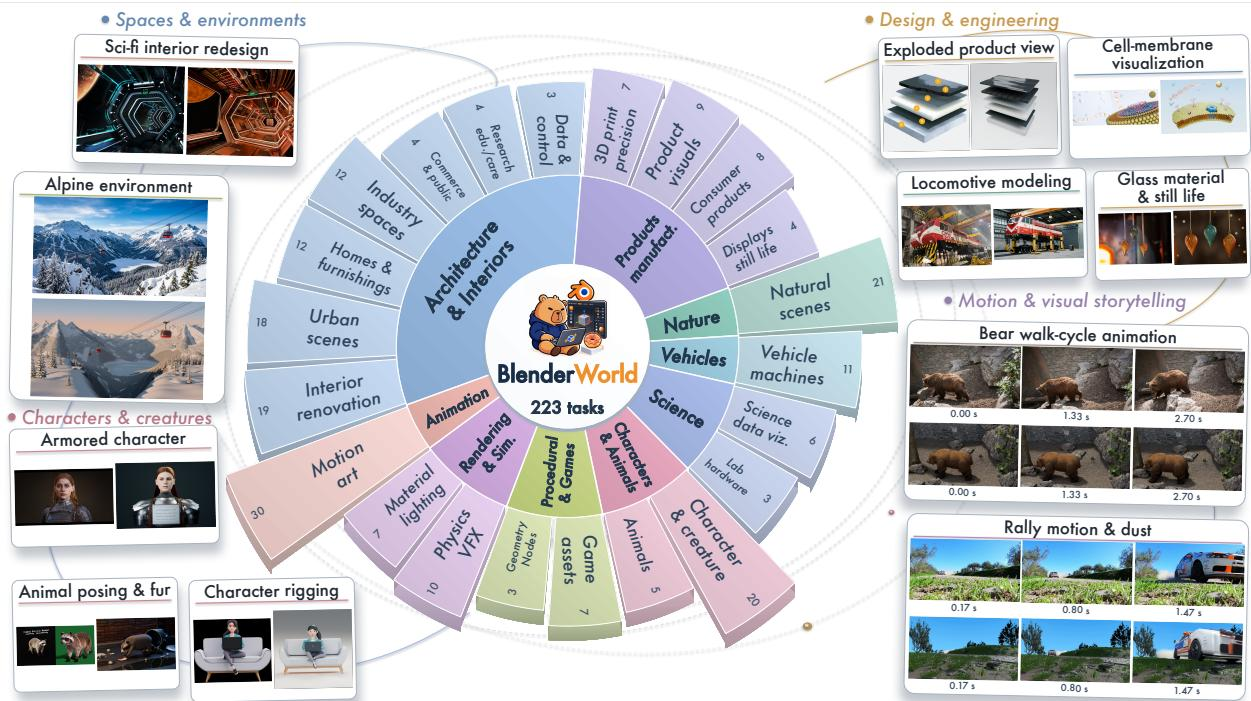
- BLENDERWORLD introduces 223 realistic Blender tasks spanning 22 subcategories across text, image, video, and specification-driven 3D reconstruction, modification, and design requests.
- A unified evaluation protocol uses task-conditioned multiview rendering of submitted Blender projects and scores them with 2,651 task-specific binary rubrics, verified by visual judges and programmatic scene-state inspection, plus holistic visual quality scores.
- Benchmarking thirteen frontier models establishes strong baselines: GPT-6-Astra achieves the highest fused score of 79.9, followed by Opus-5 at 73.0 and GPT-5.6-Sol at 67.7, while current agents pass every rubric criterion on only 42.2% of tasks and struggle with fine-grained 3D spatial coherence.
Introduction
Visual agents built on multimodal large language models are increasingly used for 3D modeling, where tasks demand long-horizon tool coordination, spatial reasoning, and active visual verification. Existing Blender-based benchmarks are often narrow, focusing on individual objects, small camera or scene-editing tasks, or predefined geometric objectives, and evaluation frequently relies on a single rendered view rather than inspecting underlying scene structure. The authors introduce BLENDERWORLD, a benchmark of 223 realistic Blender tasks across 16 application scenarios and 9 categories, driven by text, image, and video references and requiring fully editable projects. Its evaluation protocol combines task-conditioned multi-view rendering, 2,651 binary rubrics, and a dual visual and programmatic judging system. Benchmarking 13 frontier models reveals that strong agents can produce plausible visuals but still struggle to translate visual feedback into structurally sound 3D corrections.
Dataset
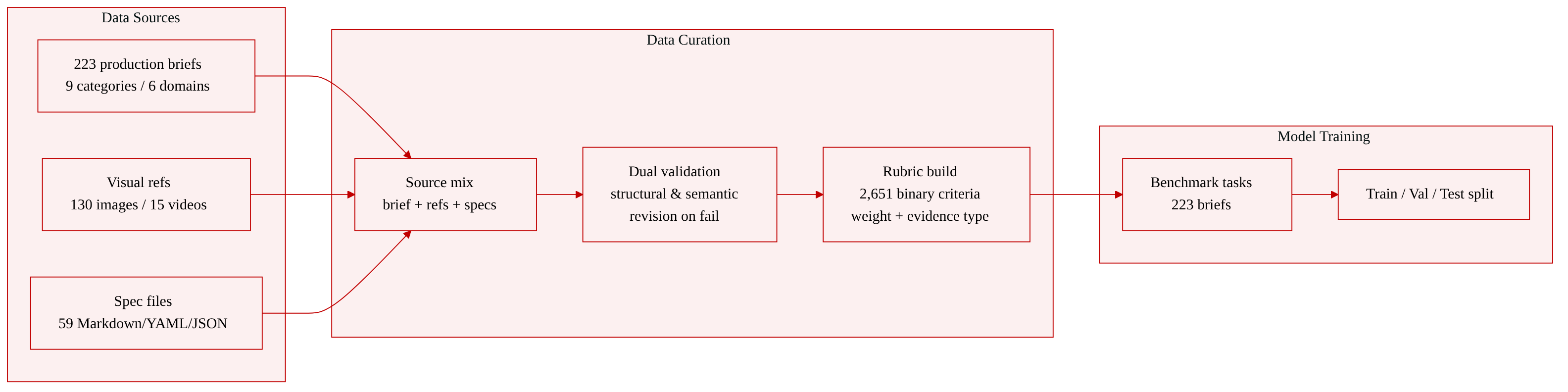
The authors construct BLENDERWORLD as a benchmark of 223 production briefs.
-
Dataset composition and sources
- 223 production briefs across 9 main task categories and 22 subcategories.
- Domains include architecture and interiors, products and manufacturing, vehicles and machinery, characters and animals, nature and landscapes, and scientific visualization.
- Tasks span 16 application scenarios.
- 145 briefs (65.0%) provide visual references: 130 images and 15 videos.
- 59 briefs (26.5%) include Markdown, YAML, or JSON specification files with dimensions, materials, camera settings, or asset budgets.
- Visual references and specification files can co-occur in the same brief.
-
Construction, filtering, and processing
- Task design varies target domain, scene complexity, user expertise, and request length.
- Reference images are curated from interiors, architecture, products, mechanical structures, and natural environments.
- An MLLM assesses image quality and structural complexity; preferred images have clearly identifiable structures and detailed shape, layout, or material information.
- Each visual reference receives one of three roles: recreation, modification, or reference-based design.
- Each brief is placed in a realistic application scenario and phrased as a natural-language production request.
- Structured attachments must be explicitly referenced in the request.
- Structural validation checks metadata compatibility, file accessibility, parseability, and that each brief asks for rendered outputs plus an editable project.
- Semantic validation uses a separate model to check image-text alignment, constraint consistency, key requirement preservation, and feasibility; failed tasks are revised.
-
Rubric construction
- The authors extract binary criteria from validated briefs, with source links for each criterion.
- Criteria are assigned to 13 categories and weighted 3 for major, 2 for secondary, and 1 for detail.
- Evidence type is either render or scene_summary.
- Reviewer models cross-check coverage, source support, and evaluability; an editor resolves issues before the final schema is frozen.
-
Evaluation statistics
- 2,651 binary criteria across 13 rubric categories.
- 6 to 22 criteria per task, with a mean of 11.9.
- Function and geometry account for 41.7% of criteria.
- 83.3% of criteria have major importance.
- 41.8% of criteria use rendered views; 58.2% use scene inspection.
- 500 criteria (18.9%) come from explicit specification-file requirements.
-
Usage
- The paper uses the 223 briefs as benchmark tasks.
- Models must produce rendered outputs and an editable project, and the rubric criteria are used to score those outputs.
Method
The authors construct the BLENDERWORLD benchmark through a structured pipeline that organizes task coverage along category taxonomy and application scenarios. As shown in the figure below, the end-to-end workflow encompasses diversified task curation, brief specification with dual-track validation, and multi-model verified rubric derivation.
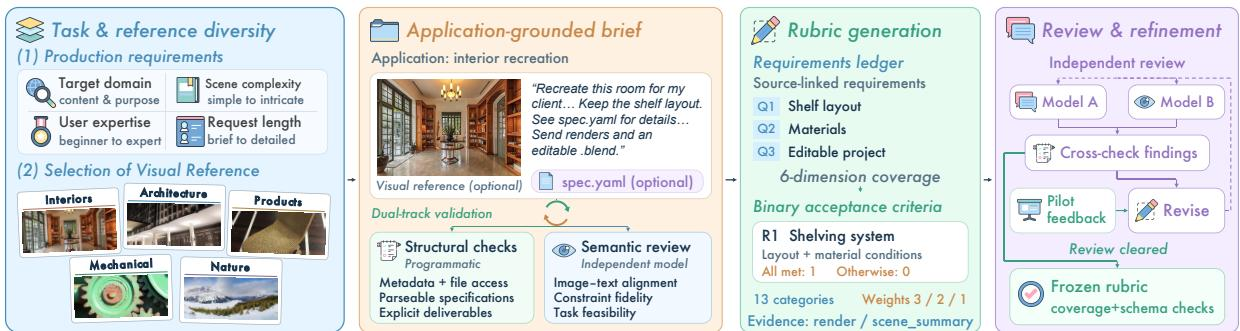
The process begins with task and reference diversity. The authors vary production requirements across target domains, scene complexity, user expertise, and request length. For reference use, they curate diverse images spanning interiors, architecture, products, mechanical structures, and natural environments. A Multimodal Large Language Model (MLLM) assesses these images for quality and structural complexity. Each visual reference is assigned one of three roles: recreation, which preserves main shapes and spatial relationships; modification, which makes requested changes while retaining specified structures; or reference-based design, which draws on the depicted form or style to develop a new design.
Next, the authors formulate application-grounded specifications. Given the production target and reference role, each specification is situated in a realistic application scenario, such as construction reports emphasizing structural relationships or product presentations focusing on appearance. Specifications are expressed as natural-language requests stating the production goal and key requirements. Detailed tasks may include Markdown, YAML, or JSON attachments containing dimensions, material lists, or camera settings.
To ensure quality, the authors implement a dual-track validation process for structural and semantic consistency. Structural checks verify metadata compatibility, file accessibility, parseable specifications, and explicit requests for rendered outputs and editable projects. For semantic review, an independent model examines the initial specification, rewritten request, reference image, and attachments to check image-text alignment, constraint consistency, and task feasibility. Tasks failing validation are fed back into the generation process for revision.
Finally, the rubric generation phase extracts requirements from validated briefs, converting them into binary criteria with source links. Each criterion is assigned to one of 13 categories, weighted as major, secondary, or detail (3/2/1), and designated an evidence type: render for visual properties or scene_summary for project inspection. The authors iteratively refine drafts via pilot evaluations to flag ambiguities. At least two independent reviewer models then cross-check coverage, source support, and evaluability using concrete counterexamples. An editor resolves flagged issues, with semantic changes triggering re-review, before freezing the final schema.
Experiment
The experiments evaluate thirteen agents on 223 text and multimodal tasks in BlenderWorld, using automatic agent rendering, evidence-routed rubric judging, and dimension scoring. GPT-6-Astra leads overall and on multimodal tasks, yet perfect rubric completion remains rare, and category analysis shows stronger results for procedural, product, and architectural scenes while natural scenes and characters are more difficult. Tool-use results indicate that higher interaction volume does not guarantee better quality, and failure analysis highlights recurring weaknesses in physical interactions, 3D spatial coherence, fine-grained geometry, and ground contact, suggesting agents often rely on 2D visual shortcuts.
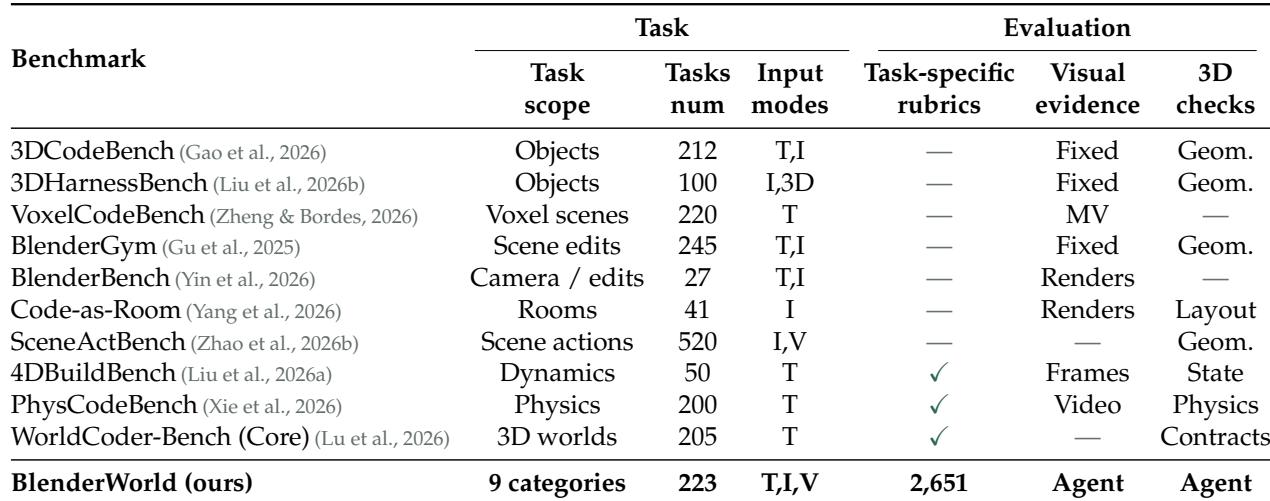
BLENDERWORLD covers nine task categories and 16 application scenarios, spanning reconstruction, modification, and reference-based design. Compared with prior object, scene, and camera benchmarks, it uniquely combines multimodal references and specification files with task-specific rubrics, agent-selected views, and inspection of editable projects. Most earlier benchmarks rely on fixed renders or geometric checks and do not use rubric-driven compliance evaluation. Existing benchmarks focus on narrower tasks such as objects, voxel scenes, rooms, or scene edits, while BLENDERWORLD spans nine task categories and 16 application scenarios. BLENDERWORLD is the only compared benchmark that combines text, image, video, or native 3D references with task-specific rubrics, agent-selected views, and editable project inspection. Function and geometry requirements dominate its rubric criteria, and scene inspection accounts for a larger share of judging than rendered views.
GPT-6-Astra leads all completion metrics across the BLENDERWORLD benchmark, ahead of Opus-5 and other evaluated models, with larger advantages on multimodal tasks than on text-only tasks. Its perfect completion rate is the highest but remains below half of tasks, showing that satisfying every rubric requirement is still difficult. Higher scoring is not tied to higher rollout volume; GPT-6-Astra uses fewer output tokens and tool calls than lower-scoring Opus-5 and DeepSeek-V4.1-Flash. GPT-6-Astra ranks first in overall, text-only, multimodal, rubric, dimension, and perfect completion metrics among the compared models. Even the strongest model fully satisfies the rubric on fewer than half of tasks, and lower-ranked models reach perfect completion less often. Despite scoring highest, GPT-6-Astra uses substantially fewer output tokens, tool calls, and image inspections than lower-scoring models such as Opus-5 and DeepSeek-V4.1-Flash.
Tool allocation data reveal distinct agent strategies: similar proportional spending on execution and viewing can accompany very different absolute workloads. Higher visual inspection volume does not reliably improve multimodal performance, as the strongest performer uses relatively few image inspections while some high-volume inspectors achieve only moderate or poor scores. One agent stands out by prioritizing asset manipulation instead of relying mainly on execution and viewing. Agents with similar budget fractions for execution and viewing can differ sharply in absolute call volume, with one top performer using roughly half the executions and views of another. More image inspection calls do not guarantee better artifact refinement; the top multimodal scorer inspects images relatively infrequently while some frequent inspectors underperform. One agent leads in asset operations, indicating a strategy centered on asset manipulation rather than only executing and viewing.
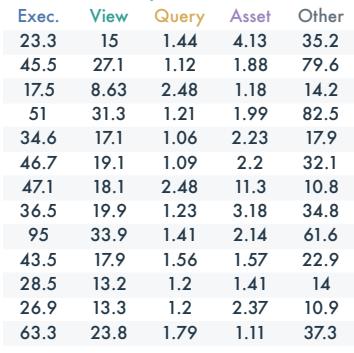
The experiments evaluate BLENDERWORLD, a benchmark spanning nine task categories and 16 application scenarios that combines multimodal references, task-specific rubrics, agent-selected views, and editable project inspection. Results show GPT-6-Astra achieves the best overall, text-only, multimodal, rubric, and completion scores, but even it fully satisfies all rubric requirements on fewer than half of tasks while using fewer tokens and tool calls than lower-scoring models. Tool allocation analysis reveals distinct agent strategies, with similar execution and viewing budgets corresponding to very different workloads, and confirms that more image inspections do not reliably improve multimodal performance.