Command Palette
Search for a command to run...
Rapport technique de MOSS-Image
Rapport technique de MOSS-Image
Modèle de génération d’images à partir de texte MOSS-Image-SFT
Résumé
Les systèmes récents de génération d'images à code source fermé peuvent produire des contenus visuels variés, allant de compositions simples à des graphiques riches en informations, mais les modèles texte-image à poids ouverts peinent encore à restituer un texte dense et des mises en page complexes. Pour réduire cet écart, nous présentons MOSS-Image, un système de génération ouvert qui associe une synthèse visuelle haute fidélité à une composition tenant compte de l'intention. Premièrement, nous préentraînons à partir de zéro un transformateur de diffusion (DiT) à flux unique de 5 milliards de paramètres selon une recette soigneusement conçue, permettant un rendu bilingue de textes longs et un contrôle précis de la mise en page. Deuxièmement, nous développons un module d'amélioration de requête agentique sensible à l'intention (PE) qui traduit des demandes utilisateur variées en spécifications détaillées de contenu et de mise en page. Ensemble, ces éléments permettent à MOSS-Image de générer des images riches en texte et cohérentes sur le plan de la mise en page. Nous introduisons en outre LongLongTextBench (LLTB) pour évaluer le rendu de textes longs en anglais et en chinois, ainsi que RealLayoutArena (RLA) pour la génération de bout en bout riche en mises en page. MOSS-Image atteint des performances de pointe parmi les modèles à poids ouverts sur LLTB, avec une couverture textuelle moyenne de 96,3 %. Sur RLA, MOSS-Image se classe deuxième dans la comparaison des systèmes de bout en bout, tandis que son réseau principal se classe premier parmi les générateurs évalués avec des requêtes améliorées partagées. Nous publierons le modèle, la recette d'entraînement et le cadre d'évaluation afin de soutenir la recherche future et de faire progresser la communauté de la génération texte-image.
One-sentence Summary
Researchers from MOSI Intelligence, SII, Fudan University, and Shanghai Jiao Tong University introduce MOSS-Image, an open text-to-image system that combines a from-scratch pretrained 5B single-stream diffusion transformer (DiT) with an intention-aware agentic prompt enhancement module for bilingual dense-text rendering and layout control, achieving 96.3% text coverage on LongLongTextBench and second place on RealLayoutArena.
Key Contributions
- The paper presents a 5B single-stream diffusion transformer foundation model for MOSS-Image, pretrained from scratch with broad data retention, multi-granularity and structure-aware supervision, and progressive-resolution training. This model enables bilingual long-form text rendering and precise layout control, achieving state-of-the-art open-weight performance on LongLongTextBench with a Mean-6 score of 96.3.
- The paper introduces an intention-aware agentic prompt enhancement module that translates diverse user requests into detailed content and layout specifications, forming the MOSS-Image end-to-end generation system. On RealLayoutArena, the system ranks second in the end-to-end comparison at 1698.70 Elo, while the backbone achieves the highest rating at 1807.34 Elo under shared enhanced natural-language prompts.
- The paper contributes LongLongTextBench and RealLayoutArena as benchmarks for long-form bilingual text rendering and layout-rich generation. Prompt-strategy ablations and cross-backbone comparisons show that detailed content and design instructions substantially improve human preference over concise requests.
Introduction
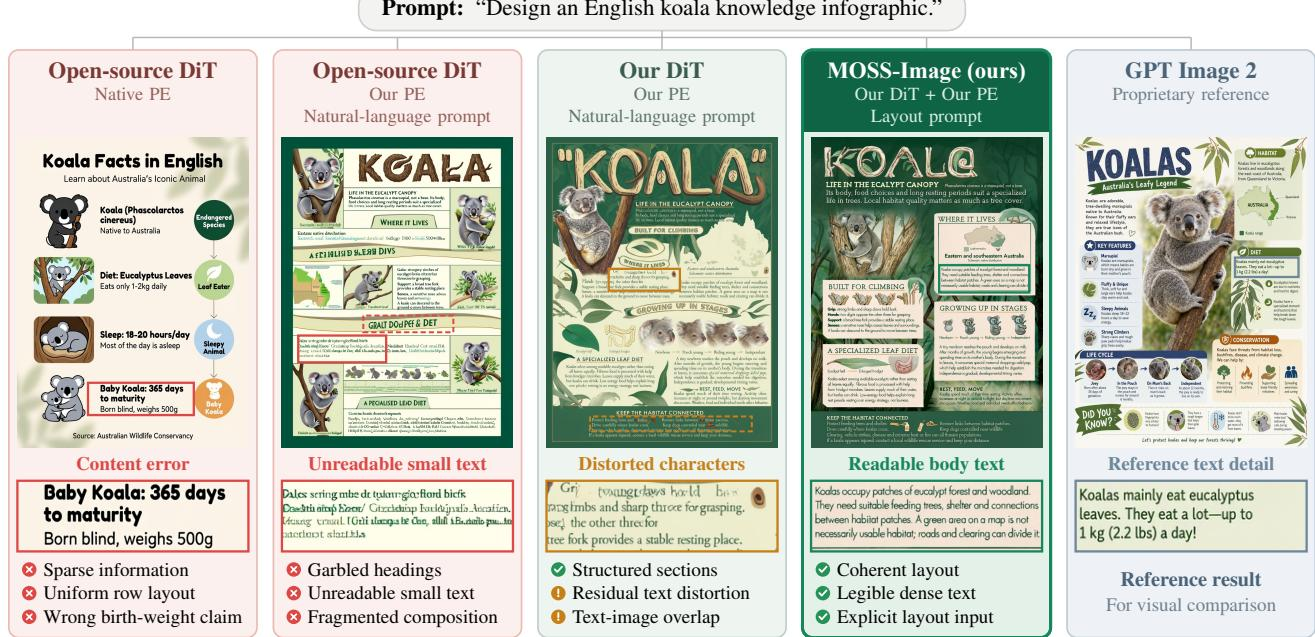
Text-to-image foundation models have made strong progress in visual quality and semantic alignment, and open-weight systems have made these capabilities more accessible. However, for information-dense graphics such as infographics, user interfaces, and knowledge cards, open models still struggle with dense text and intricate layouts; a plausible overall appearance does not guarantee legible text, complete content, or coherent spatial organization. The authors identify two coupled challenges: faithfully rendering long text and spatial constraints, and translating sparse user requests into appropriate content and layout specifications. To address this, they introduce MOSS-Image, which pairs a 5B diffusion transformer pretrained from scratch with an intention-aware agentic prompt enhancer. The system unifies natural-language and layout conditioning in a single text pathway, while the enhancer converts brief user requests into structured, executable layout plans. They also introduce LongLongTextBench for bilingual long-form text rendering and RealLayoutArena for end-to-end evaluation of complex graphic generation from short design requests.
Dataset
Pretraining Corpus
Sources and scale
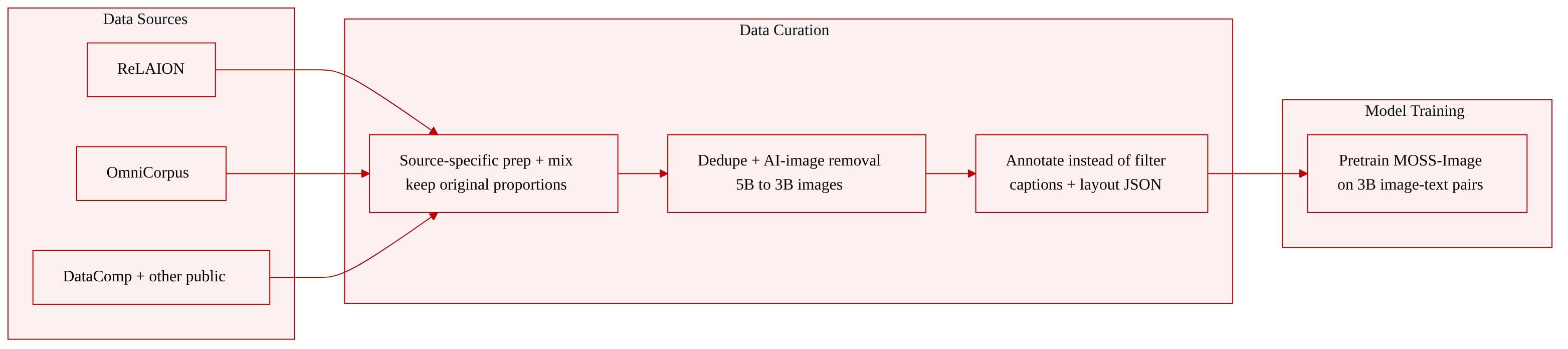
- The corpus is built from ReLAION, OmniCorpus, DataComp, and additional public image-text datasets.
- Source-specific preprocessing is applied during the original dataset builds.
- After SSCD-based deduplication and removal of AI-generated images with an in-house detector, the corpus is reduced from about 5 billion to about 3 billion images.
- Data sources are mixed in their original proportions, with no additional reweighting described.
Filtering strategy
- After deduplication and AI-image removal, no further filtering is applied at the corpus preparation stage.
- Quality filters already used during source builds, such as ReLAION NSFW and watermark checks, are still retained.
- The authors deliberately avoid excluding images for residual issues such as watermarks, blurry faces, or compression artifacts.
- Instead of filtering these cases out, the artifacts are annotated in the textual supervision to preserve broad visual coverage.
Annotation and schema
- Images are kept rather than discarded, and their artifacts are captioned.
- A ReLAION example includes the original caption, three recaptions, and a layout JSON.
- The layout JSON contains object and text boxes; visible text is transcribed verbatim, including line breaks.
- The text does not describe a separate cropping strategy; the emphasis is on retaining full images and adding artifact descriptions.
Usage in the model
- The processed 3B-image corpus is used for pretraining MOSS-Image.
- The pretraining recipe keeps all images after deduplication and AI removal, with artifact captioning used as supervision instead of exclusion.
Evaluation Benchmarks
The paper separates evaluation of the pretrained generator from evaluation of complete generation systems.
- LongTextBench: measures bilingual text rendering; results for strong models cluster between 96.05 and 98.85 overall, and the authors consider it close to saturation under its text-coverage metric. Its targets average about 120.3 characters.
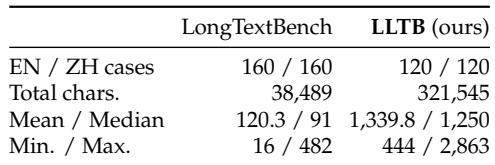
- LongLongTextBench: constructed with 240 literary-text rendering tasks, 120 in English and 120 in Chinese, across three body-length bins. It averages about 1,339.8 characters per target and contains about 321,545 total characters. It reuses the LongTextBench OCR and word/character multiset-recall metric, with coverage averaged equally across six language-length groups.
- 7Bench: measures layout control and is used to evaluate the MOSS-Image backbone without the agentic prompt enhancer.
- RealLayoutArena: constructed from 61 manually selected design references: 20 posters, 20 infographics, and 21 user interfaces. Raters compare two outputs for the same short request, with model names hidden, and score instruction following, rendering quality, and spatial organization. Bradley-Terry ratings are fitted on an Elo scale, and ties or cases where both outputs are bad count as half-wins.
Usage
- LongTextBench, LongLongTextBench, and 7Bench evaluate the pretrained generator backbone.
- RealLayoutArena evaluates complete generation systems on concise design requests.
Method
The authors introduce MOSS-Image, a system designed to generate highly controlled, text-rich graphics from concise user instructions. The framework pairs an intent-aware prompt enhancer with a pretrained text-and-layout generator.
As shown in the figure below:
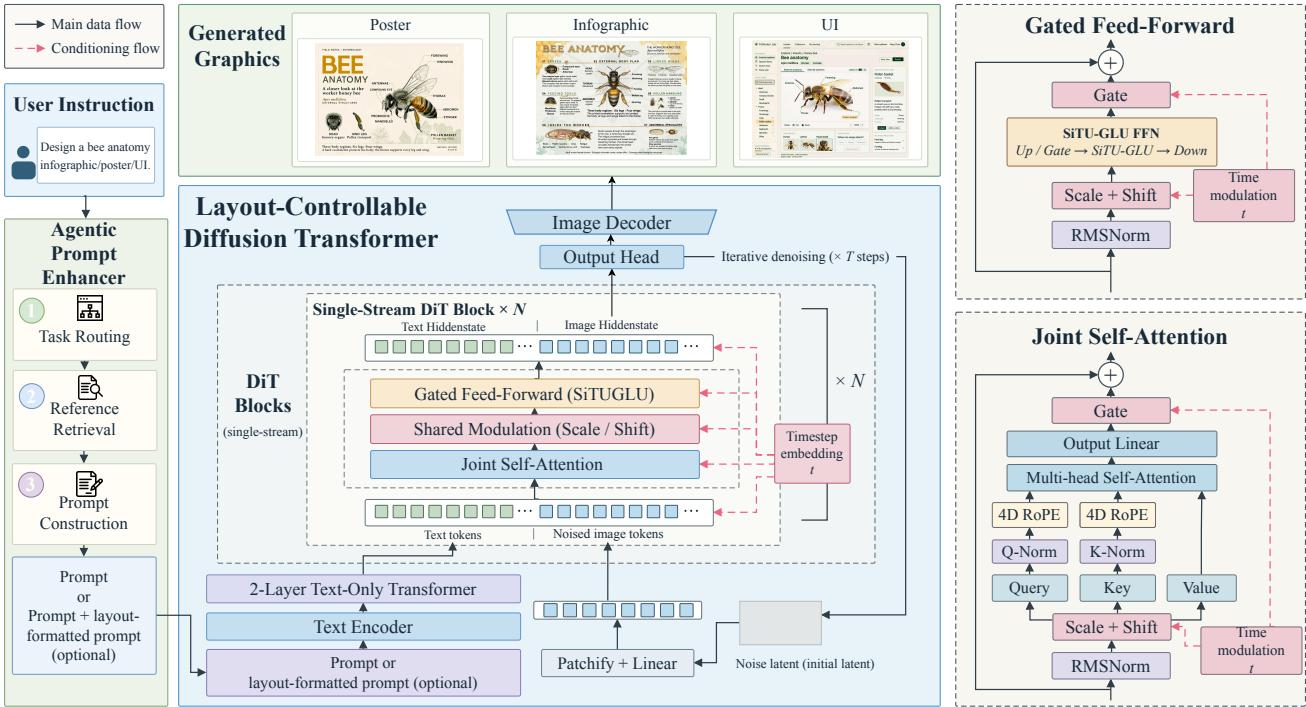
The enhancer translates a brief request into a detailed content and layout specification, which the generator then renders into an image through a shared text-conditioning interface.
The agentic prompt enhancer resolves the literal content and visual organization left unspecified by short user prompts. Leveraging a large language model at inference time, the agent performs intent-specific task routing to select modular guidance based on the requested medium. It retrieves relevant knowledge and inspects visual references to adapt the specification to the target canvas. Finally, it executes layout planning by specifying literal text, bounding boxes, typography, and spatial relationships in a structured JSON format. This JSON is validated for completeness and text fit before being passed to the generator.
The rendering backbone is a 5B single-stream Diffusion Transformer pretrained from scratch. It jointly processes text tokens from a frozen text encoder and image latents from a frozen variational autoencoder. The DiT blocks utilize joint self-attention, shared modulation, and a specialized SiTU-GLU feed-forward network. For an input x, the SiTU-GLU layer computes:
FFN(x)=Wo[cβg(g)⊙sigmoid(g)⊙cβu(u)]where g=Wgx and u=Wux. The function cβ(v)=βtanh(v/β) acts as a smooth cap, Wg, Wu, and Wo are learned projections, and ⊙ denotes elementwise multiplication.
To handle spatial and sequential dimensions effectively, the architecture employs a 4D Rotary Position Embedding. Each query or key head is partitioned into four subspaces corresponding to the reference index, sequence position, width, and height. Independent rotations are applied to these subspaces:
RoPE4D(z,p)=[Rr(r)zr;Rt(t)zt;Rw(w)zw;Rh(h)zh]This design allows the model to encode sequence and spatial positions while keeping the reference subspace unrotated when no reference inputs are provided.
The pretraining recipe focuses on broad data retention and structure-aware supervision. The authors construct a large-scale corpus by applying SSCD-based deduplication and AI-generated image removal to public datasets. Rather than aggressively filtering out images with residual attributes like watermarks or compression artifacts, they annotate these undesirable features, preserving real-world data distributions.
Supervision is provided at multiple semantic granularities, ranging from short sentences to detailed descriptions of composition and visible text. For a subset of images, structured annotations containing localized elements, bounding boxes, and transcribed text with preserved line breaks are utilized. This explicit text and structure supervision is crucial for multi-line text rendering.
Training follows a progressive schedule that increases image resolution and text-context capacity across three stages. The authors employ a hybrid Muon-AdamW optimizer, applying Muon to eligible matrices and AdamW to the remaining parameters, which demonstrates sustained convergence advantages and reduced denoising loss compared to standard AdamW. Caption sampling mixes original and recaptioned descriptions to balance detailed annotations with diverse generalization.
Experiment
The evaluation separates the pretrained MOSS-Image backbone from full generation systems, using LongTextBench and LLTB for text rendering, 7Bench for layout control, and RealLayoutArena for end-to-end design requests. The backbone demonstrates strong long-text rendering and precise layout control, while the full system is competitive with leading models on graphic design tasks. Ablations show that explicit content and structured layout prompts, especially JSON layout plans, improve quality, and the backbone follows detailed natural-language instructions well. Case studies further support zero-shot layout-guided modification and indicate that explicit line breaks and zero-centered absolute coordinates aid text rendering and spatial generalization.
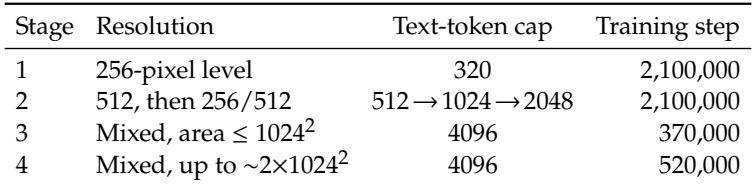
Pretraining progresses through stages that increase image resolution and text-token capacity. Early stages use smaller fixed and mixed resolutions with lower token caps, while later stages use mixed resolutions with a 4096-token cap and larger allowed image areas. Training-step budgets are larger in the lower-resolution stages and smaller in the later mixed-resolution stages. The schedule moves from 256-pixel inputs in the first stage to 512-pixel and mixed 256/512 inputs in the second stage while the text-token cap rises from 320 to 2048. Later stages use mixed-resolution inputs with a 4096 text-token cap, and the final stage permits areas up to roughly twice the earlier cap. The two lower-resolution stages use the same large training-step budget, whereas the two later mixed-resolution stages use much smaller budgets. Original captions and multi-granularity recaptions are mixed at a 20:80 ratio when both are available, with uniform selection among short, medium, and long recaptions.
The comparison shows that LongLongTextBench substantially increases text-rendering scale relative to LongTextBench. It uses fewer cases but about eight times the total character volume, with mean target length roughly eleven times longer. Its shortest target approaches LongTextBench's longest target, shifting the evaluation toward dense, page-length text. LongLongTextBench's mean target length is roughly 1,340 characters, about 11 times LongTextBench's mean. LongLongTextBench's shortest target is 444 characters, nearly matching LongTextBench's maximum of 482 characters.
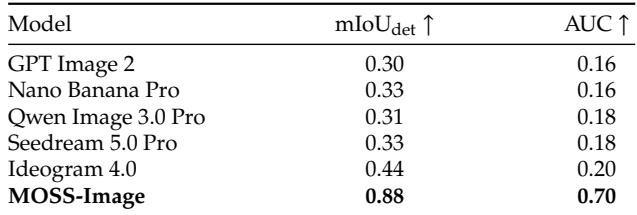
MOSS-Image leads all evaluated models on layout control, achieving the highest detected-object IoU and layout AUC by a large margin. The next-best model, Ideogram 4, scores substantially lower, while the remaining models cluster near the lower end of both metrics. These results indicate precise object placement through the text-conditioning interface. MOSS-Image is the strongest model on both layout metrics, outperforming every other evaluated system by a wide margin. Most non-MOSS models have similar low layout scores, with Ideogram 4 as the only partial exception before the large gap to MOSS-Image.
On the LLTB text-rendering benchmark, coverage varies widely across models. GPT Image 2 leads overall, and MOSS-Image is the highest-scoring open-weight system, though it trails two closed models on Mean-6. Longer Chinese passages are challenging for several models, particularly Seedream 5.0 Pro and FLUX.2. GPT Image 2 maintains near-ceiling coverage across all English and Chinese lengths, leading the evaluated models. MOSS-Image records the best open-weight Mean-6 score, clearly outperforming FLUX.2 while remaining slightly behind GPT Image 2 and Nano Banana Pro. Seedream 5.0 Pro and FLUX.2 show the steepest declines on long text, with long Chinese rendering a notable weakness.
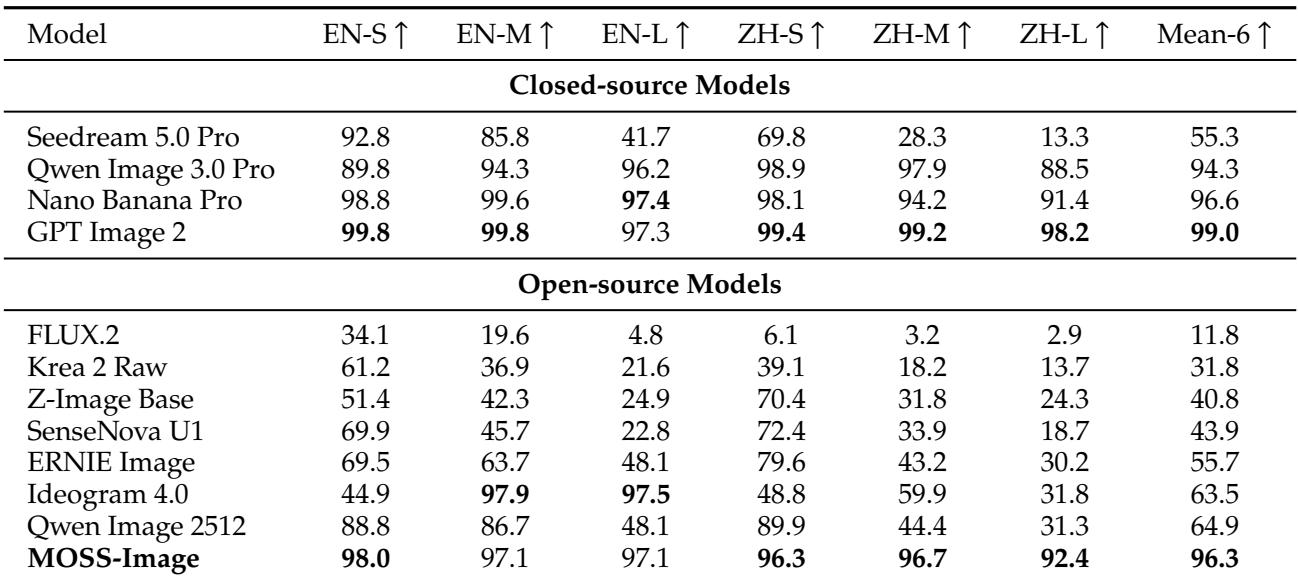
The experiments evaluate a staged pretraining schedule that increases image resolution and text-token capacity, a new LongLongTextBench designed for longer page-level text-rendering evaluation, and model comparisons on layout control and text rendering. LongLongTextBench uses fewer but much denser and longer cases than LongTextBench, shifting evaluation toward page-length content. MOSS-Image achieves the best layout control by a wide margin and is the top open-weight model on LLTB text rendering, while GPT Image 2 leads overall and long Chinese passages remain difficult for several models.