Command Palette
Search for a command to run...
Questionner les questions : maintenir l’auto-évolution des modèles de raisonnement
Questionner les questions : maintenir l’auto-évolution des modèles de raisonnement
Jinyuan Li Chengsong Huang Langlin Huang Donghong Cai Shiping Gao Yuyi Yang Jiaxin Huang
Résumé
Les modèles de raisonnement auto-évolutifs apprennent à partir de leurs propres questions générées, mais un auto-entraînement répété peut entraîner un effondrement des performances. Dans cet article, nous étudions pourquoi les performances se dégradent au fil des cycles successifs et comment maintenir l’auto-évolution. Notre analyse identifie deux problèmes de qualité récurrents dans les questions auto-générées : des questions invalides et des variantes répétées des mêmes questions mathématiques. Premièrement, les questions invalides deviennent plus fréquentes au fil des cycles, et le filtrage par cohérence des réponses augmente encore leur proportion dans les données d’entraînement. Deuxièmement, les contrôles existants de la diversité des questions fondés sur la similarité lexicale peuvent ne pas détecter des questions mathématiquement équivalentes formulées différemment, ce qui conduit à un effondrement de la diversité des questions lors des cycles d’entraînement ultérieurs. Sur la base de ces constats, nous introduisons R-Quest, qui utilise des retours sur la validité et la nouveauté des questions pour guider l’auto-évolution. Nous entraînons d’abord le solveur à reconnaître et à rejeter les questions invalides, puis utilisons ses jugements pour guider les récompenses du générateur de questions et filtrer les données d’entraînement du solveur. Pour éviter la répétition des questions, nous utilisons un modèle de base gelé pour comparer des paires de questions échantillonnées et fournir un retour de nouveauté. Empiriquement, notre méthode atteint régulièrement les meilleures performances moyennes sur 12 bancs d’essai en raisonnement mathématique, en raisonnement général et en génération de code, pour deux familles de modèles. De plus, R-Quest maintient des gains de performance stables sur dix cycles d’auto-évolution, atteignant un pic au dernier cycle et surpassant R-Zero de 17,32 points.
One-sentence Summary
Researchers from Washington University in St. Louis and the University of Michigan propose R-Quest, a method that uses validity and novelty feedback to sustain self-evolution in reasoning models by rejecting invalid questions and detecting mathematically equivalent repeated questions, achieving the highest average performance on 12 mathematical, general-domain, and code-generation benchmarks and outperforming R-Zero by 17.32 points.
Key Contributions
- An empirical analysis identifies invalid questions and repeated mathematically equivalent questions as two recurring bottlenecks in self-evolving reasoning models, showing that invalid questions increase across rounds and answer-consistency filtering further increases their proportion in training data.
- R-Quest trains the solver to recognize and reject invalid questions, uses the solver’s validity judgments to guide questioner rewards and filter solver training data, and provides task-level novelty feedback by comparing sampled question pairs with a frozen base model.
- Across two model families and 12 benchmarks in mathematical reasoning, general-domain reasoning, and code generation, R-Quest achieves the highest average performance; it also sustains gains over ten self-evolution rounds on Qwen3-4B-Base, peaking in the final round and outperforming R-Zero by 17.32 points.
Introduction
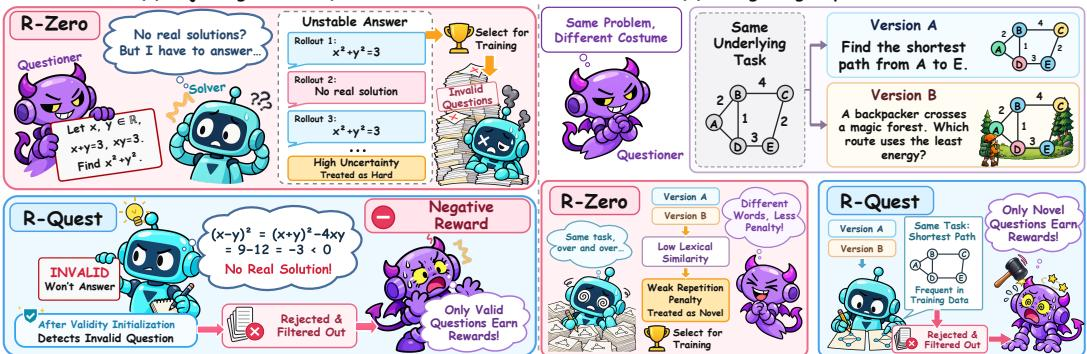
Self-evolving reasoning models that learn by generating and solving their own training tasks can reduce reliance on human-curated data, but prior questioner-solver frameworks such as R-Zero often lose early gains and eventually collapse. The authors identify two bottlenecks in self-generated questions: invalid problems with missing or contradictory conditions, and superficial repeats of the same mathematical tasks that bypass lexical repetition penalties. To address this, they introduce R-Quest, which trains the solver to reject invalid questions and uses validity and task-level novelty feedback to restrict the questioner’s difficulty rewards. R-Quest sustains improvements over ten rounds across two model families and 12 benchmarks, outperforming R-Zero without requiring stronger external models during self-evolution.
Dataset
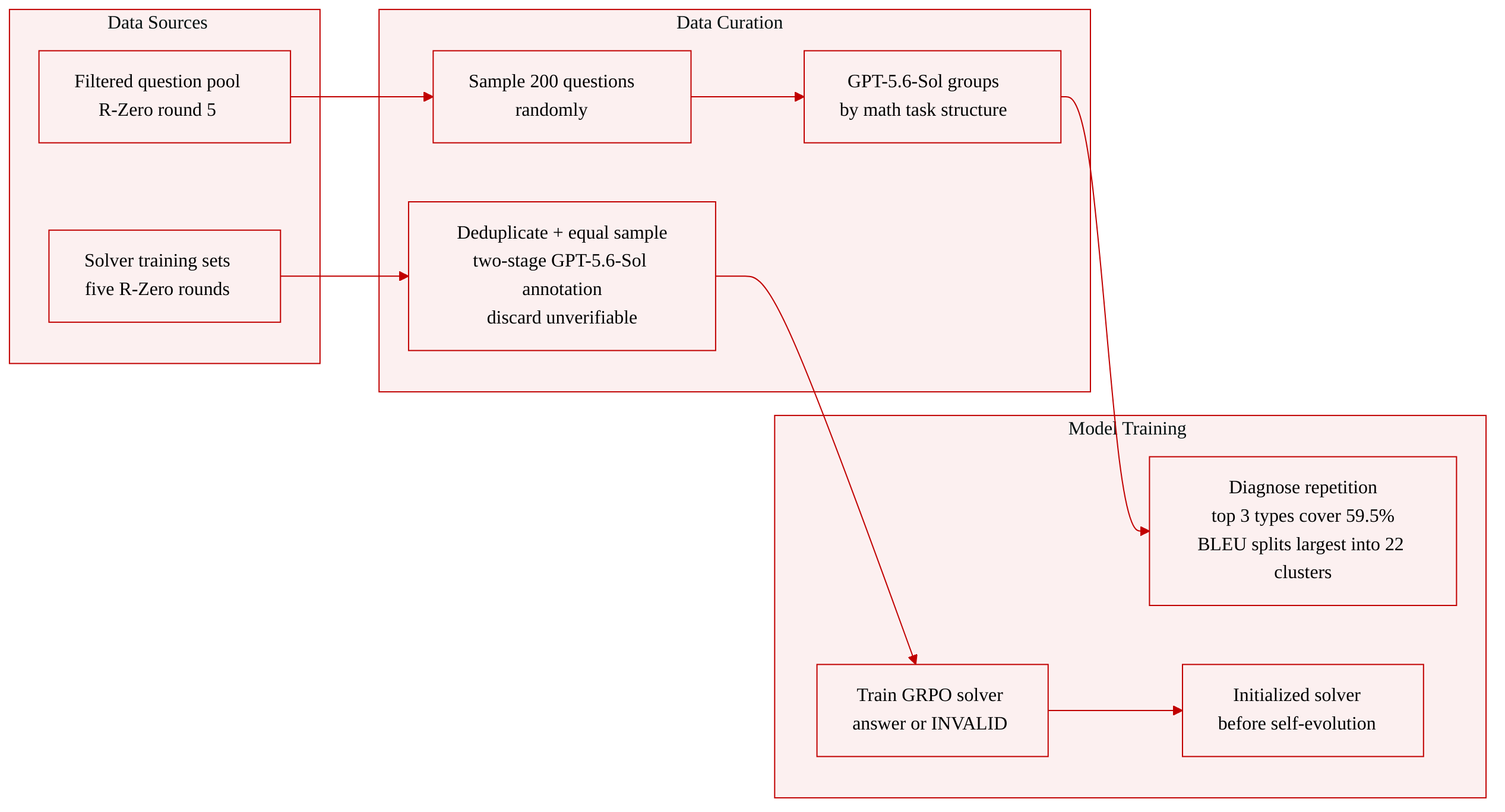
The paper uses two dataset components: a diagnostic sample of generated questions and a validity-aware solver initialization set.
-
Diagnostic repetition sample
- Source: Filtered question pool generated in the fifth round of R-Zero.
- Composition: 200 randomly sampled questions.
- Processing: GPT-5.6-Sol groups the questions by underlying mathematical task structure to identify repeated question types. The grouping protocol is given in Appendix B.3.
- Statistics: The three largest question types account for 59.5% of the sample. Under BLEU-based clustering, the largest question type is split into 22 clusters, showing that lexical clustering can fragment structurally identical questions.
- Use: Diagnoses repetition in self-evolution and motivates assessing repetition based on task structure rather than surface similarity.
-
Validity-aware initialization dataset
- Source: Solver training sets from five R-Zero iterations.
- Composition: Deduplicated questions, with an equal number randomly sampled from each iteration.
- Processing: Two-stage annotation with GPT-5.6-Sol: first, the annotator attempts to solve each question and judges whether it is valid; second, it solves only the valid questions to generate reference answers. Examples whose answers cannot be reliably verified are discarded.
- Schema: Valid questions have reference answers; invalid questions are labeled as invalid.
- Use: Trains the base model with GRPO to answer valid questions or return INVALID for invalid ones. The reward rewards correct answers and penalizes rejecting valid questions, controlled by a penalty factor. The resulting model is used as the initialized solver before self-evolution.
Method
The authors introduce R-Quest, a framework designed to sustain self-evolution in reasoning models by addressing performance collapse caused by invalid questions and repetitive tasks. The system introduces two core feedback mechanisms: validity feedback from a specialized solver and novelty feedback from a frozen base model. These signals guide the reinforcement learning rewards during alternating updates between the questioner and solver roles.
As shown in the figure below:
To prevent the solver from being misled by flawed prompts, the authors implement a validity-aware solver initialization. They construct a dataset of deduplicated questions from previous self-evolution iterations, which are annotated to distinguish valid from invalid prompts. The base model is then trained using Group Relative Policy Optimization (GRPO) to return a mathematical answer for valid questions or an explicit INVALID token for invalid ones. The training utilizes a specific reward function:
Rinit(q,a)=1[a=a∗(q)]−λ1[a=INVALID∧a∗(q)=INVALID]where a∗(q) is the reference answer for a valid question, and λ penalizes excessive refusal of valid questions. This initialization equips the solver to explicitly recognize and reject flawed questions before the main self-evolution loop begins.
To maintain question diversity and prevent the generation of repetitive task variants, the authors employ a frozen base model to assess novelty. Two questions are deemed identical if they share the same mathematical setup and task objective. While an exhaustive pairwise comparison of a batch of size B incurs an O(B2) computational cost, the authors optimize this by uniformly sampling K reference questions per candidate. A candidate is rejected if it matches any of the K references, reducing the complexity to O(BK) and effectively suppressing repeated task types.
During the alternating self-evolution process, the questioner and solver are updated using these integrated feedback signals. For a generated question q, the solver first assesses its validity. Let u(q) be the fraction of solver responses returning INVALID. The validity gate is defined as gvalid(q)=21−u(q). If gvalid(q)<0, the question is classified as invalid. For valid questions, the system calculates an uncertainty reward Runcertainty(q)=min{s(q),1−s(q)}, where s(q) is the proportion of responses in the largest answer cluster. The final questioner reward integrates the novelty gate gnovel(q):
Rquestion(q)={gvalid(q),gnovel(q)Runcertainty(q),gvalid(q)<0,gvalid(q)≥0.The questioner is updated via GRPO using this reward structure. Subsequently, the updated questioner generates new candidate questions, which undergo a majority-vote validity check. Passing questions are solved to generate pseudo-labels via answer-consistency filtering. The solver is then updated using GRPO on this filtered dataset. Crucially, this training data is mixed with a fixed proportion of the initial validity-aware dataset to ensure the solver retains its ability to reject invalid prompts throughout the continuous update cycle.
Experiment
The experiments evaluate R-Quest against base models and self-evolution baselines including R-Zero, OCNR, and R-Diverse across mathematical, general reasoning, and code generation benchmarks, using alternating questioner and solver training with validity and novelty feedback. A preliminary study shows that R-Zero generates increasingly invalid questions and that training on repaired questions reduces solver degradation, confirming invalid supervision as a contributor to collapse. Main results indicate that R-Quest sustains gains over extended self-evolution while R-Zero declines, and ablations confirm that both validity and novelty feedback are necessary for stable improvement. Further analyses show R-Quest improves validity assessment, produces more valid questions with more reliable pseudo-labels, and limits recurring question-pattern concentration, although overly strict diversity control can suppress useful challenging variants.
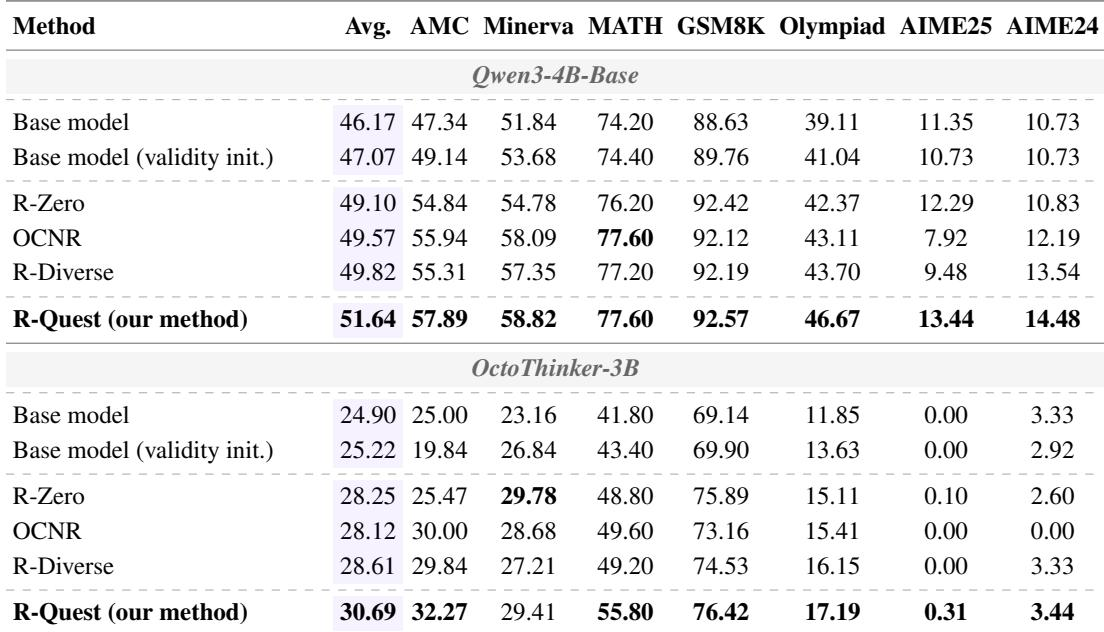
R-Quest achieves the highest average mathematical reasoning performance across seven benchmarks on both evaluated backbones, surpassing R-Zero, OCNR, and R-Diverse. Validity-aware initialization alone yields scores close to base models, while most gains emerge during subsequent self-evolution. In extended self-evolution, R-Quest sustains its advantage over ten rounds, whereas R-Zero declines below its base model. R-Quest records the highest average across all seven mathematical reasoning benchmarks for both backbones. It improves over base models by more than five average points and further outperforms R-Zero. Validity-aware initialization provides near-base performance, indicating later self-evolution drives most of the final gains. During extended training, every R-Quest checkpoint exceeds the best R-Zero score, while R-Zero eventually falls below the base model.
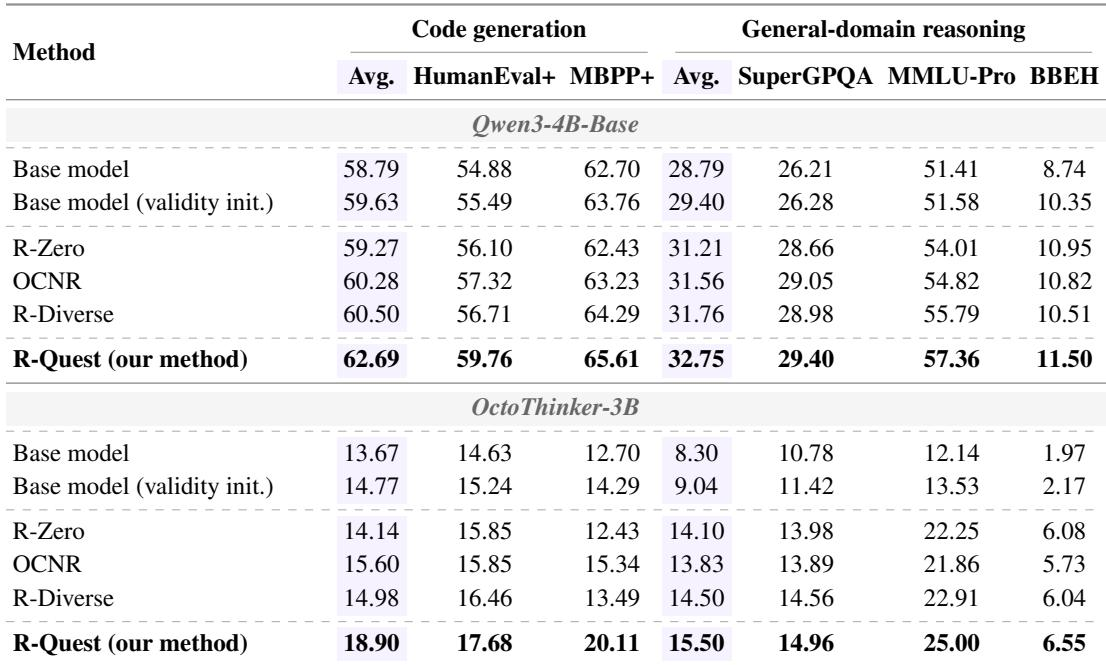
Mathematics-focused self-evolution transfers to code generation and general-domain reasoning. R-Quest is reported to improve average code generation over base models on both tested backbones, and on Qwen3-4B-Base all listed variants raise general-domain reasoning above the base model. Among the listed Qwen3-4B-Base baselines, R-Diverse achieves the highest code generation average, while OCNR and R-Diverse lead general-domain reasoning. Validity-aware initialization brings only small improvements over the base model, whereas subsequent self-evolution baselines show clearer broad reasoning gains.
The full R-Quest configuration records the highest scores across math, code, and general domains on Qwen3-4B-Base. Removing either novelty or validity feedback lowers performance in all three domains, and removing both feedback signals produces the weakest overall results. A frozen validity judge also trails the full setup, reinforcing the benefit of continuous validity training. The full R-Quest variant outperforms all ablated variants across math, code, and general domains. Ablating novelty or validity feedback alone reduces scores in every domain, with larger combined losses when both are removed. Using a frozen validity judge underperforms the full R-Quest configuration in all three domains.
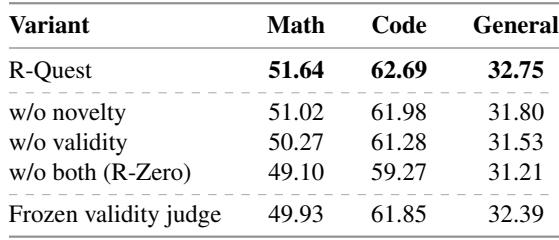
R-Quest is evaluated across seven mathematical reasoning benchmarks on two backbones, where validity-aware initialization alone yields near-base performance and subsequent self-evolution drives most of the improvement, with sustained gains over extended rounds while R-Zero falls below its base model. The approach also transfers to code generation and general-domain reasoning, improving average performance over base models on both tested backbones. Ablation studies show that removing novelty or validity feedback lowers performance across math, code, and general domains, and a frozen validity judge underperforms the full configuration, confirming that both feedback signals and continuous validity training contribute to the strongest overall results.