Command Palette
Search for a command to run...
StudentSim : Entraînement de simulateurs d'étudiants fondés sur les grands modèles de langue
StudentSim : Entraînement de simulateurs d'étudiants fondés sur les grands modèles de langue
Ke Yang Chenglong Wang Michel Galley Chandan Singh Jeevana Priya Inala ChengXiang Zhai Jianfeng Gao
Résumé
Les tuteurs en intelligence artificielle sont plus utiles lorsqu'ils s'adaptent aux forces, aux faiblesses et aux types de guidage préférés de chaque étudiant, mais déterminer quel guidage fonctionne pour quel étudiant constitue un signal épars, lent et coûteux à collecter auprès de vrais étudiants. Les simulateurs d'étudiants peuvent fournir ce signal par procuration, mais les simulateurs existants ne couvrent qu'une partie de ce qui est nécessaire : les modèles de suivi d'état reproduisent le comportement d'un étudiant mais ne peuvent pas assimiler correctement les explications ou les corrections d'un tuteur, tandis que les grands modèles de langue auxquels on demande de jouer le rôle d'un étudiant cible suivent le guidage d'un tuteur avec aisance mais ne reproduisent pas de manière fiable la compétence de l'étudiant qu'ils imitent. Nous présentons STUDENTSIM, un cadre d'entraînement qui transforme des données éparses par étudiant en un simulateur individualisé pour chaque étudiant via un pipeline en deux étapes, consistant en un entraînement mutualisé suivi d'une spécialisation par étudiant, de sorte que le simulateur reflète à la fois les réponses propres de l'étudiant et les mette à jour sous le guidage du tuteur. Pour mesurer équitablement ces deux capacités, nous construisons STUDENTSIMEVAL, un protocole standardisé couvrant 60 étudiants dans les domaines des échecs, de la rédaction en anglais langue seconde et des mathématiques, tiré de jeux de données publics d'apprenants dont les dossiers étudiants anonymisés sont partagés à des fins de recherche. Ce protocole évalue chaque méthode sur la fidélité comportementale (F ↑), mesurant dans quelle mesure un simulateur reproduit les réponses propres d'un étudiant, et sur la réactivité au guidage (R ↑), mesurant avec quelle facilité il met à jour sa réponse sous le guidage d'un tuteur, en ajustant chaque méthode sur les mêmes dossiers et en l'évaluant sur les mêmes dossiers réservés à l'évaluation, de sorte que les résultats soient directement comparables ; nous publions notre code de construction et d'évaluation afin que d'autres puissent évaluer de nouvelles méthodes sur la même référence et l'étendre. Dans les trois domaines, nos simulateurs par étudiant surpassent GPT-5.4 sur les deux métriques. Aux échecs, par exemple, STUDENTSIM atteint F = 0,51 et R = 0,91, contre 0,23 et 0,72 pour GPT-5.4 et 0,45 et 0,27 pour Maia2, un modèle de prédiction de coups d'échecs conditionné par le niveau de compétence. Comme preuve de concept que le cadre soutient également l'amélioration des tuteurs en IA, un simulateur STUDENTSIM entraîné et utilisé comme récompense pour l'apprentissage par renforcement d'un modèle de tuteur produit un tuteur d'échecs que des experts humains jugent plus précis, mieux guidé et plus personnalisé qu'à la fois une référence sans apprentissage par renforcement et un tuteur entraîné par renforcement avec une récompense issue d'un simulateur GPT-5.4. Notre code est disponible à l'adresse https://github.com/microsoft/StudentSim.
One-sentence Summary
Microsoft Research and the University of Illinois Urbana-Champaign propose STUDENTSIM, a two-stage training framework that first pools sparse per-student data and then specializes to create individualized simulators that outperform GPT-5.4 and Maia2 on behavioral fidelity and guidance responsiveness across chess, writing, and math, and can serve as a reward for reinforcement learning to improve AI tutors.
Key Contributions
- STUDENTSIM is a two-stage training framework that pools data across students for shared pretraining and then specializes to each individual, producing per-student simulators that achieve high behavioral fidelity and guidance responsiveness from sparse records.
- STUDENTSIMEVAL is a standardized evaluation protocol spanning 60 students across chess, second-language English writing, and mathematics; it measures behavioral fidelity (F) and guidance responsiveness (R) on the same held-out records, enabling fair comparison of any student simulator.
- Using a trained STUDENTSIM as the reward model in reinforcement learning for tutor training yields a chess tutor that expert human evaluators rate as more accurate, better-guided, and more personalized than a tutor trained with a GPT-5.4 simulator reward or a baseline without RL.
Introduction
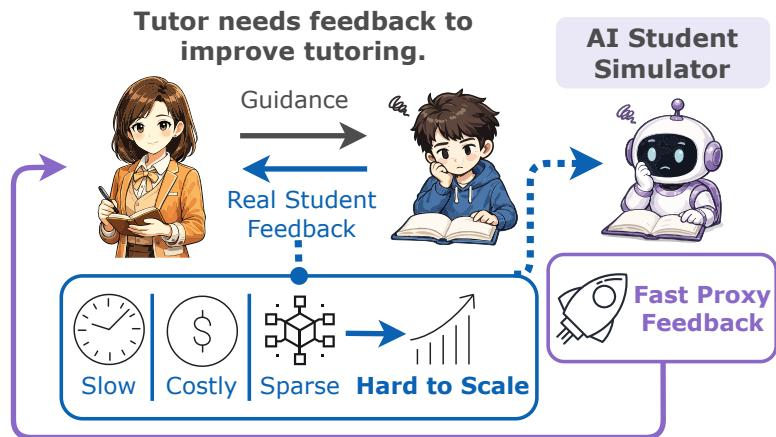
AI tutors that adapt to individual learners need training on diverse student interactions, but recruiting real students is expensive and slow. Student simulators can provide scalable proxy feedback, yet prior approaches each miss a key requirement: state-tracking models capture a student’s behavioral patterns but have no input pathway for tutor guidance, while LLM-prompted simulators respond to guidance but cannot reliably reproduce a specific student’s characteristic errors and strengths. The authors address this gap with STUDENTSIM, a framework that trains per-student simulators by first pooling records across many learners to learn shared domain patterns and then specializing on each individual’s sparse data. This yields simulators that are jointly faithful to a student’s own responses (behavioral fidelity) and responsive to tutor corrections (guidance responsiveness). They also introduce STUDENTSIMEVAL, a standardized evaluation protocol over 60 students in chess, second-language English writing, and math, and show that their simulators outperform both state-tracking and prompted-LLM baselines on both axes, and can serve as a reward model to improve an AI tutor through reinforcement learning.
Method
The authors address the challenge of per-user data sparsity by training each per-student simulator in two stages.
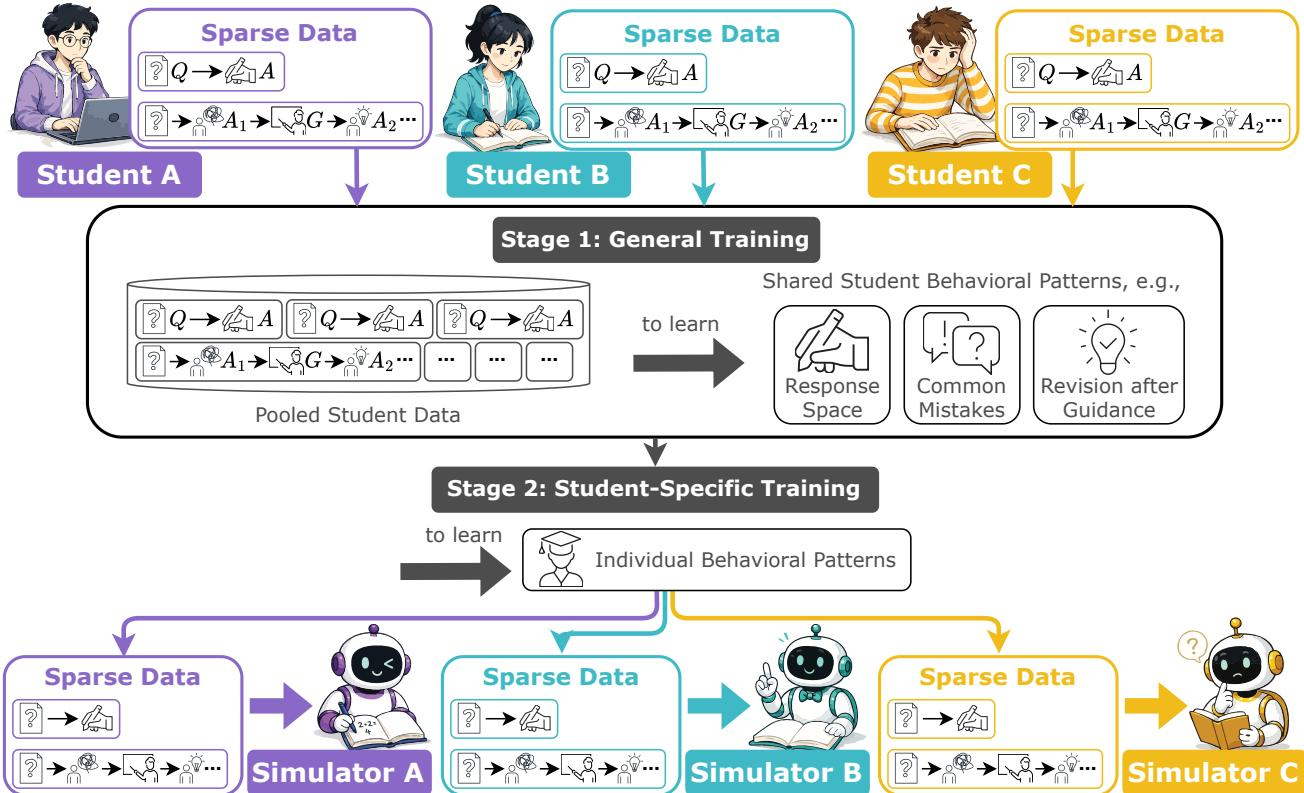
Stage 1 involves pooled training. The authors train one domain-specific base simulator on data pooled across all students in the domain. This stage learns shared characteristics across students, such as common mistake patterns, the expected response format in the domain, and the pathway from natural-language tutor guidance to a changed response. The output is a single base simulator per domain that exhibits broad student-like behavior but is not yet specialized to any individual.
Stage 2 focuses on per-student specialization. This stage initializes from the Stage 1 base simulator and adapts it to a specific student using only that student's own recorded responses and tutor-guidance interactions. Each student receives an independent specialization, producing one simulator Mi per student. This stage captures individual-specific traits, such as which mistakes a particular student tends to make and how their behavior shifts in response to specific forms of tutor guidance. The two-stage approach ensures that the shared structure of student behavior is learned reliably from pooled data, while individual idiosyncrasies are captured without overfitting to sparse per-student records.
To optimize AI tutors, the authors leverage the trained student simulator as a reward model for tutor reinforcement learning.
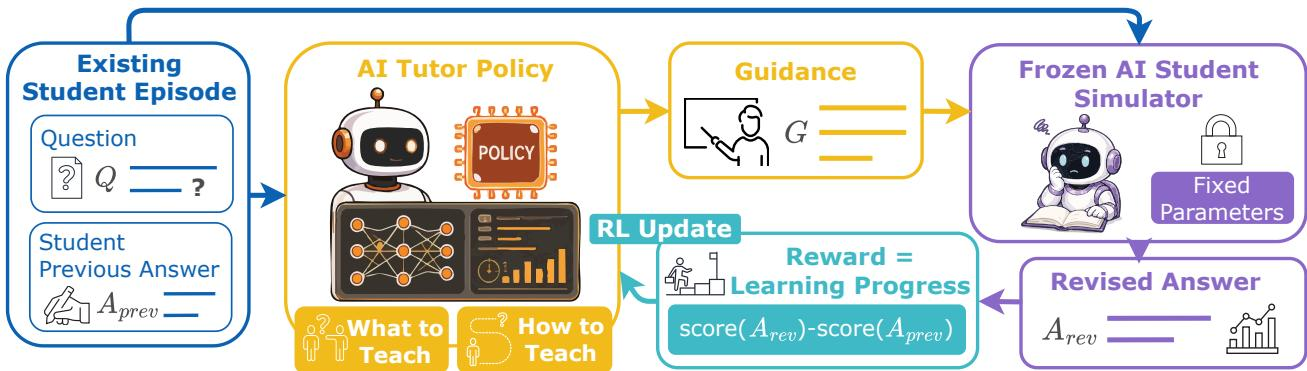
In this setup, each episode draws a chess problem Q and the student's recorded wrong move Aprev from real student records. The tutor policy proposes guidance, and a frozen student simulator emits a revised move Arev. The reward is derived from the improvement in move quality, calculated via a precomputed Stockfish lookup of Arev relative to Aprev. All conditions share the same tutor policy and supervised fine-tuning starting point, optimized with GRPO.
The authors' reward model uses the pooled Stage-1 student simulator, which captures population-level student behavior, ensuring the tutor is optimized to improve guidance for students in general. Additionally, two extensible reward heads are mounted on the same simulator backbone. A personalization head scores whether the explanation follows the intended teaching style, and a perception head penalizes explanations that misdescribe the board. These two heads act as multiplicative gates on the move-quality term. Because the trained simulator backbone already encodes student behavior and board state, these lightweight linear probes can effectively score the factual grounding and teaching style of the tutor, making the reward practically effective for AI tutor optimization.
Experiment
The evaluation instantiates the student simulator framework across chess, second-language English writing, and mathematics, using real student data to train per-student simulators on both single-turn behavior and multi-turn guidance responsiveness. Behavioral fidelity experiments show that the trained simulators outperform all baselines by capturing individual students' distinct response patterns, while guidance responsiveness experiments demonstrate that the simulators effectively follow tutor guidance, particularly in open-ended reasoning modes where large closed models fail. A chess proof-of-concept then uses the simulator as a reward model for tutor reinforcement learning, and an expert human study finds that this reward produces a tutor rated higher on accuracy, guidance quality, and personalization than using a frontier LLM as the student or no RL, highlighting the practical value of a faithful and responsive student simulator.
Training data scales differ sharply across domains: chess uses 100,000 pooled Stage 1 instances and 30 Stage 2 students with 1,000 instances each, while L2 and math use fewer Stage 2 students (15) and far smaller per-student sets (73 and 153 instances). All domains share a 0.2 multi-turn ratio, and held-out evaluation sets per student are much larger for chess (5,000 single-turn, 4,000 multi-turn) than for L2 (26, 40) or math (66, 59 on average). Chess has 30 Stage 2 students with 1,000 instances each, whereas L2 and math have only 15 students and under 160 instances per student. Held-out single-turn records per student range from 5,000 for chess to just 26 for L2, reflecting domain differences in available student data.

The trained STUDENTSIM simulator achieves the highest behavioral fidelity across all three domains, outperforming domain-specific naive baselines and large language models. In chess, it predicts player moves more accurately; in second language writing, it better matches learners' error profiles; and in math, it more often selects the exact answer a student gave, demonstrating per-student behavioral capture. STUDENTSIM's chess move prediction accuracy surpasses the specialized Maia2 baseline and far exceeds GPT-4o and GPT-5.4, which struggle to capture individual player style. In math, STUDENTSIM selects the student's actual multiple-choice answer more frequently than GPT-5.4, while the untrained naive baseline falls well behind.

The trained STUDENTSIM simulator achieves the highest guidance responsiveness across chess, second-language writing, and math, substantially surpassing both naive baselines and large closed-source models. The advantage is largest on open-ended guidance modes that require reasoning from questions or principles, as demonstrated by a chess Socratic case where only the trained simulator infers the correct move. This responsiveness stems from multi-turn training that teaches genuine guidance-following, not just copying hints. STUDENTSIM outperforms GPT-4o and GPT-5.4 in all three domains, with the largest margins in chess and math. The naive baseline shows near-zero responsiveness in second-language writing and limited chess correction, highlighting the difficulty of the task without domain training or language input. In a held-out chess Socratic scenario, a 4B trained simulator correctly infers the engine-best move from a chain of guiding questions, while GPT-5.4 selects a wrong square. Open-ended guidance modes, where the tutor prompts reasoning through questions, reveal the biggest gaps between STUDENTSIM and baselines. Math answer correction sees STUDENTSIM improve responsiveness substantially over the naive baseline, demonstrating strong ability to revise numerical answers after tutor reasoning.

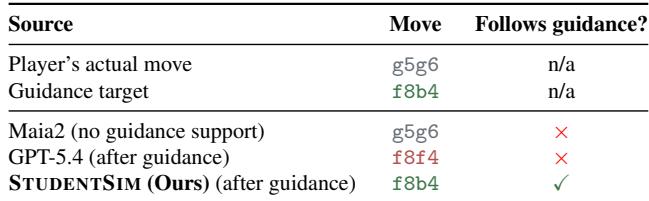
On a held-out chess position where a player blundered with a pawn push, a socratic prompt hints at a forcing queen check without naming the destination square. The STUDENTSIM model correctly outputs the engine-best move f8b4, whereas Maia2 reproduces the blunder and GPT-5.4 proposes a different incorrect queen move. Across the full guidance-following test set, STUDENTSIM attains a correlation of 0.91, substantially outperforming GPT-4o (0.77), GPT-5.4 (0.72), and Maia2 (0.27). STUDENTSIM follows the open-ended guidance and plays the correct f8b4, while Maia2 and GPT-5.4 fail with g5g6 and f8f4 respectively. On the full test set, STUDENTSIM reaches a guidance-following correlation of 0.91, far above Maia2's 0.27 and GPT-5.4's 0.72.
A trained student simulator used as the RL reward model led to a chess tutor that substantially improved accuracy, guidance quality, and personalization over both a supervised-only baseline and a reward based on a frontier language model as the student simulator. In contrast, the GPT-5.4 reward produced more severe factual errors and lower accuracy than even the no-RL tutor, demonstrating that a faithful, responsive simulator is a practical and effective reward signal for tutor optimization. The STUDENTSIM reward achieved 90.5% accuracy, a large gain over the no-RL baseline (75.7%) and GPT-5.4 reward (71.6%), meaning far fewer misleading factual errors. Guidance quality was highest with STUDENTSIM (3.31 out of 5), while GPT-5.4 reward gave only a marginal improvement over no RL (3.08 vs. 2.99). Personalization ratings nearly doubled with STUDENTSIM (3.93) compared to no RL (2.80) and GPT-5.4 reward (2.42), reflecting better adaptation to a Socratic teaching style. The GPT-5.4-simulator reward worsened factual accuracy and personalization relative to the no-RL baseline, held back by a markedly higher rate of severe factual errors. All conditions shared the same tutor policy, supervised starting point, and GRPO optimization, so the performance differences trace directly to the choice of reward model.

The evaluation spans chess, second-language writing, and math, with domain-specific training data scales and held-out sets. STUDENTSIM consistently achieves the highest behavioral fidelity, accurately capturing individual player moves, learner error profiles, and student answer choices. It also demonstrates strong guidance responsiveness, particularly in open-ended Socratic scenarios, where it follows reasoning chains to produce correct actions while baselines fail. When used as a reward model for reinforcement learning, the trained simulator yields a chess tutor with substantially improved accuracy, guidance quality, and personalization, whereas a frontier language model reward degrades performance.