Command Palette
Search for a command to run...
Au-delà du passage à l’échelle des données : pré-entraînement continu centré sur la représentation pour les modèles vision-langage-action
Au-delà du passage à l’échelle des données : pré-entraînement continu centré sur la représentation pour les modèles vision-langage-action
Résumé
Le passage à l’échelle des données robotiques est crucial pour construire des modèles vision-langage-action (VLA) généralistes, mais les trajectoires de robots sont fondamentalement plus difficiles à mettre à l’échelle que les données image-texte à l’échelle du web, car elles exigent une collecte incarnée et ne couvrent que de manière éparse le monde physique. Cela fait de la qualité de la représentation un goulot d’étranglement central : avec un budget fixe de données robotiques, le pré-entraînement continu des VLA doit convertir des trajectoires limitées en connaissances visuo-actionnelles transférables, plutôt que de simplement ajuster des actions. Nous proposons VLAct, un squelette de VLM orienté VLA entraîné avec une recette de pré-entraînement continu centré sur la représentation, qui part d’un VLM pré-entraîné et s’entraîne sur des données robotiques larges, hétérogènes et multi-incarnations avant un ajustement fin spécifique à la tâche. VLAct préserve le large a priori du VLM, évite de sur-spécialiser le squelette à une seule tête d’action et encourage une sémantique d’action partagée entre les incarnations grâce à la préservation de l’a priori du VLM, à la co-supervision continue multi-têtes des actions et à une disposition d’action partiellement unifiée entre les incarnations, tout en laissant aux utilisateurs en aval la liberté d’attacher des têtes d’action spécifiques à la tâche lors de l’ajustement fin. Sur des bancs d’essai de simulation multi-incarnations, des expériences sur robots réels et des transferts vers des incarnations non vues, VLAct améliore systématiquement les performances en aval sous des protocoles d’ajustement fin fixes. Sur LIBERO-Plus et RoboTwin 2.0, VLAct surpasse des systèmes VLA industriels à grande échelle tels qu’ABot-M0 et LingBot-VLA, atteignant respectivement 82,6 % et 92,5 % de succès. Sur le banc d’essai de simulation RoboDojo récemment publié, VLAct obtient un score moyen de 10,66 et un taux de succès de 7,60 %, se classant sixième parmi toutes les politiques en termes de taux de succès. Il surpasse toutes les entrées explicitement désignées comme modèles monde-action (WAM) sur les deux métriques, ainsi que plusieurs systèmes développés par l’industrie. Plus remarquable encore, sur RoboCasa-GR1, une incarnation humanoïde jamais vue pendant le pré-entraînement continu, VLAct avec seulement 20 % des trajectoires en aval surpasse déjà la référence GR00T-N1.6 entraînée sur l’ensemble des données. Ces résultats sont obtenus en utilisant des données entièrement open source et une configuration d’entraînement de seulement 16 GPU, montrant qu’un pré-entraînement continu centré sur la représentation peut offrir des performances hautement compétitives avec un budget de calcul modeste et constitue un axe indépendant important du progrès des VLA au-delà du passage à l’échelle des données. Tous les modèles et pipelines d’entraînement sont open source.
One-sentence Summary
The authors propose VLAct, a representation-centric continued pre-training recipe for vision-language-action models that preserves VLM priors and employs multi-head continuous action co-supervision with a partially unified cross-embodiment action head, achieving state-of-the-art multi-embodiment performance including 82.6% on LIBERO-Plus and 92.5% on RoboTwin 2.0, and, with only 20% of the data, outperforming GR00T-N1.6 on an unseen humanoid embodiment.
Key Contributions
- VLAct is a VLA-oriented VLM backbone trained with a representation-centric continued pre-training recipe that starts from a pretrained VLM and uses broad heterogeneous multi-embodiment robot data; it combines VLM-prior preservation, multi-head continuous action co-supervision, and a partially unified cross-embodiment action layout while letting downstream users attach task-specific action heads during fine-tuning.
- Controlled probes show that discrete FAST-token pre-training discards fine-grained temporal and amplitude information, while single-head continuous supervision can cause head-specific representation collapse, motivating VLAct's multi-head continuous co-supervision.
- Under fixed fine-tuning protocols, VLAct reaches 82.6% success on LIBERO-Plus and 92.5% on RoboTwin 2.0, surpassing ABot-M0 and LingBot-VLA, and on RoboDojo it obtains a 10.66 average score and 7.60% success rate. On the unseen humanoid RoboCasa-GR1 benchmark, VLAct with only 20% of downstream trajectories outperforms the full-data GR00T-N1.6 baseline, using fully open-source data and a 16-GPU training setup.
Introduction
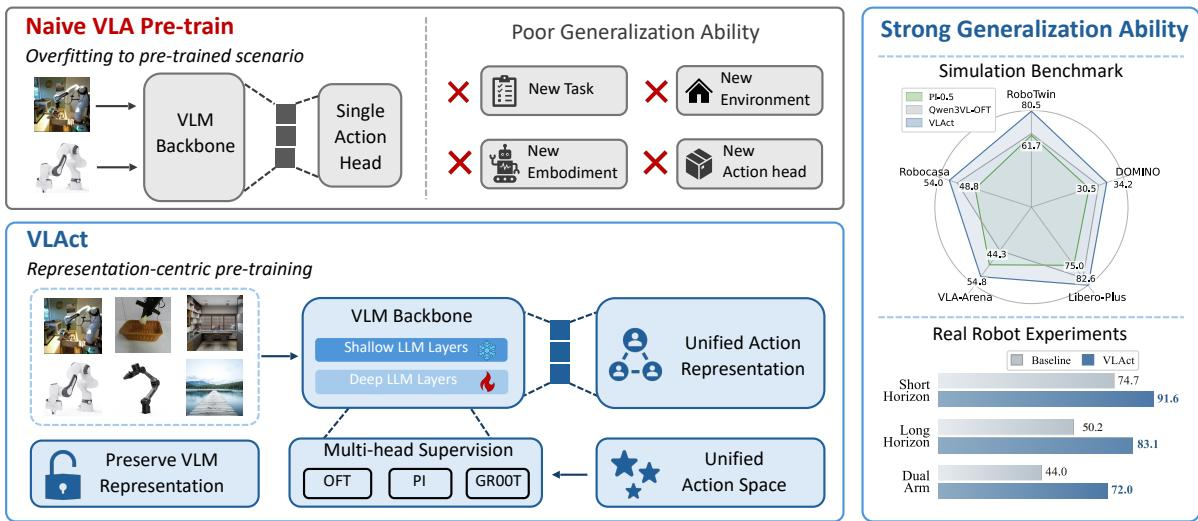
Vision-language-action (VLA) models seek to bring web-scale representation learning to robot control, but robot trajectories must be collected through physical execution and remain sparse samples of a combinatorial interaction space spanning scenes, objects, tasks, embodiments, and contact dynamics. Prior VLA continued pre-training often treats the stage as large-scale action fitting, which can erode the general vision-language prior, over-specialize the backbone to one action head's decoding geometry, and weaken cross-embodiment sharing through isolated robot-specific heads. The authors propose VLAct, a representation-centric continued pre-training recipe that preserves the VLM prior via shallow-layer protection and caption-data mixing, applies multi-head continuous action co-supervision to keep action features broadly decodable, and uses a partially unified cross-embodiment action layout with a wrap-aware loss for periodic joints. These components shape a transferable backbone before downstream task-specific fine-tuning.
Method
The authors propose VLAct, a representation-centric Vision-Language-Action (VLA) model that performs continued pre-training of a reusable VLA backbone initialized from a Vision-Language Model (VLM). The overall pipeline consists of a continued pre-training phase to shape the backbone, followed by a fine-tuning phase where the pre-training heads and caption stream are discarded. During fine-tuning, a freshly initialized task-specific action head is attached, ensuring that downstream improvements stem from the learned backbone representation rather than a pre-adapted action head.
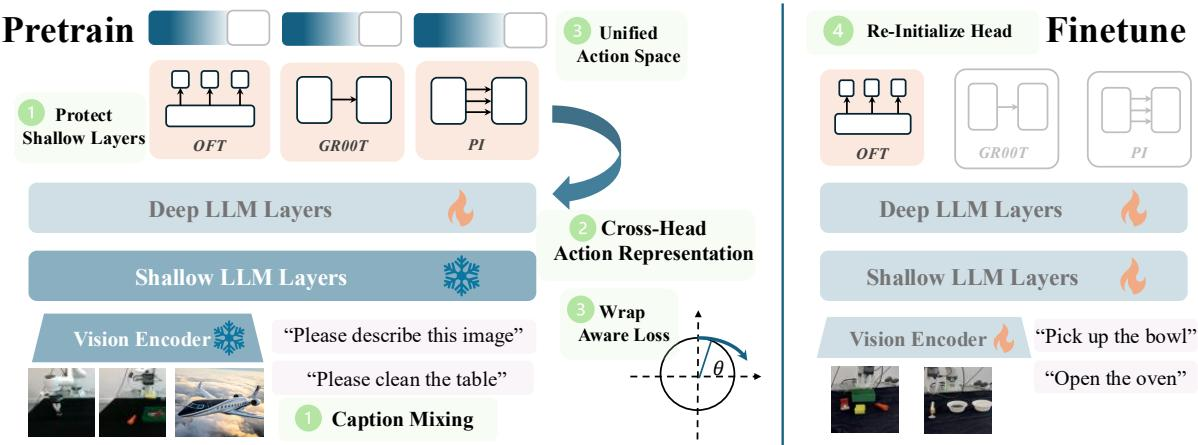
To prevent naive action-driven continued pre-training from overwriting the strong vision-language representations learned from broad web-scale data, the authors implement two preservation mechanisms. First, they apply shallow-layer protection by freezing the entire vision encoder and the lower half of the LLM layers during pre-training. This protects low-level visual processing and early vision-language alignment while allowing the upper layers to adapt to action-conditioned reasoning. Second, they utilize caption-mixed pre-training, mixing robot trajectories with caption data. Captions provide dense supervision over objects, attributes, and spatial relations, anchoring the trainable layers with robust vision-language supervision.
To ensure the backbone supports head transfer and learns high-quality action features rather than overfitting to a specific head geometry, the authors introduce co-supervised multi-head pre-training. Three representative continuous action heads (OFT, PI, and GR00T) are attached to the shared VLA backbone in parallel. Given the same vision-language input, the backbone produces a shared latent representation z, and each head predicts the same ground-truth action chunk a. The training objective is formulated as:
Laction=LOFT+LPI+LGR00T.This multi-head supervision forces the backbone to encode action information in a head-agnostic form, preventing representation collapse toward a single decoder geometry and improving transferability across different downstream heads.
To handle variation across different robot embodiments without forcing incompatible degrees of freedom into the same coordinates, VLAct employs a partially unified cross-embodiment action space. Rather than using isolated embodiment-specific heads or a naively fully unified space that pads lower-dimensional robots, the authors use a single shared action head where the action space is unified only along physically comparable dimensions.
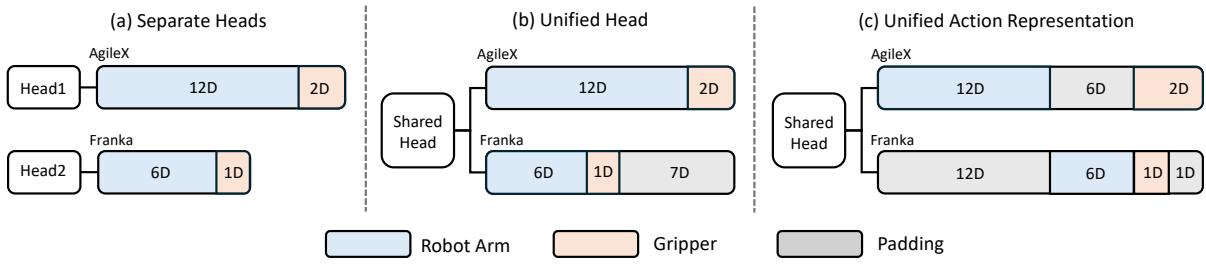
Concretely, gripper dimensions are shared across embodiments because open and close commands have comparable semantics, while arm dimensions remain embodiment-specific when robots possess different kinematics. During training, each sample contributes loss only on the active dimensions for its specific embodiment, and inactive dimensions are masked out. Furthermore, to address parameterization issues with absolute joint angles where standard regression treats 179∘ and −179∘ as far apart, the authors apply a wrap-aware loss on periodic joint-angle dimensions, measuring angular residuals modulo 360∘.
Experiment
The pilot study isolates the action-head axis by fixing the Qwen3-VL-4B backbone and varying discrete and continuous heads, showing that discrete supervision transfers coarsely but loses fine-grained action information, while single-head continuous supervision can cause head-specific representation collapse. The main experiments pre-train VLAct on open-source Franka and AgileX data with captioning for VLM preservation, then evaluate it on LIBERO-Plus, RoboTwin 2.0, DOMINO, real-world Franka tasks, and held-out GR-1 and ARX X5 embodiments. VLAct improves robustness and real-world generalization over same-backbone baselines, remains stable across downstream action heads, and transfers data-efficiently to unseen robots, supporting the conclusion that it learns reusable action representations rather than head-specific or embodiment-specific features.
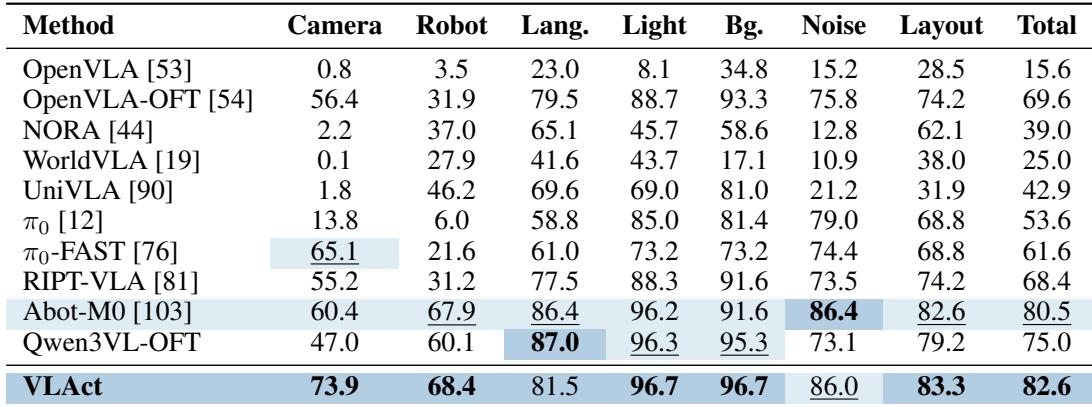
On the LIBERO-Plus robustness benchmark, VLAct reports the highest overall success rate at 82.6%, exceeding Qwen3VL-OFT by 7.6 points and Abot-M0 by 2.1 points. The improvement is concentrated in camera, robot, noise, and layout perturbations, indicating stronger visual-spatial robustness from continued pre-training. Among the listed prior methods, OpenVLA-OFT ranks highest with a 69.6% total, followed by π0-FAST at 61.6%. VLAct achieves the best overall success rate of 82.6%, outperforming Qwen3VL-OFT and Abot-M0 by 7.6 and 2.1 points respectively. Gains over Qwen3VL-OFT are largest on camera, robot, noise, and layout perturbations, pointing to improved visual-spatial representations.
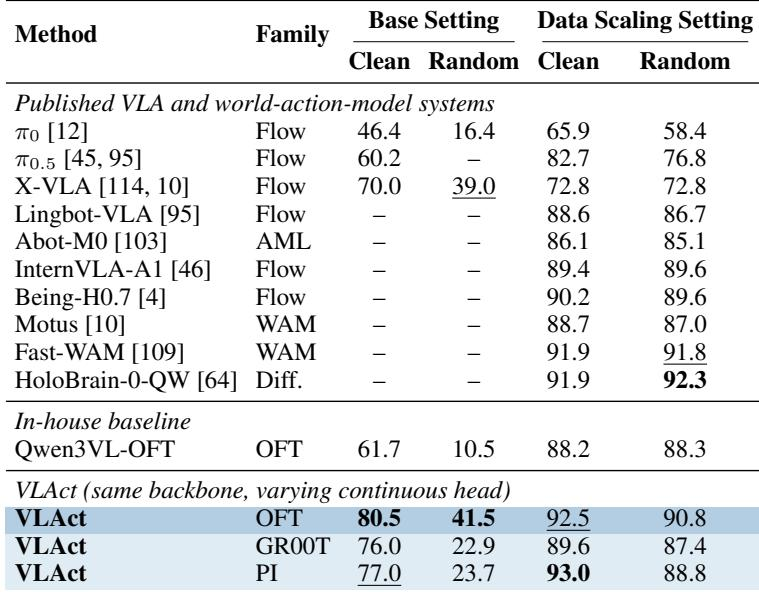
On RoboTwin 2.0, VLAct establishes the strongest Base-setting results among the compared methods and remains competitive in the Data Scaling setting. Its VLAct-OFT configuration reaches 92.5% Clean and 90.8% Random success, outperforming several larger-scale VLA and world-action-model baselines while staying close to the top systems. Strong Random performance after clean-only Base fine-tuning suggests the pretrained backbone improves both sample efficiency and generalization to visual distribution shifts. VLAct achieves the strongest Base-setting performance among the compared methods. In Data Scaling, VLAct-OFT outperforms large-scale systems such as InternVLA-A1, Being-H0.7, Motus, LingBot-VLA, ABot-M0, and π, while remaining close to HoloBrain-0 and Fast-WAM. After fine-tuning only on clean Base trajectories, VLAct still performs strongly on the randomized evaluation set, indicating improved clean-to-random generalization under visual and scene variation. Adding randomized expert demonstrations in the Data Scaling setting yields high Clean and Random success rates relative to published baselines.
VLAct ranks in the top quartile of the RoboDojo leaderboard by both average score and success rate, and its cross-embodiment transfer outperforms all designated world-action-model entries. It also surpasses several industry-developed systems despite using fully open-source data and a 16-GPU continued pre-training setup. The largest advantages appear on Precision and Long-Horizon tasks, while Memory remains a relative weakness. VLAct places eighth by average score and sixth by success rate among 35 policies, putting it in the top quartile on both metrics. It outperforms every explicitly designated world-action-model entry, including the strongest WAM, on both aggregate metrics. The largest gains over a Qwen3-VL-based entry occur on Precision and Long-Horizon tasks, while Memory is a clear limitation.
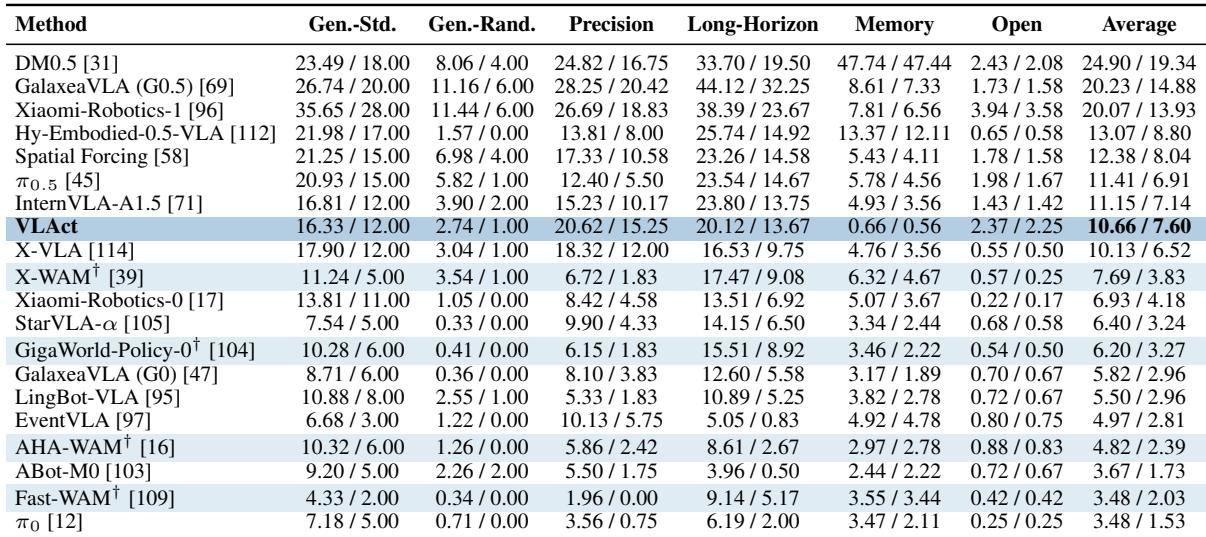
The evaluation spans robustness, generalization, and cross-embodiment skill transfer. On LIBERO-Plus, continued pre-training strengthens visual-spatial representations, with the largest robustness gains under camera, robot, noise, and layout perturbations. On RoboTwin 2.0, VLAct achieves the strongest base-setting results and maintains strong clean-to-random generalization after fine-tuning only on clean trajectories. On RoboDojo, VLAct ranks in the top quartile and surpasses world-action-model baselines, particularly on precision and long-horizon tasks, while memory remains a relative limitation.