Command Palette
Search for a command to run...
Crêtes de densité stables : cohérence et convergence du Mean Shift sous contrainte de sous-espace
Crêtes de densité stables : cohérence et convergence du Mean Shift sous contrainte de sous-espace
Wanli Qiao
Résumé
L’algorithme de Mean Shift sous contrainte de sous-espace (SCMS) est une méthode non paramétrique répandue pour l’extraction de crêtes de densité, qui constituent une représentation de faible dimension de données en grande dimension. Il est communément admis dans la littérature que les trajectoires du SCMS convergent vers la crête de densité classique, que nous appelons « crête statique », définie à l’aide du gradient de la densité ainsi que des valeurs et vecteurs propres de la hessienne de la densité. Dans cet article, nous démontrons que cette hypothèse n’est pas vérifiée en général, car la définition statique ne tient pas compte de la rotation de l’espace propre suiveur le long du flot continu du champ de vecteurs sous-jacent à l’algorithme. Pour résoudre ce problème, nous proposons un changement de paradigme en introduisant la « crête stable », une nouvelle structure géométrique définie sous l’angle des systèmes dynamiques et du jacobien du gradient de densité projeté. Nous prouvons que cette crête stable est la véritable cible théorique de l’algorithme SCMS. Sur cette base, nous développons un cadre SCMS généralisé utilisant un pas constant, dont nous établissons la convergence R-linéaire uniforme et la surjectivité topologique sur la crête stable. Nous dérivons en outre les vitesses de convergence pour l’estimation de la crête stable en termes de distance de Hausdorff. Enfin, nous révélons que l’algorithme SCMS original souffre d’une complexité de calcul en temps polynomial, causée par le couplage implicite du pas à la largeur de bande de lissage via l’opérateur Mean Shift, et nous montrons comment notre cadre généralisé fournit une solution statistiquement cohérente et plus efficace.
One-sentence Summary
Wanli Qiao demonstrates that the Subspace Constrained Mean Shift algorithm does not converge to the classical static density ridge, and instead proposes the "stable ridge"—a dynamical systems-based structure defined via the Jacobian of the projected density gradient—along with a generalized constant-step-size framework that achieves uniform R-linear convergence, topological surjectivity, and statistically consistent estimation with improved computational efficiency.
Key Contributions
- The paper introduces the stable ridge, a geometric structure defined via the Jacobian of the projected density gradient, and proves it is the true theoretical target of the SCMS algorithm, correcting the prior assumption that SCMS converges to the static ridge.
- A generalized SCMS framework using a constant step size is developed, and its uniform R-linear convergence and topological surjectivity onto the stable ridge are established, along with convergence rates for estimating the stable ridge via Hausdorff distance.
- The analysis reveals that the original SCMS algorithm suffers from polynomial-time computational complexity because the step size is implicitly coupled to the smoothing bandwidth, and the generalized framework provides a more efficient solution that recovers the log-density ridge in O(log n) iterations.
Introduction
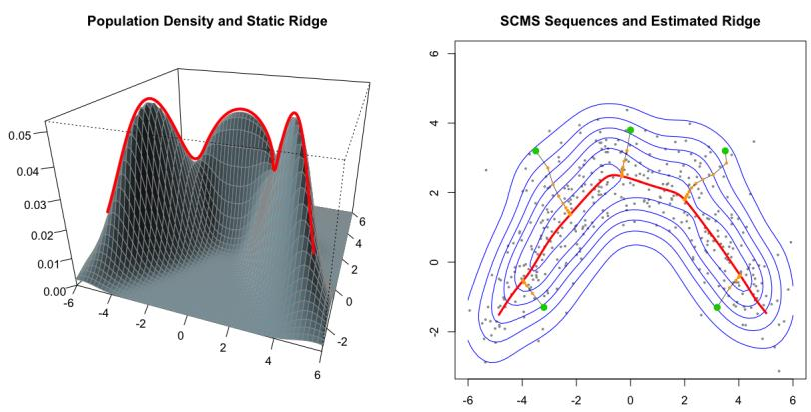
Extracting low-dimensional geometric structures from high-dimensional data is a core challenge in statistics and machine learning, with applications ranging from mapping cosmic web filaments to tracing blood vessels in medical images. Density ridges offer a compelling approach by defining these structures through the local differential geometry of the underlying probability density, and the Subspace Constrained Mean Shift (SCMS) algorithm has become a popular tool for estimating them. Prior work assumed SCMS converges to the static ridge, defined by pointwise conditions on the density Hessian, but recent counterexamples revealed this assumption is false, leaving the algorithm’s true target an open problem.
The authors resolve this by introducing the stable ridge, a new concept defined through the dynamical system governing the projected gradient vector field rather than static Hessian conditions. They prove that SCMS actually targets and converges to this stable ridge, establishing rigorous statistical consistency and computational complexity guarantees. Their analysis further uncovers a computational bottleneck in the original SCMS algorithm, where coupling the step size to the smoothing bandwidth forces polynomial iteration growth with sample size, and they propose a generalized framework with a constant step size that achieves logarithmic iteration complexity.
Method
The authors establish a rigorous theoretical foundation for the Subspace Constrained Mean Shift (SCMS) algorithm by first defining the geometric and regularity conditions under which stable ridge extraction is well-posed. The analysis begins with the introduction of the ridge-regular class, a set of density functions satisfying three key properties: a spectral gap between the k-th and (k+1)-th eigenvalues of the Hessian, negative definiteness of the Jacobian of the projected gradient field when restricted to the trailing eigenspace, and a lower bound on the projected gradient away from the ridge. These conditions, formalized in Assumptions (A1) and (A2), guarantee that the stable ridge R(f) is a compact, C2-smooth k-dimensional submanifold without boundary.
With the population geometry in place, the authors analyze the continuous flow φt(x) driven by the projected gradient vector field ξ(x). Lemma 2 demonstrates that for any point within a neighborhood Rϵ(f) of the ridge, the magnitude of ξ decays exponentially along the flow at rate γ, ensuring that trajectories remain confined to this neighborhood and converge to limit points on R(f). The limit map Φ(x) is shown to be continuously differentiable and, crucially, surjective from the boundary ∂Rϵ(f) onto the entire ridge, guaranteeing that initializing the flow from this boundary suffices to recover every point on the target manifold.
To bridge the continuous analysis with practical discretized implementations, the authors introduce a generalized SCMS algorithm that operates directly on the vector field ξ(x) with a constant step size α. The one-step operator is defined as Gα(x)=x+αξ(x). Lemma 4 establishes step-size bounds under which the discrete sequence remains within Rϵ(f) and the projected gradient decays geometrically at rate ρ=1−αγ/4. Theorem 2 then proves R-linear convergence of the iterates to a limit point on the stable ridge, with a uniform rate across all initial points in the neighborhood. The associated limit map Φα is continuous and approximates the continuous flow map Φ with error linearly bounded by α, as quantified in Proposition 2. Theorem 3 further confirms the surjectivity of Φα from the boundary set onto the ridge, mirroring the continuous case.
The finite-sample analysis translates these population guarantees to the empirical setting, where the density f is replaced by a kernel density estimator f. Under uniform convergence bounds on the derivatives of f and its associated geometric quantities, Corollary 2 shows that f inherits the ridge-regular properties with parameters scaled by 1/2. The sample version of the generalized SCMS algorithm, using the operator Gα(x)=x+αξ(x), is then analyzed. Theorem 5 establishes that, with high probability, the empirical iterates converge at an R-linear rate to the estimated ridge R(f), and Theorem 6 proves surjectivity of the empirical limit map Φα from ∂Rϵ(f) onto R(f). The total estimation error, combining computational and statistical components, is bounded in Theorem 7. By selecting the bandwidth h≍((logn)1+δ/n)1/(d+8) and stopping after O(logn) iterations, the Hausdorff distance between the recovered set and the true ridge achieves the rate O(((logn)1+δ/n)2/(d+8)).
The authors extend the framework to the original SCMS algorithm, which operates on the log-density p(x)=logf(x) and couples the step size to the bandwidth through the Mean Shift vector. They show that the original update can be rewritten as xm+1=xm+αn(xm)ξlog(xm), where the adaptive step size satisfies αn(x)≍h2. Under analogous regularity assumptions on the log-density, Lemma 7 establishes local diffeomorphism and surjectivity properties for the empirical log-density operator. Theorem 8 provides the total error bound, but reveals a critical computational limitation: because the step size scales with h2, achieving the statistical error rate requires m∗=O(n2/(d+8)) iterations, which grows polynomially with sample size. In contrast, the generalized SCMS formulation with a constant step size α achieves the same statistical accuracy in only O(logn) iterations, offering a substantial computational advantage for large-scale ridge extraction tasks.
Experiment
The evaluation uses Monte Carlo simulations with a radially symmetric density formed by convolving a uniform circle with Gaussian noise to validate the theoretical properties of the SCMS algorithms. The computational complexity experiment confirms that the generalized SCMS algorithm with a fixed step size bypasses the bandwidth-dependent iteration bottleneck of the original SCMS, showing nearly constant iteration counts as sample size grows, though the step size must be carefully tuned to avoid overshooting. The statistical consistency experiment verifies that the Hausdorff error between the estimated and true ridge decays with sample size at a rate faster than the theoretical upper bound, which is attributed to the density being flat along the ridge in this special scenario. Overall, the results support the theoretical findings that decoupling step size from bandwidth improves computational efficiency while maintaining statistical convergence.