Command Palette
Search for a command to run...
AskChem : une infrastructure centrée sur les affirmations pour la synthèse de la littérature en chimie
AskChem : une infrastructure centrée sur les affirmations pour la synthèse de la littérature en chimie
Bing Yan Stefano Martiniani
Résumé
La synthèse de la littérature en chimie nécessite souvent d'assembler des résultats spécifiques disséminés dans de nombreuses publications, alors que les systèmes de recherche documentaire existants retournent principalement des listes de documents classés. Par conséquent, les scientifiques et les agents d'IA doivent localiser manuellement les informations pertinentes, vérifier leur provenance et assembler des réponses transversales aux articles. Nous présentons AskChem, une infrastructure centrée sur les affirmations pour la recherche transversale en chimie. AskChem fait évoluer l'unité de recherche du document vers l'affirmation porteuse de provenance : chaque article est converti en affirmations atomiques et typées, chacune étant étayée par un DOI source et une citation textuelle ou un localisateur de preuve explicite. Sur ce réservoir partagé d'affirmations, AskChem expose des structures complémentaires pour la recherche et la synthèse : une taxonomie à facettes stabilisée pour la recherche hiérarchique et la navigation, un graphe de preuves reliant les affirmations par des relations, et une taxonomie exploratoire vivante qui situe les articles indexés sous des principes scientifiques. AskChem indexe actuellement 2,4 millions d'affirmations issues de 147 000 articles et offre une interface web, ainsi que des accès REST, SDK et MCP pour les agents d'IA. Sur AskChem-Bench, l'ancrage d'un lecteur GPT-5.5 dans AskChem produit 100 % de DOI résolubles, contre 88,3 % sans recherche documentaire, et la plus forte densité de citations parmi cinq systèmes testés. AskChem est accessible en ligne à l'adresse https://askchem.org.
One-sentence Summary
Researchers at New York University present AskChem, a claim-centered infrastructure that converts chemistry papers into atomic, provenance-carrying claims, exposing a faceted taxonomy, evidence graph, and living taxonomy for cross-paper synthesis, and which, indexing 2.4M claims from 147K papers, boosts AI reader DOI resolvability to 100% and achieves the highest citation density among tested systems.
Key Contributions
- A provenance-carrying claim representation segments chemistry papers into atomic, typed assertions grounded by a source DOI and a verbatim quote or evidence locator, deployed over 2.4M claims from 147K papers.
- Complementary structures over the shared claim store include a stabilized faceted taxonomy for hierarchical retrieval and browsing, an evidence graph linking claims through typed relations, and an exploratory living taxonomy situating papers under scientific principles.
- Human- and agent-facing interfaces are provided through a web UI, REST API, SDK, and MCP server, along with AskChem-Bench, where grounding a GPT-5.5 reader yields 100% resolvable DOIs and the highest citation density among five tested systems, versus 88.3% without retrieval.
Introduction
Chemists frequently need to synthesize evidence scattered across many papers, such as comparing catalyst performance metrics, but existing literature search tools return document-level results. This forces researchers to manually extract and verify individual claims, a process that is slow and error-prone. LLM-based assistants face the same limitation: document retrieval does not expose the underlying claims or their relationships, and models may fabricate citations when relying on parametric memory. The authors introduce AskChem, a system that reorients search around provenance-carrying scientific claims. By extracting atomic, typed assertions with source DOIs and verbatim quotes from 147K papers, AskChem enables direct retrieval of specific findings, cross-paper synthesis, and structured navigation through faceted taxonomies, evidence graphs, and a principle-centered hierarchy.
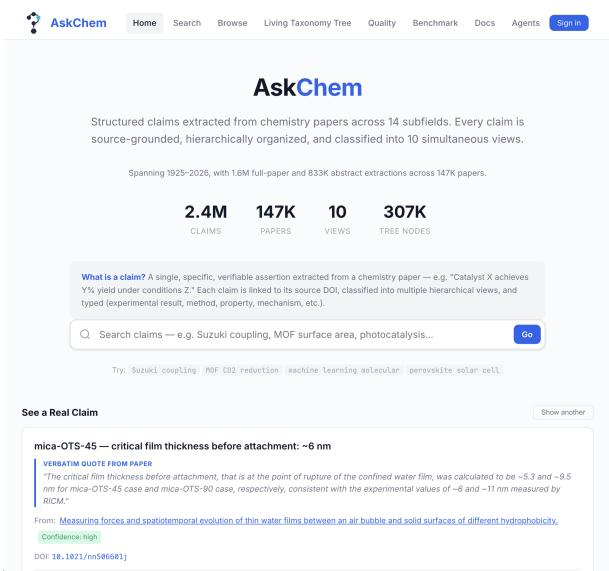
Dataset
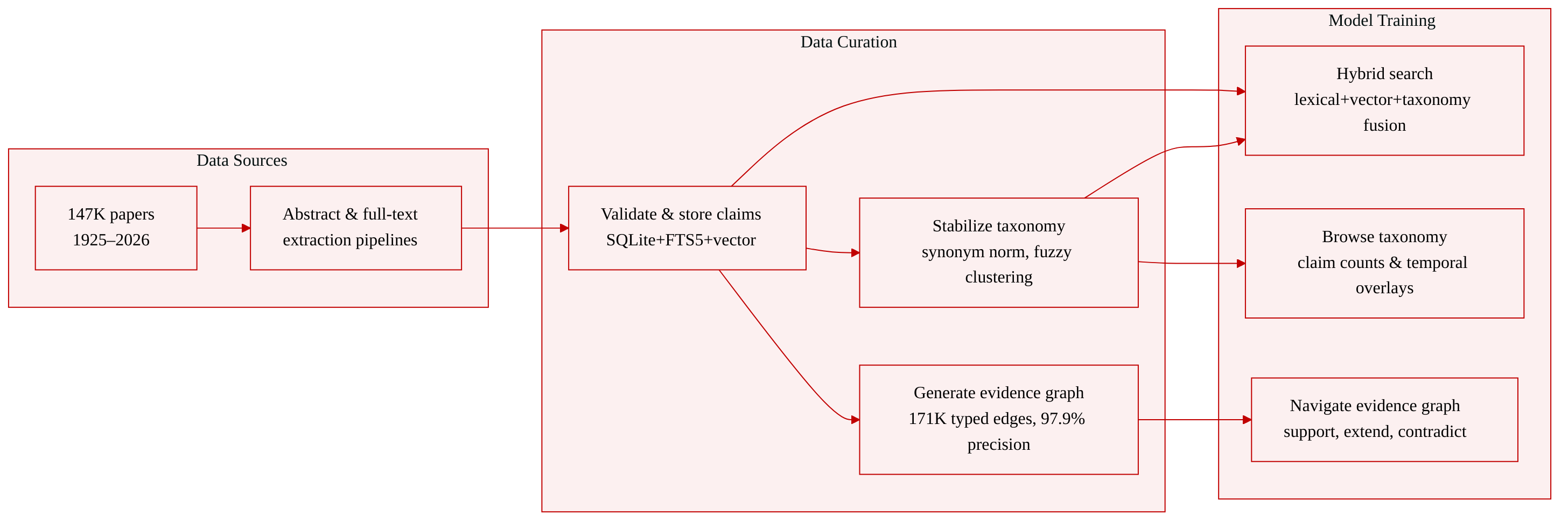
The authors build the AskChem dataset around three interconnected components, all extracted from scientific papers and used as a live retrieval and exploration index.
-
Claims 2.4 million atomic, typed scientific assertions. Each claim is grounded by a source DOI and a verbatim quote, and includes structured fields (reactants, conditions, measurements, materials) plus an extraction confidence score. Every claim carries paper-level metadata (DOI, venue, year, citation count, disambiguated authors via OpenAlex).
-
Stabilized faceted taxonomy 307,000 populated taxonomy nodes organized into L1/L2/L3 paths. Five content views capture what a claim is about (reaction type, substance class, application, technique, mechanism topic), with additional views for claim type, extracted measurements, time, and source authors. The taxonomy is induced from paper text and then stabilized through canonical routing, synonym normalization, and fuzzy clustering of near-duplicate subcategories.
-
Evidence graph 171,342 typed, directed edges linking claims. Relation types include cites_as_evidence, supports, extends, contradicts, and derives_from, each with a confidence score and provenance. A manual verification of 148 edges (146 decidable) showed 97.9% edge-type precision.
Sources and extraction Claims come from 147,000 papers spanning 1925–2026. Two complementary pipelines populate the store: a high-throughput extractor processes abstracts at scale, while a deeper extractor reads full-text PDFs to capture claim types often absent from abstracts (hypotheses, limitations, surprising findings). All outputs are validated against a claim schema that enforces provenance fields, numeric ranges, and chemistry-specific fields, so 100% of the 2.4M claims are source-grounded.
Processing Extracted claims are stored in SQLite with FTS5 full-text search and a vector index. Taxonomy paths are induced automatically from recurring terminology across papers and then stabilized for production retrieval. Relation edges are generated by a dedicated extraction layer, with confidence scoring and provenance attached to each edge.
How the data is used The dataset serves as the operational index for the AskChem platform, not as a training split. Hybrid search combines lexical (FTS5), paper-level, taxonomy-node, and dense-vector recall using reciprocal rank fusion. Taxonomy facets let users group results and browse category hierarchies. The evidence graph acts as a relational layer: an API endpoint returns inbound and outbound evidence links for a claim, and the web interface induces a graph over top search hits so users can navigate from a finding to claims that support, extend, or contradict it.
Method
The authors design AskChem around a claim-centered representation, replacing full papers with atomic, typed scientific assertions as the primary retrieval unit. A Claim is grounded by a source DOI and a verbatim quote, and includes structured fields such as reactants, conditions, measurements, or materials, along with an extraction confidence score. This representation ensures that individual findings, rather than entire documents, become the objects that can be searched, grouped, linked, and verified.
As shown in the framework diagram:
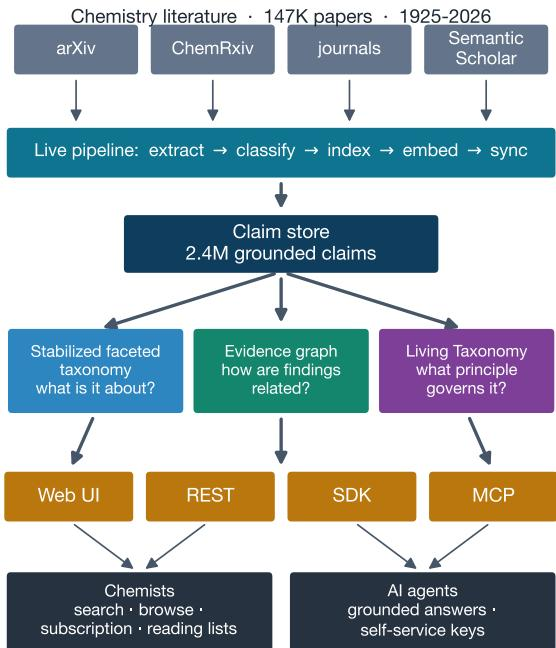
The platform anchors several structures under the same claim identity. A Source records paper-level metadata, including DOI, venue, year, citation count, and authors disambiguated via OpenAlex. A TreeNode places a claim in one or more faceted taxonomy paths, while an Edge records a typed relation between two claims. Keeping these structures anchored to shared claim identifiers allows search, hierarchical browsing, and graph traversal to return the same provenance-bearing objects.
To populate the claim store, the authors employ two complementary extraction pipelines. A high-throughput extractor processes abstracts at scale, while a deeper extractor reads full-text PDFs to capture claim types often absent from abstracts, such as hypotheses, limitations, and surprising findings. Each extraction call returns structured JSON validated against the claim schema, ensuring required provenance fields and chemistry-specific constraints are met.
As illustrated by the corpus statistics:
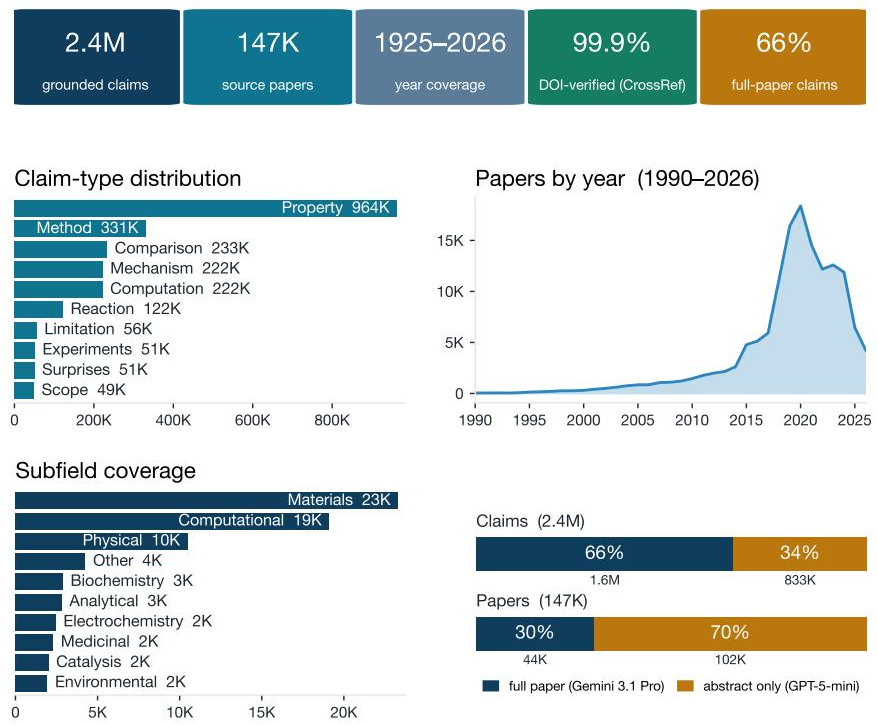
These validation checks establish traceability. In the deployed index, all claims are source-grounded, carrying a claim type, a source DOI, and a verbatim quote. The interface returns these provenance-carrying claims directly to the user.
As demonstrated in the platform interface:
To support cross-paper search, the authors add a relation-extraction layer over the claim store. The extractor emits typed, directed edges between claims, including cites_as_evidence, supports, extends, contradicts, and derives_from, each with confidence scores and provenance. This graph serves as a relational layer over retrieval, allowing users to move from a finding to claims that support, extend, or contradict it.
The authors induce a faceted taxonomy to organize claims by what they concern. Rather than imposing a fully predefined chemistry ontology, AskChem induces category paths while digesting papers and extracting claims. These paths reveal recurring terminology across reactions, substances, applications, techniques, and mechanisms. The induced paths are stabilized through canonical top-level routing, synonym normalization, and fuzzy clustering of near-duplicate subcategories, resulting in a persistent set of L1/L2/L3 paths suitable for production retrieval.
The taxonomy defines multiple operational views over the same claim store. Each claim can be assigned a path in populated views, such as coupling/cross_coupling/suzuki under by_reaction_type. Five content views capture what a claim is about: reaction type, substance class, application, technique, and mechanism topic. Additional views organize claim type, extracted measurements, time, and source authors.
As shown in the decomposition of claims across views:
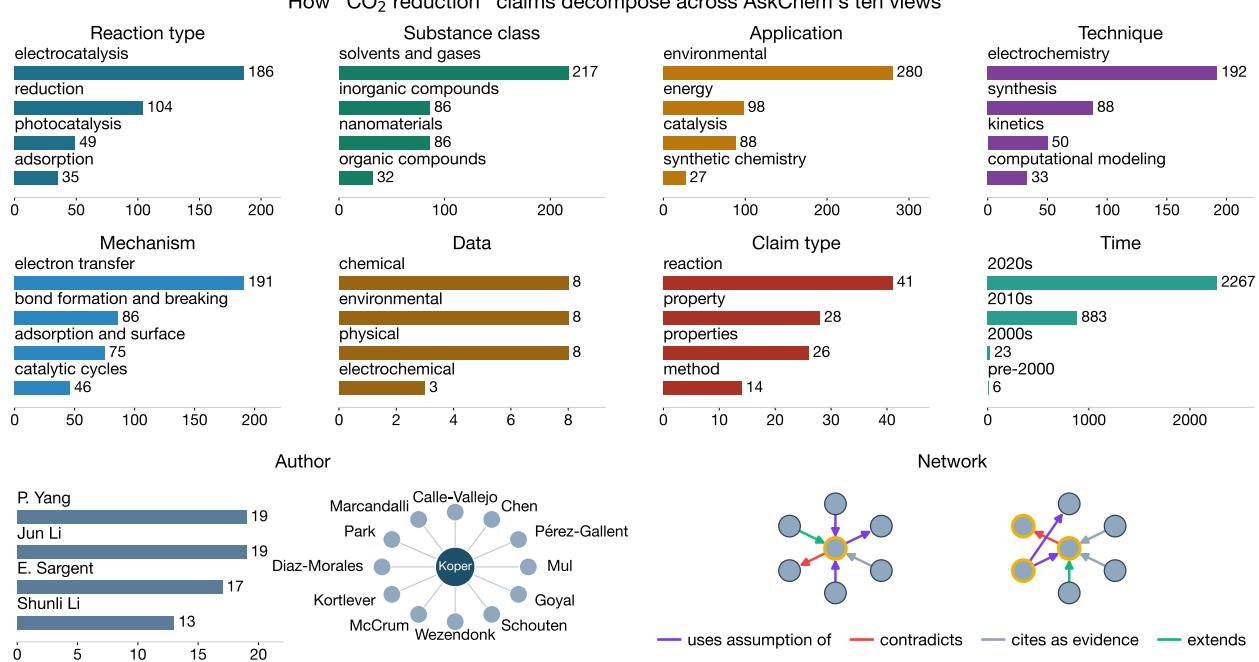
These facets act as different navigational lenses over the same provenance-carrying claims. The stabilized taxonomy is used as an operational index. Hybrid search combines FTS5 claim-text retrieval, paper-level recall, taxonomy-node recall, and dense-vector recall using reciprocal rank fusion. Returned claims retain their associated view paths, allowing clients to group results or expand related categories.
Complementing the faceted taxonomy, the authors introduce a principle-centered living taxonomy that asks which broader scientific idea governs a paper's contribution. It organizes paper-grounded leaves under principles, theories, models, mechanisms, and phenomena.
As illustrated by the principle-centered organization:
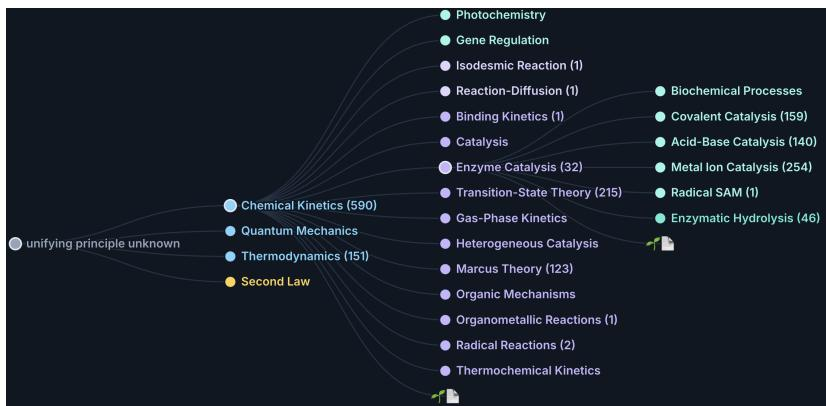
The tree includes an abstention mechanism that proposes new branches when no existing node is suitable. The authors treat this structure as an exploratory overview of the indexed corpus rather than a fully validated scientific ontology.
Experiment
The evaluation validates AskChem's source grounding, structure reliability, retrieval quality, and scalability. All claims are traceable to verbatim evidence, and the evidence graph shows high edge-type precision. Claim-centered retrieval eliminates DOI hallucination and yields the best citation density and relevance, outperforming a reader without retrieval and other systems, while operating at corpus scale. AskChem is distinguished from existing databases and assistants by its faceted, provenance-carrying claim store usable by both humans and agents.
Grounding a GPT-5.5 reader in AskChem eliminates DOI hallucination, yielding 100% verified citations and the highest citation density, paper relevance, and share of recent high-impact work among all tested systems. The retrieval-free baseline frequently fabricates references and scores lowest on relevance and recency. Edison Scientific’s agentic system leads in grounded specificity and on-topic rate, highlighting a trade-off between citation verifiability and the depth of quantitative detail. AskChem achieves perfect DOI resolvability, with every cited reference verified via CrossRef, whereas the unaugmented reader resolves only 88.3% of DOIs. The AskChem-grounded reader cites nearly twice as many verified DOIs per answer as the LLM-only baseline and more than double the density of Paperclip and NotebookLM, while also surfacing a much larger fraction of recent high-impact literature.
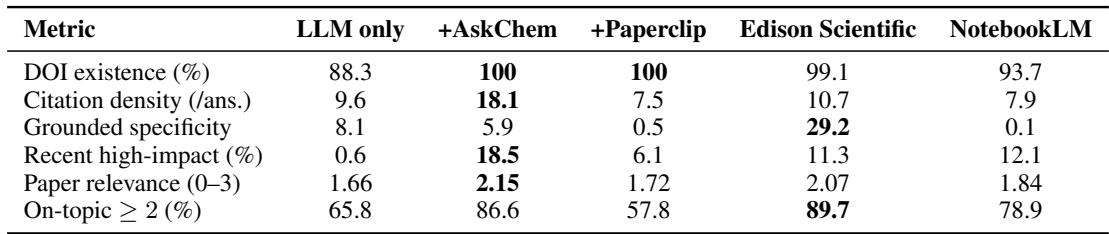
The evaluation compares a GPT-5.5 reader grounded in the AskChem system against a retrieval-free baseline and an agentic system from Edison Scientific, along with other tools like Paperclip and NotebookLM. Grounding the reader in AskChem eliminates DOI hallucination, yielding fully verified citations, the highest citation density, and superior relevance and recency, while the baseline frequently fabricates references. The agentic system achieves the best grounded specificity and on-topic rate, revealing a trade-off between citation verifiability and depth of quantitative detail. Overall, AskChem achieves perfect DOI resolvability and cites substantially more verified recent high-impact literature than all other systems.