Command Palette
Search for a command to run...
CoRT : Rejeu contrefactuel pour l'optimisation de politique guidée par rubrique au niveau du jeton
CoRT : Rejeu contrefactuel pour l'optimisation de politique guidée par rubrique au niveau du jeton
Bo-Wen Zhang Junwei He Wen Wang Song-Lin Lv Wentao Ma Rongyi Lin Shuhan Zhong Lan-Zhe Guo
Résumé
L'apprentissage par renforcement basé sur des rubriques enrichit l'entraînement des modèles de langage en évaluant les sorties du modèle par rapport à des critères explicites. Pourtant, dans les pipelines de type GRPO, ces jugements structurés sont réduits à une récompense scalaire au niveau de la réponse et convertis en un avantage au niveau de la réponse, qui est diffusé uniformément à tous les jetons générés. Cela ne laisse aucun mécanisme explicite pour attribuer le crédit au sein d'une réponse, même lorsque différents critères sont ancrés dans différentes parties, décisions de formatage ou choix sémantiques. Nous proposons CoRT, une méthode de pondération du crédit au niveau du jeton pour le GRPO conditionné par rubrique. Au lieu d'entraîner un modèle auxiliaire de notation de jetons, CoRT utilise le rejeu contrefactuel pour réévaluer la même réponse échantillonnée avec l'invite originale conditionnée par la rubrique et une invite appariée sans critères. Les contrastes de log-vraisemblance par jeton qui en résultent servent de proxy pour la dépendance au contexte de la rubrique. CoRT mappe ces contrastes à des poids bornés et normalisés par réponse et les utilise pour redistribuer l'avantage signé du GRPO entre les jetons, sans introduire de scoreur auxiliaire ni modifier la récompense au niveau de la réponse. Des expériences sur des modèles ajustés aux instructions et avec différentes granularités de récompense montrent que CoRT améliore le GRPO apparié au niveau de la réponse dans la grande majorité des comparaisons, avec un gain moyen de 4,4 points de pourcentage. La méthode reste compétitive par rapport aux références apprises d'attribution de crédit au niveau du jeton tout en évitant une étape distincte d'apprentissage de la pertinence. Ces résultats suggèrent que les contrastes de vraisemblance contrefactuels internes à la politique fournissent un signal d'entraînement efficace pour l'attribution de crédit intra-réponse tout en conservant la simplicité et la stabilité du GRPO.
One-sentence Summary
CoRT, proposed by researchers from Nanjing University, ByteDance, and the University of Chinese Academy of Sciences, is a token-level credit weighting method for rubric-conditioned GRPO that uses counterfactual replay to compute tokenwise log-likelihood contrasts between rubric-conditioned and criteria-free prompts, redistributing the signed advantage without an auxiliary scorer and yielding an average 4.4 percentage point improvement while retaining GRPO's simplicity.
Key Contributions
- CoRT is a token-level credit assignment method for rubric-conditioned GRPO that uses counterfactual replay to compute tokenwise log-likelihood contrasts between rubric-conditioned and criteria-free prompts, serving as a proxy for criterion dependence without training an auxiliary scoring model.
- CoRT maps these contrasts to bounded, response-normalized weights and redistributes the signed GRPO advantage across tokens, keeping the original rollout distribution, scalar reward, verifier, and clipped surrogate structure intact.
- Experiments across instruction-tuned models and reward granularities show that CoRT improves over response-level GRPO in most comparisons, with an average gain of 4.4 percentage points, and remains competitive with learned token-level credit baselines while integrating smoothly with alternative policy optimization algorithms like DAPO and GSPO.
Introduction
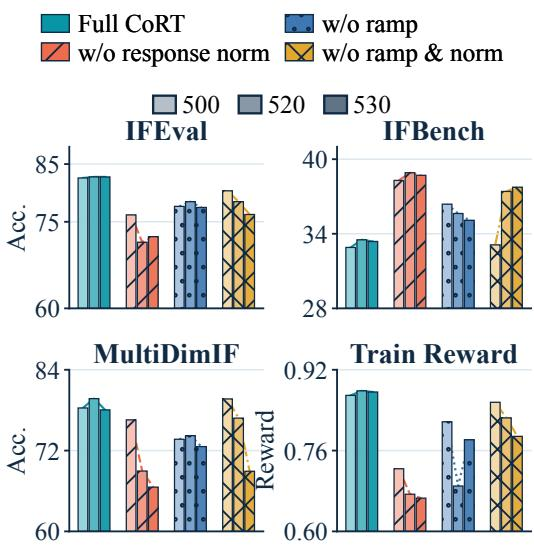
In rubric-based instruction following, language models are fine-tuned with response-level rewards that evaluate how well the output satisfies a set of criteria. Standard GRPO assigns the same advantage signal to all tokens in a response, ignoring the fact that some tokens contribute more to meeting the criteria than others. This within-response credit mismatch can slow learning and destabilize training. The authors introduce CoRT, a lightweight method that uses counterfactual replay to rescore each response with the criteria removed, then converts the resulting likelihood contrast into token-level credit weights. These weights redistribute the GRPO advantage toward tokens that depend more on the criteria, without requiring a separate model, while keeping the original rollout distribution, verifier, and clipped surrogate objective intact.
Experiment
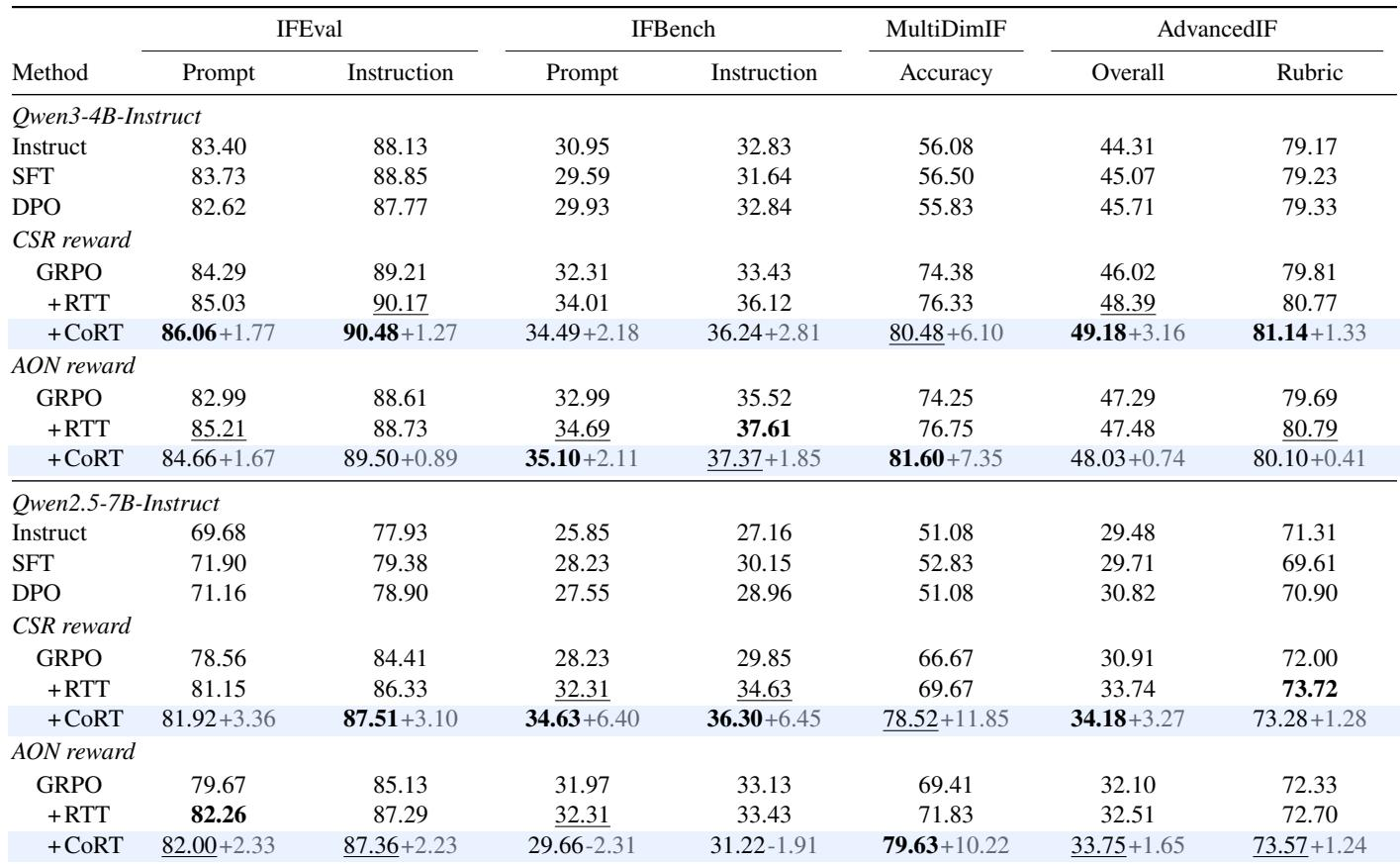
Within the Qwen3-4B-Instruct block, the CSR reward GRPO variant consistently achieves the highest scores across all instruction-following benchmarks, outperforming Instruct, SFT, and DPO baselines. The largest improvement is on MultiDimIF Accuracy, where GRPO reaches 74.38 compared to the 55–57 range of the other methods, while the other metrics show more modest gains. GRPO with CSR reward yields the best result on every metric, with a particularly large jump on MultiDimIF Accuracy. SFT and DPO trade places as the second-best method depending on the benchmark, with SFT stronger on IFEval and DPO stronger on IFBench Instruction, MultiDimIF Overall, and AdvancedIF Rubric.
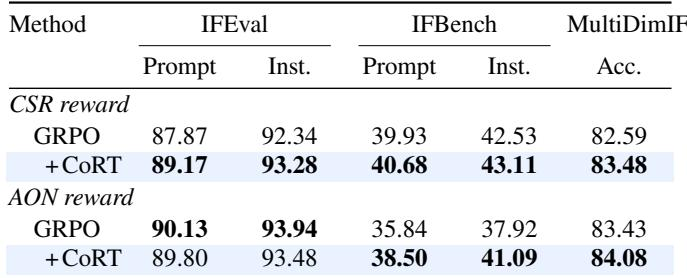
The Qwen3-14B model was evaluated with two reward strategies, CSR and AON, both with and without CoRT. CoRT consistently improves MultiDimIF accuracy, especially for AON where instruction following accuracy rises from 37.92 to 41.09, but it slightly reduces IFEval and IFBench scores when applied to the AON strategy. AON without CoRT achieves the highest IFEval and IFBench, while AON with CoRT yields the best overall MultiDimIF accuracy. CoRT boosts MultiDimIF instruction following accuracy for AON reward GRPO from 37.92 to 41.09, while slightly lowering IFEval from 90.13 to 89.80. CSR reward GRPO sees uniform improvements from CoRT across all metrics, with IFEval rising from 87.87 to 89.17.
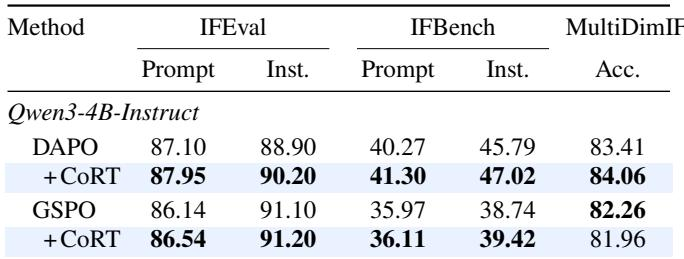
Adding CoRT to DAPO leads to consistent improvements across all evaluated metrics, including clear gains on instruction-following benchmarks. In contrast, CoRT provides only marginal benefits for GSPO, with a slight drop in MultiDimIF accuracy. DAPO with CoRT achieves the highest MultiDimIF accuracy among the compared configurations. DAPO with CoRT improves IFEval instruction score by 1.3 points and IFBench instruction score by 1.23 points over DAPO alone. GSPO with CoRT yields only a 0.1 point increase on IFEval instruction and a 0.68 point increase on IFBench instruction, while MultiDimIF accuracy decreases by 0.3 points. DAPO+CoRT outperforms GSPO+CoRT on MultiDimIF accuracy by a clear margin, achieving 84.06 versus 81.96.
Across three experiments, the paper evaluate a range of training methods for instruction-following with Qwen3 models. The CSR reward GRPO variant consistently outperforms baselines, yielding especially large gains on MultiDimIF accuracy. The reasoning trace augmentation CoRT improves MultiDimIF accuracy when applied to GRPO with CSR reward or DAPO, but it can slightly reduce standard IFEval/IFBench scores for AON reward GRPO or GSPO, while DAPO+CoRT achieves the best MultiDimIF accuracy among compared RL configurations.