Command Palette
Search for a command to run...
SearchOS-V1 : Vers une collaboration robuste d'agents de recherche d'information en domaine ouvert
SearchOS-V1 : Vers une collaboration robuste d'agents de recherche d'information en domaine ouvert
Résumé
Les avancées récentes des grands modèles de langage intégrés à des outils ont fait de la recherche web une capacité centrale des agents de recherche d'information. Cependant, à mesure que l'historique des interactions s'allonge, les agents peinent de plus en plus à suivre la progression de la tâche. Lorsque les tentatives de recherche ne produisent pas de preuves utiles, les systèmes actuels, qu'ils soient mono-agents ou multi-agents, peuvent se retrouver piégés dans des boucles répétitives, gaspillant le budget de recherche et compromettant finalement la qualité et l'exhaustivité du résultat final. Nous présentons SearchOS, un cadre multi-agents au niveau système qui transforme un suivi de progression de recherche fragile et implicite en un état explicite, persistant et partagé. Tout d'abord, nous formulons la recherche d'information en domaine ouvert comme une complétion de schéma relationnel avec citations sourcées, où les agents découvrent des entités, renseignent des attributs dans des tables liées et ancrent chaque valeur à une preuve source. Ensuite, nous concevons la Gestion de Contexte Orientée Recherche (SOCM), qui externalise l'état évolutif en une Tâche Frontière, un Graphe de Preuves, une Carte de Couverture et une Mémoire d'Échecs. S'appuyant sur SOCM, SearchOS applique un mécanisme d'ordonnancement pipeline-parallèle qui superpose l'exécution des sous-agents et réaffecte en continu les créneaux libérés à des tâches ciblant les lacunes de couverture non résolues, afin d'améliorer l'utilisation et le débit. Pour ordonnancer et contrôler l'exécution des agents de recherche, SearchOS introduit un Harnais Intergiciel d'Outil de Recherche qui intercepte les interactions entre le modèle et les outils pour enregistrer les preuves sourcées et réagir aux blocages ou à l'épuisement du budget, et fournit un système hiérarchique réutilisable de compétences comprenant des compétences stratégiques et d'accès pour augmenter le processus de recherche des agents et éviter de répéter des schémas de recherche infructueux d'une exécution à l'autre. Sur WideSearch et GISA, SearchOS domine toutes les métriques parmi les références mono-agents et multi-agents évaluées, ouvrant la voie à une collaboration robuste en recherche d'information.
One-sentence Summary
SearchOS, a multi-agent framework from Renmin University of China and Ant Group, transforms implicit search progress into explicit shared state via Search-Oriented Context Management (SOCM) with Frontier Task, Evidence Graph, Coverage Map, and Failure Memory, and pipeline-parallel scheduling, achieving robust open-domain information-seeking collaboration and outperforming baselines on WideSearch and GISA.
Key Contributions
- Search-Oriented Context Management (SOCM) externalizes search progress into a Frontier Task, Evidence Graph, Coverage Map, and Failure Memory, paired with pipeline-parallel orchestration that dispatches unresolved coverage gaps to specialized agents.
- A Search Tool Middleware Harness intercepts model-tool interactions to ground evidence, enforce search budgets, and detect stalls or repetition, moving execution control outside agent prompts.
- A hierarchical skill library supplies reusable search strategies and site-specific access procedures that augment agent behavior and prevent repeated failed search patterns across sessions.
Introduction
The authors tackle the challenge of building reliable, long-horizon web search agents from large language models. While tool-augmented LLMs can iteratively search and synthesize information, they struggle as interaction histories grow: evidence becomes buried, coverage gaps go unnoticed, and agents waste budget on redundant or dead-end queries. Multi-agent setups often compound these issues with duplicated effort and idle workers, because coordination state remains transient within conversation logs rather than being explicitly maintained. The authors introduce SearchOS, a framework that externalizes search progress as a shared, system-managed state. It formulates open-domain information seeking as relational schema completion with grounded citations, then coordinates specialized agents through a pipeline-parallel orchestration that continuously dispatches unresolved gaps. A middleware harness enforces budget limits, anchors evidence, and detects stalls, while a hierarchical skill library supplies reusable search strategies and site-specific access procedures.
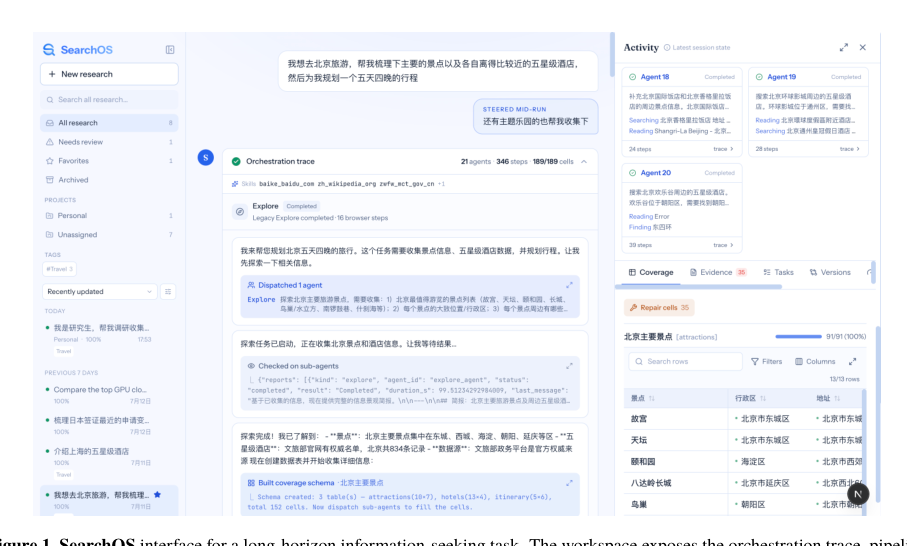
Method
The authors formulate open-domain information seeking as relational schema completion with grounded citations. Given a natural-language request, the system constructs a relational search schema consisting of tables with attributes and primary keys, along with foreign-key relations. The goal is to discover entities, populate a value matrix, and maintain a citation matrix linking each value to a source URL and anchored excerpt.
To execute this, the authors introduce SearchOS, a stateful closed-loop system that aligns execution with the evolving search state.
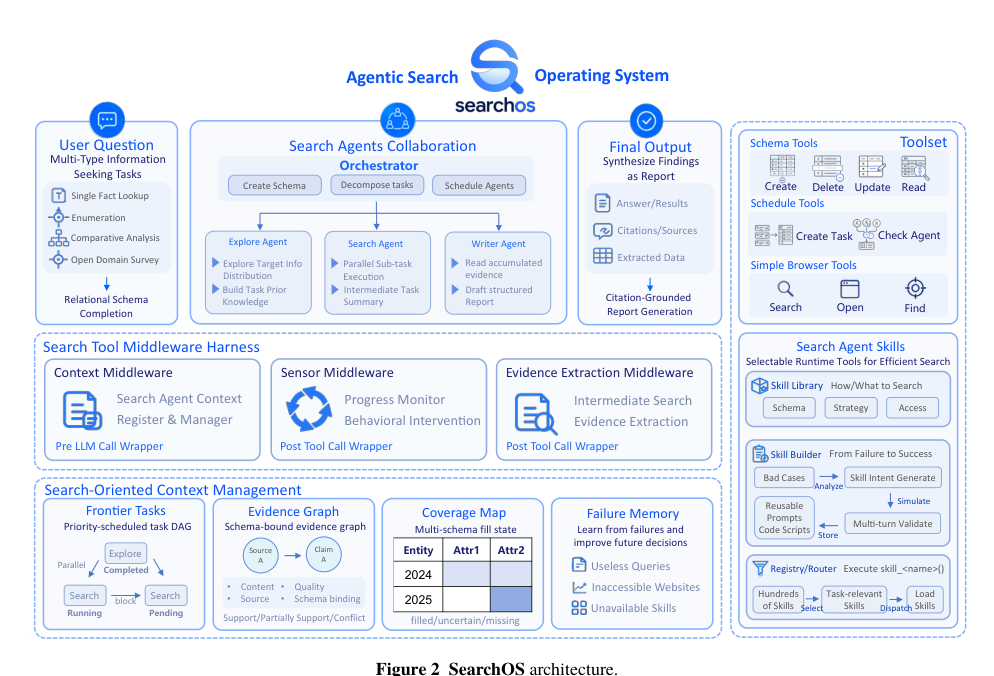
As shown in the framework diagram, SearchOS dispatches unresolved schema gaps through an orchestrator, commits observations through Search-Oriented Context Management (SOCM), and grounds interactions via middleware. The system employs an orchestrator-worker architecture where the orchestrator builds the schema and prioritizes gaps, explore agents identify candidates, search agents collect grounded evidence, and a writer produces the final cited report.
SOCM externalizes long-horizon search information as a durable shared state, comprising the Frontier Task, Evidence Graph, Coverage Map, and Failure Memory. The Frontier Task acts as a dependency-aware task pool, scheduling work based on priorities and dependencies. The Evidence Graph stores atomic findings with fine-grained provenance rather than page-level summaries, linking values to sources and supporting spans. The Coverage Map materializes schema cells to track their status, ensuring progress is measurable. Finally, Failure Memory records unsuccessful actions to prevent agents from repeating exhausted paths.
To avoid idle time from synchronized batches, the authors apply pipeline parallelism to role-scoped work. The orchestrator continuously dispatches tasks from the ready set to available execution slots based on frontier priority. After each completion, SOCM is updated, and the released slot is refilled, allowing roles to overlap when dependencies permit.
During long-horizon search, agents face model-level failures and system-level disruptions. To address this, the authors introduce a system-level Search Tool Middleware Harness that intercepts the agent loop at model and tool boundaries.
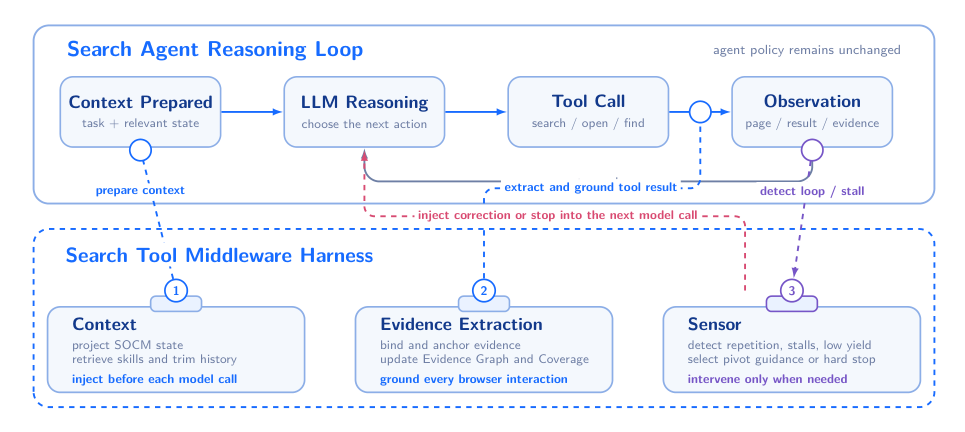
As illustrated in the figure below, the harness consists of three components. Context Middleware prepares the role-specific model context by projecting shared state, retrieving skills, and trimming history before each model call. Evidence Extraction Middleware processes tool observations to extract schema-bound candidates, requiring both schema binding and span anchoring before atomically updating the Evidence Graph and Coverage Map. Sensor Middleware measures coverage and evidence progress to detect stalls and enforce resource limits, deciding whether to continue execution, inject a correction, or stop a branch.
Because search requires reusable knowledge at different operational levels, the authors organize it into hierarchical search skills: orchestrator, strategy, and access skills.
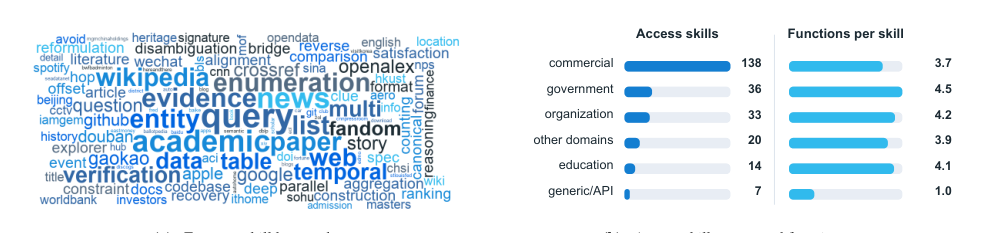
As shown in the figure below, SearchOS-V1 contains 280 pre-built skills across various domains. Orchestrator skills provide global playbooks for task decomposition and schema alignment. Strategy skills encode source-independent methods for query reformulation and reasoning. Access skills handle source-specific retrieval and extraction for databases, government portals, and other catalogs. At startup, orchestrator skills are injected as a shared playbook, while strategy and access skills are retrieved and executed based on task requirements.
Experiment
SearchOS is evaluated on WideSearch and GISA, two benchmarks for large-scale information gathering and general information-seeking tasks. It outperforms both single-agent and multi-agent baselines, with the largest gains on recall- and completeness-sensitive metrics, demonstrating the benefit of relational schema completion and coverage-aware dispatch. Ablation studies confirm that search-time schema planning, continuous pipeline scheduling, loop-sensor interventions, and hierarchical skills all contribute to improved effectiveness and efficiency, with skills substantially reducing session time while boosting row-level consistency.
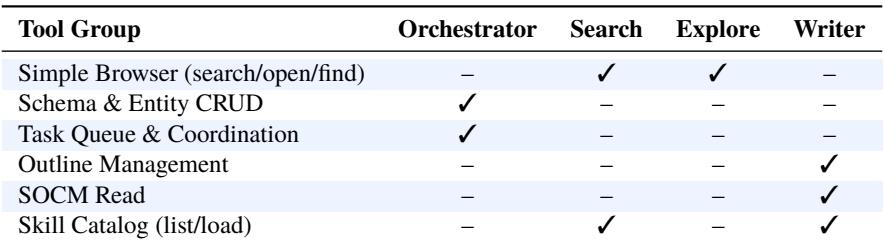
Tool assignments enforce a strict separation of responsibilities: the orchestrator alone manages schema, entities, and task coordination, while search and explore agents share browser tools for evidence gathering. The writer is provisioned with outline management, shared context access, and skill loading to produce structured reports, and search agents can also load skills to guide retrieval. Only the orchestrator has access to schema and entity CRUD and task queue tools, centralizing global planning and coordination. Search and explore roles are both granted simple browser tools, but neither can modify the schema or task queue. The writer role is given outline management and SOCM read access, enabling it to structure the final report without direct browsing. Skill catalog tools are shared between search and writer roles, allowing reusable retrieval patterns to inform both evidence collection and report generation.
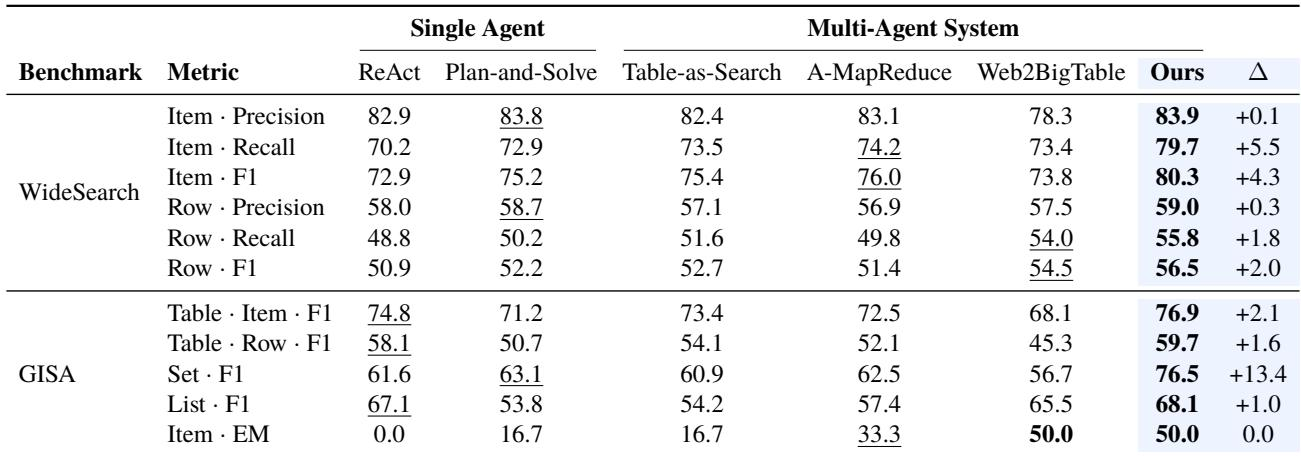
SearchOS leads all headline F1 metrics on both WideSearch and GISA benchmarks. On WideSearch, it improves Item-level F1 by 4.3 points over the strongest baseline, driven by a large recall gain while maintaining the highest precision. On GISA, the largest gain is on Set questions, where it outperforms the best baseline by 13.4 points, demonstrating strong completeness in answer enumeration. On WideSearch, SearchOS achieves the best Item-level Precision (83.9) and Recall (79.7), yielding an F1 of 80.3, a +4.3-point improvement over the strongest baseline, with the gain concentrated in recall. On GISA, SearchOS attains a Set question F1 of 76.5, a 13.4-point lead over the best baseline, and also tops Table F1 at both Item (76.9) and Row (59.7) levels.
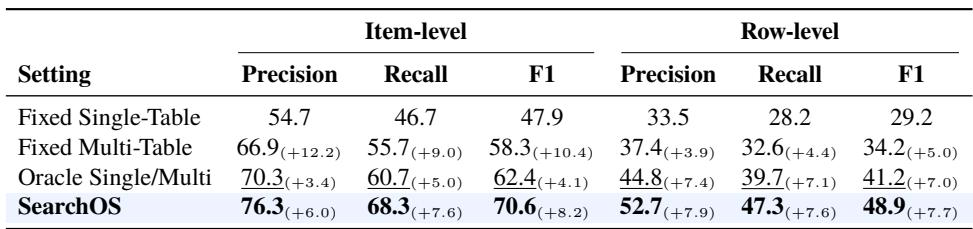
Autonomous schema planning outperforms any fixed schema choice, even when an oracle selects the better of single-table or multi-table schemas per task. The relative advantage of multi-table over single-table schemas varies by task, and SearchOS adapts by predominantly choosing single-table structures while still surpassing the oracle. These results show that schema planning should remain part of the search process rather than be fixed in advance. Fixed multi-table schemas improve Item F1 by more than ten points over fixed single-table schemas, but the benefit is task-dependent. An oracle that selects the better fixed schema per case still trails SearchOS by over eight Item F1 points. SearchOS autonomously chose single-table schemas for most tasks, yet achieved the highest overall scores. The consistent gap between SearchOS and the oracle indicates that dynamic schema planning captures task-specific structure that fixed schemas miss.
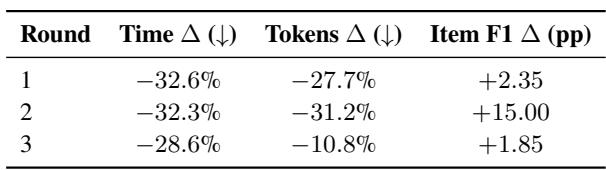
Continuous scheduling consistently reduces end-to-end time and token consumption while improving retrieval quality across repeated runs. Across three paired rounds, median time drops by 28.6–32.6% and Item F1 rises in every round, with an average time reduction of 24.3%. The gains come from immediately refilling released slots, which eliminates idle capacity at batch barriers. Median end-to-end time falls by 28.6–32.6% across the three rounds, showing stable efficiency gains. Item F1 improves in all rounds, with a median gain of up to 15 percentage points.
Continuous pipeline-parallel scheduling reduces end-to-end time by 24.3% compared to batch scheduling on WideSearch, while improving slot utilization, task throughput, and Item F1. The policy eliminates idle capacity at batch barriers, achieving higher efficiency with fewer LLM calls and better retrieval quality. Continuous scheduling lowers average time from 629s to 476s and raises slot utilization from 34.6% to 41.7%. It improves Item F1 by about 7 points (79.66 to 86.75) and tasks per minute from 2.99 to 3.37, while using 13% fewer LLM calls.

Strict role separation in SearchOS centralizes planning and coordination, with the orchestrator alone managing schema and tasks while search and writer roles share appropriate tools. On WideSearch and GISA benchmarks, SearchOS achieves state-of-the-art results, driven by large recall gains and strong completeness on set questions. Autonomous schema planning outperforms even the best fixed schema chosen by an oracle, and continuous scheduling eliminates idle capacity, consistently reducing end-to-end time and token consumption while improving retrieval quality.