Command Palette
Search for a command to run...
Une paramétrisation de modèle de bilan énergétique unidimensionnel pour la formation de glace de CO2 sur les surfaces de planètes extrasolaires excentriques
Une paramétrisation de modèle de bilan énergétique unidimensionnel pour la formation de glace de CO2 sur les surfaces de planètes extrasolaires excentriques
Vidya Venkatesan Aomawa Shields Russell Deitrick Eric Wolf Andrew Rushby
VASP : Calcul hybride de la densité d'états et de la structure de bandes du silicium
Résumé
Les planètes excentriques peuvent passer une part significative de leur orbite à de grandes distances de leurs étoiles hôtes, où les basses températures peuvent provoquer la condensation du CO₂ atmosphérique à la surface, à l’image des calottes polaires de glace sur Mars. Les effets radiatifs sur le climat de ces planètes tout au long de leur orbite dépendraient de l’albédo de la glace de CO₂ de surface, qui varie en fonction de la longueur d’onde et qui peut s’accumuler au périastre ou à proximité, et qui varie selon la distribution spectrale de l’énergie de l’étoile hôte. Pour explorer ces effets possibles, nous avons intégré une paramétrisation de l’albédo de la glace de CO₂ dans un modèle climatique à bilan énergétique unidimensionnel. Avec l’inclusion de cette paramétrisation, nos simulations ont montré que les planètes autour de naines de type F nécessitent 29 % de flux moyen sur l’orbite supplémentaire pour se déglacer d’une couverture globale de glace d’eau, par rapport aux simulations qui utilisent uniquement une paramétrisation traditionnelle de l’albédo de la glace d’eau pure. Lorsque l’excentricité est supposée nulle et que les étoiles hôtes sont variées, les planètes autour de naines de type F, qui présentent des albédos de Bond plus élevés que leurs équivalents autour de naines de type M, nécessitent 30 % de flux moyen sur l’orbite supplémentaire pour sortir d’un état de boule de neige d’eau. De plus, la chaleur intense subie au périastre aide les planètes excentriques à sortir d’un état de boule de neige avec une augmentation plus faible de l’instellation par rapport aux planètes sur des orbites circulaires ; cela permet aux planètes excentriques de présenter des conditions plus chaudes sur une large gamme d’instellations. Cette étude souligne l’importance d’intégrer une paramétrisation de l’albédo pour la formation de glace de CO₂ dans les modèles climatiques afin d’évaluer avec précision l’habitabilité des planètes excentriques, car nous montrons que, même à des excentricités modérées, les planètes dotées d’atmosphères semblables à celles de la Terre peuvent atteindre des températures de surface suffisamment basses pour la condensation du CO₂ à leur surface, tout comme les planètes recevant de faibles quantités d’instellation sur des orbites circulaires.
One-sentence Summary
Integrating a CO₂ ice-albedo parameterization into a one-dimensional energy balance model demonstrates that F-dwarf planets require 29 to 30% more orbit-averaged flux to thaw from a snowball state than those simulated with pure water ice, while periastron heating facilitates snowball escape at lower instellation increases, underscoring the necessity of accounting for surface CO₂ condensation in exoplanet habitability assessments.
Key Contributions
- A carbon dioxide ice-albedo parameterization is integrated into a one-dimensional energy balance model to quantify wavelength-dependent surface reflectivity across varying host star spectral energy distributions and orbital positions. This modification enables accurate radiative feedback simulations for Earth-like planets orbiting F, G, K, and M-dwarf stars.
- Incorporating this parameterization increases the orbital flux required to deglaciate ice-covered planets, with F-dwarf worlds requiring 29% more orbit-averaged instellation than simulations using traditional water ice-albedo parameterizations. The results demonstrate an extended climate hysteresis trend where deglaciation thresholds are significantly higher for F-dwarf planets compared to M-dwarf counterparts.
- Orbital eccentricity and carbon dioxide ice-grain size modulate deglaciation thresholds through distinct radiative mechanisms. Intense periastron heating allows eccentric planets to exit snowball states with a smaller relative instellation increase than circular-orbit planets, while a 2000 µm ice-grain size reduces planetary albedo and lowers the required instellation for thawing.
Introduction
Planets on eccentric orbits experience dramatic temperature fluctuations, often cooling enough at apoastron to condense atmospheric CO₂ into surface ice. This exotic ice significantly alters planetary reflectivity and climate stability, making accurate habitability assessments highly dependent on how stellar radiation interacts with mixed ice surfaces. Prior climate modeling efforts have largely overlooked these dynamics, typically relying on traditional water ice albedo schemes or focusing exclusively on circular orbits and solar system bodies. The authors incorporate a CO₂ ice-albedo parameterization into a one-dimensional energy balance model to quantify its radiative impact on Earth-like planets orbiting F through M dwarf stars. Their simulations demonstrate that accounting for CO₂ ice formation substantially increases the stellar flux required to thaw global ice cover, with outcomes heavily modulated by orbital eccentricity, host star spectrum, and ice grain size, ultimately highlighting the necessity of refined albedo frameworks for exoplanet climate research.
Dataset
- Dataset Composition and Sources: The authors assemble a curated collection of planetary climate inputs sourced from the Virtual Planet Laboratory database, the Exoclimates Database maintained by the SCECIE at UC Irvine, and published literature. Reference Earth metrics for top-of-atmosphere albedo and annual surface temperature are also incorporated.
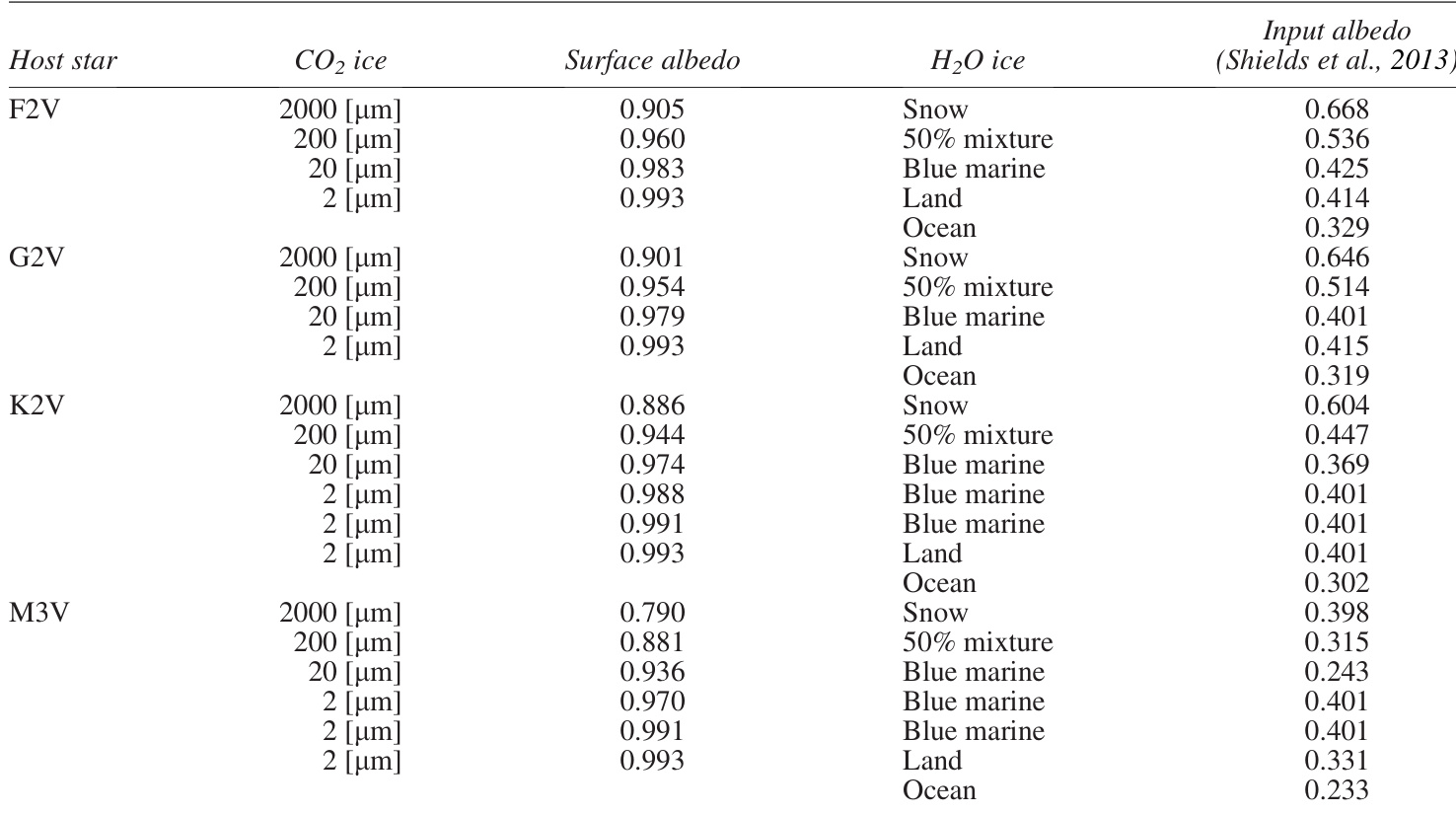
- Subset Details: The collection includes spectral energy distributions for F, G, K, and M dwarf stars. Surface albedo files cover snow, blue marine ice, a 50 percent snow and marine ice mixture, and carbon dioxide ice across four distinct grain sizes (2, 20, 200, and 2000 micrometers). Bond albedo values are provided for land, ocean, and water ice.
- Data Usage and Processing: Rather than a machine learning training split, the authors feed these inputs into a one-dimensional energy balance model to run climate simulations. Bond albedo is computed by integrating surface albedo against downwelling shortwave radiation, while atmospheric scattering effects are deliberately omitted for carbon dioxide ice to isolate pure surface reflectance.
- Additional Processing and Metadata: Stellar spectra are normalized by integrated flux, and land and ocean grid cells apply a Legendre polynomial to model zenith angle dependence at high latitudes. The authors distribute these parameters across varying orbital eccentricities and stellar types to evaluate carbon dioxide condensation thresholds and overall climate stability.
Method
The authors leverage a one-dimensional energy balance model (EBM) adapted from North and Coakley (1979) to simulate the zonally averaged surface temperatures of planets orbiting stars with varying eccentricities. The core of the model is governed by an equation that balances incoming shortwave radiation with outgoing longwave radiation (OLR), incorporating thermal inertia, horizontal heat transport, and planetary albedo. The model accounts for the time evolution of temperature via a heat capacity term C(x), while heat diffusion across latitudes is represented by a diffusion parameter D0. The OLR is parameterized as a linear function A+BT(x,t), where A and B are derived from Spiegel et al. (2010). The absorbed shortwave radiation is determined by the incident flux Q, the latitude-dependent solar flux S(x,t), and the planet's albedo A(x,t).
The EBM is extended to include a parameterization for CO₂ ice formation, which occurs when surface temperatures fall below a condensation threshold of 131.06 K. This modification introduces a distinct albedo value for CO₂ ice, which is treated as a surface albedo, unlike the broadband bond albedo used for water ice and other surface types. The model assumes that once CO₂ condenses, it forms a topmost layer, and the atmosphere is fully condensed, rendering the CO₂ ice surface albedo equivalent to the top-of-atmosphere (TOA) albedo under these conditions. For temperatures above 319 K, the model transitions into a runaway greenhouse (RGH) state, where OLR is capped at 300 Wm⁻², following the RGH parameterization from Palubski et al. (2020).

To capture seasonal variations, a seasonal EBM computes temperature and albedo at each latitude band for every time step throughout the year, using the instantaneous insolation. Annual mean values are obtained by averaging over the orbital period. A multi-layer approach is employed for cold-start simulations, initializing the planet in a globally ice-covered CO₂ snowball state. The model transitions between surface states—CO₂ ice, water ice, and liquid water—based on temperature thresholds: CO₂ ice forms below 131.06 K, water ice below 273 K on land and 271 K on ocean, and liquid water above 319 K. The transition from ice-covered states to an ice-free state is governed by the insolation, with the model tracking the annual percent surface coverage of each state.
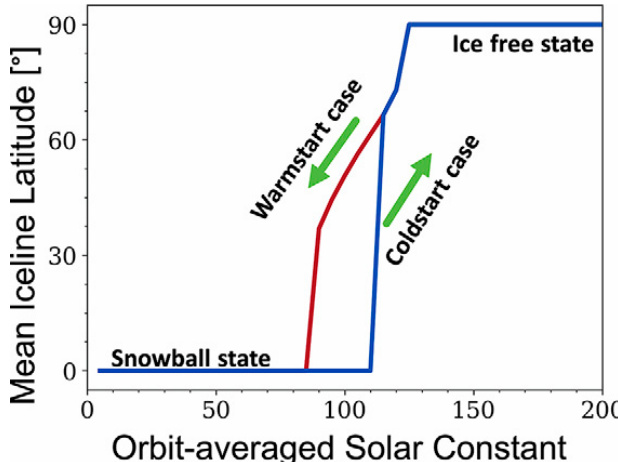
The model is run under two scenarios: a warm-start case, where the planet begins with no ice at 150% of the orbit-averaged solar constant and cools down to form ice, and a cold-start case, where the planet begins globally covered in CO₂ ice and warms up. The difference in the mean iceline latitude between these two paths illustrates the climate hysteresis of the system. The hysteresis loop, shown in the figure below, represents the range of insolation over which the planet can exist in either a snowball or ice-free state, depending on its initial condition. A wider loop indicates greater climate stability, while a narrower loop suggests higher sensitivity to insolation changes.
Experiment
The study validates a one-dimensional energy balance model against Earth and Mars observational data to confirm its accuracy in simulating atmospheric heat transport, surface albedo, and global temperature distributions before applying a novel CO₂ ice-albedo parameterization across varying stellar types, orbital eccentricities, and ice grain sizes. Qualitatively, incorporating CO₂ ice substantially increases planetary reflectivity and amplifies climate hysteresis, making cold-start planets significantly more resistant to thawing, particularly around brighter F- and G-dwarf stars. Conversely, higher orbital eccentricity mitigates global glaciation by delivering intense periastron heating that sustains liquid water across broader stellar flux ranges and reduces overall climate sensitivity. Ultimately, the findings establish that integrating CO₂ ice-albedo feedback is essential for accurately predicting the deglaciation thresholds, climate stability, and habitability potential of cold, eccentric exoplanets.
The the the table presents albedo values for different surface types and CO2 ice grain sizes across various host stars, with values varying based on the type of ice and grain size. The data indicate that CO2 ice albedo is highly dependent on grain size, with larger grains showing lower albedo values compared to smaller grains, while water ice albedo varies depending on the surface type and host star. The inclusion of CO2 ice albedo parameterization significantly affects climate simulations, particularly for planets orbiting F-, G-, and K-type stars, where higher albedo leads to increased resistance to thawing out of global ice cover. CO2 ice albedo decreases with increasing grain size, showing lower values for larger grains compared to smaller ones. Water ice albedo varies by surface type, with snow and blue marine ice having higher values than land and ocean surfaces. The inclusion of CO2 ice albedo parameterization increases the instellation required for planets to exit global ice cover, especially for F-, G-, and K-type stars.
The experiments evaluate how CO2 and water ice albedo vary with grain size, surface composition, and host star type, while validating the impact of incorporating CO2 ice albedo parameterization into planetary climate models. The findings reveal that larger CO2 ice grains exhibit lower reflectivity, whereas water ice albedo is strongly influenced by surface characteristics. Ultimately, integrating these albedo variations significantly alters climate predictions by increasing the stellar energy required for planets orbiting F, G, and K-type stars to escape global glaciation, underscoring the critical role of ice microphysics in planetary thawing dynamics.