Command Palette
Search for a command to run...
Dhan-Shomadhan : Un jeu de données pour la classification des maladies des feuilles de riz pour les variétés locales de riz bangladaises
Dhan-Shomadhan : Un jeu de données pour la classification des maladies des feuilles de riz pour les variétés locales de riz bangladaises
Md. Fahad Hossain
Classification des maladies du riz
Résumé
Ce jeu de données représente la quasi-totalité des maladies nuisibles au riz au Bangladesh. Il se compose de 1106 images de cinq maladies nuisibles, à savoir la tache brune, l'écaille foliaire, la pyriculariose du riz, la pourriture du riz et la flétrissure furtive, présentées avec deux variations de fond différentes : des photos de fond de champ et des photos sur fond blanc. Ces deux variations de fond permettent au jeu de données d'atteindre une plus grande précision, afin que les utilisateurs puissent exploiter ces données tant pour des applications sur le terrain que pour la prise de décision sur fond blanc. Les données ont été collectées dans les champs de riz de la division de Dhaka. Ce jeu de données peut être utilisé pour la classification des maladies foliaires du riz, ainsi que pour la détection des maladies par vision par ordinateur et reconnaissance de formes, en vue de l'identification de différentes maladies foliaires du riz.
One-sentence Summary
Dhan-Shomadhan comprises 1,106 rice leaf images collected from Dhaka Division that document Brown Spot, Leaf Scaled, Rice Blast, Rice Turngo, and Stealth Blight across field and white backgrounds to support computer vision and pattern recognition methods for disease classification and detection.
Key Contributions
- This work introduces a dataset of 1,106 rice leaf images capturing five prevalent diseases in Bangladesh: Brown Spot, Leaf Scaled, Rice Blast, Rice Turngo, and Stealth Blight. All samples were collected from agricultural fields in the Dhaka Division.
- The dataset incorporates two distinct background variations, including natural field conditions and controlled white backgrounds, to enhance classification accuracy for field deployment and standardized decision-making.
- This collection provides a structured resource for training computer vision and pattern recognition models to perform automated rice leaf disease classification and detection.
Introduction
The provided excerpt only lists an author name and lacks the technical context, prior limitations, and methodological details required to summarize the research background. Please share the abstract or relevant body text so I can draft a concise summary highlighting the application domain, existing challenges, and how the authors advance the field.
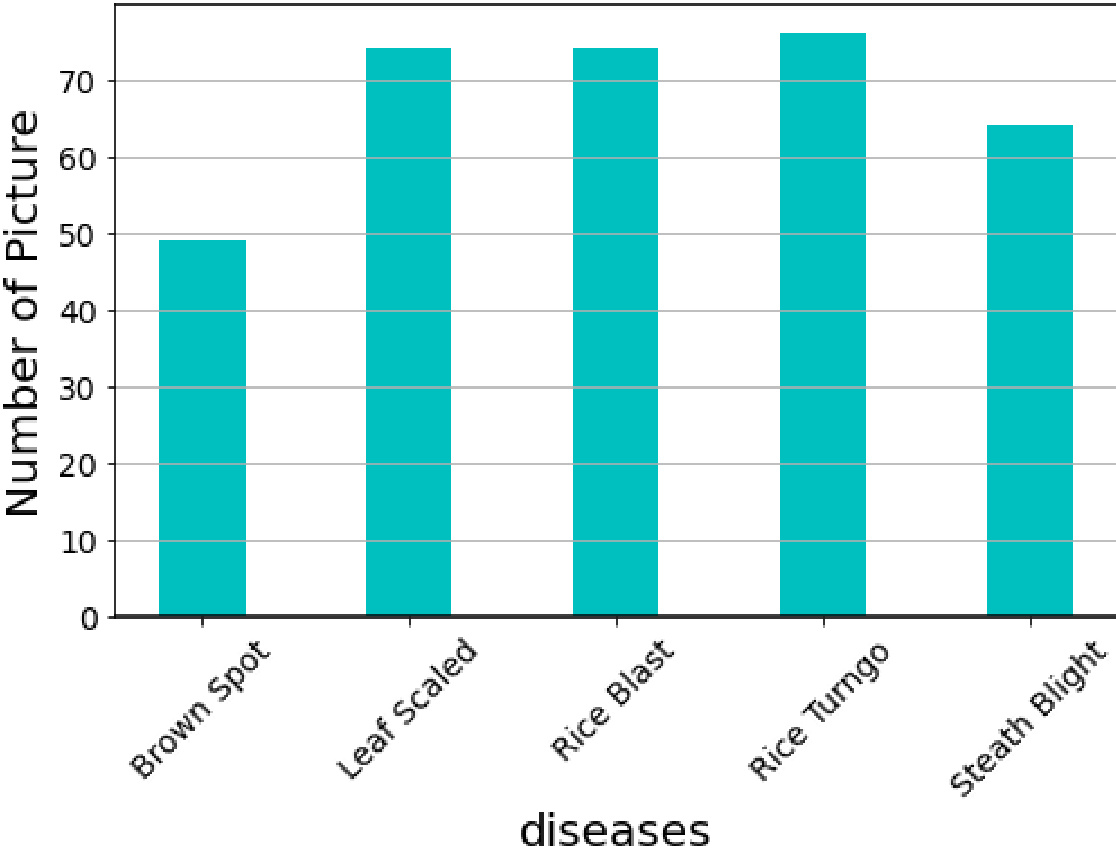
Dataset
-
Dataset composition and sources: The authors compiled a collection of 1,106 rice leaf images sourced directly from agricultural fields in the Dhaka Division of Bangladesh. The dataset covers five major rice diseases: Brown Spot, Leaf Scald, Rice Blast, Rice Tungro, and Sheath Blight.
-
Key details for each subset: Each disease category is divided into two distinct background variations to enhance model generalization. The field background subset contains images captured outdoors under varied lighting and weather conditions, featuring natural paddy environments. The white background subset includes images taken indoors against a plain white paper backdrop using consistent daylight. While exact per disease image counts are referenced in the original figures, the dataset maintains a consistent dual background structure across all five classes.
-
How the paper uses the data: The authors utilize this dataset to develop and evaluate computer vision models for rice disease classification and detection. The dual background design is specifically intended to bridge the gap between controlled laboratory analysis and real world field deployment. The provided documentation does not specify explicit training validation splits or data mixture ratios for model training.
-
Processing and metadata details: Images were captured using a Vivo Y15 smartphone camera at a resolution of 1952x4160 pixels with a fixed 4mm focal length. Photographers manually framed shots to isolate and focus exclusively on diseased leaf spots rather than capturing entire plants. The collection process implicitly records contextual metadata such as disease type, background variation, and environmental conditions like season and weather, though no formal annotation pipeline or automated cropping algorithm is described.
Experiment
The provided content consists exclusively of the table image placeholders and lacks descriptive text outlining experimental setups or validation objectives. Consequently, no qualitative findings or overarching conclusions can be synthesized from the given material. A comprehensive summary would require the accompanying textual analysis that typically accompanies these specifications tables.