Command Palette
Search for a command to run...
Explorer la diffusion élastique cohérente neutrino-noyau des neutrinos de réacteur avec l'expérience NUCLEUS
Explorer la diffusion élastique cohérente neutrino-noyau des neutrinos de réacteur avec l'expérience NUCLEUS
Échantillonnage Nucleus
Résumé
Le projet NUCLEUS vise à réaliser une mesure de haute précision de la diffusion élastique cohérente neutrino-noyau (CEvNS) sur le site de la centrale nucléaire d’EdF Chooz B en France. La CEvNS constitue un processus unique pour étudier les propriétés des neutrinos et rechercher une physique au-delà du Modèle Standard. L’étude de la CEvNS est également importante pour les recherches de matière noire légère, car elle pourrait représenter un bruit de fond irréductible pour les expériences de détection de matière noire à haute sensibilité. NUCLEUS est une expérience en cours de construction, fondée sur des calorimètres cryogéniques à seuil ultra-faible (~20 eV_nr), fonctionnant à des températures de l’ordre de quelques dizaines de millikelvins.
One-sentence Summary
The NUCLEUS experiment will perform a high-precision measurement of coherent elastic neutrino-nucleus scattering using reactor neutrinos from the EdF Chooz B nuclear power plant in France, employing ultra-low threshold (~20 eV_nr) cryogenic calorimeters operated at tens of millikelvin temperatures to study neutrino properties, search for physics beyond the Standard Model, and assess its potential as an irreducible background for high-sensitivity dark matter experiments.
Key Contributions
- The NUCLEUS experiment utilizes gram-scaled cryogenic calorimeters operating at tens-of-mK temperatures to detect nuclear recoils with a threshold of approximately 20 eV_nr. This apparatus enables high-precision measurements of coherent elastic neutrino–nucleus scattering at the Chooz B nuclear power plant.
- A dedicated shielding and background mitigation framework addresses cosmic-ray induced noise to enable reliable detection in the shallow overburden environment of the reactor site. This strategy ensures effective discrimination of dominant above-ground backgrounds while maintaining sensitivity to sub-keV nuclear recoils.
- The experiment leverages high-flux reactor anti-neutrinos up to 10 MeV to probe the fully coherent regime, providing a measurement approach complementary to stopped-pion sources. This configuration supports tests of the Standard Model, searches for physics beyond the Standard Model, and characterizes the neutrino floor for dark matter experiments.
Introduction
The authors investigate coherent elastic neutrino-nucleus scattering, a low-energy neutral current interaction that serves as a vital probe for testing the Standard Model, searching for sterile neutrinos, and characterizing the neutrino floor that ultimately limits direct dark matter detection. While stopped-pion experiments have previously observed this process at higher energies, reactor-based approaches face distinct experimental hurdles. Detecting reactor neutrinos demands ultra-low energy thresholds, careful material selection to balance high scattering rates against minimal recoil energy, and robust shielding against cosmic rays due to the shallow underground placement typical of power plants. To address these challenges, the authors present the NUCLEUS experiment, which utilizes gram-scale cryogenic calorimeters cooled to tens of millikelvin to achieve a ~20 eVnr nuclear recoil threshold. This configuration enables high-precision measurements at the Chooz B nuclear reactor, offering a complementary pathway to explore low-momentum neutrino physics while directly informing dark matter background modeling.
Method
The NUCLEUS experiment employs a multi-layered detection and shielding architecture designed to achieve ultra-low background levels for the detection of coherent elastic neutrino-nucleus scattering (CEvNS). The overall framework consists of a series of nested shielding and veto systems surrounding the cryogenic detectors, with the target crystals positioned at the core. The apparatus is housed within a cryostat that enables operation at millikelvin temperatures, necessary for the sensitive detection of low-energy nuclear recoils.
At the center of the setup are two arrays of gram-scaled cryogenic calorimeters: nine cubes of calcium tungstate (CaWO₄) and nine of sapphire (Al₂O₃), arranged in a dual-target configuration to exploit the nuclear charge (Z) dependence of the CEvNS cross section. These detectors operate via phonon detection using transition edge sensors (TES) made of tungsten, which are thermally coupled to the crystal lattice. When a particle interacts with the target material, the resulting lattice vibration generates phonons that propagate through the crystal and are sensed by the TES. The resistance change in the TES, occurring at its superconducting transition temperature, is read out using a superconducting quantum interference device (SQUID). This design allows for high energy resolution and low detection thresholds, with a prototype achieving a threshold of approximately 19.7 eV for nuclear recoils.
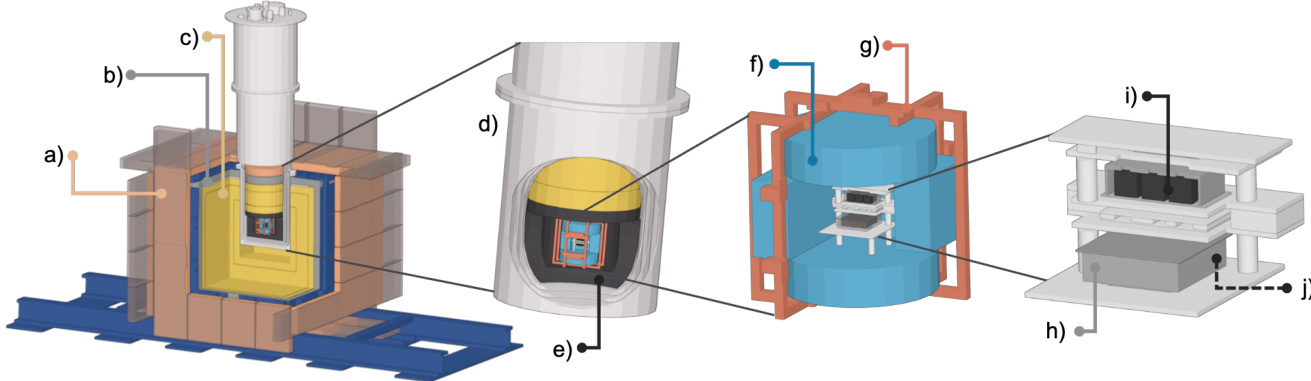
Refer to the framework diagram. The cryogenic detectors are mounted within a copper cage (h) that suspends them from a spring system to isolate them from mechanical vibrations originating in the cryostat. This cage also supports the Cryogenic Outer Veto (COV), which consists of six high-purity germanium crystals (f) arranged to provide a nearly 4π-coverage for active shielding against external backgrounds. The COV operates in ionization mode with a threshold of approximately 10 keV and functions in anti-coincidence with the primary detectors to veto events caused by ambient radioactivity and atmospheric muons.
Inside the cryostat, a 4-cm thick boron carbide (B₄C) layer (e) is positioned closest to the detectors to capture thermal neutrons produced by interactions of fast neutrons with surrounding shielding materials. This layer is part of the passive shielding strategy that includes a 5-cm thick lead shield (b) to attenuate gamma radiation and a 20-cm thick borated polyethylene layer (c) to moderate and absorb neutrons. The entire cryogenic assembly is housed within a dilution refrigerator (d), which maintains the low operating temperature.
The most external active shielding is the muon veto (MV), composed of 28 5-cm thick scintillating plastic panels (a) read out by silicon photomultipliers (SiPMs) and optical fibers. This system operates at room temperature and provides a high-coverage veto against cosmic-ray muons. To ensure complete coverage and maintain performance at cryogenic temperatures, a cryogenic muon veto is also integrated within the cryostat, operating at 800 mK. This system complements the MV and ensures a geometrical efficiency greater than 99%.
Additionally, an inner veto (IV) made of a silicon structure instrumented with TES is used to detect surface events and mechanical stress relaxation, providing anti-coincidence signals with the primary detectors. This system is thermally and mechanically tested using silicon detector dummies in a mock-up configuration. The combination of these active and passive shielding layers, along with anti-coincidence techniques, is designed to suppress background events and enable the experiment to reach a target background level of less than 100 counts per kilogram per day per keV.
Experiment
The NUCLEUS experiment employs gram-scale cryogenic calorimeters with comprehensive background shielding to detect coherent elastic neutrino-nucleus scattering from reactor neutrinos. Current underground commissioning and calibration efforts are validating the mechanical integration and detector response prior to deployment at the Chooz B facility. The initial measurement phase focuses on confirming the detection capability of the signal using a minimal detector mass. A subsequent expansion to a larger detector volume will enable high-precision characterization of the scattering cross-section, establishing a robust pathway for advanced low-threshold neutrino research.