Command Palette
Search for a command to run...
Le titre est vide. Veuillez fournir le titre à traduire.
Le titre est vide. Veuillez fournir le titre à traduire.
Classification multi-classes utilisant LIBSVM
Résumé
Please provide the title and abstract you would like me to translate into French.
One-sentence Summary
The authors propose C2G-SSIM, a perceptually relevant color-to-grayscale conversion method that preserves chrominance information via singular value decomposition, outperforming eight benchmark algorithms on the Cadik and COLOR250 datasets while improving scene classification accuracy when integrated with a deep belief network and dense SIFT features.
Key Contributions
- A color-to-grayscale conversion algorithm is proposed that integrates singular value decomposition with the color-to-gray structure similarity index to dynamically weight chrominance information rather than applying fixed conversion ratios. This framework enhances the perceptual quality of converted images by preserving critical luminance and color contrast details.
- The processed grayscale images are evaluated using a deep belief network classification system that extracts dense scale invariant feature transform descriptors to quantify the impact of chrominance data on scene recognition. Experimental results confirm that incorporating the preserved chrominance components improves overall scene classification accuracy.
- Quantitative assessments on the Cadik and COLOR250 datasets demonstrate that the proposed decolorization technique achieves higher perceptual quality scores than eight existing benchmark algorithms. Furthermore, ensembling classification models trained on images generated by the proposed and conventional decolorization methods yields a measurable improvement in overall scene recognition performance.
Introduction
Scene classification systems frequently convert color photographs to grayscale to streamline feature extraction and reduce computational overhead. However, standard conversion techniques often discard vital chrominance patterns or rely on computationally intensive optimization, which ultimately degrades downstream classification accuracy. The authors leverage Singular Value Decomposition paired with a Color-to-Gray Structure Similarity metric to dynamically weight chrominance data during decolorization. This approach preserves perceptually relevant color contrast while maintaining processing efficiency. They demonstrate that the resulting grayscale images significantly boost scene classification performance, particularly when fused with outputs from conventional decolorization models.
Method
The authors leverage a perceptually improved image decolorization framework that integrates the C2G-SSIM index with singular value decomposition (SVD) to enhance the quality of color-to-grayscale conversion. The overall methodology begins with an input color image I∈Rh×w×3, which is first transformed into the CIELab* color space via a color space transformation function T, resulting in a transformed image C. This color space is chosen for its suitability in image editing, particularly in separating luminance from chrominance components. The luminance component C1 is extracted from C, while the chrominance components C1 and C2 are subjected to SVD, decomposing each into their respective eigenvalues and eigenvectors.
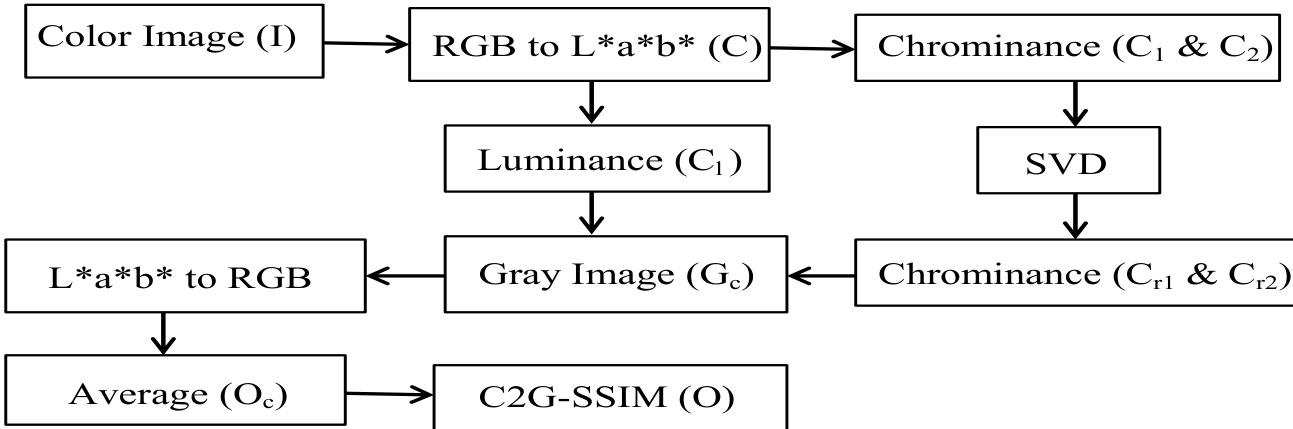
As shown in the figure below, the chrominance components are reconstructed using selected eigenvalues and eigenvectors based on the rank of the input chrominance planes, yielding reconstructed chrominance planes Cr1 and Cr2. The gray image Gc is then generated by combining the luminance component C1 with a weighted sum of the reconstructed chrominance planes, as defined by the equation Gc(k)=C1+c×∑i=12Cri(k), where k indexes the pixel locations and c is a weight parameter. The resulting gray image is then transformed back to the RGB color space, and the average of the red, green, and blue channels is computed to produce the final decolorized image Oc.
The key innovation lies in the adaptive determination of the weight parameter c, which is optimized to maximize the C2G-SSIM index between the original color image and the converted grayscale image. The C2G-SSIM index is computed in three stages: color space transformation, measurement of luminance, contrast, and structure similarity, and their combination. In the luminance stage, the similarity L(xc) is computed using a Gaussian-filtered window around each pixel location xc, with the luminance means of the reference and grayscale images, uf(xc) and ug(xc), respectively. The contrast measure C(xc) evaluates the weighted mean color difference in the chrominance planes, while the structure measure S(xc) assesses the cross-correlation between the standard deviations of the luminance and chrominance components. The overall C2G-SSIM index q(xc) is obtained as a weighted product of these components, q(xc)=L(xc)α×C(xc)β×S(xc)γ, with α, β, and γ as positive exponents. The parameter c is selected to maximize this index, ensuring optimal preservation of perceptual quality in the grayscale output.
Experiment
The proposed image decolorization technique was evaluated on the Cadik and COLOR250 datasets using structural similarity assessments and visual comparisons against established benchmarks. These experiments validate that the method effectively preserves color variations and structural contrast, consistently outperforming existing conversion algorithms. The technique was further assessed within an AGMM-DBN-SVM scene classification framework by combining its outputs with the standard NTSC rule. Results confirm that the approach captures complementary scene information, substantially boosting overall classification accuracy and demonstrating its practical value for perceptually enhanced grayscale conversion.
The authors evaluate their proposed image decolorization method using a quality metric and compare it against several benchmark techniques. Results show that the proposed method achieves higher performance across different datasets and outperforms existing methods in terms of both individual image scores and overall success rate. The method is also integrated with a standard rule for scene classification, leading to improved accuracy by combining complementary information. The proposed method consistently achieves higher performance compared to existing benchmark techniques across multiple datasets. The proposed method outperforms all other techniques in terms of overall success rate and average quality index. Combining the proposed method with a standard rule improves classification accuracy by leveraging complementary class information.
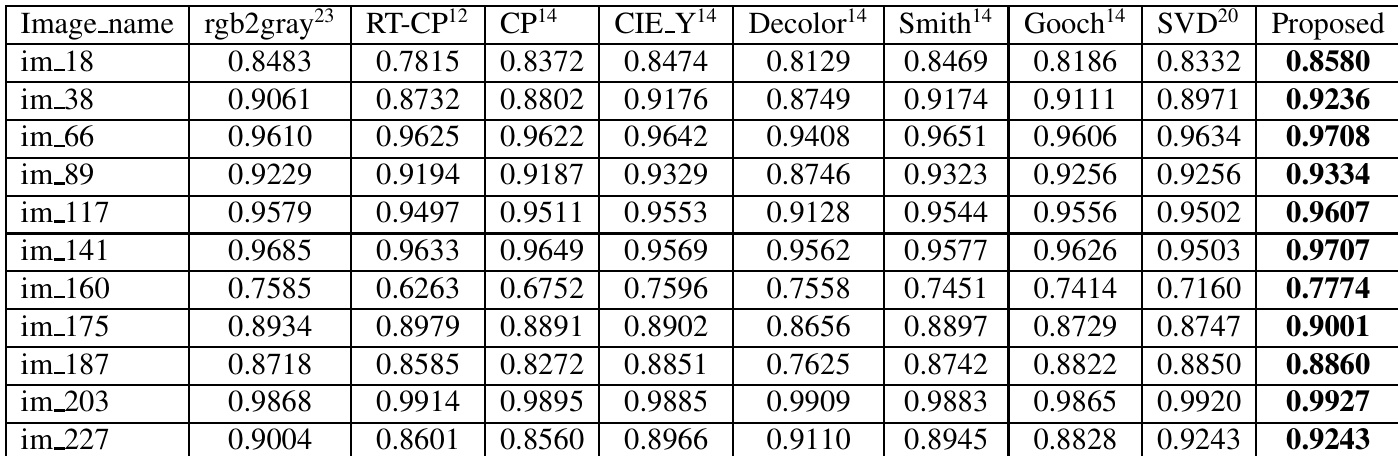
The authors evaluate a proposed image decolorization method using the C2G-SSIM metric on two datasets, showing that the method achieves higher quality results compared to existing techniques. The proposed method is also integrated with the NTSC rule at the model level for scene classification, leading to improved classification accuracy across all classes and overall performance. The proposed decolorization method outperforms existing techniques in C2G-SSIM quality index for both benchmark datasets. The proposed method achieves higher overall classification accuracy when combined with the NTSC rule compared to other decolorization methods. The integration of the proposed method with the NTSC rule improves classification accuracy for all individual classes.

The authors evaluate a proposed image decolorization method using the C2G-SSIM metric on two benchmark datasets, comparing it against existing techniques. Results show that the proposed method achieves higher average C2G-SSIM values than all other methods, with the highest score observed among the compared techniques. The method also demonstrates superior performance in terms of success rate and average index across both datasets. The proposed method achieves the highest average C2G-SSIM index compared to all benchmark techniques. The proposed method outperforms existing techniques in success rate and average C2G-SSIM index across both datasets. The proposed method's performance is superior to existing methods in both objective evaluation and scene classification tasks.
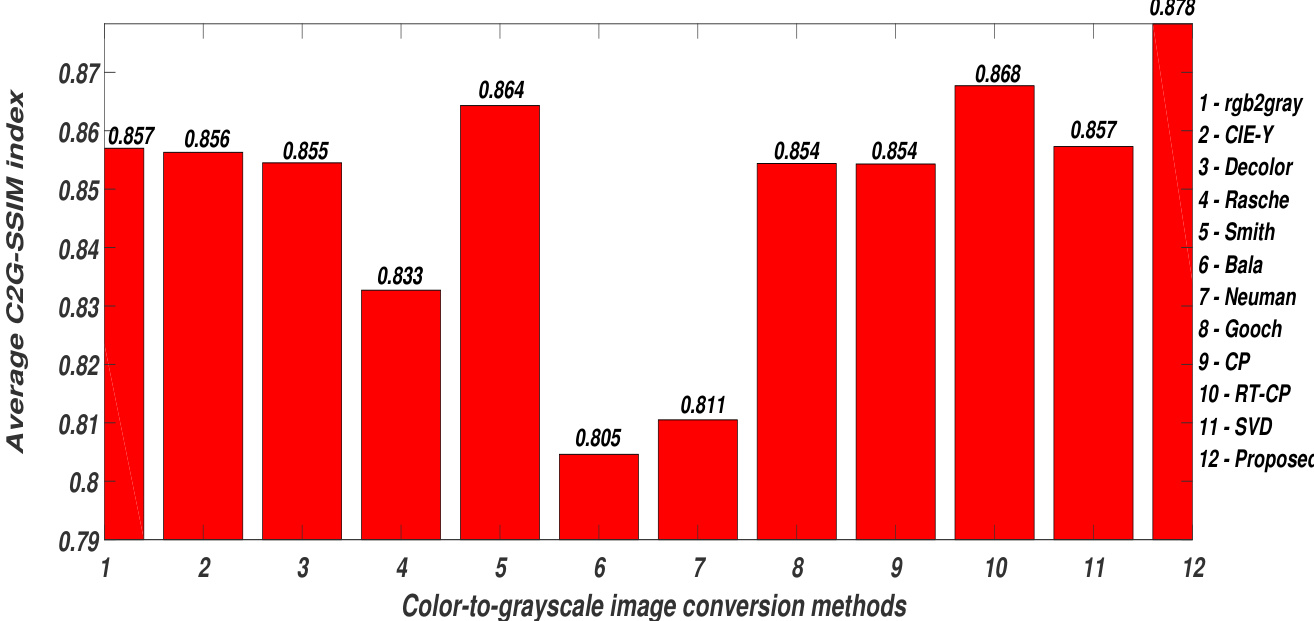
The authors evaluate a proposed image decolorization method using the C2G-SSIM metric on two benchmark datasets, showing that the method outperforms existing techniques in terms of structural similarity and visual quality. The results indicate that the optimal performance is achieved with a variable weight parameter rather than a fixed value, and the method demonstrates superior success rates and average quality metrics across both datasets. Additionally, combining the proposed decolorization method with the NTSC rule improves classification accuracy, highlighting its complementary strengths in scene classification. The proposed method achieves higher C2G-SSIM scores compared to existing techniques, particularly with a variable weight parameter rather than a fixed one. The proposed method outperforms all benchmark techniques in success rate and average C2G-SSIM index on both datasets. Combining the proposed method with the NTSC rule significantly improves classification accuracy, demonstrating its complementary benefits in scene classification.
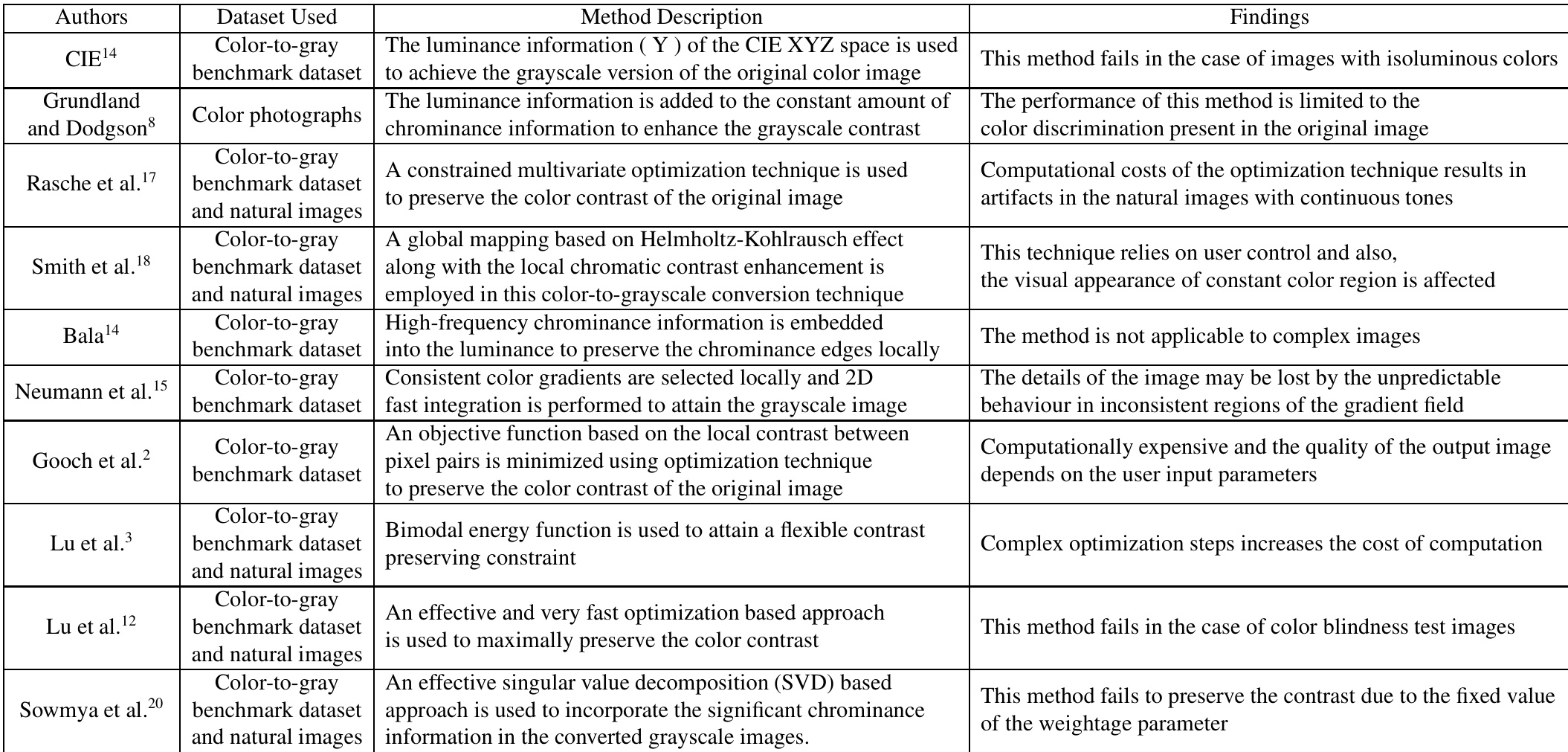
The authors evaluate a proposed image decolorization method using the C2G-SSIM metric on two benchmark datasets, showing that the method outperforms existing techniques in terms of structural similarity and perceptual quality. The results indicate that the proposed method achieves higher C2G-SSIM scores and success rates compared to benchmark algorithms, and its complementary information enhances scene classification accuracy when combined with the NTSC rule. The proposed method achieves higher C2G-SSIM scores than existing benchmark techniques for both datasets. The proposed method shows superior success rates and average C2G-SSIM values compared to existing algorithms. Combining the proposed method with the NTSC rule improves classification accuracy across all classes and overall system performance.

The authors evaluate their proposed image decolorization method across two benchmark datasets to validate its structural and perceptual quality against established techniques. Results demonstrate that the approach consistently produces superior grayscale conversions, particularly when optimized with a dynamic weighting strategy rather than fixed parameters. Additionally, integrating the method with a standard scene classification rule significantly boosts overall accuracy by effectively leveraging complementary visual information across all categories.