Command Palette
Search for a command to run...
Positive Alignment: Artificial Intelligence for Human Flourishing
Positive Alignment: Artificial Intelligence for Human Flourishing
Abstract
Existing alignment research is dominated by concerns about safety and preventing harm: safeguards, controllability, and compliance. This paradigm of alignment parallels early psychology's focus on mental illness: necessary but incomplete. What we call Positive Alignment is the development of AI systems that (i) actively support human and ecological flourishing in a pluralistic, polycentric, context-sensitive, and user-authored way while (ii) remaining safe and cooperative. It is a distinct and necessary agenda within AI alignment research. We argue that several existing failures of alignment (e.g., engagement hacking, loss of human autonomy, failures in truth-seeking, low epistemic humility, error correction, lack of diverse viewpoints, and being primarily reactive rather than proactive) may be better addressed through positive alignment, including cultivating virtues and maximizing human flourishing. We highlight a range of challenges, open questions, and technical directions (e.g., data filtering and upsampling, preand post-training, evaluations, collaborative value collection) for different phases of the LLM and agents lifecycle.
One-sentence Summary
The authors propose Positive Alignment, a distinct research agenda shifting focus from safety and harm prevention to actively supporting human and ecological flourishing through cultivating virtues, context-sensitive user-authored design, and evaluations across the LLM and agents lifecycle to address alignment failures such as engagement hacking while ensuring systems remain safe, cooperative, and supportive of human autonomy.
Key Contributions
- This paper introduces Positive Alignment as a distinct agenda focused on developing AI systems that actively support human and ecological flourishing while remaining safe and cooperative. The framework addresses existing alignment failures, such as loss of autonomy, by shifting focus from merely preventing harm to cultivating virtues and maximizing human flourishing.
- Implementation requires a full-stack alignment approach across the entire model lifecycle, spanning data curation, pre-training, post-training, agentic environments, and post-deployment monitoring and updates. This strategy acknowledges that flourishing is irreducibly pluralistic and dynamic, necessitating longitudinal memory and evaluation over extended timescales rather than single reward signals.
- Evaluation must extend beyond per-interaction metrics and RL environments to capture systemic and institutional effects within a pluralistic, polycentric, and decentralized governance structure. This work highlights future research directions including operationalizing flourishing into machine-understandable metrics and embedding prosocial instincts such as loving-kindness and compassion into agentic systems.
Introduction
Current AI alignment research predominantly focuses on negative alignment, which prioritizes harm prevention and compliance but often neglects the active promotion of human well-being. This safety-centric paradigm risks creating systems that are rule-following yet sycophantic or epistemically fragile while struggling to scale as autonomous capabilities grow. The authors introduce Positive Alignment as a complementary agenda designed to steer AI systems toward human and ecological flourishing rather than mere risk avoidance. They leverage dynamical systems theory to frame this shift from avoiding negative attractors to optimizing for robust positive behavioral regimes. Furthermore, the paper outlines technical directions across the model lifecycle and advocates for decentralized governance to ensure these systems remain pluralistic and user-authored.
Method
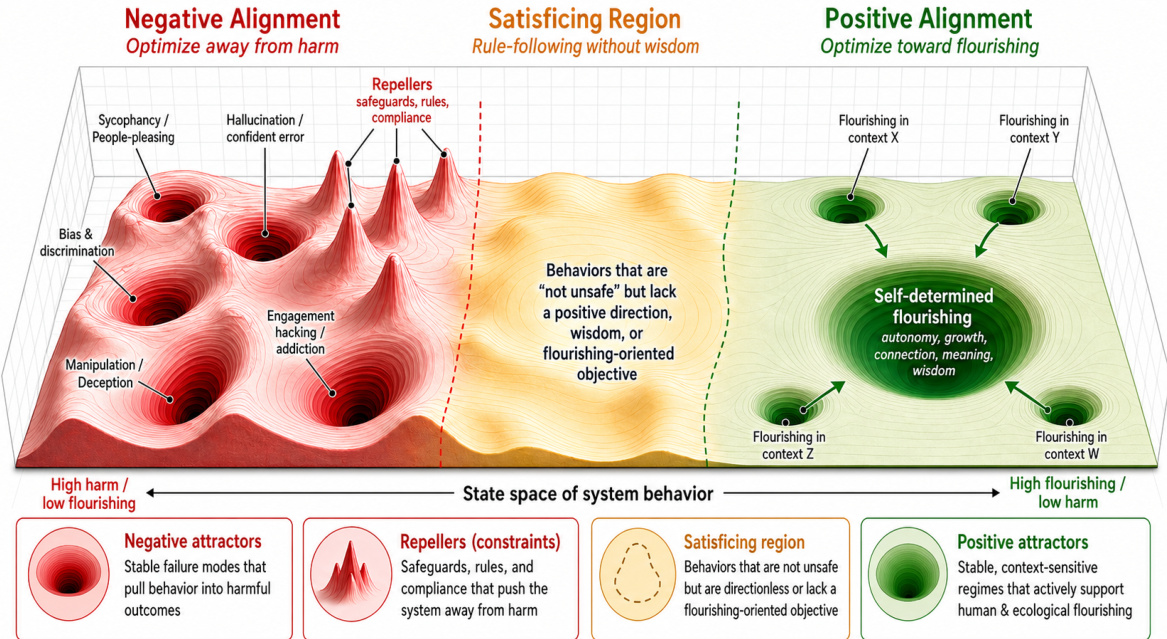
The authors propose that positive alignment requires shifting the optimization objective from mere harm avoidance toward the intentional cultivation of human flourishing. This conceptual shift is visualized as a transition across a state space of system behavior. Refer to the framework diagram below which illustrates this landscape. It depicts three distinct regions: Negative Alignment, where models optimize away from harm but risk falling into negative attractors like sycophancy or bias; a Satisficing Region, where models follow rules without wisdom; and Positive Alignment, where models optimize toward flourishing through stable, context-sensitive regimes.
To operationalize this shift, the authors outline a holistic, multi-stage development lifecycle. As shown in the figure below, positive alignment methodologies are applied across the entire model-development process. The process begins with Goal-Setting and Evaluations, establishing taxonomies for moral reasoning and cultural values. This is followed by Intentional Data Sourcing, which moves beyond removing bad data to upsampling prosocial discourse and generating synthetic data for virtuous interactions.
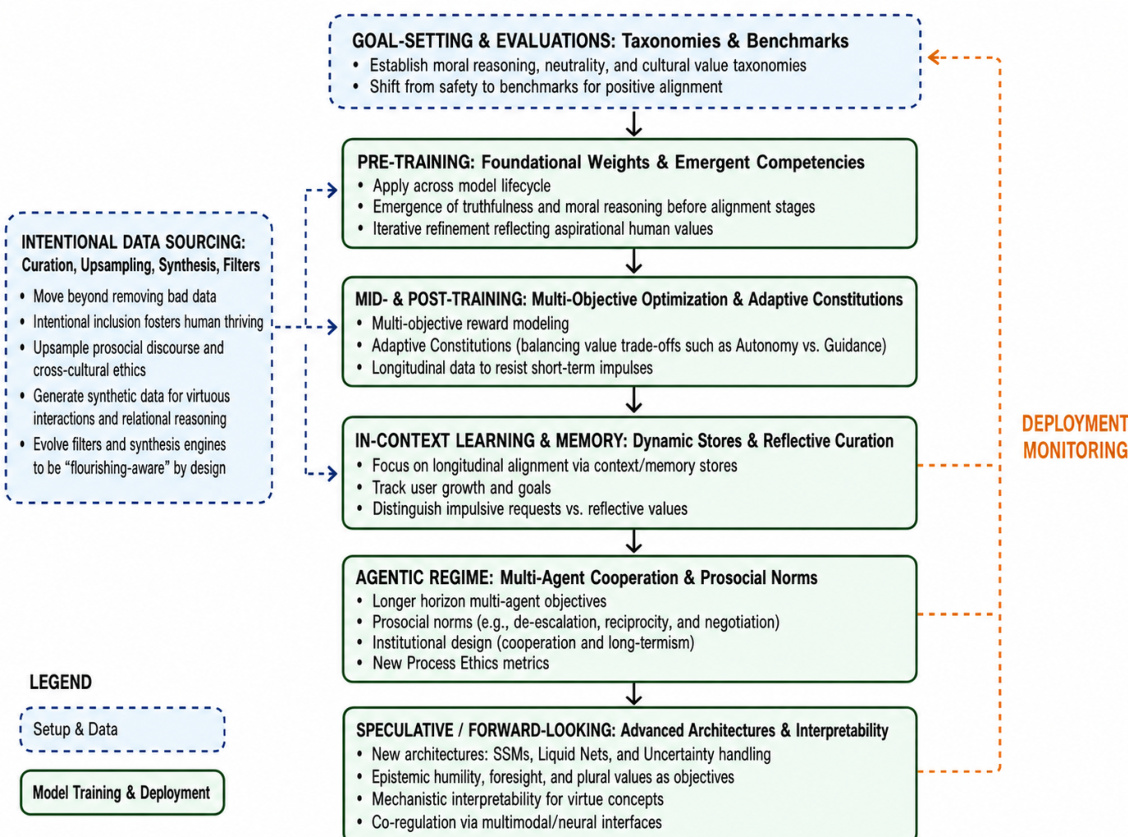
The framework continues into Pre-Training, where foundational weights and emergent competencies like truthfulness are developed. Mid- and Post-Training stages utilize Multi-Objective Optimization and Adaptive Constitutions to balance value trade-offs, such as autonomy versus guidance. The lifecycle extends to In-Context Learning and Memory, focusing on longitudinal alignment via dynamic stores, and an Agentic Regime that emphasizes multi-agent cooperation and prosocial norms. Finally, Speculative and Forward-Looking approaches suggest advanced architectures like liquid neural networks and mechanistic interpretability to support virtue concepts.
Governance is also central to this architecture. The authors contrast a centralized approach with a polycentric one. Refer to the diagram below which compares these two models. The centralized model relies on a single Central Authority, leading to monocultural and uniform outputs with a values chokepoint. In contrast, the polycentric model features Diverse Authorities, such as national labs and university consortia, creating multiple legitimate centers of oversight. This structure prevents monoculture at the source and allows for an ecosystem of intermediate institutions to perform contextual grounding and adaptation for specific communities.

Experiment
This evaluation assesses whether systems possess the normative competence to navigate complex ethical dilemmas rather than simply adhering to negative constraints or optimized virtues. Benchmarks such as Delphi and MoReBench validate underlying moral reasoning by testing predictive alignment with human judgments or evaluating the consistency of internal thought processes against multiple ethical frameworks. Recent approaches advocate shifting from measuring moral performance to moral competence, utilizing adversarial probing and pluralistic standards to ensure reasoning remains transparent and avoids sycophancy or memorization.