Command Palette
Search for a command to run...
ARIS: Autonomous Research via Adversarial Multi-Agent Collaboration
ARIS: Autonomous Research via Adversarial Multi-Agent Collaboration
Ruofeng Yang Yongcan Li Shuai Li
Abstract
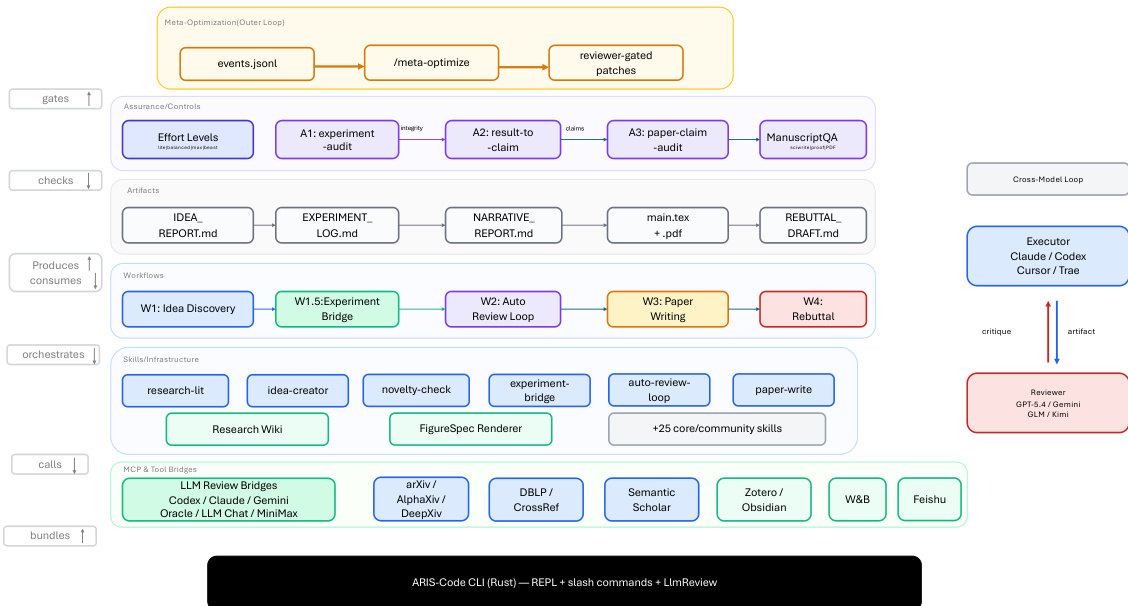
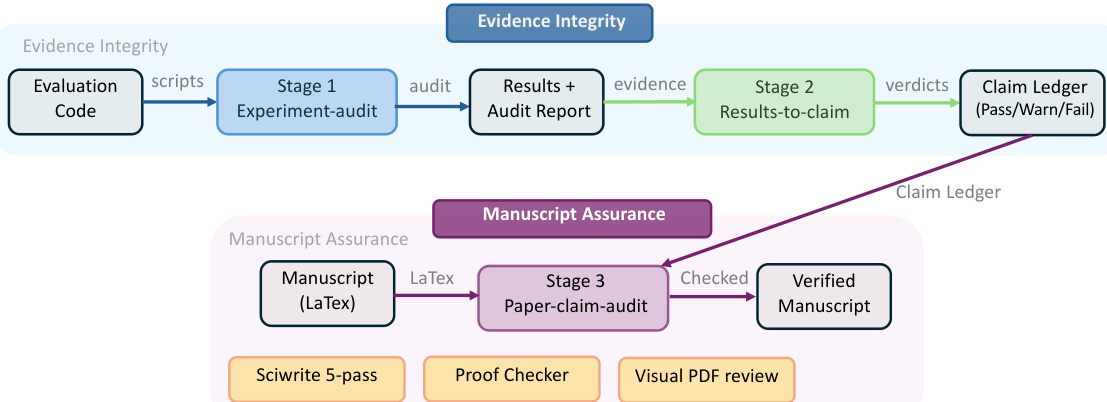
This report describes ARIS (Auto-Research-in-sleep), an open-source research harness for autonomous research, including its architecture, assurance mechanisms, and early deployment experience. The performance of agent systems built on LLMs depends on both the model weights and the harness around them, which governs what information to store, retrieve, and present to the model. For long-horizon research workflows, the central failure mode is not a visible breakdown but a plausible unsupported success: a long-running agent can produce claims whose evidential support is incomplete, misreported, or silently inherited from the executor's framing. Therefore, we present ARIS as a research harness that coordinates machine-learning research workflows through cross-model adversarial collaboration as a default configuration: an executor model drives forward progress while a reviewer from a different model family is recommended to critique intermediate artifacts and request revisions. ARIS has three architectural layers. The execution layer provides more than 65 reusable Markdown-defined skills, model integrations via MCP, a persistent research wiki for iterative reuse of prior findings, and deterministic figure generation. The orchestration layer coordinates five end-to-end workflows with adjustable effort settings and configurable routing to reviewer models. The assurance layer includes a three-stage process for checking whether experimental claims are supported by evidence: integrity verification, result-to-claim mapping, and claim auditing that cross-checks manuscript statements against the claim ledger and raw evidence, as well as a five-pass scientific-editing pipeline, mathematical-proof checks, and visual inspection of the rendered PDF. A prototype self-improvement loop records research traces and proposes harness improvements that are adopted only after reviewer approval.
One-sentence Summary
Addressing the risk of plausible unsupported success in long-horizon workflows, ARIS is an open-source research harness that coordinates autonomous machine learning research through cross-model adversarial collaboration, pairing an executor model that drives progress with a reviewer from a different model family that critiques intermediate artifacts, while its execution layer supports iterative discovery via a persistent research wiki, model integrations via MCP, deterministic figure generation, and more than 65 Markdown-defined skills.
Key Contributions
- ARIS is an open-source research harness that coordinates autonomous machine learning workflows through a three-layer architecture featuring over 65 reusable Markdown-defined skills, model integrations via MCP, a persistent research wiki, and deterministic figure generation.
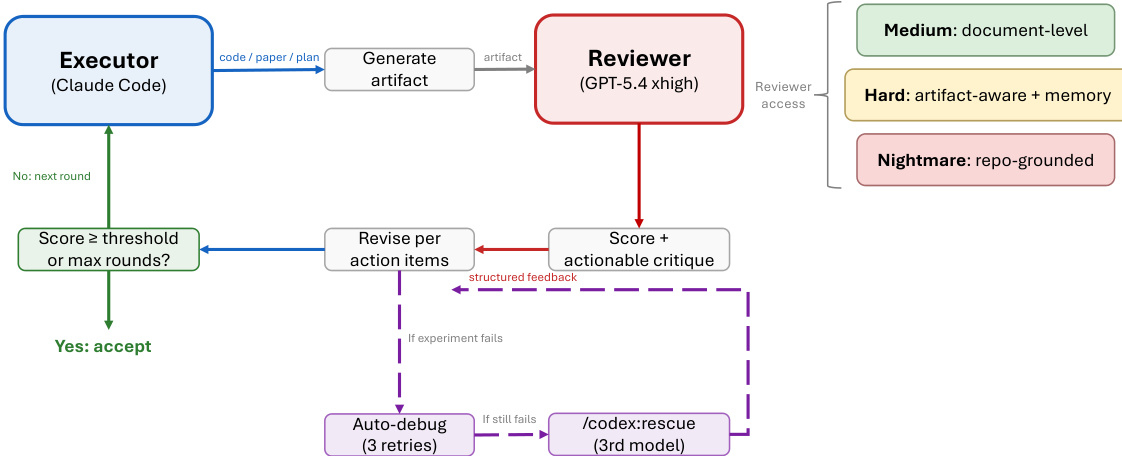
- The framework implements a cross-model adversarial collaboration mechanism where an executor model drives progress while a reviewer from a distinct model family critiques intermediate artifacts and requests revisions, effectively breaking self-review blind spots without the coordination overhead of larger multi-agent committees.
- The system incorporates an explicit assurance stack for integrity auditing and cross-platform portability, supporting reproducible end-to-end research workflows that span idea generation, experimentation, and manuscript preparation across multiple host environments.
Introduction
Automating the end-to-end machine learning research pipeline holds significant promise for accelerating scientific discovery, yet long-horizon autonomous tasks remain highly susceptible to hallucinations, correlated errors, and misreported results. Prior autonomous research agents typically rely on same-model self-refinement and tightly coupled workflows, which fail to catch shared inductive biases, lack modular resumption capabilities, and offer minimal system-level verification of experimental integrity. To address these gaps, the authors propose ARIS, a framework that treats single-agent execution as inherently unreliable and decomposes the research process into modular, state-preserving stages. The authors leverage an adversarial cross-family executor-reviewer pairing with explicit assurance checks at critical milestones, ensuring that each research artifact is independently validated by a distinct model family before advancing to the next workflow phase.
Dataset
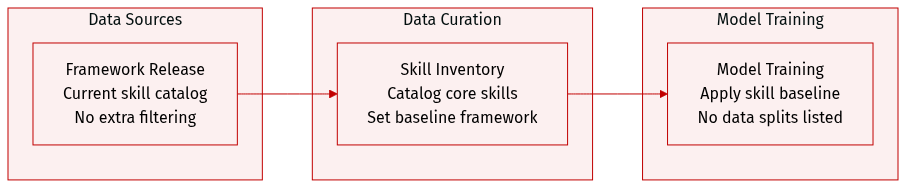
- Dataset composition and sources: The authors compile a skill inventory that catalogs core framework skills from a current release, as outlined in Table 5.
- Subset details: The provided excerpt does not define distinct subsets, so specific sizes, origins, or filtering criteria are not documented.
- Usage and training configuration: The authors reference the inventory to establish a baseline skill framework. The text does not outline training splits, mixture ratios, or data blending strategies.
- Processing and metadata: No cropping methods, metadata generation steps, or additional preprocessing pipelines are described in the available content.
Method
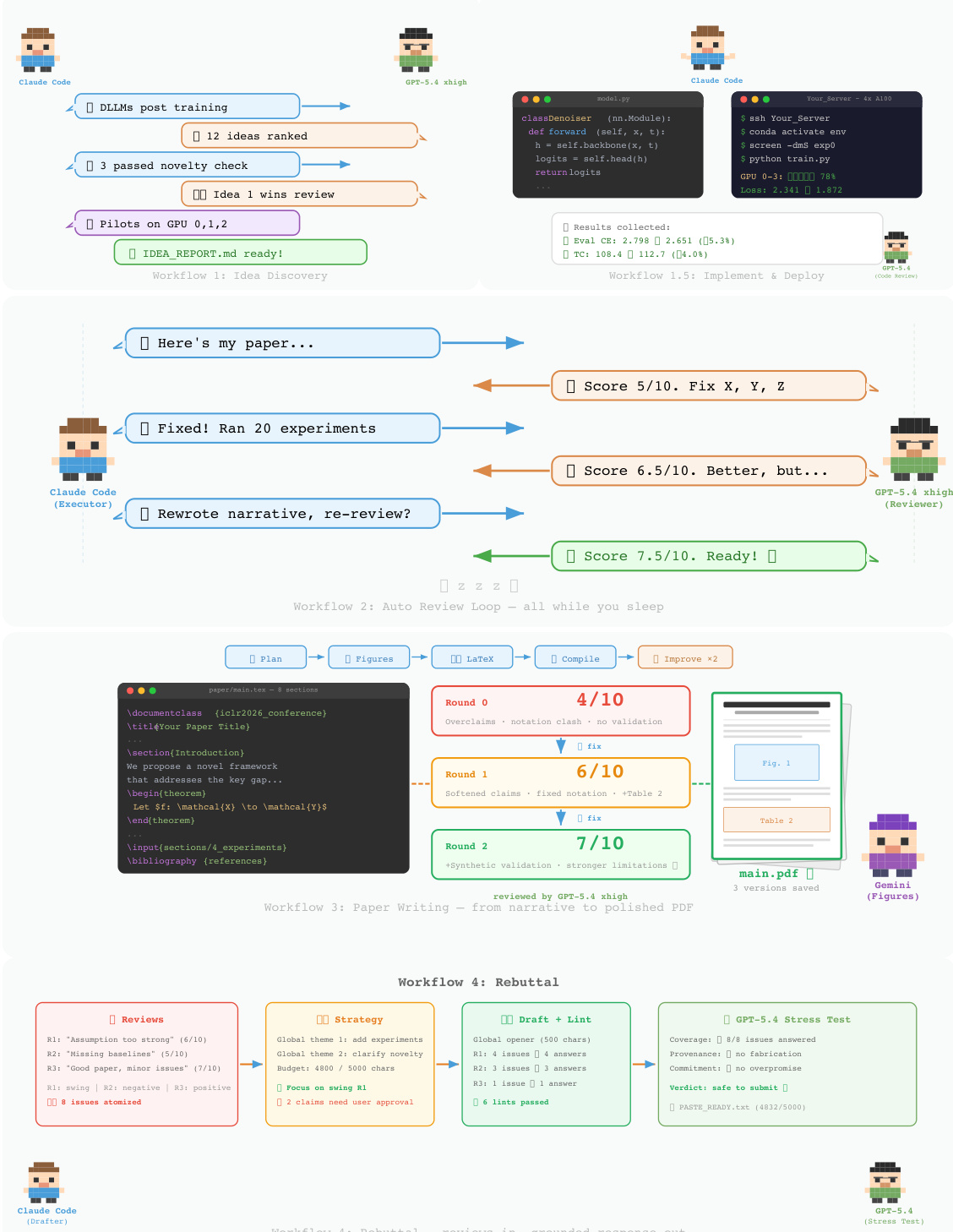
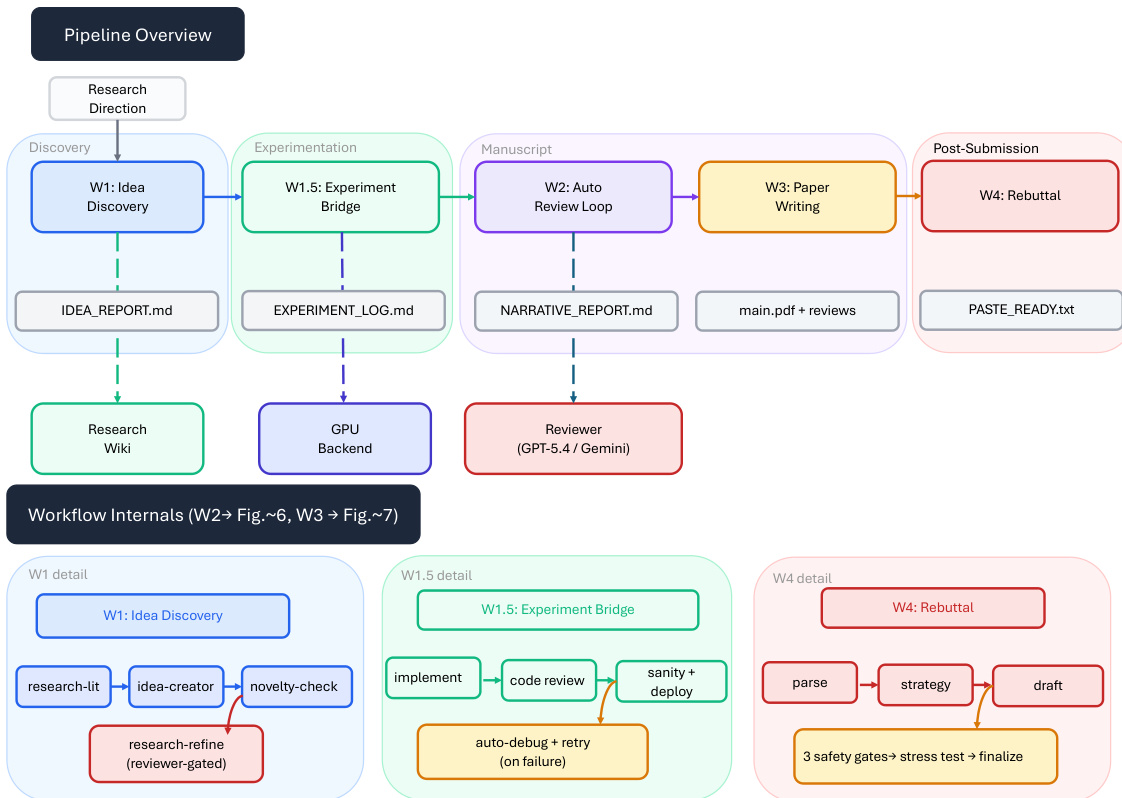
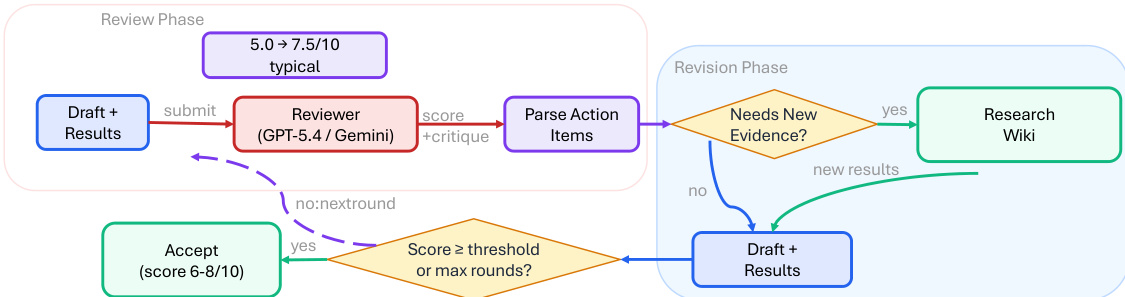
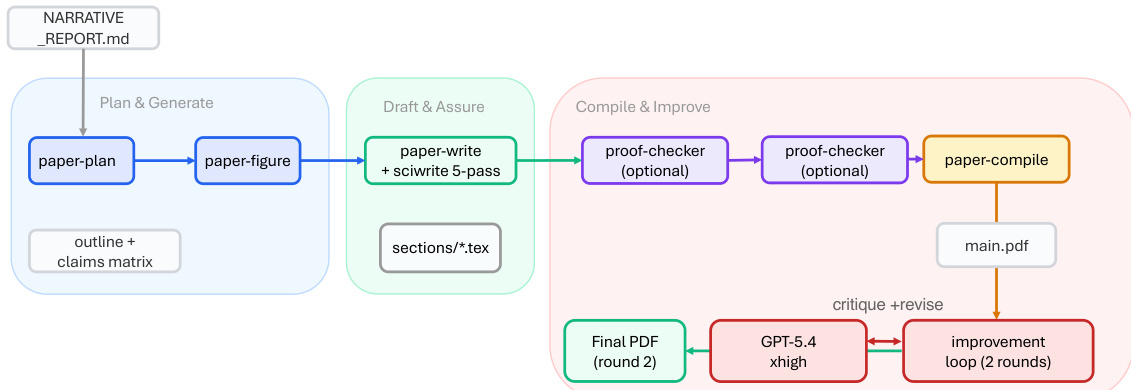
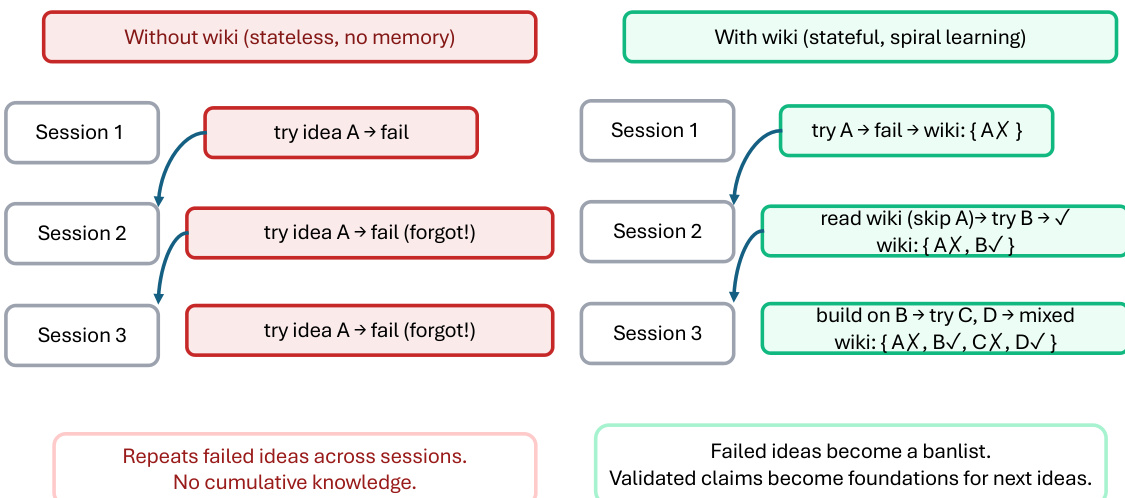
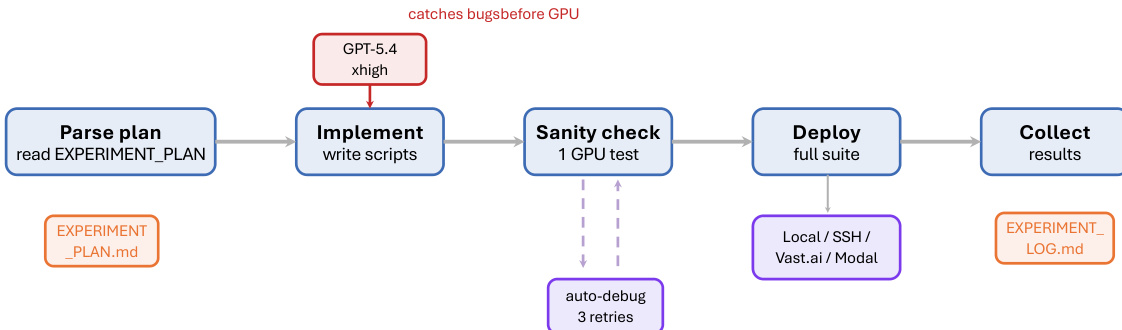
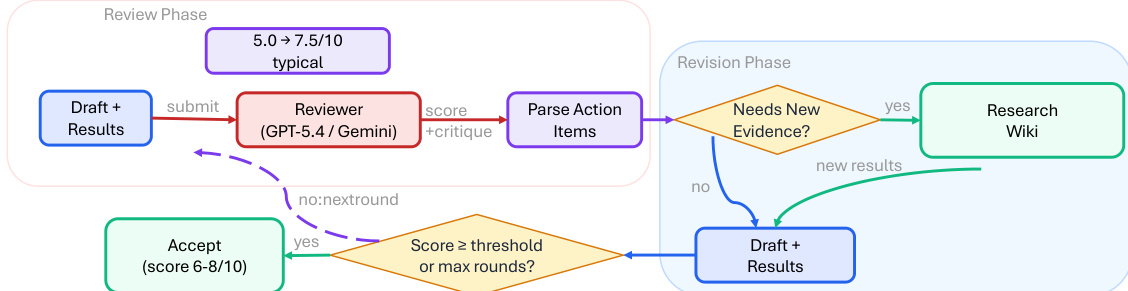
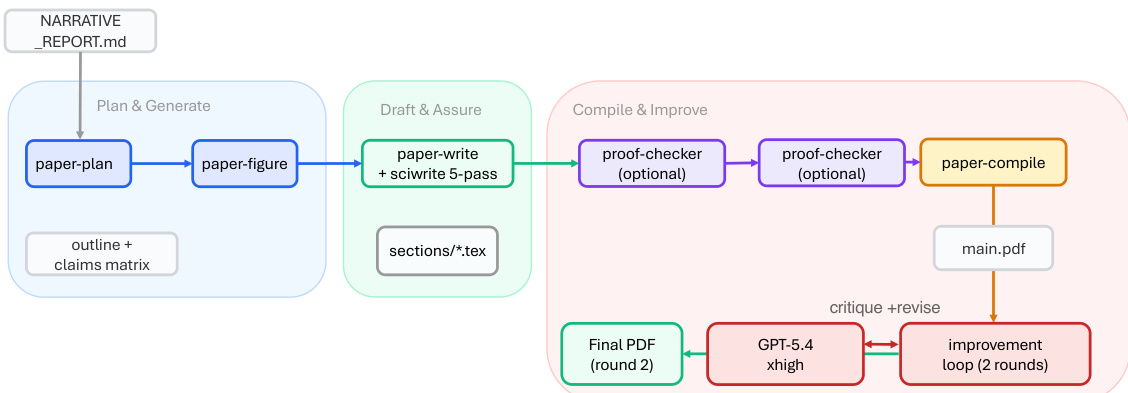
The ARIS framework is structured around three primary architectural layers—execution, orchestration, and assurance—that collectively address the challenges of long-horizon, autonomous machine learning research. The execution layer provides a modular foundation through more than 65 reusable skills, each defined as a plain-text Markdown file (SKILL.md) that specifies inputs, outputs, procedural steps, and quality gates. These skills are coordinated via versionable artifact contracts, enabling checkpoint-based recovery and auditability. The orchestration layer manages five end-to-end workflows—idea discovery, experiment bridge, auto-review loop, paper writing, and rebuttal—chained through these contracts and grouped into four research phases: Discovery, Experimentation, Manuscript, and Post-Submission. This layer supports adjustable effort settings and configurable routing to reviewer models, allowing users to scale depth and breadth while maintaining core review invariants. The assurance layer implements a multi-stage process to detect and mitigate plausible unsupported success, including evidence integrity verification, result-to-claim mapping, and claim auditing against raw evidence and a claim ledger. It also includes a five-pass scientific-editing pipeline, mathematical-proof checks, and visual inspection of rendered PDFs. A prototype meta-optimization loop records research traces and proposes harness improvements that are only adopted after reviewer approval, enabling iterative refinement of the system itself. The overall architecture is designed to enforce independent assurance by default, leveraging cross-model adversarial collaboration between an executor and a reviewer drawn from different model families, thereby reducing shared inductive biases and enhancing critical evaluation.





Experiment
The evaluation relies on observational deployment tracking and a single overnight operational run to assess ARIS under realistic conditions. These experiments validate the system's practical capability to autonomously prune unsupported claims and iteratively refine manuscripts through automated review cycles, alongside demonstrating substantial ecosystem expansion across multiple technical domains. Because the reported outcomes remain observational, they confirm operational feasibility rather than establishing causal advantages for specific reviewer architectures or model configurations. A future controlled benchmark protocol will be required to isolate the impact of algorithmic design from external variables like researcher expertise and task difficulty.
The authors present a comparison of different systems, including their own, across several capabilities such as cross-family review, adversarial review, composability, E2E research workflows, assurance stack, and cross-platform portability. The system developed by the authors, ARIS, demonstrates a comprehensive set of features, particularly in composability and E2E research workflows, and supports cross-platform portability. ARIS supports cross-platform portability and E2E research workflows, which are not supported by other systems. ARIS includes composable skills and an assurance stack, features absent in most compared systems. ARIS implements a default cross-family policy, whereas other systems either lack this capability or use partial or none policies.
The evaluation compares ARIS against existing systems across multiple capability dimensions, validating its performance in cross-family and adversarial reviews, composability, end-to-end research workflows, assurance stacks, and cross-platform portability. ARIS demonstrates superior integration by uniquely supporting full end-to-end workflows and cross-platform deployment while introducing composable skills and a dedicated assurance stack absent in competing tools. Additionally, it establishes a comprehensive default cross-family policy that addresses the partial or missing coverage found in alternative approaches.