Command Palette
Search for a command to run...
PaddleOCR-VL: Boosting Multilingual Document Parsing via a 0.9B Ultra-Compact Vision-Language Model
PaddleOCR-VL: Boosting Multilingual Document Parsing via a 0.9B Ultra-Compact Vision-Language Model
PaddleOCR-VL: Multimodal Document Parsing
Abstract
In this report, we propose PaddleOCR-VL, a SOTA and resource-efficient model tailored for document parsing. Its core component is PaddleOCR-VL-0.9B, a compact yet powerful vision-language model (VLM) that integrates a NaViT-style dynamic resolution visual encoder with the ERNIE-4.5-0.3B language model to enable accurate element recognition. This innovative model efficiently supports 109 languages and excels in recognizing complex elements (e.g., text, tables, formulas, and charts), while maintaining minimal resource consumption. Through comprehensive evaluations on widely used public benchmarks and in-house benchmarks, PaddleOCR-VL achieves SOTA performance in both page-level document parsing and element-level recognition. It significantly outperforms existing solutions, exhibits strong competitiveness against top-tier VLMs, and delivers fast inference speeds. These strengths make it highly suitable for practical deployment in real-world scenarios.
One-sentence Summary
This report proposes PaddleOCR-VL, a 0.9B ultra-compact vision-language model that integrates a NaViT-style dynamic resolution visual encoder with the ERNIE-4.5-0.3B language model to achieve state-of-the-art performance on public and in-house benchmarks for multilingual document parsing and complex element recognition across 109 languages with minimal resource consumption.
Key Contributions
- This work introduces PaddleOCR-VL, a resource-efficient vision-language model featuring a compact 0.9B parameter core that combines a NaViT-style dynamic resolution visual encoder with the ERNIE-4.5-0.3B language model. The model efficiently supports 109 languages and enables accurate recognition of complex document elements such as text, tables, formulas, and charts while maintaining minimal resource consumption.
- Comprehensive evaluations on widely used public and in-house benchmarks demonstrate that the model achieves state-of-the-art performance in both page-level document parsing and element-level recognition. Results indicate significant outperformance against existing solutions and strong competitiveness against top-tier vision-language models with fast inference speeds.
- We introduce PaddleOCR 3.0 as a major release designed to enhance text recognition accuracy and document parsing capabilities for modern AI applications. This update includes the high-precision PP-OCRv5 text recognition pipeline, which leverages advanced model architectures and training strategies to deliver state-of-the-art results.
Introduction
Document parsing is critical for feeding structured information into large language models and retrieval systems, yet modern documents present complex layouts that challenge existing technologies. Prior pipeline approaches suffer from integration complexity and cumulative error propagation, while end-to-end multimodal models often generate hallucinations or incur substantial computational overhead. The authors address these limitations with PaddleOCR-VL, a resource-efficient vision-language model designed for high-performance document analysis. They leverage a compact 0.9B architecture combining a dynamic high-resolution visual encoder with a lightweight language model to achieve state-of-the-art accuracy across 109 languages without compromising inference speed.
Dataset
-
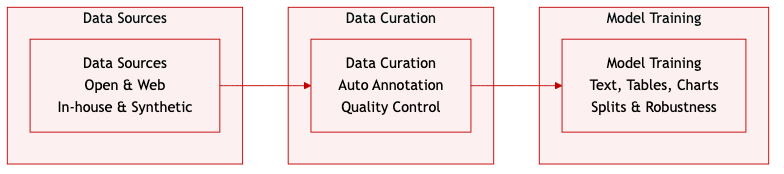
Dataset Composition and Sources The authors build the training set using four main sources to ensure breadth. These include established open-source repositories, synthesized data to correct distribution imbalances, network-accessible web documents such as academic papers and newspapers, and proprietary in-house collections.
-
Key Details for Each Subset
- Text: 20 million image-text pairs covering 109 languages with annotations at line, block, and page levels.
- Tables: Over 5 million image-table pairs using the OTSL format, sourced from mining and synthesis tools generating 10,000 samples per hour.
- Formulas: Includes printed and handwritten expressions in Chinese and English, sourced from UniMER-1M and MathWriting, and validated via LaTeX rendering engines.
- Charts: Over 0.8 million image-chart pairs combining 220,000 cleaned public samples with persona-based synthetic rendering.
-
Model Usage and Training Splits The team trains on both isolated element images and complete document pages to improve parsing performance. Challenging examples are integrated to enhance robustness and prevent overfitting on clean canonical datasets.
-
Processing and Metadata Construction
- Annotation: A two-stage pipeline uses PP-StructureV3 for pseudo-labels and large multimodal models for refinement.
- Quality Control: Hallucination filtering removes incorrect content, while rule-based checks verify n-gram consistency and HTML validity.
- Cropping: Formula regions are cropped based on layout analysis bounding boxes before recognition.
- Chart Logic: Annotations treat data retrieval as a query task involving axis tick labels and data points.
Method
The proposed PaddleOCR-VL framework decomposes the complex task of document parsing into a two-stage pipeline to balance accuracy and efficiency. The first stage focuses on layout analysis to localize semantic regions and determine reading order, while the second stage performs fine-grained recognition of diverse content elements. The overall architecture is illustrated below.
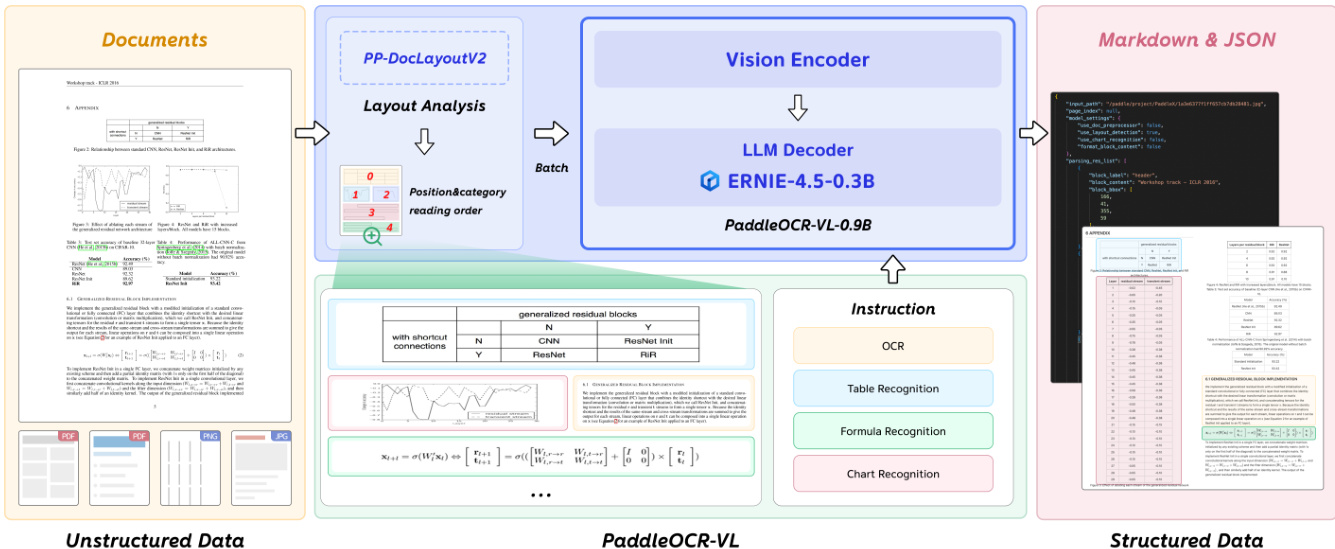
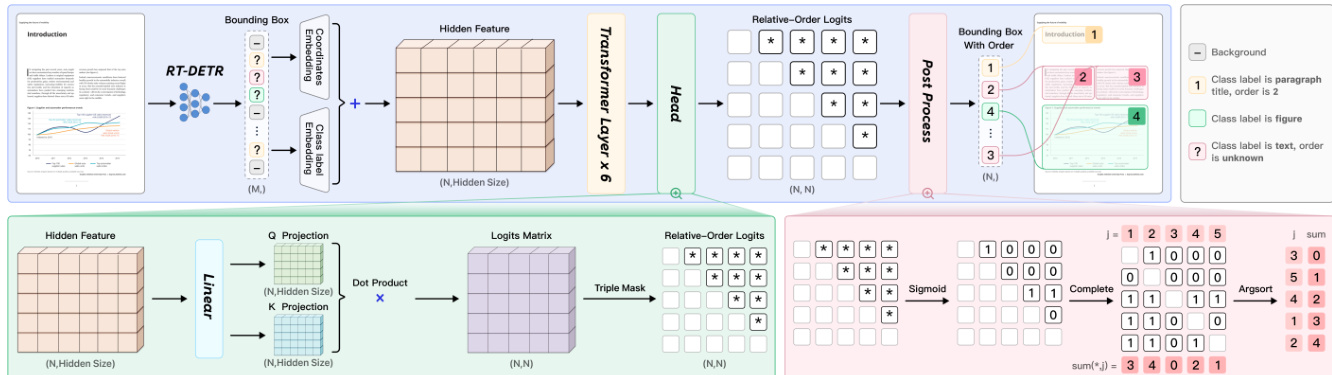
Layout Analysis To address the latency and instability issues inherent in end-to-end vision-language models for layout tasks, the authors employ a dedicated lightweight model named PP-DocLayoutV2. This module is responsible for element detection, classification, and reading order prediction. As shown in the figure below, the architecture consists of an RT-DETR-based detection model for localization and a subsequent pointer network for ordering. The detection model outputs bounding boxes and class labels, which are then embedded using absolute 2D positional encodings and class label embeddings. A geometric bias mechanism is incorporated into the encoder attention to model pairwise geometric relationships. The pairwise relation head projects element representations into query and key vectors to compute bilinear similarities, resulting in an N×N matrix representing relative order. Finally, a deterministic win-accumulation decoding algorithm recovers a topologically consistent reading order.
Element-level Recognition For the recognition stage, the authors propose PaddleOCR-VL-0.9B, which integrates a dynamic resolution visual encoder with a compact language model. The architecture follows a style inspired by LLaVA, connecting a pre-trained vision encoder to a large language model via a projector. Refer to the architecture diagram below for the detailed module design.
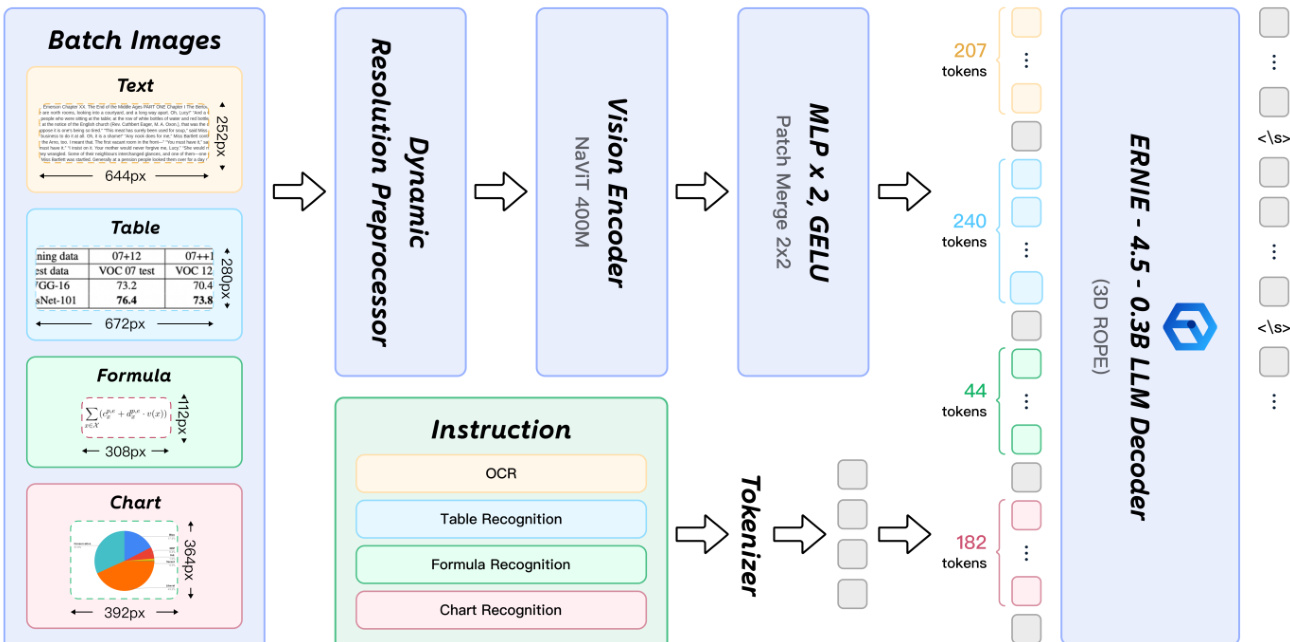
The vision encoder utilizes a NaViT-style design initialized from Keye-VL, supporting native-resolution inputs without distortion. This allows the model to handle images of arbitrary resolution. A randomly initialized 2-layer MLP with GELU activation and a merge size of 2 bridges the visual features to the language model's embedding space. For the language decoder, the ERNIE-4.5-0.3B model is selected to balance parameter count with inference efficiency. The implementation further enhances positional representation by incorporating 3D-RoPE. The model is trained to handle specific instructions for OCR, table recognition, formula recognition, and chart recognition.
Training Recipe and Data Construction The training process relies on a diverse and high-quality dataset constructed through automatic annotation and synthesis. The data pipeline includes open-source datasets, synthesized datasets, network-accessible datasets, and in-house datasets. As illustrated in the figure below, the system employs an EVAL Engine for hard case mining to identify performance bottlenecks in specific scenarios.
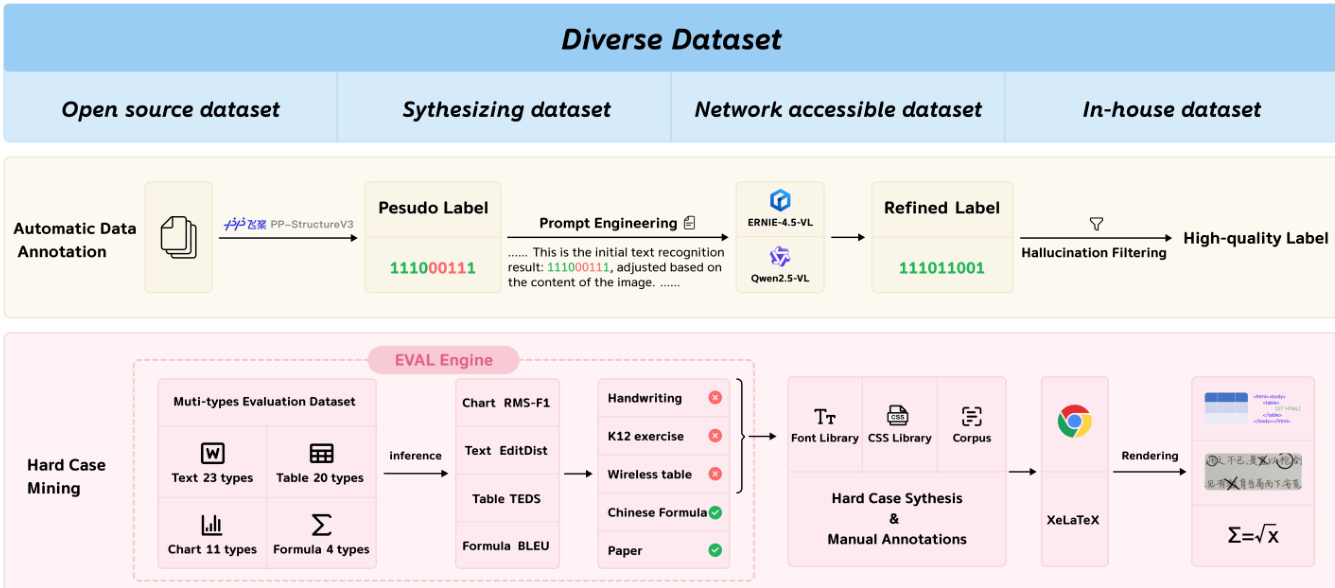
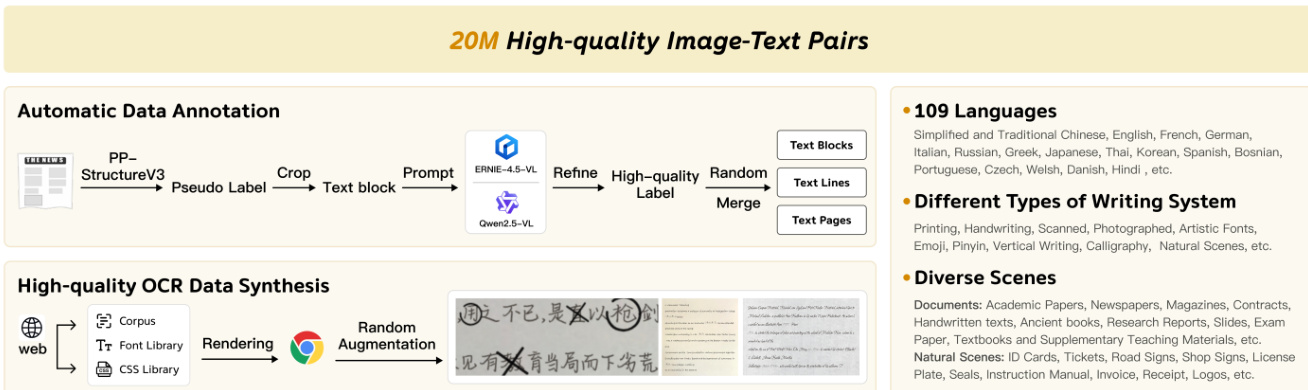
To ensure robustness, the authors generate 20 million high-quality image-text pairs. This involves automatic data annotation using PP-StructureV3 to create pseudo labels, which are then refined by vision-language models. Additionally, high-quality OCR data is synthesized using a corpus, font library, and CSS library, followed by random augmentation. This diverse data covers 109 languages and various writing systems including printing, handwriting, and scanned text.
The training strategy for the recognition model is divided into two stages. The first stage focuses on pre-training alignment using 29 million image-text pairs to associate visual information with textual representations. The second stage involves instruction fine-tuning on a curated dataset of 2.7 million samples to adapt the model to specific downstream tasks like table structure recognition and formula conversion.
Experiment
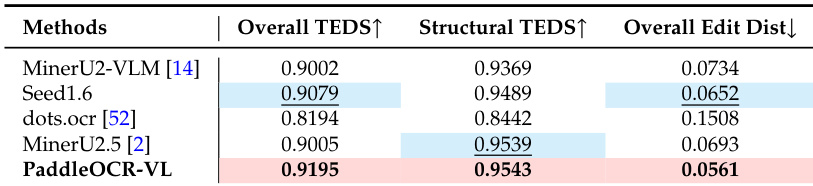
The evaluation framework assessed PaddleOCR-VL against leading general vision language models and specialized document parsing tools using multiple public and in-house benchmarks designed to measure page-level document structure and element-level recognition capabilities. Experiments validated the model's state-of-the-art accuracy in parsing text, tables, formulas, and charts while demonstrating superior inference efficiency through optimized asynchronous execution workflows. Qualitative findings further highlight the system's robustness in managing complex layouts, diverse languages, and challenging handwriting scenarios compared to existing solutions.
The the the table compares the the the table recognition capabilities of PaddleOCR-VL against several leading models. Results show that the proposed model achieves the best performance across overall accuracy, structural analysis, and error metrics. PaddleOCR-VL secures the highest score for overall the the table structure similarity. The model demonstrates the lowest error rate among all compared methods. Structural parsing capabilities exceed those of the closest competitor.
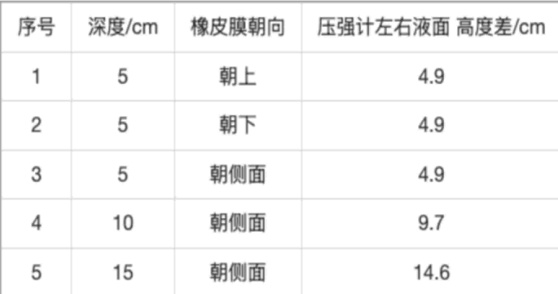
The experiment investigates liquid pressure by recording manometer height differences at various depths and orientations. Results show that pressure is consistent in all directions at a fixed depth but increases as depth increases. Liquid pressure is equal in all directions at the same depth. Pressure increases as the depth of the liquid increases. The manometer height difference reflects the magnitude of pressure.
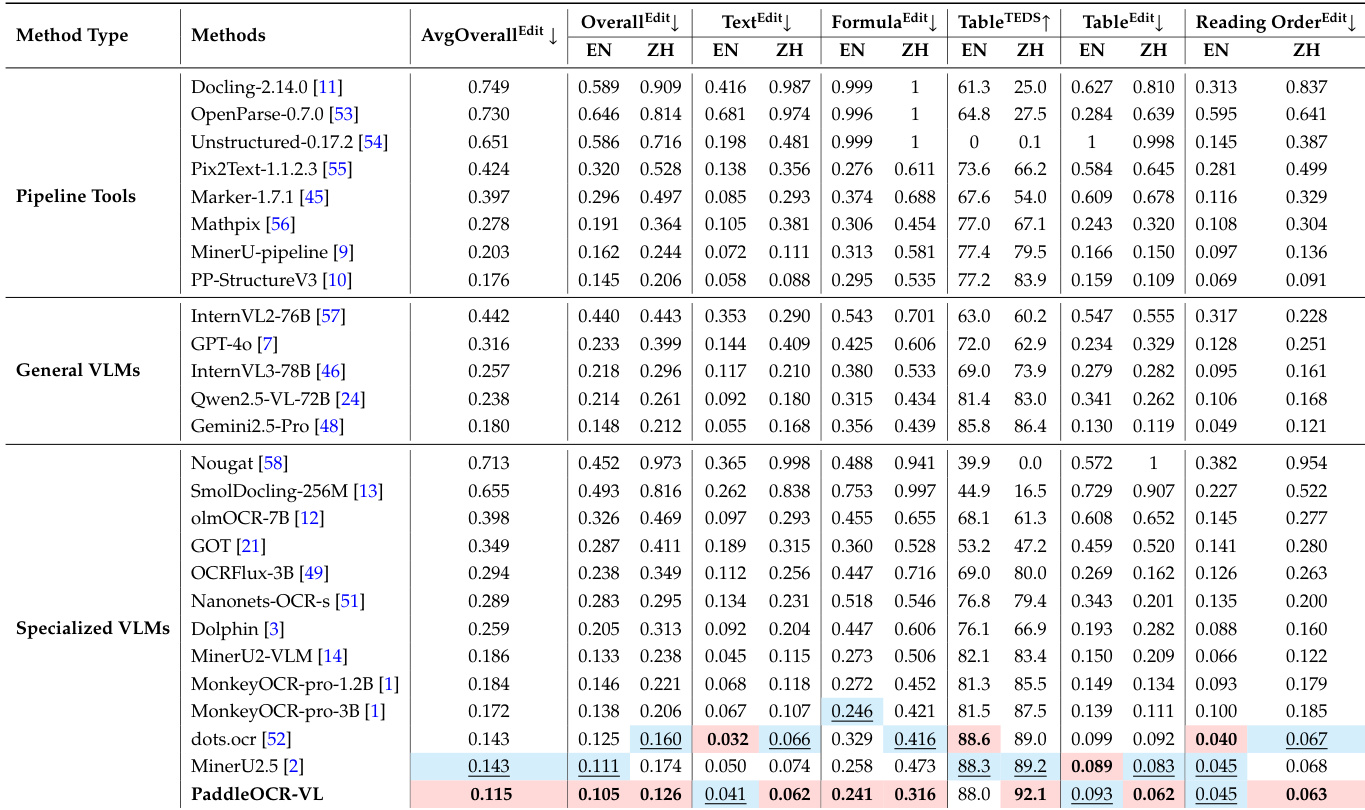
The authors evaluate PaddleOCR-VL against various pipeline tools and vision language models on the OmniDocBench v1.0 benchmark. Results indicate that PaddleOCR-VL achieves state-of-the-art performance with the lowest average overall edit distance, outperforming competitors in text, formula, and the the table recognition tasks. PaddleOCR-VL achieves the lowest average overall edit distance compared to other methods. The model demonstrates superior accuracy in Chinese text and the the table recognition metrics. PaddleOCR-VL maintains the best reading order preservation, particularly for Chinese documents.
The the the table compares the edit distance performance of PaddleOCR-VL against various general and specialized models across ten different languages. Results indicate that PaddleOCR-VL consistently achieves the lowest error rates, demonstrating superior accuracy in multilingual text recognition tasks. PaddleOCR-VL achieves the lowest edit distance across all evaluated languages. The model outperforms general vision language models like Qwen2.5-VL-72B. Significant accuracy improvements are observed over specialized document parsing tools.

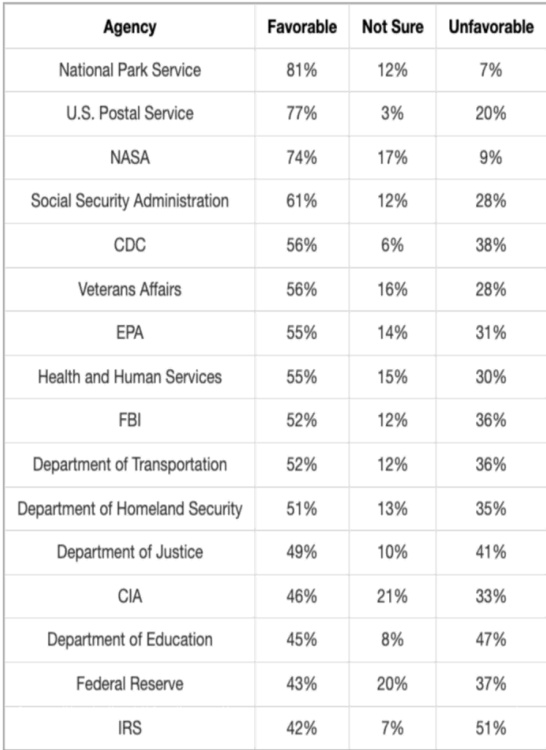
The the the table displays public opinion data on various United States government agencies, categorized by favorable, unsure, and unfavorable responses. The National Park Service receives the most positive reception, whereas the Internal Revenue Service faces the highest level of disapproval. National Park Service leads in favorable ratings. IRS has the highest unfavorable percentage. NASA and Postal Service also show strong favorable sentiment.
The experiments described include evaluations of the PaddleOCR-VL model alongside separate studies on fluid dynamics and public sentiment. PaddleOCR-VL demonstrates state-of-the-art performance in the table recognition, document parsing, and multilingual text accuracy when benchmarked against leading vision-language and specialized tools. Additional experiments validate that liquid pressure increases with depth while also analyzing favorability ratings for various United States government agencies.