Command Palette
Search for a command to run...
Stateful Conformer with Cache-Based Inference for Streaming Automatic Speech Recognition
Stateful Conformer with Cache-Based Inference for Streaming Automatic Speech Recognition
Vahid Noroozi Somshubra Majumdar Ankur Kumar Jagadeesh Balam Boris Ginsburg
Nemotron-Speech-Streaming-ASR: Automatic Speech Recognition Demo
Abstract
In this paper, we propose an efficient and accurate streaming speech recognition model based on the FastConformer architecture. We adapted the FastConformer architecture for streaming applications through: (1) constraining both the look-ahead and past contexts in the encoder, and (2) introducing an activation caching mechanism to enable the non-autoregressive encoder to operate autoregressively during inference. The proposed model is thoughtfully designed in a way to eliminate the accuracy disparity between the train and inference time which is common for many streaming models. Furthermore, our proposed encoder works with various decoder configurations including Connectionist Temporal Classification (CTC) and RNN-Transducer (RNNT) decoders. Additionally, we introduced a hybrid CTC/RNNT architecture which utilizes a shared encoder with both a CTC and RNNT decoder to boost the accuracy and save computation. We evaluate the proposed model on LibriSpeech dataset and a multi-domain large scale dataset and demonstrate that it can achieve better accuracy with lower latency and inference time compared to a conventional buffered streaming model baseline. We also showed that training a model with multiple latencies can achieve better accuracy than single latency models while it enables us to support multiple latencies with a single model.
One-sentence Summary
By constraining look-ahead and past contexts and introducing an activation caching mechanism, the authors propose a stateful FastConformer architecture for streaming automatic speech recognition that eliminates the accuracy disparity between training and inference and supports hybrid CTC/RNNT decoders to achieve superior accuracy and lower latency on the LibriSpeech and multi-domain large-scale datasets.
Key Contributions
- The paper introduces an efficient streaming speech recognition model based on the FastConformer architecture by constraining both look-ahead and past contexts in the encoder to minimize the accuracy gap between training and inference.
- A novel activation caching mechanism is presented that converts the non-autoregressive encoder into an autoregressive recurrent model during inference, which eliminates the need for redundant buffer computations and reduces inference costs.
- A hybrid CTC/RNNT architecture is developed using a shared encoder with both decoders to improve accuracy and convergence speed while saving computation, outperforming conventional buffered streaming models on the LibriSpeech and multi-domain datasets.
Introduction
Streaming automatic speech recognition (ASR) is essential for real-time applications, yet it faces a significant accuracy gap compared to offline models that utilize global context. Traditional streaming methods often rely on large overlapping buffers to mitigate this gap, which leads to redundant and costly computations, or they use architectures that create inconsistencies between training and inference. The authors leverage the FastConformer architecture to introduce a stateful streaming model that utilizes an activation caching mechanism. This approach converts a non-autoregressive encoder into an autoregressive recurrent model during inference, allowing for efficient processing without the need for overlapping chunks. By constraining both look-ahead and past contexts during training, the authors ensure consistency between training and streaming modes, significantly reducing latency and computational overhead while improving accuracy.
Method
The authors propose a cache-aware streaming FastConformer designed to maintain consistent behavior between training and inference by controlling the left and right contexts of each audio step. While the original FastConformer encoder utilizes self-attention, convolutions, and linear layers, the streaming version requires specific modifications to ensure causality. For instance, the authors replace batch normalization with layer normalization to avoid using statistics from the entire input sequence and ensure all convolution layers are fully causal through specific padding strategies.
To manage the context size in self-attention layers, the authors evaluate three distinct approaches. The first is zero look-ahead, which uses masking to ensure each step only accesses past tokens, resulting in low latency but potentially lower accuracy. The second is regular look-ahead, where a fixed number of future tokens are accessible. As shown in the figure below, in this approach, the dependency on future frames increases as the model moves deeper into the network, which can lead to significant latency and unnecessary re-computation of tokens.
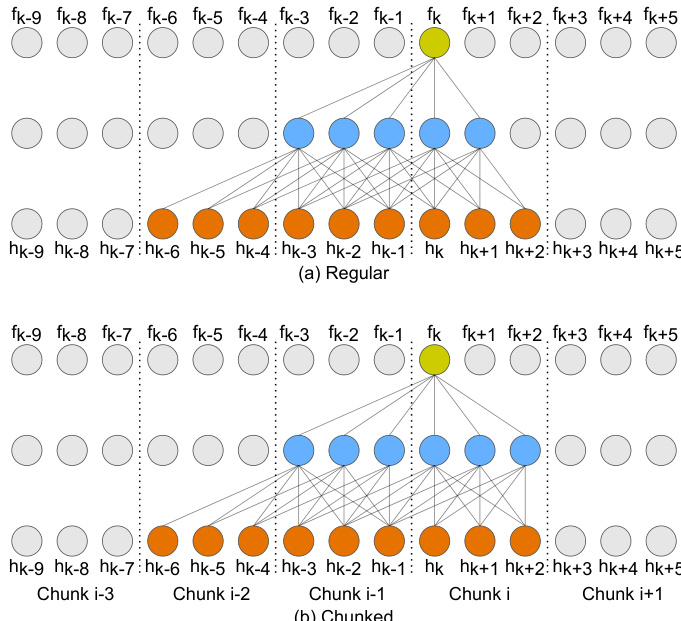
The third approach, chunk-aware look-ahead, addresses these limitations by splitting the input into chunks of size C. In this configuration, tokens within a chunk can access other tokens in the same chunk and a limited number of previous chunks. Refer to the framework diagram to see how this approach maintains a constant dependency on future frames regardless of network depth. This method eliminates redundant computations and allows for an average look-ahead that is larger than the regular approach, improving accuracy within the same latency budget.
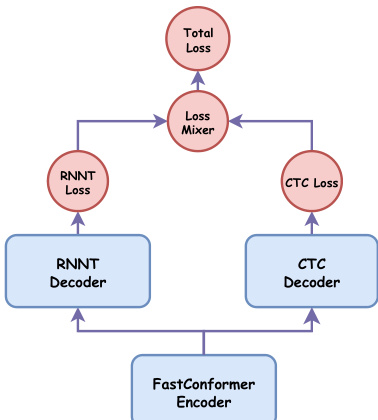
To optimize the training process, the authors employ a hybrid architecture that utilizes both a CTC decoder and an RNNT decoder sharing a single encoder. This design allows for faster convergence and improved accuracy for both decoders through joint training. The total loss optimized during training is a weighted summation of the individual losses:
ltotal=α⋅lctc+lrnntwhere α is a hyperparameter controlling the balance between the two. The architecture of this hybrid model is illustrated in the figure below:

During streaming inference, the model processes input in chunks. To avoid the inefficiency of re-computing past context, the authors implement a caching mechanism. For causal 1D depth-wise convolutions, a fixed-size cache stores the last K−1 activations. For self-attention layers, the cache size grows until it reaches the maximum allowed left context size Lc, at which point the oldest activations are dropped. This caching strategy ensures that the streaming inference results are identical to processing the entire audio in a single step while significantly reducing computational duplication.
Experiment
The researchers evaluated a cache-aware streaming FastConformer architecture using CTC and RNNT decoders across LibriSpeech and the large-scale NeMo ASRSET 3.0 datasets. The experiments demonstrate that cache-aware models provide superior accuracy, lower latency, and greater computational efficiency compared to traditional buffered streaming approaches. Furthermore, the results show that utilizing a hybrid architecture and multi-lookahead training improves model robustness and accuracy across various latency requirements.
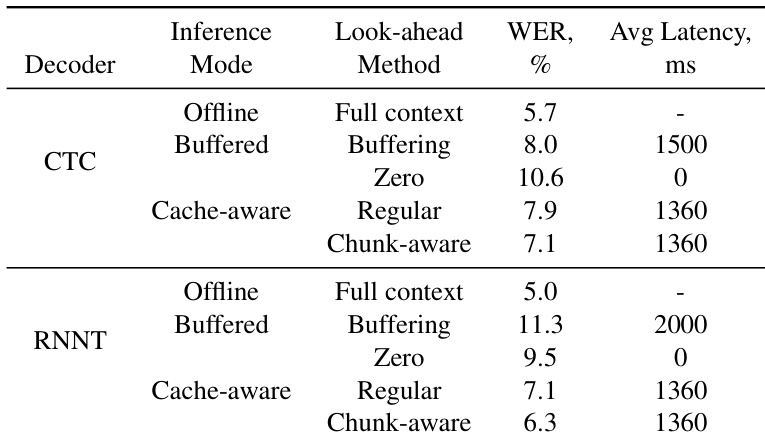
The authors compare the performance of CTC and RNNT decoders across different inference modes, including offline, buffered, and cache-aware approaches. Results show that cache-aware methods, particularly the chunk-aware approach, provide better accuracy and lower latency compared to buffered streaming. Cache-aware models achieve higher accuracy than buffered streaming models for both CTC and RNNT decoders. Chunk-aware streaming outperforms regular look-ahead methods in terms of accuracy at equivalent latency levels. The accuracy degradation from offline models is smaller in cache-aware streaming than in buffered streaming approaches.
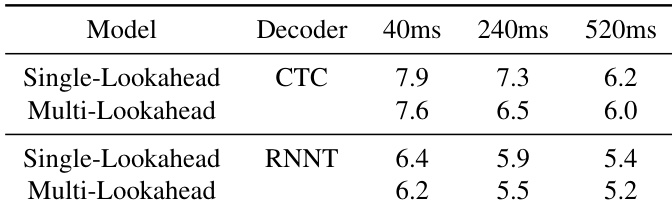
The authors compare single-lookahead models against multi-lookahead models across different latencies for both CTC and RNNT decoders. Results show that training with multiple lookaheads improves accuracy and robustness across all tested latency levels. Multi-lookahead models achieve better accuracy than single-lookahead models for both CTC and RNNT decoders. The performance improvement from multi-lookahead training is consistent across various latency settings. RNNT decoders generally demonstrate higher accuracy compared to CTC decoders in this configuration.
The authors evaluate the performance of cache-aware streaming models using both CTC and RNNT decoders across multiple speech datasets. Results demonstrate that cache-aware approaches consistently outperform buffered streaming methods in terms of accuracy across various benchmarks. Cache-aware models achieve higher accuracy than buffered streaming models while maintaining significantly lower latency Increasing the look-ahead size leads to improved accuracy for both CTC and RNNT decoders RNNT-based cache-aware models generally show better performance across most benchmarks compared to their CTC counterparts

The authors compare regular and chunk-aware streaming approaches using hybrid and non-hybrid architectures for both CTC and RNNT decoders. Results show that the chunk-aware approach provides more flexibility across different latency levels and generally achieves better accuracy than the regular approach. Chunk-aware models achieve higher accuracy than regular look-ahead models at comparable latency levels Hybrid architectures demonstrate superior performance compared to non-hybrid architectures in the chunk-aware setting The RNNT decoder consistently outperforms the CTC decoder across the evaluated latency settings
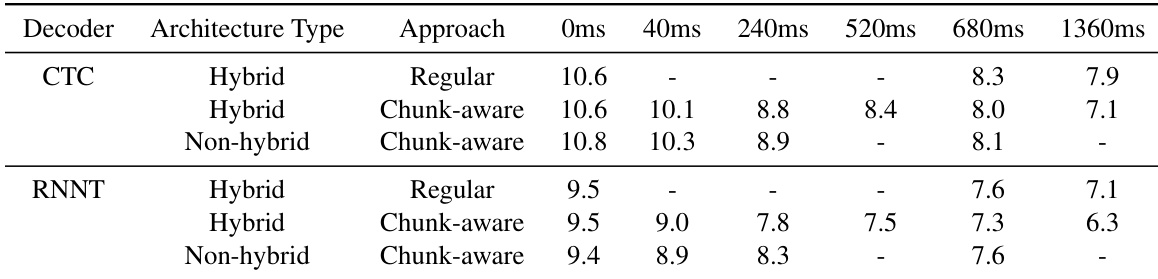
The experiments evaluate various inference modes, look-ahead strategies, and architectural configurations for CTC and RNNT decoders across multiple speech datasets. The results demonstrate that cache-aware and chunk-aware streaming approaches consistently provide superior accuracy and lower latency compared to traditional buffered or regular look-ahead methods. Furthermore, training with multi-lookahead models and utilizing hybrid architectures enhances robustness and performance, with RNNT decoders generally outperforming CTC decoders across most settings.