Command Palette
Search for a command to run...
The Final Average Score of Code Tasks Increased by 2.36, and Companies Like Google Have Proposed the SIM Mechanism to Allow Harness to Extend Optimization Experience Across Models and datasets.

The capabilities of large language model agents do not depend only on the underlying model itself. The agent execution framework (Harness), which determines what context the model can see, what tools it can call, and how the task execution process is organized, also affects its final performance. Harness optimization is usually carried out under fixed policy model (Policy Model) and benchmark (Benchmark) conditions. When either of these conditions changes, the optimizer must decide: which parts of the already evolved Harness can continue to be used, and which parts need adjustment. However, the Harness alone may not explain why certain modifications were made previously, or what effects those modifications achieved.
Against this background, a research team from Google explores Continual Recursive Self-Improvement (CRSI), a research setting that continues existing Harness optimization methods across compatible benchmarks or policy models. The study proposes a Self-Improvement Memory (SIM) mechanism. SIM categorizes selected modification proposals according to the Harness problem to be solved, and enables the Proposer and Selector to access the relevant modification rationale, expected and actually observed results, and evaluation context. When a new problem arises, SIM creates a corresponding memory entry; when the optimizer makes further attempts on an existing problem, SIM appends the new modification proposals and their results to the existing record. In this way, SIM can help the optimizer determine which modifications should be retained, adjusted, replaced, or removed.
Experiments conducted in four domains show that, in cross-dataset and paired cross-model comparisons, SIM achieves higher final scores than optimization methods that only continue the Harness itself and those that only retain root-cause information. In 10 independent source-side runs in the coding domain, compared with the method that only continues the Harness, paired continuation optimization using SIM improved the final score by an average of 2.36 points (p = 0.003).
The related research, titled “Self-Improvement Memory Enables Continual Recursive Self-Improvement,” has been released as a preprint on arXiv.
Research highlights:
-
The study defines two continual optimization settings: one is cross-dataset continuation optimization with a fixed policy model; the other is cross-model continuation optimization with a fixed benchmark and its data splits
-
The study proposes a structured recording mechanism for storing the problems faced by the Harness, the modifications taken, and the corresponding results, and uses this information to guide both proposal and selection
-
The complete SIM method outperforms both the method that only continues the Harness and the method that only retains root-cause information across 6 cross-dataset settings and 4 cross-model settings from Opus to Gemini
https://hyper.ai/papers/2611.18856
Datasets and benchmarks cover four domains
The study does not limit evaluation to a single coding benchmark; instead, it covers four domains: coding, text classification, agentic workspace, and engineering design, and selects task environments where the source and target sides can use a compatible Harness execution interface.
① Coding: Uses Terminal-Bench 2.1 (TB2.1) as the source-side benchmark; Terminal-Bench 4 (TB4) as the target-side benchmark.
② Text Classification: Uses the online classification environment provided by Meta-Harness.
The source-side test suite consists of three datasets:
-
LawBench
-
Gretel-adapted version of Symptom2Disease
-
USPTO-50k
The target-side test suite contains 8 datasets that did not participate in source-side RSI optimization:
-
AG News
-
GoEmotions
-
Banking77
-
Financial PhraseBank
-
SciCite
-
TweetEval-Hate
-
Amazon Reviews (Amazon5)
-
SciTail
③ Agentic Workspace: Uses Harvey LAB as the source-side benchmark; the target-side environment consists of three benchmarks: JobBench, GDPval, and APEX-Agents.
④ Engineering Design: Uses EngDesign as the source-side benchmark; Frontier-Eng as the target-side benchmark.
The SIM mechanism establishes a continuously updatable improvement profile for the Harness
This study follows the Meta-Harness methodology, optimizing an executable Harness around a fixed policy model. The optimization process divides tasks into non-overlapping evolution and held-out evaluation sets, and only feedback from the evolution set can be used to propose modifications, select candidates, update SIM, and decide when to stop optimization.
Each optimization consists of multiple rounds. In each round, the evaluator first executes the current Harness and returns the score, execution trace, and error information. The Proposer uses this feedback and prior optimization history, including historical feedback and code diffs, to generate multiple candidate Harnesses. The Selector filters candidates before execution and selects from the evaluated candidates based on performance, complexity, domain specificity, and performance regression risk. If no candidate is accepted, the current Harness remains unchanged.
In Continual Recursive Self-Improvement (CRSI), after source-side optimization is complete, the optimization process continues from the final retained Harness in a new target environment. The study considers two cases: cross-dataset CRSI, where the policy model remains fixed and the benchmark changes; and cross-model CRSI, where the benchmark and its data splits remain fixed and the policy model changes. Both cases require compatible executable Harness interfaces at the source and target sides.
Self-Improving Memory (SIM)
To retain the experience accumulated during source-side optimization, the study proposes Self-Improving Memory (SIM), which categorizes and organizes related modification proposals according to recurring Harness problems.
For a given problem root-cause hypothesis, such as premature task completion, SIM creates a corresponding memory entry that records, in order, each modification attempt addressing this problem. Each attempt includes the modification proposal and its rationale, the expected and actually observed task outcomes, and provenance information, including the domain, benchmark, policy model, and optimization round. Which tasks a modification is expected to fix is recorded before evaluation and verified after evaluation is complete.
In each optimization round, the Proposer receives the full SIM via the system prompt, and the Selector also reads the same records when evaluating candidates. Both can read all memory entries without retrieval or truncation. Each candidate modification must cite an existing problem root cause or propose a new root cause. After proposal selection is complete, only the selected candidates are recorded, including their actual measured results; even if the modification degrades performance or fails to fix the expected tasks, the corresponding results are retained. SIM then appends the new records to the corresponding problem entries or creates new entries, while preserving the prior modification history. If no modification proposal is accepted, the memory remains unchanged.
SIM-Based Continual Recursive Self-Improvement
Source-side RSI starts from an empty SIM and ultimately produces the evolved Harness and its corresponding self-improvement memory.
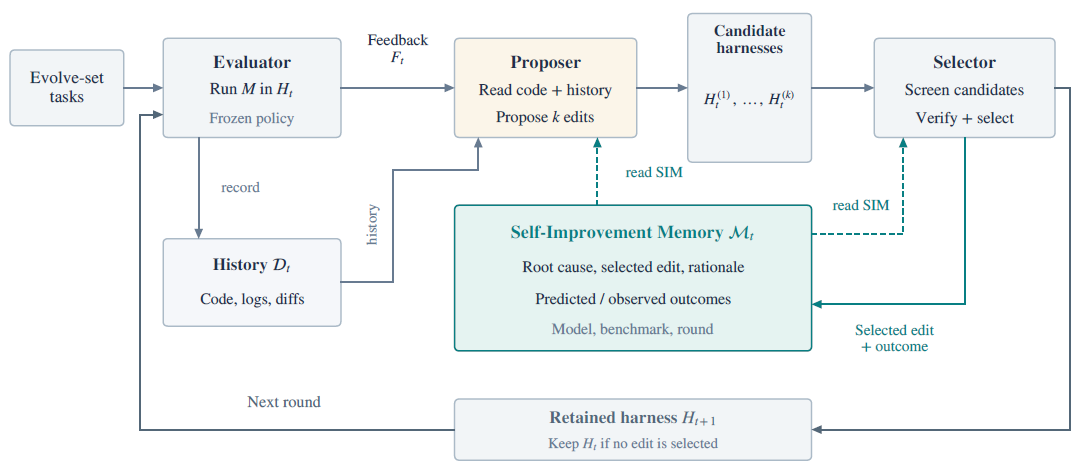
During target-side optimization, the full SIM conveys both pieces of information simultaneously. The Proposer and Selector use the rationale, actual results, and evaluation context of prior modifications to judge whether these modifications still apply to the current problems and decide which Harness modifications to retain, adjust, replace, or remove, while continuing to preserve the historical memory records.
The full SIM method outperforms Harness-only continuation
The researchers validate and deeply analyze the value of the SIM mechanism through a series of experiments.
① Cross-Dataset Continual Recursive Self-Improvement (Cross-Dataset CRSI)
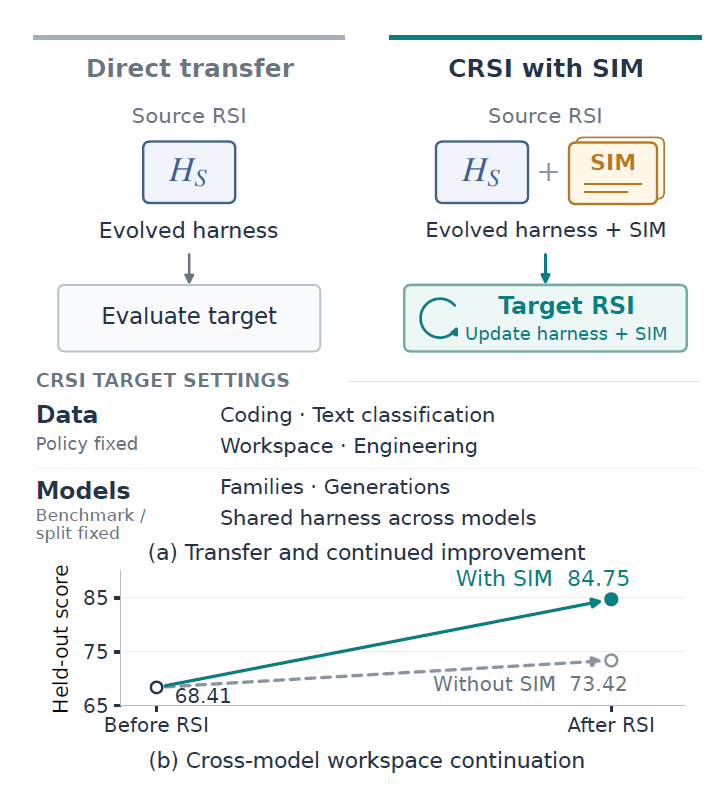
Cross-dataset experiments first validate the value of this memory mechanism—in all 6 dataset transfer scenarios, SIM improved the final score. The memory ablation experiment shown below starts from the same source-side evolved Harness and compares three continual optimization approaches: no SIM, problem root causes only, and full memory records. The results show that Full SIM achieves the highest final score in all 6 experimental settings.
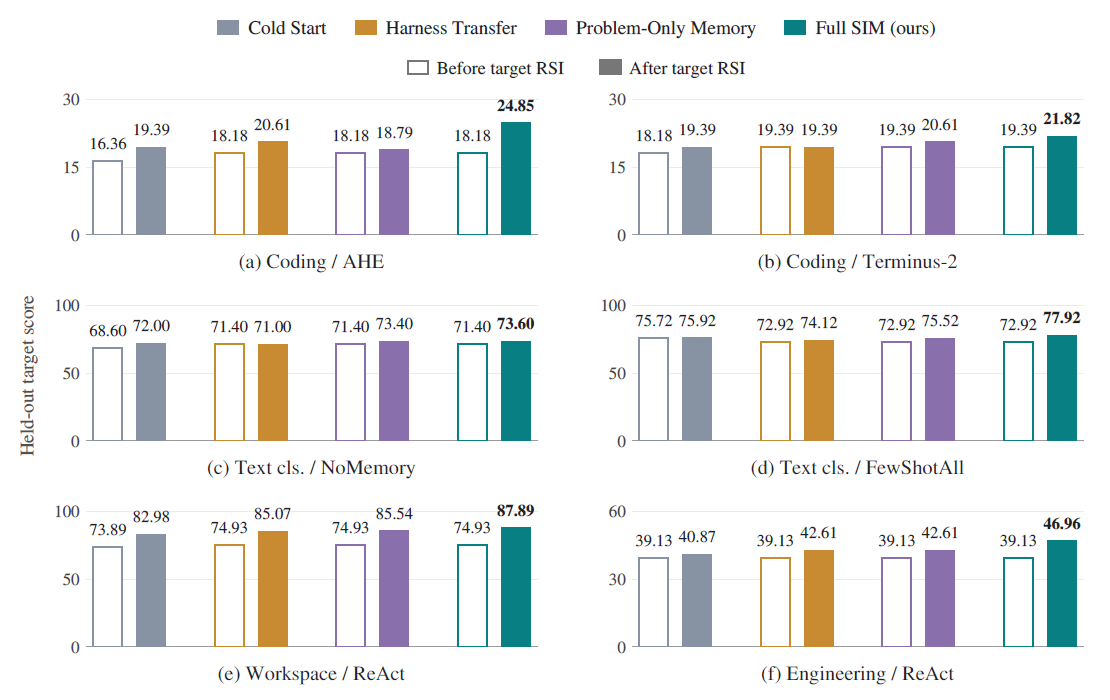
Compared with Harness Transfer, Full SIM improves the final score by 2.43–4.35 points; compared with Problem-Only Memory, it improves by 0.20–6.06 points. In contrast, retaining only problem root-cause information is unstable. Problem-Only Memory's score difference relative to Harness Transfer ranges from 1.82 points lower to 2.40 points higher. This indicates that in addition to retaining diagnoses of problem root causes, further preserving modification history and evaluation evidence can bring additional benefits for continual optimization.
② Cross-Model Continual Recursive Self-Improvement (Cross-Model CRSI)
Cross-model results further amplify this discrepancy—when a Harness evolved and optimized using the Opus model was first run on the Gemini model, its scores in all experimental domains were lower than Gemini's initial Harness (as shown below): the score gap ranged from 0.60 points in the text classification domain to 5.48 points in the workspace domain.
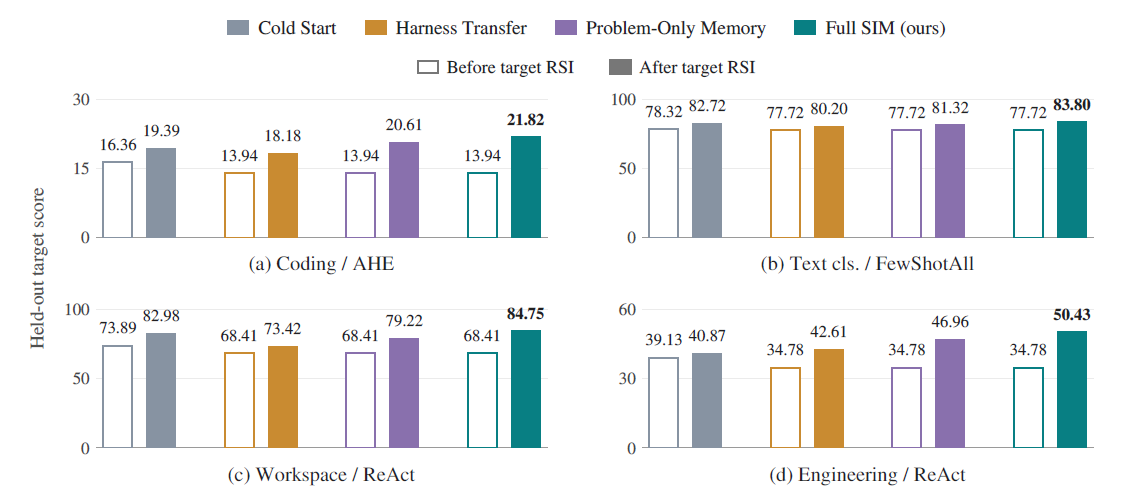
Even if RSI optimization continues on the target side, it may not necessarily be able to make up for this initial disadvantage. In the four experimental domains, Harness Transfer (transferring only the Harness) still had lower final scores than Cold Start in three of them. By contrast, Full SIM achieved the highest final score in all four domains, outperforming the method that only transfers the Harness and continues optimization by 3.60–11.33 points.
The performance difference in the workspace domain was the most significant. Both Full SIM and Harness Transfer started from the same initial score of 68.41 points, but after continuous optimization on the target side, Full SIM's final score reached 84.75 points, while Harness Transfer reached only 73.42 points.
① The Role of SIM in Continuous Recursive Self-Improvement
SIM can improve the effectiveness of continuous optimization starting from the same evolved Harness
To rule out the influence of chance in a single optimization run, the study also conducted paired repeated experiments in the programming domain. Starting from Terminus-2, the researchers independently performed source-side RSI 10 times on TB2.1, and then let each resulting Harness continue optimization on TB4 in two ways: "with SIM" and "without SIM".
The experimental results are shown in the table below. Among the 10 paired experiments, the method using SIM achieved a higher final score in 9 groups, and in only 1 group did the continuous optimization method without SIM perform better, leading by 0.61 points.
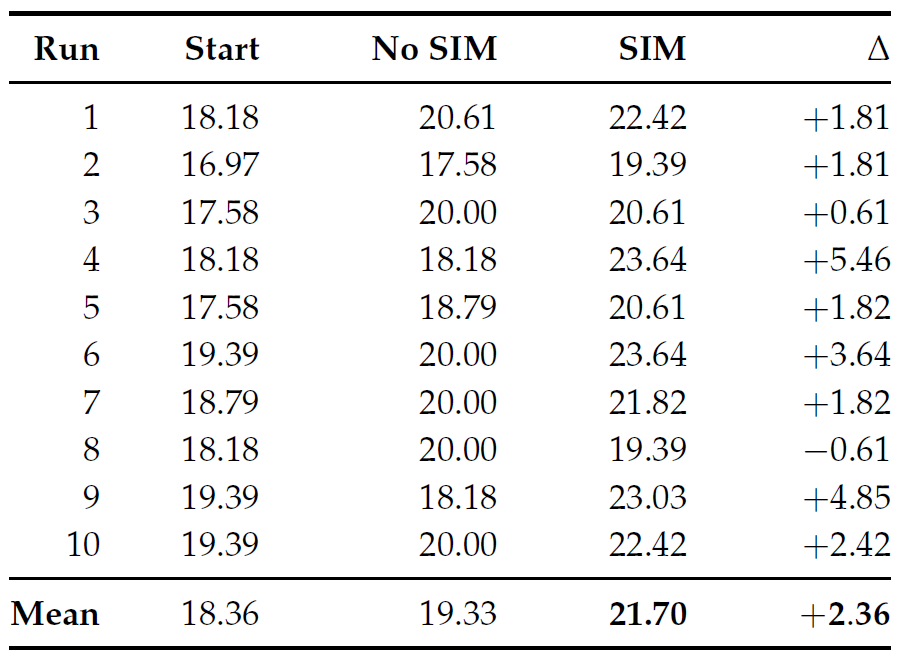
The above results indicate that SIM brought statistically significant performance improvements in these 10 paired experiments with independent source-side runs.
SIM can guide the reuse and adjustment of inherited modification plans
After source-side RSI optimization based on Terminus-2, Full SIM and Harness Transfer inherited the same task-completion checking mechanism, as shown below:
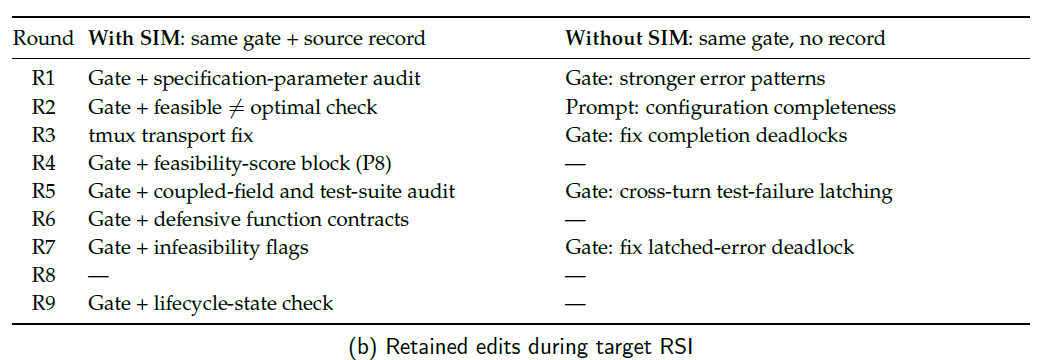
When SIM is used, the proposal generator can leverage the original design rationale of this checking mechanism and its execution results on the source side, adding a checking mechanism suitable for the target task while retaining the task-completion verification function; in runs without SIM, the optimizer chose to further tighten the task-completion checking mechanism and twice fixed the resulting task-completion deadlock problem. In addition, this optimization process also incorrectly attributed the checking mechanism inherited from the source side to modifications made in its own first round of optimization.
This case shows that a certain design requirement may still be applicable to the new task environment, but its specific implementation needs to be adjusted accordingly. The role of SIM is to help the optimizer understand the design intent of inherited mechanisms, thereby making more targeted decisions about which functions should be retained and which implementations need to be modified.
SIM can accelerate target-side optimization progress on programming tasks and better preserve source-side performance
For the two initial Harnesses used in the programming domain, Full SIM consistently maintained the best performance or tied with the best method throughout the entire optimization process from round 1 to round 10, as shown below:
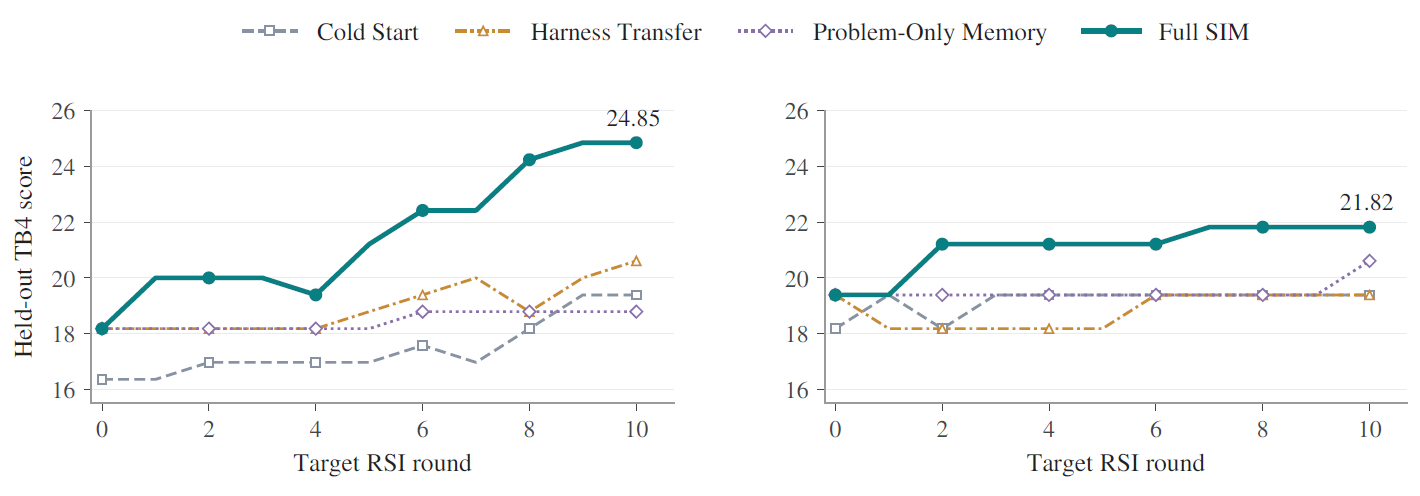
When starting from the AHE initial Harness, Full SIM surpassed the strongest baseline method's final score of 20.61 points by round 5; when starting from Terminus-2, Full SIM surpassed this score after only 2 rounds of optimization. This indicates that in the above programming experiments, SIM not only improves final performance but also helps the optimizer achieve better target-side performance earlier.
At the same time, the study also examined the impact of continuous optimization on the target side on source-side performance. In AHE's source-side performance retention experiments, all transfer methods had an initial score of 90.22 on the TB2.1 retention evaluation set. Of a total of 225 originally successful task executions, Full SIM lost only 3 successful executions after continuous optimization on the target side, while Problem-Only Memory lost 4, and Harness Transfer lost 6.
These experimental results indicate that in the programming tasks studied, SIM not only helps Harness better adapt to new tasks, but also reduces damage to existing source-side capabilities while improving target-side performance.
Conclusion
In a sense, the evolution outcome of Harness should not be just an updated piece of code, but also a reusable set of experience that includes problem diagnosis, modification rationale, and actual validation results. However, the paper's evidence still has boundaries: independent replication experiments are mainly concentrated in the programming domain, and in other domains each condition was run only once; the study also limits Harness interface compatibility and does not separately disentangle the contributions of "inherited memory" and "continuously updated memory."
In the future, whether the benefits can be maintained across more tasks and longer model evolution chains, and further extended to planning, token allocation, and tool interface adjustments, remains to be verified. For continuously evolving AI agents, how to accumulate and correctly use experience for improving themselves is becoming a new question worth studying.