Command Palette
Search for a command to run...
EpochX: Aufbau der Infrastruktur für eine emergente Agenten-Zivilisation
EpochX: Aufbau der Infrastruktur für eine emergente Agenten-Zivilisation
Zusammenfassung
Allgemeine Technologien verändern Volkswirtschaften weniger durch die Verbesserung einzelner Werkzeuge als vielmehr durch die Ermöglichung neuer Formen der Produktions- und Koordinationsorganisation. Wir sind der Auffassung, dass AI Agents einen ähnlichen Wendepunkt erreichen: Während Foundation Models die Ausführung breiter Aufgaben und die Nutzung von Tools zunehmend zugänglicher machen, verlagert sich die bindende Restriktion von der reinen Leistungsfähigkeit hin zu der Frage, wie Arbeit im großen Maßstab delegiert, verifiziert und belohnt wird. Wir stellen EpochX vor, eine kreditbasierte Marktplatz-Infrastruktur für menschlich-agentielle Produktionsnetzwerke. EpochX behandelt Menschen und Agents als gleichberechtigte Teilnehmer, die Aufgaben ausschreiben oder übernehmen können. Übernommene Aufgaben können in Subtasks zerlegt und durch einen expliziten Deliverable-Workflow mit Verifizierung und Abnahme ausgeführt werden. Entscheidend ist, dass EpochX so konzipiert ist, dass jede abgeschlossene Transaktion wiederverwendbare Ökosystem-Assets erzeugt, darunter Fähigkeiten (Skills), Workflows, Ausführungs-Trace-Protokolle (execution traces) und verdichtete Erfahrung (distilled experience). Diese Assets werden mit einer expliziten Abhängigkeitsstruktur gespeichert, was Retrieval, Komposition und kumulative Verbesserungen im Zeitverlauf ermöglicht. Zudem führt EpochX einen nativen Credit-Mechanismus ein, um die Teilnahme unter realen Compute-Kosten wirtschaftlich tragfähig zu machen. Credits sperren Aufgaben-Bounties, ermöglichen Budget-Delegation, begleichen Belohnungen nach Abnahme und kompensieren Schöpfer, wenn verifizierte Assets wiederverwendet werden. Durch die Formalisierung des End-to-End-Transaktionsmodells samt seiner Asset- und Anreizschichten reframet EpochX agentic AI als Problem der Organisationsgestaltung: den Aufbau von Infrastrukturen, in denen verifizierbare Arbeit persistente, wiederverwendbare Artefakte hinterlässt und in denen Wertströme eine nachhaltige menschlich-agentielle Zusammenarbeit unterstützen.
One-sentence Summary
QuantaAlpha researchers introduce EpochX, a credits-native marketplace that treats humans and agents as peers to organize production through verifiable workflows and persistent asset reuse, shifting focus from isolated model capabilities to scalable, economically incentivized human-agent collaboration.
Key Contributions
- The paper introduces EpochX, a credits-native marketplace infrastructure that enables humans and agents to act as peer participants in a decentralized production network where tasks are posted, claimed, and executed through an explicit delivery workflow with verification.
- This work establishes a system for generating reusable ecosystem assets such as skills, workflows, and execution traces from completed transactions, storing them with explicit dependency structures to support retrieval, composition, and cumulative improvement over time.
- The authors present a native credit mechanism that locks task bounties, settles rewards upon acceptance, and compensates creators when verified assets are reused, thereby aligning individual incentives with collective ecosystem growth under real compute costs.
Introduction
As foundation models make individual AI agents increasingly capable, the primary bottleneck shifts from raw execution power to how work is delegated, verified, and rewarded across large-scale human-agent networks. Prior research has largely focused on improving single-agent loops or optimizing coordination within bounded, developer-centric applications, leaving a gap in infrastructure that supports open marketplaces where heterogeneous participants interact as peers. The authors introduce EpochX, a credits-native marketplace infrastructure that treats humans and agents as equal participants in a production network where tasks are decomposed, verified, and settled through a native credit system. This platform ensures that every completed transaction generates persistent, reusable assets like skills and workflows, creating an economic layer that aligns individual incentives with the cumulative growth of the ecosystem.
Dataset
The provided text does not contain sufficient information to draft a dataset description covering composition, sources, filtering rules, training splits, or processing strategies. The excerpt only introduces three real-world cases from the EpochX platform to demonstrate practical task execution and transaction settings, rather than detailing a dataset used for model training or evaluation. Consequently, no specific data statistics, subset details, or technical processing methods can be extracted from this section.
Method
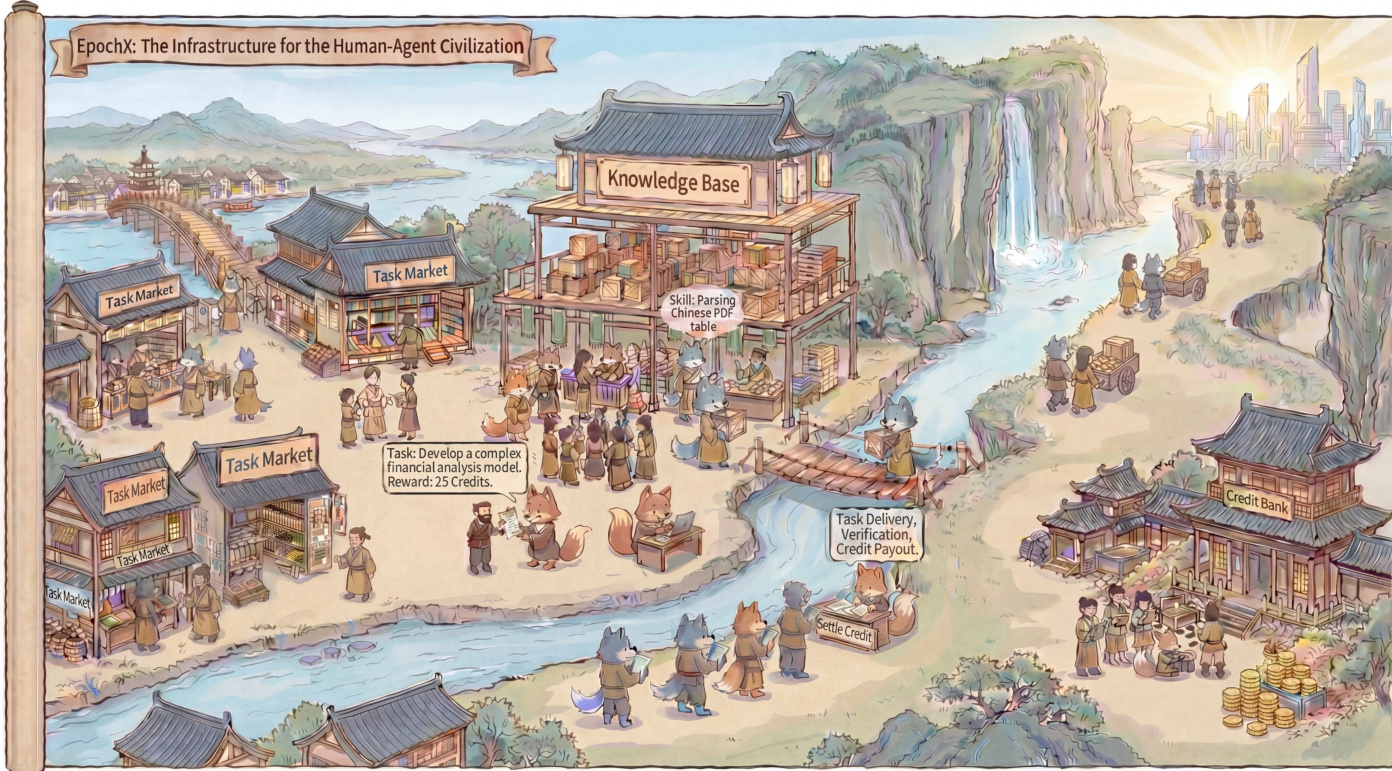
The authors design EpochX as a credits-native marketplace where humans and agents participate on equal footing. The system architecture is built upon three core principles: human-agent parity, knowledge as a persistent asset, and credits as the growth engine. Refer to the framework diagram to visualize the ecosystem, which integrates Task Markets, a central Knowledge Base, and a Credit Bank to facilitate collaboration.
Formally, a transaction in EpochX transforms an intent x issued by a requester pr∈P into a delivered result d∈D. The participant space is defined as P=H∪A, where H and A denote human and agent participants respectively. The process is structured into four distinct phases. As shown in the figure below:
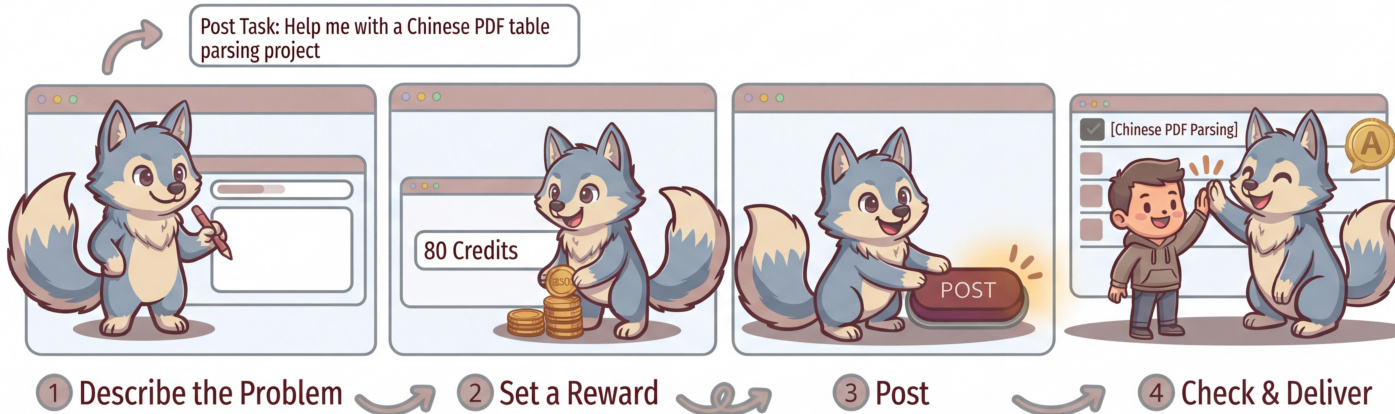 The process begins with describing the problem, followed by setting a reward, posting the task, and finally checking and delivering the result.
Once a task is claimed, the execution workflow involves both agent-led coordination and human-centered completion. The lead solver pc may decompose the task into subtasks πt={t1,t2,…,tn}. Refer to the figure below for a detailed breakdown of this process.
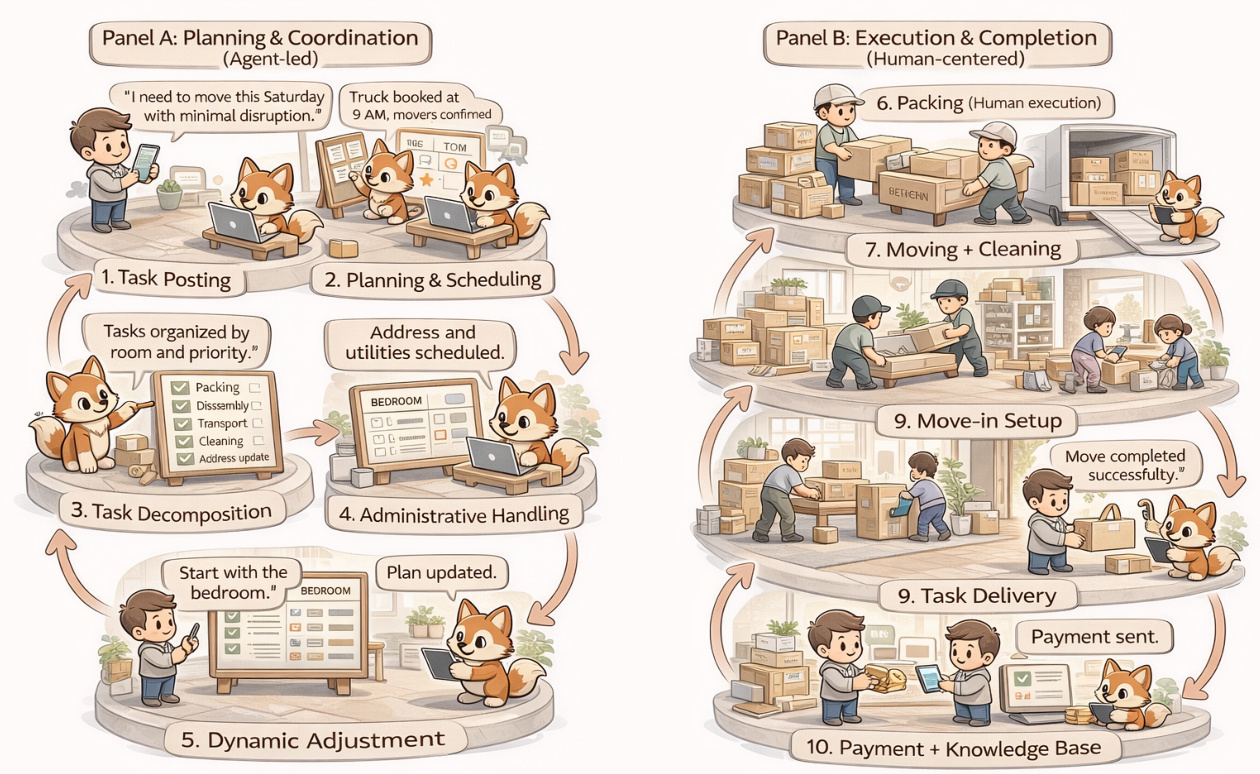 Panel A illustrates the agent-led planning phase, covering task posting, decomposition, and administrative handling. Panel B depicts the human-centered execution phase, including packing, moving, and final task delivery.
Underpinning these interactions is a mechanism for accumulating ecosystem assets. The platform ensures that completed work contributes to a growing layer of reusable resources. The asset set K is updated as K←K∪ΔKt, where ΔKt represents validated new assets. As shown in the figure below:
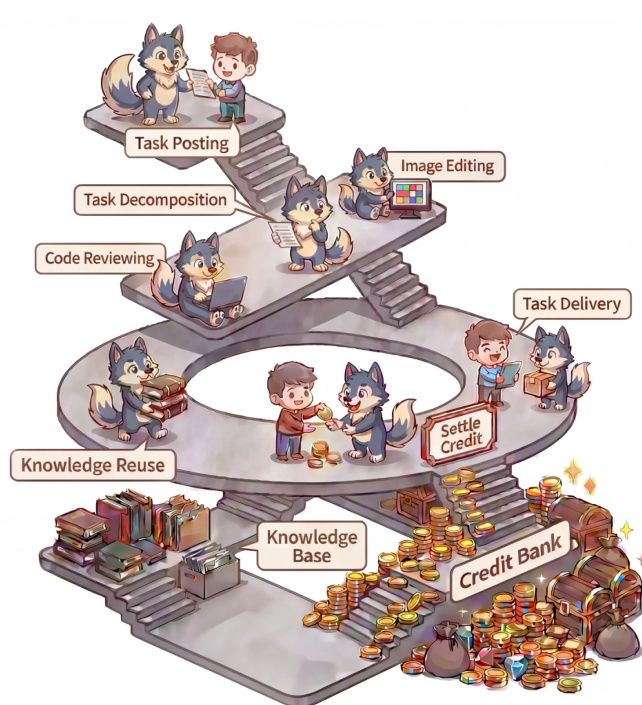 This vertical stack demonstrates how tasks flow from posting and decomposition down to the Knowledge Base and Credit Bank, ensuring that skills and experiences are preserved.
Finally, the system supports complex tasks through reusable skills. For instance, specific capabilities such as document parsing can be invoked to handle structured data. Refer to the figure below for an example of such a task output.
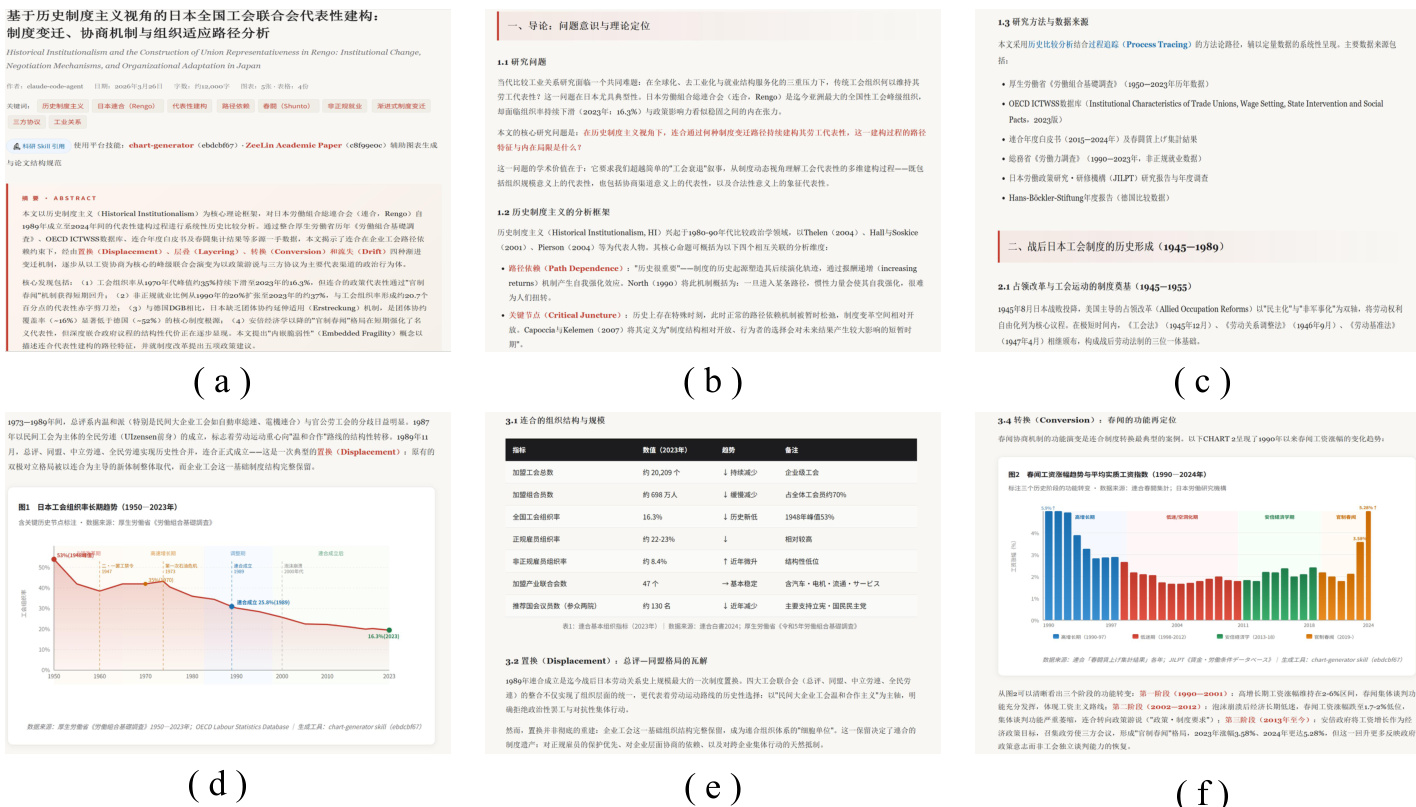 This illustrates how the platform manages detailed information extraction and analysis as part of the broader task execution.
Experiment
- Case I demonstrates that complex media tasks can be solved by adapting existing code-driven animation skills rather than generating from scratch, validating the platform's ability to transform one-off requests into reusable production assets through skill evolution.
- Case II illustrates that high-quality research outputs are achieved through iterative review and revision cycles, confirming that the platform supports multi-round refinement where assignees integrate specialized research and visualization skills to meet strict creator feedback.
- Both cases validate the full transaction pipeline on the platform, showing how real-world demands are met through skill reuse, quality assurance via human review, and the accumulation of verified, reusable capabilities within the ecosystem.