Command Palette
Search for a command to run...
Die Entmystifizierung von Video Reasoning
Die Entmystifizierung von Video Reasoning
Zusammenfassung
Jüngste Fortschritte im Bereich der Videogenerierung haben ein unerwartetes Phänomen offenbart: Diffusionsbasierte Videomodelle weisen nicht-triviale Schlussfolgerungsfähigkeiten auf. Frühere Arbeiten führen dies auf einen Chain-of-Frames (CoF)-Mechanismus zurück, bei dem angenommen wird, dass Schlussfolgerungen sequenziell über die Videoframes hinweg entfaltet werden. In dieser Arbeit stellen wir diese Annahme in Frage und enthüllen einen grundlegend anderen Mechanismus. Wir zeigen, dass Schlussfolgerungen in Videomodellen vielmehr primär entlang der Diffusions-Denoising-Schritte entstehen. Durch qualitative Analysen und gezielte Probing-Experimente stellen wir fest, dass Modelle in frühen Denoising-Schritten mehrere Kandidatenlösungen explorieren und schrittweise zu einer finalen Antwort konvergieren – einen Prozess, den wir als Chain-of-Steps (CoS) bezeichnen.Über diesen Kernmechanismus hinaus identifizieren wir mehrere emergente Schlussfolgerungsverhalten, die für die Modellleistung entscheidend sind: (1) Arbeitsgedächtnis, das eine persistente Referenzierung ermöglicht; (2) Selbstkorrektur und -verbesserung, die eine Erholung von fehlerhaften Zwischenergebnissen erlauben; sowie (3) „Wahrnehmung vor Aktion", bei der frühe Schritte semantische Verankerung herstellen und spätere Schritte strukturierte Manipulationen durchführen. Innerhalb eines einzelnen Diffusionsschritts entdecken wir zudem eine selbstentwickelte funktionale Spezialisierung in Diffusion Transformers: Frühe Schichten kodieren dichte perzeptive Strukturen, mittlere Schichten führen Schlussfolgerungen aus, und spätere Schichten konsolidieren latente Repräsentationen.Motiviert durch diese Erkenntnisse stellen wir eine einfache, trainingsfreie Strategie als Proof-of-Concept vor, die demonstriert, wie sich die Schlussfolgerungsfähigkeit durch das Ensembling latenter Trajektorien identischer Modelle mit unterschiedlichen Random Seeds verbessern lässt. Insgesamt liefert unsere Arbeit ein systematisches Verständnis dafür, wie Schlussfolgerungen in Videogenerierungsmodellen entstehen, und bildet eine Grundlage, um zukünftige Forschungsarbeiten bei der besseren Ausnutzung der inhärenten Schlussfolgerungsdynamik von Videomodellen als neuem Substrat für Intelligenz zu leiten.
One-sentence Summary
Researchers from SenseTime Research and Nanyang Technological University propose that video reasoning emerges via a Chain-of-Steps mechanism during diffusion denoising rather than across frames. This discovery reveals emergent behaviors like self-correction and enables a training-free strategy to enhance reasoning by ensembling latent trajectories.
Key Contributions
- The paper introduces the Chain-of-Steps (CoS) mechanism, demonstrating that reasoning in diffusion-based video models unfolds along denoising steps rather than across frames, where models explore multiple candidate solutions early and progressively converge to a final answer.
- This work identifies three emergent reasoning behaviors critical to performance: working memory for persistent reference, self-correction capabilities to recover from intermediate errors, and a perception-before-action dynamic where early steps establish semantic grounding before later steps perform manipulation.
- A training-free inference strategy is presented that improves reasoning by ensembling latent trajectories from identical models with different random seeds, with experiments showing this approach retains diverse reasoning paths and increases the likelihood of converging to correct solutions.
Introduction
Diffusion-based video models have recently demonstrated unexpected reasoning capabilities in spatiotemporally consistent environments, offering a new substrate for machine intelligence beyond static images and text. Prior research incorrectly attributed this ability to a Chain-of-Frames mechanism where reasoning unfolds sequentially across video frames, leaving the true internal dynamics largely unexplored. The authors challenge this assumption by revealing that reasoning primarily emerges along the diffusion denoising steps, a process they term Chain-of-Steps. They identify critical emergent behaviors such as working memory, self-correction, and functional layer specialization within the model architecture. Leveraging these insights, the team introduces a simple training-free strategy that ensembles latent trajectories from multiple model runs to improve reasoning performance by preserving diverse candidate solutions during generation.
Method
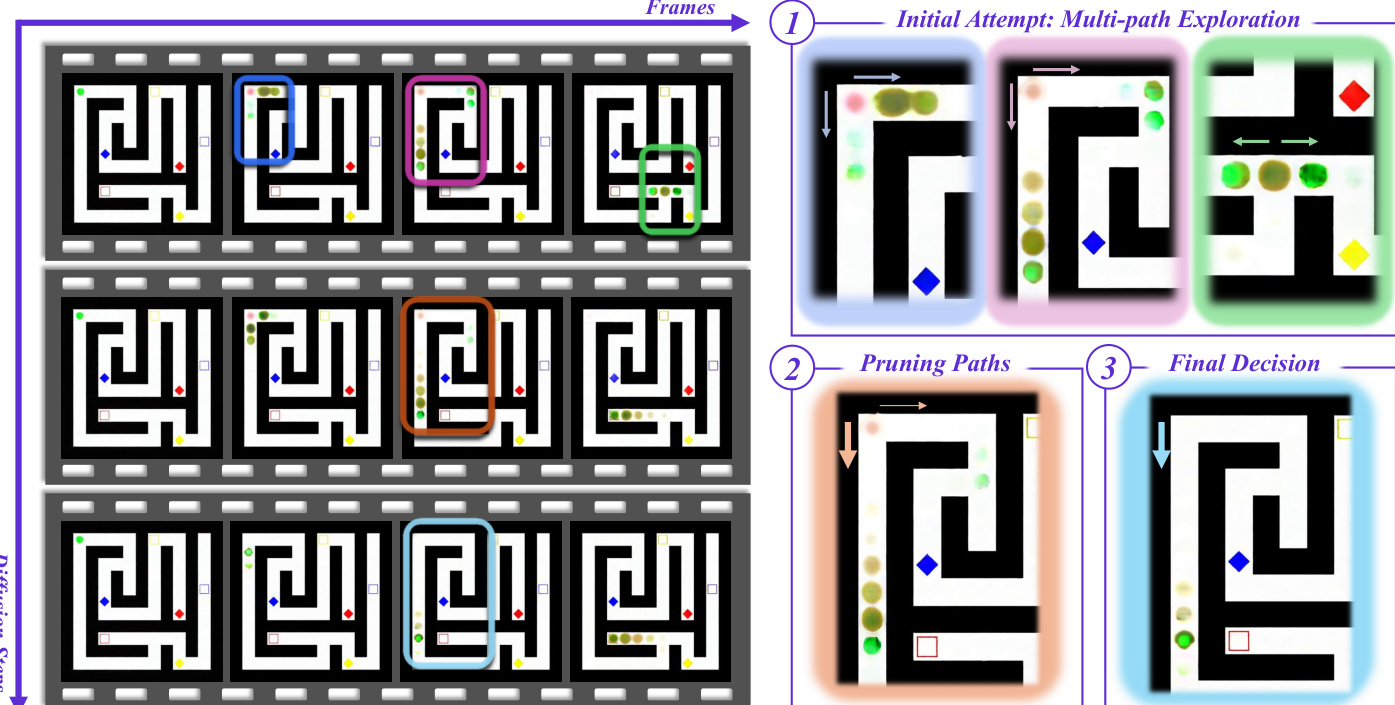
The proposed framework is built upon VBVR-Wan2.2, a video reasoning model finetuned from the Wan2.2-I2V-A14B architecture using flow matching. The core mechanism treats the diffusion denoising process as a primary axis for reasoning. The model learns a velocity field vθ(xs,s,c) conditioned on a prompt c, guiding the latent xs along a continuous transport path defined by xs=(1−s)x0+sx1, where x0 is the clean latent and x1 is noise. By estimating the clean latent at each step via x^0=xs−σs⋅vθ(xs,s,c), the system visualizes the evolution of semantic decisions. This analysis reveals that early diffusion steps function as a high-level heuristic search where the model populates the latent workspace with multiple hypotheses, while later steps prune suboptimal trajectories to converge on a solution.
Refer to the framework diagram for a visualization of this multi-path exploration and subsequent pruning in a maze-solving task.
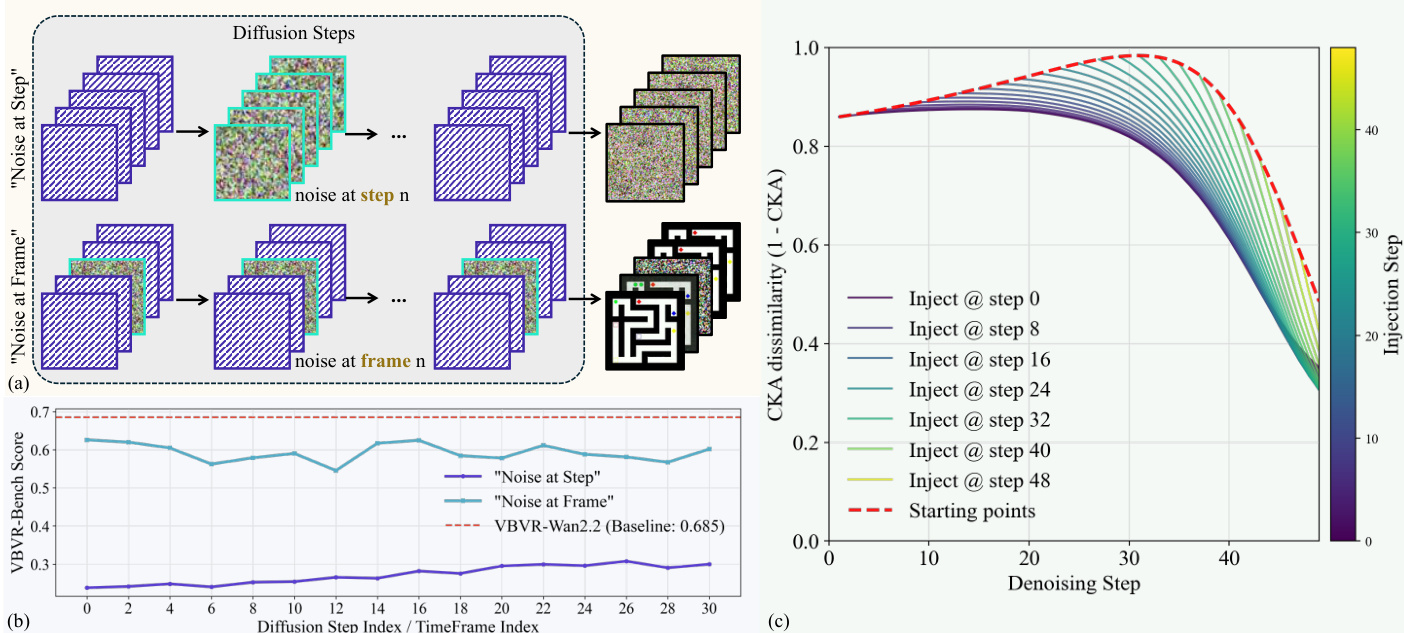
The study further analyzes the impact of noise injection strategies on the reasoning trajectory, comparing noise at specific diffusion steps versus frames.
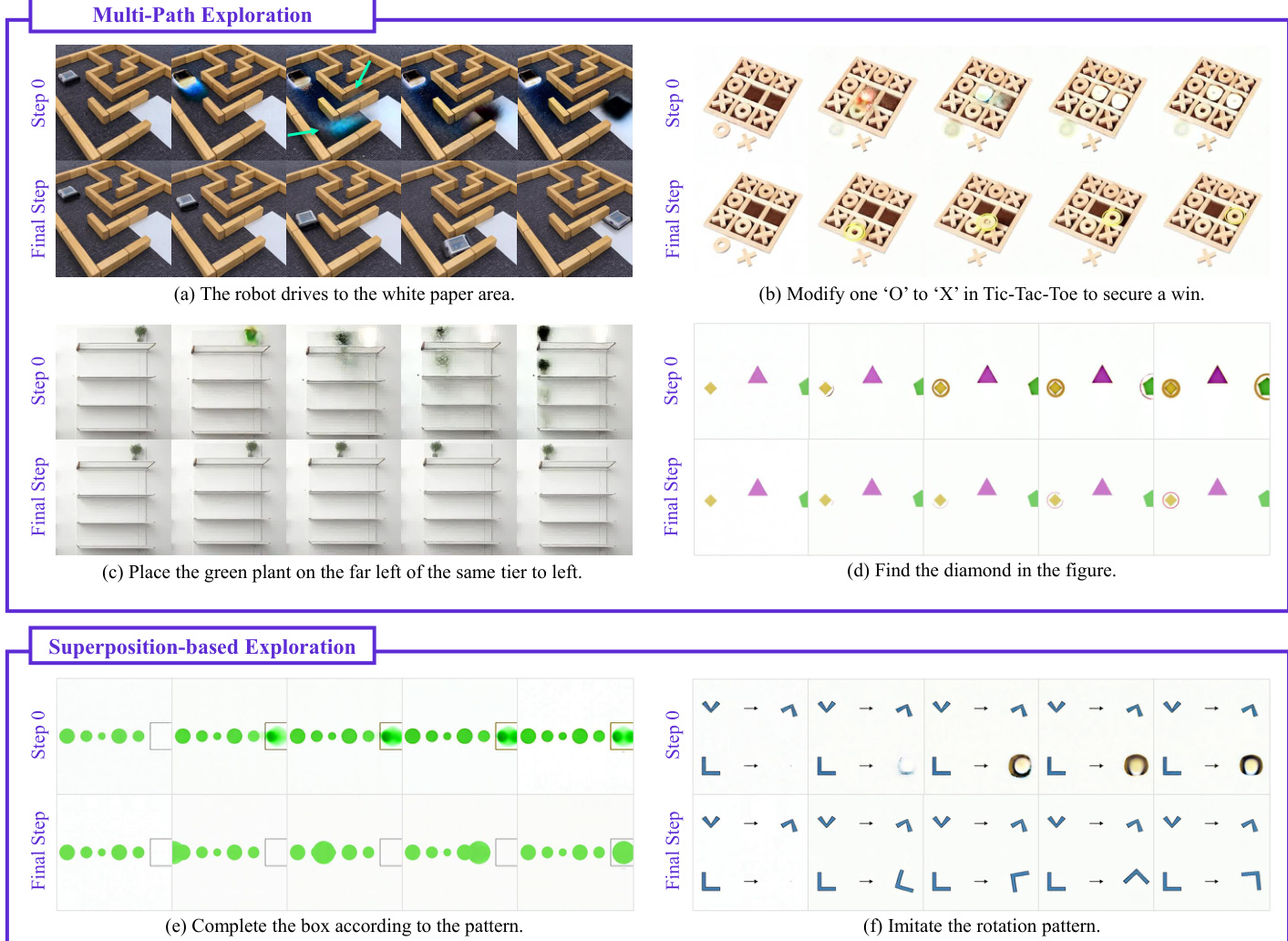
Two distinct modes of step-wise reasoning are identified: Multi-path Exploration, where parallel possibilities are spawned, and Superposition-based Exploration, where patterns are completed through overlapping states.
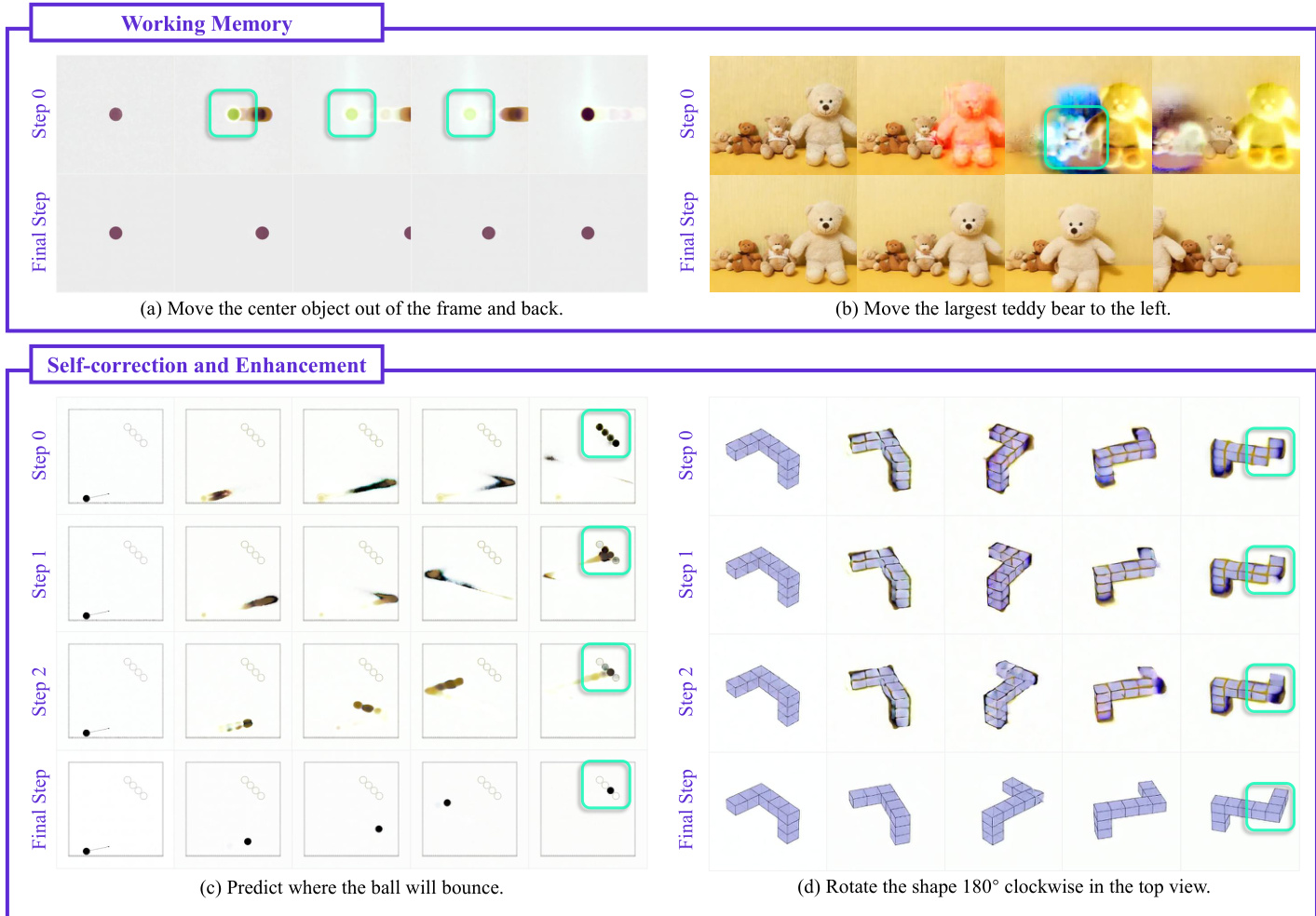
The architecture exhibits emergent reasoning behaviors critical for complex tasks, including working memory to retain essential information and self-correction to refine intermediate hypotheses.
To stabilize these reasoning trajectories, a training-free ensemble strategy is implemented. This method exploits the shared probabilistic bias in the reasoning manifold by executing multiple independent forward passes with different initial noise seeds. During the critical early diffusion steps, hidden representations from the mid-layers (specifically layers 20 to 29) are extracted and spatially-temporally averaged. This latent-space ensemble filters out seed-specific noise and steers the probability distribution toward a more stable state.
Experiment
- Chain-of-Steps analysis validates that video reasoning occurs across diffusion denoising steps rather than frame-by-frame, with models exploring multiple solution paths in parallel before converging to a final outcome.
- Noise perturbation experiments confirm that disrupting specific diffusion steps severely degrades performance, whereas corrupting individual frames is more easily recovered, proving that the reasoning trajectory is highly sensitive to step-wise information flow.
- Layer-wise mechanistic analysis reveals a hierarchical processing structure where early transformer layers focus on global background context, while middle and later layers concentrate on foreground objects and execute critical logical reasoning.
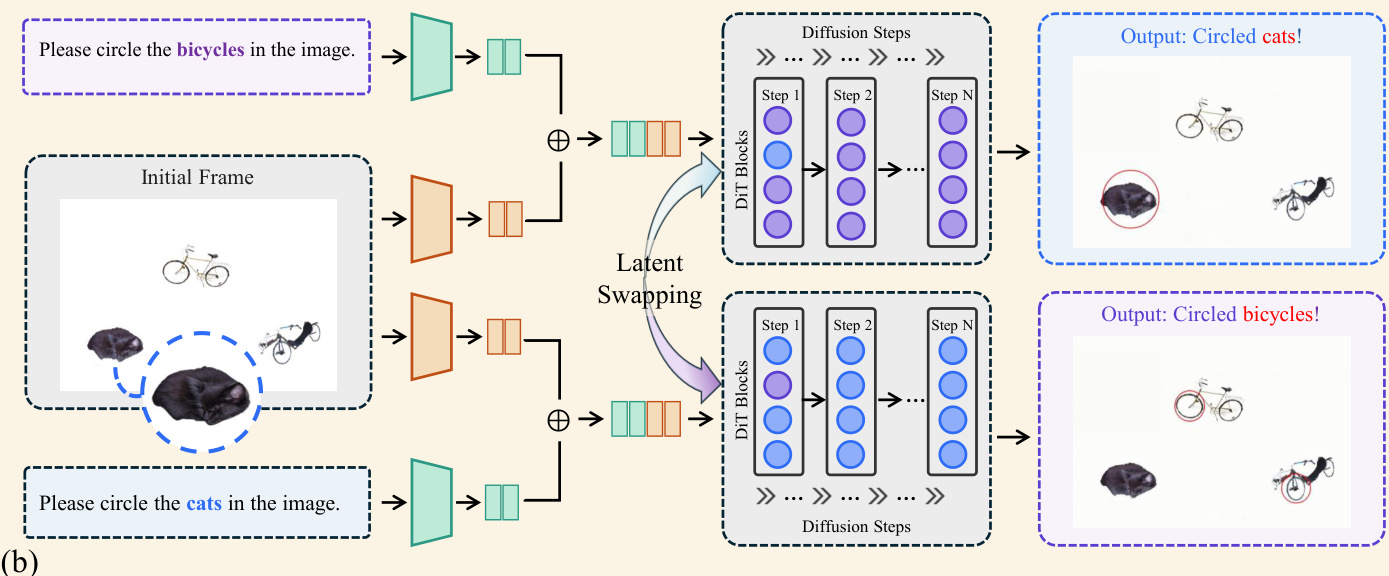
- Latent swapping experiments demonstrate that middle layers encode semantically decisive information, as altering representations at these specific depths directly reverses the final inference results.
- Investigations into frame counts and model distillation show that while reasoning is not strictly frame-dependent, maintaining a minimum number of frames is essential for spatiotemporal coherence, and aggressive step compression in distilled models can collapse the latent exploration phase required for effective reasoning.
- Qualitative observations identify emergent behaviors such as working memory for preserving object states, self-correction mechanisms that refine incorrect initial hypotheses, and a "perception before action" transition where static grounding precedes dynamic motion planning.