Command Palette
Search for a command to run...
IndexCache: Beschleunigung von Sparse Attention durch Wiederverwendung von Cross-Layer-Indizes
IndexCache: Beschleunigung von Sparse Attention durch Wiederverwendung von Cross-Layer-Indizes
Yushi Bai Qian Dong Ting Jiang Xin Lv Zhengxiao Du Aohan Zeng Jie Tang Juanzi Li
Zusammenfassung
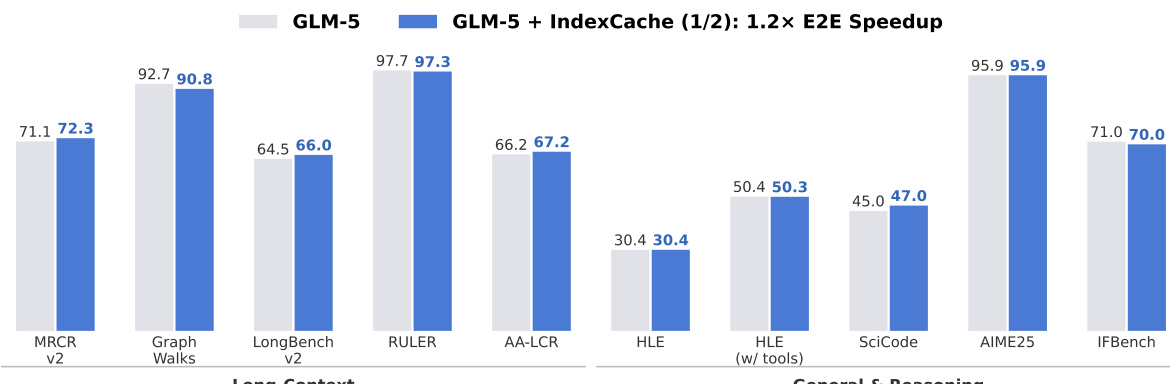
Lange Kontexte mit agentenbasierten Workflows haben sich als ein entscheidender Anwendungsfall für große Sprachmodelle (Large Language Models, LLMs) etabliert, wodurch die Effizienz von Aufmerksamkeitsmechanismen (Attention) sowohl für die Inferenzgeschwindigkeit als auch für die Betriebskosten von zentraler Bedeutung ist. Sparse Attention adressiert diese Herausforderung effektiv. DeepSeek Sparse Attention (DSA) stellt dabei eine repräsentative, produktionsreife Lösung dar: Ein leichter „Lightning-Indexer" selektiert pro Anfrage die Top-k relevantesten Token und reduziert die Komplexität der Kern-Aufmerksamkeit von O(L2) auf O(Lk). Der Indexer selbst behält jedoch weiterhin eine Komplexität von O(L2) bei und muss in jeder Schicht unabhängig ausgeführt werden, obwohl die resultierenden Top-k-Auswahlen über aufeinanderfolgende Schichten hinweg hochgradig ähnlich sind.Wir stellen IndexCache vor, das diese redundante Schicht-übergreifende Information nutzt, indem es die Schichten in eine kleine Menge von „Full-Layers" unterteilt, die ihre eigenen Indexer ausführen, und einer Mehrheit von „Shared-Layers", die lediglich die Top-k-Indizes der nächstgelegenen Full-Layer wiederverwenden. Wir schlagen zwei komplementäre Ansätze zur Bestimmung und Optimierung dieser Konfiguration vor. Der trainingsfreie IndexCache wendet einen Greedy-Suchalgorithmus an, der entscheidet, welche Schichten Indexer beibehalten sollen, indem er direkt den Sprachmodellierungsverlust (Language Modeling Loss) auf einem Kalibrierungsdatensatz minimiert, ohne dass Gewichtsaktualisierungen erforderlich sind. Der trainingsbewusste IndexCache führt einen Multi-Layer-Distillationsverlust ein, der jeden beibehaltenen Indexer gegen die durchschnittlichen Aufmerksamkeitsverteilungen aller von ihm bedienten Schichten trainiert. Dies ermöglicht es, selbst bei einfachen verschachtelten Mustern die Genauigkeit eines vollständigen Indexers zu erreichen.Experimentelle Ergebnisse an einem 30-Milliarden-Parameter-DSA-Modell zeigen, dass IndexCache 75 % der Berechnungen des Indexers eliminieren kann, wobei die Qualitätsverluste vernachlässigbar bleiben. Im Vergleich zum Standard-DSA wird eine Vorverarbeitungsbeschleunigung (Prefill Speedup) von bis zu 1,82-fach und eine Dekodierungsbeschleunigung (Decode Speedup) von bis zu 1,48-fach erzielt. Diese positiven Ergebnisse werden zudem durch unsere vorläufigen Experimente am produktionsreifen GLM-5-Modell (Abbildung 1) bestätigt.
One-sentence Summary
Researchers from Tsinghua University and Z.ai introduce IndexCache, a technique that optimizes DeepSeek Sparse Attention by exploiting cross-layer redundancy to share token indices. This approach eliminates up to 75% of indexer computations in long-context workflows, delivering significant inference speedups without requiring model retraining or degrading output quality.
Key Contributions
- Long-context agentic workflows rely on DeepSeek Sparse Attention to reduce core attention complexity, yet the required lightning indexer still incurs quadratic O(L2) cost at every layer, creating a significant bottleneck for inference speed and serving costs.
- IndexCache addresses this redundancy by partitioning layers into Full layers that compute indices and Shared layers that reuse the nearest Full layer's top-k selections, utilizing either a training-free greedy search or a training-aware multi-layer distillation loss to optimize the configuration.
- Experiments on a 30B DSA model demonstrate that IndexCache removes 75% of indexer computations with negligible quality degradation, achieving up to 1.82x prefetch and 1.48x decode speedups while maintaining performance across nine long-context and reasoning benchmarks.
Introduction
Large language models face a critical bottleneck in long-context inference due to the quadratic complexity of self-attention, which sparse mechanisms like DeepSeek Sparse Attention (DSA) address by selecting only the most relevant tokens. While DSA reduces core attention costs, its reliance on a lightweight indexer at every layer still incurs quadratic overhead that dominates latency during the prefill stage. The authors leverage the observation that token selection patterns remain highly stable across consecutive layers to introduce IndexCache, a method that eliminates up to 75% of indexer computations by reusing indices from a small subset of retained layers. They propose both a training-free approach using greedy layer selection and a training-aware strategy with multi-layer distillation to maintain model quality while achieving significant speedups in long-context scenarios.
Method
The authors leverage the observation that sparse attention indexers exhibit significant redundancy across consecutive layers to reduce computational overhead. In standard DeepSeek Sparse Attention, a lightweight lightning indexer scores all preceding tokens at every layer to select the top-k positions. While this reduces core attention complexity from O(L2) to O(Lk), the indexer itself retains O(L2) complexity. IndexCache addresses this by partitioning the N transformer layers into two categories: Full layers and Shared layers. Full layers retain their indexers to compute fresh top-k sets, while Shared layers skip the indexer forward pass and reuse the index set from the nearest preceding Full layer. This design allows the system to eliminate a large fraction of the total indexer cost with minimal architectural changes.
To determine the optimal configuration of Full and Shared layers without retraining, the authors propose a training-free greedy search algorithm. The process begins with all layers designated as Full. The algorithm iteratively evaluates the language modeling loss on a calibration set for each candidate layer conversion. At each step, the layer whose conversion to Shared status results in the lowest loss increase is selected. This data-driven approach identifies which indexers are expendable based on their intrinsic importance to the model's performance rather than relying on uniform interleaving patterns.
For models trained from scratch or via continued pre-training, a training-aware approach further optimizes the indexer parameters for cross-layer sharing. Standard training distills the indexer against the attention distribution of its own layer. IndexCache generalizes this by introducing a multi-layer distillation loss. This objective encourages the retained indexer to predict a top-k set that is jointly useful for itself and all subsequent Shared layers it serves. The loss function is defined as:
LmultiI=j=0∑mm+11t∑DKL(pt(ℓ+j)qt(ℓ)),where pt(ℓ+j) represents the aggregated attention distribution at layer ℓ+j and qt(ℓ) is the indexer's output distribution. Theoretical analysis shows that this multi-layer loss produces gradients equivalent to distilling against the averaged attention distribution of all served layers. This ensures the indexer learns a consensus top-k selection that covers important tokens across the entire group of layers.
Experimental evaluations on a 30B parameter model demonstrate the efficiency gains achieved by removing indexer computations. The method successfully eliminates up to 75% of indexer costs while maintaining comparable quality. Performance metrics regarding prefill time and decode throughput are summarized below.
The results confirm that IndexCache delivers significant speedups in both prefill and decode phases without degrading model capabilities.
Experiment
- End-to-end inference experiments demonstrate that IndexCache significantly accelerates both prefill latency and decode throughput for long-context scenarios, with speedups increasing as context length grows, while maintaining comparable performance on general reasoning tasks.
- Training-free IndexCache evaluations reveal that greedy-searched sharing patterns are essential for preserving long-context accuracy at aggressive retention ratios, whereas uniform interleaving causes substantial degradation; however, general reasoning capabilities remain robust across most configurations.
- Training-aware IndexCache results show that retraining the model to adapt to index sharing eliminates the sensitivity to specific patterns, allowing simple uniform interleaving to match full-indexer performance and confirming the effectiveness of cross-layer distillation.
- Scaling experiments on a 744B-parameter model validate that the trends observed in smaller models hold true, with searched patterns providing stable quality recovery even at high sparsity levels.
- Analysis of cross-layer index overlap confirms high redundancy between adjacent layers but reveals that local similarity metrics fail to identify optimal sharing patterns, necessitating end-to-end loss-based search to prevent cascading errors in deep networks.