Command Palette
Search for a command to run...
ReMix: Verstärkungsbasiertes Routing für Mixturen von LoRAs beim Fine-Tuning von LLMs
ReMix: Verstärkungsbasiertes Routing für Mixturen von LoRAs beim Fine-Tuning von LLMs
Zusammenfassung
Low-Rank-Adapter (LoRA) stellen eine parameter-effiziente Feinabstimmungstechnik dar, bei der trainierbare niedrigrangige Matrizen in vortrainierte Modelle injiziert werden, um diese an neue Aufgaben anzupassen. Mixture-of-LoRAs-Modelle erweitern neuronale Netze effizient, indem sie den Eingabevektor jeder Schicht auf eine kleine Teilmenge spezialisierter LoRAs dieser Schicht routen. Bestehende Router für Mixture-of-LoRAs weisen jedem LoRA ein gelerntes Routing-Gewicht zu, um ein durchgängiges Training des Routers zu ermöglichen. Trotz ihrer empirischen Versprechen beobachten wir, dass die Routing-Gewichte in der Praxis typischerweise extrem unausgewogen über die LoRAs verteilt sind, wobei häufig nur ein oder zwei LoRAs die Routing-Gewichte dominieren. Dies begrenzt im Wesentlichen die Anzahl der wirksamen LoRAs und behindert somit erheblich die Ausdruckskraft bestehender Mixture-of-LoRAs-Modelle. In dieser Arbeit führen wir diese Schwäche auf die Natur lernbarer Routing-Gewichte zurück und überdenken das grundlegende Design des Routers. Um dieses kritische Problem zu adressieren, schlagen wir einen neuen Router vor, den wir „Reinforcement Routing for Mixture-of-LoRAs" (ReMix) nennen. Unser Kernkonzept besteht darin, nicht-lernbare Routing-Gewichte zu verwenden, um sicherzustellen, dass alle aktiven LoRAs gleich wirksam sind, ohne dass ein LoRA die Routing-Gewichte dominiert. Da unsere Router aufgrund der nicht-lernbaren Routing-Gewichte nicht direkt mittels Gradientenabstieg trainiert werden können, schlagen wir zudem einen unverzerrten Gradientenschätzer für den Router vor, der die Reinforce Leave-One-Out (RLOO)-Methode nutzt. Dabei betrachten wir den Überwachungsverlust als Belohnung und den Router als Policy im Rahmen des Reinforcement Learning. Unser Gradientenschätzer ermöglicht zudem eine Skalierung der Trainingsrechenleistung, um die Vorhersageleistung unseres ReMix zu steigern. Umfangreiche Experimente belegen, dass unser vorgeschlagener ReMix unter vergleichbarer Anzahl aktivierter Parameter deutlich besser abschneidet als die aktuell fortschrittlichsten parameter-effizienten Feinabstimmungsmethoden.
One-sentence Summary
Researchers from the University of Illinois Urbana-Champaign and Meta AI propose ReMix, a novel Mixture-of-LoRAs framework that replaces learnable routing weights with non-learnable ones to prevent router collapse. By employing an unbiased gradient estimator and RLOO technique, ReMix ensures all active adapters contribute equally, significantly outperforming existing parameter-efficient finetuning methods.
Key Contributions
- Existing Mixture-of-LoRAs models suffer from routing weight collapse where learned weights often concentrate on a single adapter, effectively wasting the computation of other activated LoRAs and limiting the model's expressive power.
- The authors propose ReMix, a novel router design that enforces constant non-learnable weights across all active LoRAs to ensure equal contribution and prevent any single adapter from dominating the routing process.
- To enable training with these non-differentiable weights, the paper introduces an unbiased gradient estimator using the reinforce leave-one-out technique, which allows ReMix to significantly outperform state-of-the-art methods across diverse benchmarks under strict parameter budgets.
Introduction
Low-rank adapters (LoRAs) enable efficient fine-tuning of large language models by injecting trainable matrices into frozen weights, while Mixture-of-LoRAs architectures aim to further boost capacity by routing inputs to specialized subsets of these adapters. However, existing approaches that rely on learned routing weights suffer from a critical flaw where weights collapse to a single dominant LoRA, effectively wasting the computational resources of the other active adapters and limiting the model's expressive power. To resolve this, the authors introduce ReMix, a reinforcement routing framework that enforces equal contribution from all active LoRAs by using non-learnable constant weights and training the router via an unbiased gradient estimator based on the REINFORCE leave-one-out technique.
Method
The authors propose ReMix, a reinforcement routing method for Mixture-of-LoRAs designed to mitigate routing weight collapse. The method fundamentally alters the adapter architecture and training procedure to ensure diverse LoRA utilization.
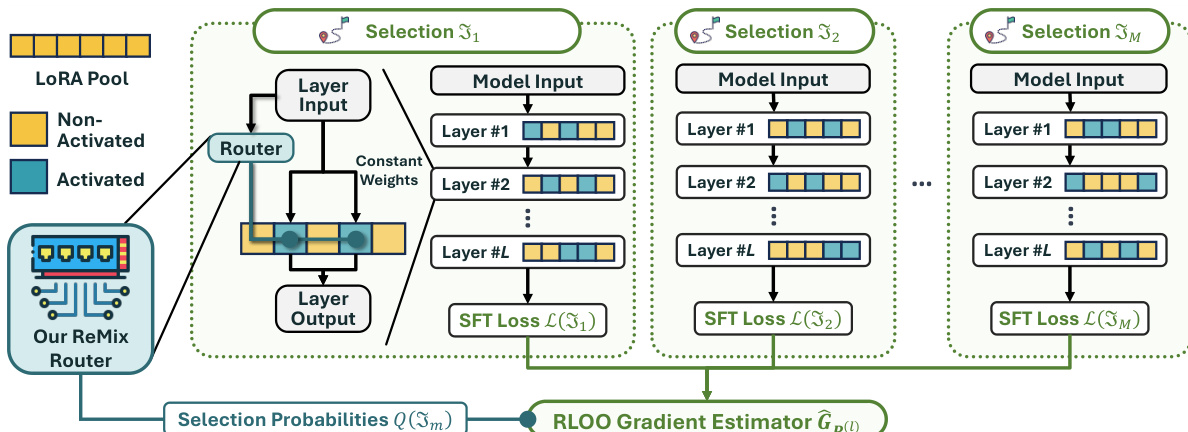
In the adapter architecture, the router computes a categorical distribution q(l) over the available LoRAs for a given layer input. Instead of using these probabilities as continuous weights, the model selects a subset of k LoRAs. Crucially, the routing weights for these activated LoRAs are set to a constant value ω, while non-activated LoRAs receive zero weight. This design guarantees that the effective support size remains fixed at k, preventing the router from concentrating probability mass on a single LoRA. The layer output is then computed as the sum of the frozen model output and the weighted contributions of the selected LoRAs.
To train the router parameters, the authors address the non-differentiability of the discrete selection process by framing it as a reinforcement learning problem. The SFT loss serves as the negative reward signal. During finetuning, the model samples M distinct selections of LoRA subsets. For each selection, the SFT loss is calculated. These losses are then used to estimate the gradient for the router parameters via the RLOO gradient estimator. This estimator leverages the variance reduction technique of using the average loss across samples as a baseline. The gradient estimator is defined as: GP(l):=M−11∑m=1M(L(Jm)−L)∇P(l)logQ(Jm) where L represents the average SFT loss across the M selections.
As shown in the figure below, the framework visualizes the ReMix architecture where the router generates selection probabilities that guide the activation of specific LoRA pools across multiple layers. The process involves generating multiple selections, computing the SFT loss for each, and aggregating these signals through the RLOO gradient estimator to update the router.
During inference, the authors employ a top-k selection strategy. Theoretical analysis shows that if the router is sufficiently trained, selecting the k LoRAs with the highest probabilities guarantees the optimal subset. This deterministic approach improves upon random sampling used during training.
Experiment
- Analysis of existing Mixture-of-LoRAs methods reveals a critical routing weight collapse where only one LoRA dominates per layer, severely limiting model expressivity and rendering other LoRAs ineffective.
- The proposed ReMix method consistently outperforms various baselines across mathematical reasoning, code generation, and knowledge recall tasks while maintaining superior parameter efficiency.
- Comparisons with single rank-kr LoRA demonstrate that ReMix successfully activates diverse LoRA subsets rather than relying on a fixed subset, validating its ability to leverage mixture capacity.
- Ablation studies confirm that both the RLOO training algorithm and top-k selection mechanism are essential components for achieving peak performance.
- Experiments show that ReMix benefits from scaling the number of activated LoRAs and increasing training compute via sampled selections, unlike deterministic baselines which cannot utilize additional compute resources.
- The method exhibits robustness to different routing weight initialization schemes, maintaining stable performance regardless of the specific weight configuration used.