Command Palette
Search for a command to run...
ArtHOI: Synthese artikulierter Mensch-Objekt-Interaktionen durch 4D-Rekonstruktion auf Basis von Video-Priors
ArtHOI: Synthese artikulierter Mensch-Objekt-Interaktionen durch 4D-Rekonstruktion auf Basis von Video-Priors
Zihao Huang Tianqi Liu Zhaoxi Chen Shaocong Xu Saining Zhang Lixing Xiao Zhiguo Cao Wei Li Hao Zhao Ziwei Liu
Zusammenfassung
Die Synthese physikalisch plausibler, artikulierter Mensch-Objekt-Interaktionen (HOI) ohne 3D- oder 4D-Überwachung bleibt eine grundlegende Herausforderung. Obwohl neuartige Zero-Shot-Ansätze Video-Diffusionsmodelle nutzen, um Mensch-Objekt-Interaktionen zu generieren, beschränken sich diese weitgehend auf die Manipulation starrer Objekte und verfügen nicht über eine explizite 4D-geometrische Schlussfolgerung. Um diese Lücke zu schließen, formulieren wir die Synthese artikulierter HOI als ein 4D-Rekonstruktionsproblem unter Nutzung monokularer Videopriors: Ausgehend ausschließlich von einem durch ein Diffusionsmodell generierten Video rekonstruieren wir eine vollständige 4D-artikulierte Szene ohne jegliche 3D-Überwachung. Dieser rekonstruktionsbasierte Ansatz behandelt das generierte 2D-Video als Überwachungsdaten für ein inverses Rendering-Problem und ermöglicht die Wiederherstellung geometrisch konsistenter und physikalisch plausibler 4D-Szenen, die natürliche Kontaktbedingungen, Artikulation sowie zeitliche Kohärenz einhalten.Wir stellen ArtHOI vor, das erste Zero-Shot-Framework zur Synthese artikulierter Mensch-Objekt-Interaktionen mittels 4D-Rekonstruktion aus Videopriors. Unsere zentralen Designentscheidungen umfassen: 1) Flussbasierte Partsegmentierung: Nutzung optischer Flüsse als geometrische Hinweise zur Trennung dynamischer von statischen Regionen in monokularen Videos; 2) Entkoppelte Rekonstruktionspipeline: Da die gemeinsame Optimierung von menschlicher Bewegung und Objektartikulation unter monokularer Ambiguität instabil ist, rekonstruieren wir zunächst die Objektartikulation und synthetisieren anschließend die menschliche Bewegung, konditioniert auf den rekonstruierten Objektzustand.ArtHOI verbindet videobasierte Generierung mit geometriebewusster Rekonstruktion und erzeugt Interaktionen, die sowohl semantisch konsistent als auch physikalisch fundiert sind. In diversen artikulierte Szenarien (z. B. Öffnen von Kühlschränken, Schränken und Mikrowellen) übertrifft ArtHOI bestehende Methoden signifikant hinsichtlich der Kontaktgenauigkeit, der Reduktion von Penetrationen und der Fidelity der Artikulation. Damit erweitert ArtHOI die Zero-Shot-Synthese von Interaktionen über die reine Manipulation starrer Objekte hinaus durch eine rekonstruktionsinformierte Synthese.
One-sentence Summary
Researchers from NTU S-Lab introduce ArtHOI, the first zero-shot framework synthesizing articulated human-object interactions by reformulating the task as a 4D reconstruction problem from monocular video priors. Unlike prior end-to-end generation methods limited to rigid objects, ArtHOI employs flow-based segmentation and a decoupled two-stage pipeline to recover physically plausible dynamics for complex articulated scenes like opening cabinets.
Key Contributions
- Existing zero-shot methods struggle to synthesize physically plausible interactions with articulated objects because they rely on rigid-body assumptions and lack explicit 4D geometric reasoning.
- ArtHOI introduces a novel two-stage reconstruction pipeline that treats monocular video generation as supervision for inverse rendering, using flow-based segmentation and decoupled optimization to recover articulated object dynamics and human motion without 3D supervision.
- Experiments on diverse scenarios like opening fridges and cabinets demonstrate that ArtHOI significantly outperforms prior approaches in contact accuracy, penetration reduction, and articulation fidelity.
Introduction
Synthesizing physically plausible human interactions with articulated objects, such as opening cabinets or doors, is critical for advancing robotics, virtual reality, and embodied AI. Prior zero-shot methods relying on video diffusion models struggle in this domain because they treat objects as rigid bodies and lack explicit 4D geometric reasoning, leading to physically implausible results and an inability to model complex part-wise kinematics. To address these limitations, the authors introduce ArtHOI, the first zero-shot framework that formulates articulated interaction synthesis as a 4D reconstruction problem from monocular video priors. Their approach leverages a decoupled pipeline that first recovers object articulation using optical flow cues and then synthesizes human motion conditioned on the reconstructed object states, ensuring geometric consistency and physical plausibility without requiring 3D supervision.
Method
The authors address the problem of synthesizing physically plausible articulated human-object interactions from monocular video priors by formulating it as a 4D reconstruction problem. To resolve the ambiguity between human movement and object articulation under weak 2D supervision, they employ a decoupled two-stage reconstruction framework. As illustrated in the framework diagram, the pipeline takes a monocular video and reconstructs a full 4D articulated scene using 3D Gaussians. The architecture separates the optimization into Stage I, which recovers object articulation with kinematic constraints, and Stage II, which refines human motion conditioned on the reconstructed geometry.
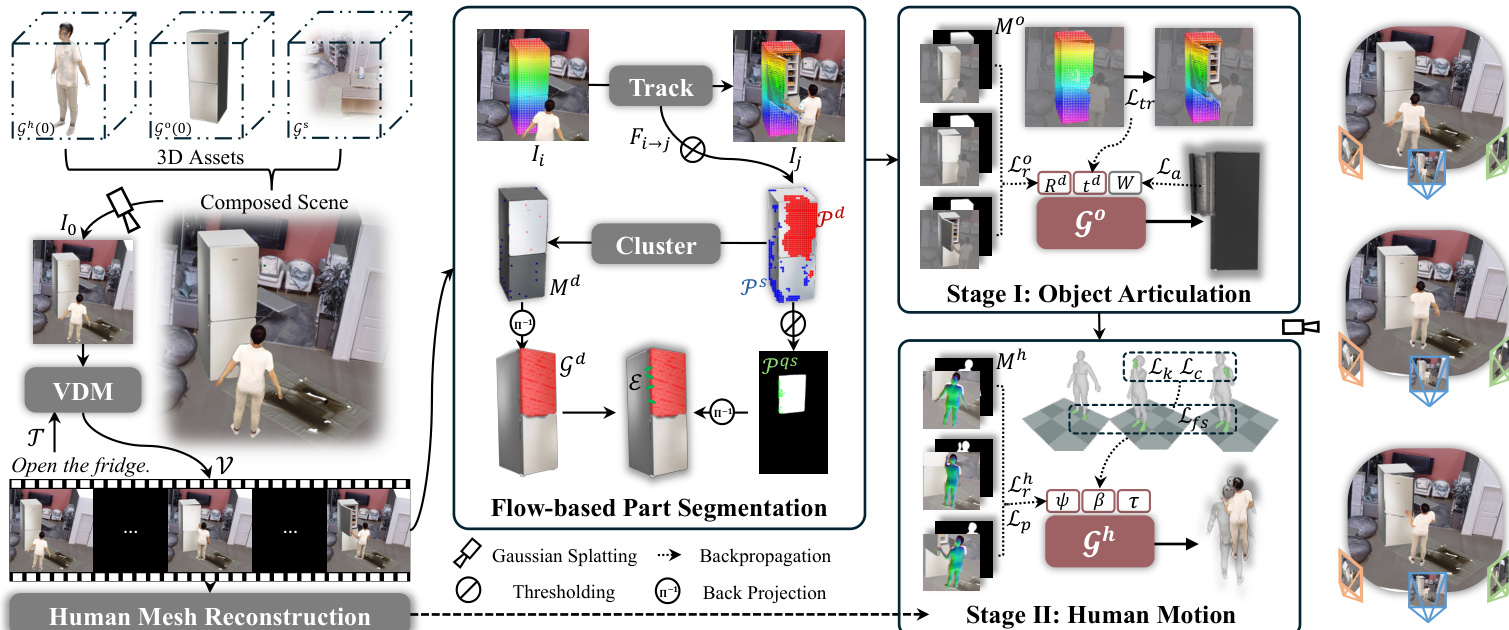
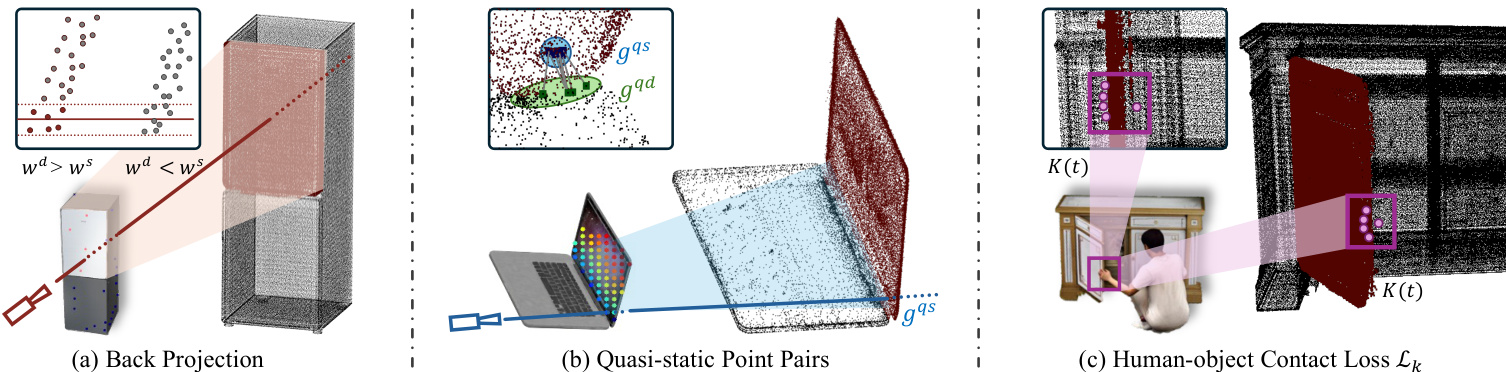
To enable kinematic modeling, the system first identifies which object regions are articulated through a flow-based part segmentation pipeline. This module combines point tracking, SAM-guided masks, and back projection to 3D. The system tracks dense 2D trajectories to classify points as dynamic or static, then uses the Segment Anything Model to produce binary masks. These masks are transferred to the 3D Gaussian representation via back projection, where pixel influences are accumulated to assign Gaussians to dynamic or static sets. To enforce rigid-body constraints, quasi-static point pairs are identified at the articulation boundary to link dynamic and static regions. The key components for this articulated interaction under monocular supervision are detailed in the figure below, which depicts back projection mapping masks to 3D, quasi-static point pairs linking regions, and the contact loss mechanism.
In Stage I, the system reconstructs object articulation by optimizing SE(3) transformations Td(t) for the dynamic parts while keeping static parts fixed. The optimization objective integrates a reconstruction loss to match the video prior, a tracking loss to align with point trajectories, and an articulation loss to maintain connectivity between binding pairs. The total loss is formulated as:
{Rd,td}minLro+λaLa+λsLs+λtrLtr.The articulation loss La penalizes changes in distance between binding pairs (gd,gs)∈E, ensuring the object parts move as a rigid body. This stage establishes a geometrically consistent 4D object scaffold.
In Stage II, the human motion is refined conditioned on the fixed object geometry. The authors derive 3D contact keypoints by identifying frames where the human mask overlaps the object silhouette but the object mask is absent, indicating occlusion by the human hand. These 2D regions are lifted to 3D using the depth of the nearest dynamic object Gaussians. The human parameters (SMPL-X) are then optimized to minimize a kinematic loss that pulls hand joints toward these 3D targets, alongside reconstruction, prior, foot sliding, and collision losses. The kinematic loss is defined as:
Lk=t=1∑Tj∈Kt∑∥Jj(θ(t))−Kj(t)∥22,where Kj(t) represents the derived 3D contact targets. This ensures physically plausible interactions without requiring multi-view input.
Experiment
- Comprehensive experiments on zero-shot articulated human-object interaction synthesis validate that the proposed method achieves superior geometric consistency, physical plausibility, and temporal coherence compared to state-of-the-art baselines.
- Interaction quality evaluations demonstrate that the approach generates more realistic foot contact, higher hand-object contact rates, and lower physical penetration than existing methods, while maintaining competitive motion smoothness.
- Articulated object dynamics tests confirm the framework's ability to accurately recover joint rotations from monocular video, significantly outperforming specialized methods designed for articulated object estimation.
- Experiments on rigid objects show that the reconstruction-informed synthesis generalizes effectively, producing better contact accuracy and physical plausibility than methods relying on depth priors or video diffusion alone.
- A user study with diverse participants reveals a strong preference for the proposed method over all baselines, particularly regarding the realism of interactions and the quality of contact.
- Ablation studies verify that the two-stage decoupled optimization, articulation regularization, and kinematic loss are critical components, as their removal leads to unstable convergence, geometric drift, and misaligned human-object contact.